Steel boat build - Almarine 1200fa

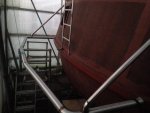
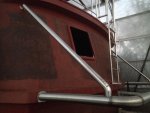
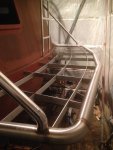
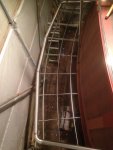
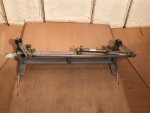
More photos today of the stainless steel work. One of the things that you really have to get to grips with with welding, is how the metal distorts due to the welding, heat and contraction. Stainless seems to be particularly challenging in this respect and I have to say that many test pieces were completed and a few hours of YouTube watched prior to completing any work for real! For the handrailing, Tee joints are the worst! having Notched the end of the tube and placed it against another, if you then proceed to complete the weld without any other control of distortion, what was the straight section of tube will be bent like a banana following the weld! To counteract this, with ideas stolen from the internet and YouTube, I made the clamp shown in the first photo. This has a raised central nib such that when tightened onto the tube with the g-clamps, bends the tube in the opposite direction slightly. The clamp was then left in place whilst the weld was completed and when everything cools and the clamp is removed, hopefully you end up with a straight section of tube and a nice Tee joint. It was a case of learning through experience as to how much “counter bend pressure” to put into the tube prior to welding. This wasn’t required for the tack welds, just the final full welds.
After all the welding was completed, all the welds had a pickling acid applied to remove the weld tarnish which was then washed off and the welds polished using small 60mm buffing wheels in a drill.

Bouba - I think your question is answered in these photos!

View attachment 133262View attachment 133263View attachment 133264View attachment 133265View attachment 133266View attachment 133267View attachment 133268View attachment 133269View attachment 133271View attachment 133272
The railings and steps are a work of art ? ...is this all the original plans or did you go off the reservation ?
 
The railings and steps are a work of art ? ...is this all the original plans or did you go off the reservation ?

The original plans for the boat only extended to the bare steel shell. There were some general sketches, but often when you tried to make things work, the dimensions wouldn’t work. This was particularly the case for the suggested internal layouts. Fly bridge access and layout is mine as was the ladder to the swim platform. Other stuff was pinched from images of similar boats.
 
Swim platform and rudders today!

So in coming up with the ideas for the swim platform and maintaining my goal of minimising the need to have anything bolted to the steel hull and hopefully avoiding the associate corrosion issues, the platform was obviously going to be welded to the hull. I also chose to not have any stays or struts going down from the platform onto the hull beneath the waterline. So to provide the structural support needed, I chose to form a cantilevered structure. This idea was pinched from a boat I saw in one of the boat yards local to me.
The peripheral frame is formed from 3” 316L stainless with 2” used for the cantilevers and a grid of 50 x 5mm stainless for the deck support structure. This was later covered with a GRP deck.

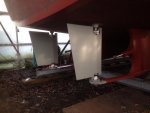
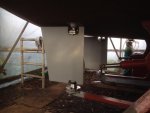
The rudders are on 11/2” stainless shafts and are supported at the skeg in a custom Acetal bearing (another job for the Myford) and at the bottom of the 10mm thick rudder tube in a cutlass bearing (Yep - Myford again!) The top of the shaft/tube is sealed with an old school stuffing gland. The rudders are slightly offset from the centreline of the prop shafts which allows the shafts to be withdrawn, without removing the rudders. As you can see, the rudders can also be removed without taking the rudder shafts out. The rudders have a 1/4”bsp connection on the bottom edge so they could be pressure tested on completion. The rudder tubes had 3 coats of Jotamastic 87 inside and out prior to it all being assembled.

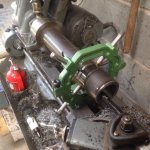
The photo of the lathe, shows the rudder tubes being bored out to suit the cutlass bearing - a bit of a stretch for this lathe!

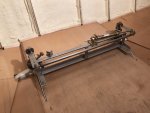
The photos of the steering gear are from much later in the build, but I don’t seem to have any earlier ones of the tops of the rudder shaft arrangements.

7ADCE8B8-7B9B-4DDC-A196-96CC49035220.jpegBFFA677A-4622-4A8F-92DE-D94B4891B994.jpeg430FA620-2D73-49FB-BF8E-A204A7B853B5.jpeg79188950-8087-4B3D-8882-411122D54633.jpegDDAB1F64-A816-410E-9161-B99DAFBDD728.jpeg87F8BC42-4F5F-4B9D-AB44-7BDB60ACC217.jpeg3C2D99EA-F5D0-4C90-A328-7000068A44ED.jpeg7A034837-17AA-40DC-8E7D-AF4BA76E3E84.jpeg41433F87-2C47-4923-A957-7BE57FBDD444.jpeg
 
I should also have mentioned that the rudders are ”electrically insulated“ from the rudder shafts via insulating gaskets and nylon shouldered washers under the bolts. The rudders will have their own zinc anodes.
 
That’s a nice arrangement...those skegs look strong. Also the big window on the transom is very important for getting the dog off the swim platform (straight from the sea to the bed)
 
really impressive stuff,
being a welder, and welding a whole boat together, including nice SS work is one thing,
but rebuilding diesel engines, generators,...
and making your own cutlass bearing on a lathe
and the whole steering system ...
absolutely stunning !!

Vas has got some strong competition here,

ones again congratulations !
and thanks for sharing this impressive story !
 
really impressive stuff,
being a welder, and welding a whole boat together, including nice SS work is one thing,
but rebuilding diesel engines, generators,...
and making your own cutlass bearing on a lathe
and the whole steering system ...
absolutely stunning !!

Vas has got some strong competition here,

ones again congratulations !
and thanks for sharing this impressive story !
He also rebuilt the gearbox.....but if he can write software like Vas then I will eat my hat?
 
As things stand, I will still have sea water in the manifolds. Interested in your suggestion though! Do you have any photos of the pipework routing etc?

Sorry. No pics.

From memory it's pretty straight forward.

Look at the coolant pump, there should be a spare port with a bsp bung in it, whip out that bung, fit a hose tail and rubber hose taking coolant into the front of the manifold where the sea water currently enters.

Remove the inspection plate on the back of the head, 6 bolts, 5/16 unf I think, drill and fit a hose tail, refit, coolant coming out the back of the manifold goes into this new hose tail.

Re-route the Sea water coming out of the main HE/header tank into the exhaust water injection port.

Job jobbed.

Do you have the cylindrical cast iron charge coolers? If so you need to get the tube stacks out and epoxy the inside of the cast iron case. This needs keeping on top of every couple of years.

Should then be very dependable for years. I ran a pair for 14 years. Sweet spot at 1800rpm.
 
He also rebuilt the gearbox.....but if he can write software like Vas then I will eat my hat?

?? Not that I’m inviting a competition ( as I’m pretty sure I would lose) , but in my previous working life within the NHS, I did write software for Honeywell Excel Classic building management systems using RACL programming language - early days PLC stuff.

Does that count? ??
 
Sorry. No pics.

From memory it's pretty straight forward.

Look at the coolant pump, there should be a spare port with a bsp bung in it, whip out that bung, fit a hose tail and rubber hose taking coolant into the front of the manifold where the sea water currently enters.

Remove the inspection plate on the back of the head, 6 bolts, 5/16 unf I think, drill and fit a hose tail, refit, coolant coming out the back of the manifold goes into this new hose tail.

Re-route the Sea water coming out of the main HE/header tank into the exhaust water injection port.

Job jobbed.

Do you have the cylindrical cast iron charge coolers? If so you need to get the tube stacks out and epoxy the inside of the cast iron case. This needs keeping on top of every couple of years.

Should then be very dependable for years. I ran a pair for 14 years. Sweet spot at 1800rpm.

Thanks for the info. I’ll have a look at that.

Ive fitted two new Bowman charge coolers which have alloy cases. It’s the air side that comes into contact with the alloy on these. Hopefully they will last a while!
 
As I‘ve built a motor boat, some of the technical areas that you’ve mentioned are obviously not relevant for my project. You’re right about the length of build time being an issue though. For me, it was the fact that Bonito Boats BV was sold a few years after I started. The previous owner/designer continued supplying kits for a couple of years and then retired. Although still contactable, I have tried to not bother him too much.

I got turned off from the forums in the early days due to some very mixed reactions/responses on my project. I enjoy engaging with people who are genuinely interested and I value the ideas and even the constructive criticism, but I really struggle with people who just seem to want to bring you down for their own apparent enjoyment! This has been good so far though ??

The forums are plagued by know nothing naysayers.

If you get them don’t be put off.

Amazing thread. Amazing boat. You are as much of a nutter as Wayne of this forum. And that’s a compliment.

I’m now reading some more……..,
 
Last edited:
Today’s instalment covers the generator and some of the through hull fittings.
The generator was an eBay find for a few hundred pounds. It was bought on the basis of a good running engine but not producing any power. On arrival it was found to be exactly as described and on further investigation I found that the stator windings were open circuit.
The unit is a Kohler 6.5EFOZ . I have to say that I found the Kohler manuals to be absolutely excellent with full fault finding and diagnostic instructions within!
I stripped the unit and took the stator windings to a local motor rewind shop and they rewound the stator for £450 and tested everything for me. While the unit was stripped, I took the advantage of giving the ancillary items a good checking over - replacing /repairing whatever was required. I fitted a new starter motor as the mounting flange on the original unit was broken, new raw water pump complete, swapped out the heat exchanger for a better unit and replaced all the pipes. On reassembly, I set up the engine speed and AVR and load tested the unit for a few hours - all good. Coat of paint to finish and in the boat it went!

Other photos today are of the sea water intakes and the through hull arrangements for the exhausts and deck drains. I decided to route the engine exhausts through the sides of the boat instead of taking them out through the transom. This reduces the exhaust back pressure and avoids having to route pipe work which would have been difficult to access later, through the aft cabin.

Where the stainless was welded to the mild steel hull, this was done with TIG using a 309L filler rod. My understanding is the when you weld stainless to mild, some of the chromium in the stainless leaches out into the mild. The 309L filler rod has a high chromium content to try to counteract that. The important detail really with these welds is that they are well protected with epoxy afterwards to keep moisture away from the junction of dissimilar metals.

View attachment 133122View attachment 133123View attachment 133125View attachment 133127View attachment 133128View attachment 133129View attachment 133130View attachment 133131View attachment 133132View attachment 133133

Identical to my generator. Except, of course, yours is immaculate and looks way better. I had the raw water pump fail recently. Double check that if you haven’t already.
 
So by this time, the larger items of kit were in the boat, the welding on the hull itself was complete - time to start all of the bright work as I was working towards getting to a point where all welding on the boat structure was completed so that the paint could be sorted.

After looking around at similar boats, I decided to use 11/4” OD for the majority of the handrailing with 1”OD for the fly bridge and the upper frame on the radar arch and 3/4”OD for the inner trim around the aft deck and fly bridge for attaching dodgers to. First job was to make two benders for bending the 11/4” tube - one for the long curves and one for the tighter radii. Plenty of info and examples of this sort of thing on YouTube, so I adapted the ideas I saw to what I had and could achieve with available tooling. The draw former and rollers were obtained from Stakesys. The 8t long stroke Jack from eBay. The hydraulic bender produces an almost perfect bend with barely any distortion and no rippling. For the smaller diameter tubes, I bought pre-formed bends (hygienic tube bends) and polished them on my buffer.

I have a small Myford lathe in my workshop so I used this to do all of the tube notching. I replaced the tool post on the cross slide with a small machine vice and by fitting a suitable hole saw in the chuck and carefully feeding the work into the rotating cutter, a fair quality notch can be cut. All of the tube joints were cut in this way.

The tube was formed and all tacked together across the various sections of the boat prior to doing the final welding. All welding on the tube was with TIG using 316L filler for stainless to stainless and 309L for stainless to mild steel.

I’ll cover the distortion issue tomorrow and more photos of the bright work as it progresses.

View attachment 133185View attachment 133186View attachment 133187View attachment 133188View attachment 133189View attachment 133190View attachment 133191View attachment 133192View attachment 133193View attachment 133194

Is there nothing you can’t do?

To think you had to be persuaded to do this thread.

Amazing.
 
Identical to my generator. Except, of course, yours is immaculate and looks way better. I had the raw water pump fail recently. Double check that if you haven’t already.

Yes, I fitted a complete new pump. It was a Johnson pump in place of the original, as it was much cheaper. It did need a new mounting bracket though.
 
Ok, so by now the hull had been completely welded and all the stainless steel had been completed - so anything requiring to be fitted to the outside of the boat, would be mounted on the stainless - no bolts through the mild steel!

I was now up to about 5years believe it or not! As the build had progressed, I had been able to protect the steel on the interior of the hull by applying the initial coat of epoxy primer and in some areas where equipment had been fitted - all four coats. The outside of the hull was a different matter though. I had protected the welds with stripe coating, but the areas in between by now had formed some corrosion - particularly where the factory applied sigma weld primer was a bit thinner!

Time to blank off all the openings in the hull and superstructure and hire a blast pot and compressor! Oh, and buy a couple of ton of crushed glass for the blast media.

If anyone ever tells you that sandblasting is a dirty horrible job, you can tell them from me that they’re wrong! It’s a 100 times worse than that!

I also masked off all of the stainless steel with the usual newspaper and masking tape and then wrapped 1000g visqueen around it to hopefully protect it from the blasting. The visqueen was removed prior to spraying the Jotamastic.

The blasting took much longer than expected and this was in part to a very temperamental blast pot and an even more temperamental diesel driven air compressor! Towards the end, the compressor kept shutting down every five minutes with no fault indication showing, so I had my Boatywife sat by the compressor restarting it again! She loved it ?

As soon as the blasting was completed, it was a clean up and spray the first coat of Jotamastic 87. I used the AL version for the first two coats which has very fine particles of aluminium in it. All of the Jotun product was supplied by SML and they provided a comprehensive back up service including advice for the paint plan, thinning, nozzle size etc. Brilliant service.

After the blasting and clean up, there was no further preparation to the steel prior to spraying the first coat of epoxy primer. The need is to protect the steel prior to any flash corrosion occurring. The primer was sprayed with a Wagner airless sprayer and I wore an air fed full face helmet whilst doing so. The primer contains isocyanate, so very nasty stuff indeed! The thickness of the primer being applied was checked with a wet film thickness gauge and it seemed that I was spraying a much thicker coat than the minimum - so I continued on that basis. From memory, I think I used about 40 litres of primer per coat.

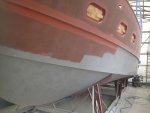
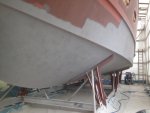
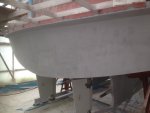
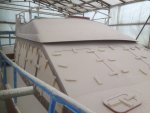
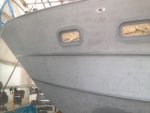
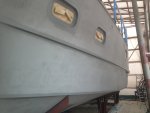
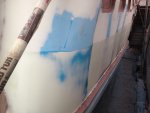
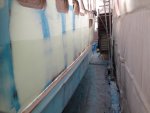
The first coat of primer was red over which I then completed the majority of the hull fairing. More on that tomorrow!

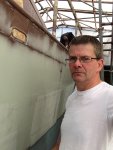
Sorry about the selfie! I just thought I would put a face to all this! ?

335C58A5-8D43-440B-A77B-69D3B4EE6AC1.jpeg43A10684-E5F7-443E-8BF8-1AFA103481AF.jpegDE0A4686-4FBE-49E5-98AD-E2A07B432A7A.jpegE6B4E3A6-4E9D-4FD5-8222-434774AAE388.jpegA5E2AC76-1874-4B7F-B542-65F39FF7987B.jpegB403EC16-EA29-44B9-AF95-D6A2142425BF.jpeg70F26001-C0DB-4114-B4A4-2DFBA4C1FB12.jpeg5DF2639E-BAA8-4392-B626-890B52F55CAF.jpeg240C79E5-82A1-4FF5-B31A-B20BF213C81F.jpeg378A80B9-B3EF-42D1-9846-D78FAC8B81D1.jpeg
 
you look like a normal sort of chap…not the lunatic you’ve got to be to even think about doing something like this :)

in all seriousness massive kudos to you I’m gobsmacked at your abilities and staying power!
Thanks for taking the time to post it all (y)
 
Top