Electric Boats

Just for information this is the charging times for a Tesla Model 3 (from Google)
I think this underlines Henry's comments about the infrastructure.
Most domestic supplies are 60amp (14Kw) which has to handle all the devices in the house as well as charging a car.
Heat your hot water with an immersion heater and boil a kettle and you could be getting close to overloading the supply.


MethodkWCharging time (empty to full)
Standard three-pin plug2.337.75 hours
Dedicated home charging point7.411.75 hours
Fast charger22*8 hours* (vehicle limited to 11kW)
Rapid chargerUp to 25022 minutes

Holy cow, how much hot water do you need? Are you running a roman bath house?
 
Just for information this is the charging times for a Tesla Model 3 (from Google)
I think this underlines Henry's comments about the infrastructure.
Most domestic supplies are 60amp (14Kw) which has to handle all the devices in the house as well as charging a car.
Heat your hot water with an immersion heater and boil a kettle and you could be getting close to overloading the supply.

Nowhere near.

Immersion heater 3KW.
Fast electric kettle 1.5KW.
 
Even though 42% of UK homes have no off street parking!!

And that is another massive thing EV promotors like to overlook. Also what if you are a household with say 4 car drivers. How would charging that lot work over night.

Not been thought through at all. It wont work plain and simple
 
My thoughts:

.1 Advanced research into developing significantly higher capacity, compact, and lighter batteries is currently commissioned by major Companies in the UK and undertaken at Imperial College, NPL and other sites - along with other H2 technologies and fuel cells also in development and have been for some years now, it will happen. I don't think any can deny it, just wonder when.

.2 NH3 (Ammonia)? Not asked to pipe that into any labs recently that I have been working on, need to be very careful here - I worked for the sole importer (then) of NH3 absorption chillers (R717 Arkla Units) when in my 20s, they had them fitted to most British Gas sites and even the roof of the HVCA in London (in fact I fitted 6 units to ICL Hammersmith in the 80s). Gas-fired chillers, we had to mix NH3 into a solution then charge the units, a waft of that use to take your breath away! It happened to me more than once - mind you it cleared the nose! Not sure I would want to store that on a boat, would rather have H2 albeit NH3 is just over half as light as air so will rise.

.3 We do use 11kV (and much higher voltage) networks throughout the UK, it would not be too difficult to plumb them into new perhaps even domestic sites in the future (yes I know TX issues, RMU's and HV switchgear etc, etc., I have designed numerous site infrastructures, most University and larger commercial sites I work on use multiple 11kV rings). I do wonder though where we might get all the capacity from to charge soo many cars, but trust me we will have to.

So like it or not, I reckon EVs and EBs will be with us - mind you, with E-Energy in the domestic market exceeding 30p/kWH now, we had better get some nuclear in ASAP.... Yet another contentious issue! Electric heat pumps CoP brings it closer kW/kW to gas, perhaps small scale gas fired domestic CHP - until the gas runs out :D
 
And that is another massive thing EV promotors like to overlook. Also what if you are a household with say 4 car drivers. How would charging that lot work over night.

Not been thought through at all. It wont work plain and simple
Absolutely agree.
My example of an immersion heater and an electric kettle was to put the everyday house usage into perspective.
My hot water tank has two 3Kw immersion heaters and my kettle is 2Kw.
Also people use electric fires to keep themselves warm.
There will be pumps for the heating system and loads of other stuff - electric cookers would be a big load but we have several fridges.
It all mounts up.
And some families (my next door neighbour for example) has a hot tub - there's another 6Kw.
So my comment above stands.
Most houses would need more than a 60amp supply - especially if you are a multi car household.
 
Absolutely agree.
My example of an immersion heater and an electric kettle was to put the everyday house usage into perspective.
My hot water tank has two 3Kw immersion heaters and my kettle is 2Kw.
Also people use electric fires to keep themselves warm.
There will be pumps for the heating system and loads of other stuff - electric cookers would be a big load but we have several fridges.
It all mounts up.
And some families (my next door neighbour for example) has a hot tub - there's another 6Kw.
So my comment above stands.
Most houses would need more than a 60amp supply - especially if you are a multi car household.
Oh I see.

so it’s completely beyond the wit of man to upgrade the power supply to a house that wants to charge more than 1 can simultaneously.
I had no idea. I kind of assumed that people would look at their electricity supply and then say “well, that wasn’t designed for EVs, I’ll have to get it upgraded” and then get it done.
My mother has just been through that process. You wouldn’t get all that many tanks of petrol for what she had to pay to upgrade the electric supply to a house that was new when Henry the 8th was on the throne. The end result is a power supply that will easily cope with charging 2 cars simultaneously with spare capacity left over to run the rest of the house.
 
One point how are the government going to collect the money they collect by fuel and road tax.

All main roads will become toll roads , and/or the car road tax will need to be increased and applied to all cars including EV's
 
OK - so how about MILD Hybrid cars.
I understand that they use a conventional lead acid battery thus not having an expensive battery replacement (or two) during the life of the car.
I presume you mean the sort of stop start car who's starter motor is a big alternator ?

Let's take the quoted 7,000 miles annual use. Nice new economic car that does 70 miles per gallon uses 100 gallons at £6.50 a gallon. £650 fuel per year. MILD gives a 5-10% saving at best assuming you're driving in town so a saving of £30-60 per year with technology that's going to cost you £500 every 5 years when it needs mending, possibly more.

I'll say no on that one....
 
Absolutely agree.
My example of an immersion heater and an electric kettle was to put the everyday house usage into perspective.
My hot water tank has two 3Kw immersion heaters and my kettle is 2Kw.
Also people use electric fires to keep themselves warm.
There will be pumps for the heating system and loads of other stuff - electric cookers would be a big load but we have several fridges.
It all mounts up.
And some families (my next door neighbour for example) has a hot tub - there's another 6Kw.
So my comment above stands.
Most houses would need more than a 60amp supply - especially if you are a multi car household.

Do not ignore significant diversity Mike with those loads, perhaps in future we may see TP&N supplies fed into domestic premises depending on size; where we have issues with large infrastructures we use load-lopping, so less essential supplies such as immersion heaters can be switched on/off intermittently - It will have to happen! Simple to prioritise and engineer - its the grid network that we should be investing in for now.
 
Just for fun, when I did my Elec Technicians course way back in the 70s, we still had to study thermionic valves.... can anyone remember looking in the back of the TV to see if they lit up!

How many of them could we now fit into even a small IC or RPi....!:)
 
?
I do, still have an hifi amp with valves (on the output stage) 2 on each side (iirc!) nice soft sound with half decent JBL speakers but have to wait for them to heat up before getting any sound at all (half a minute or so...)

EL37 iirc
 
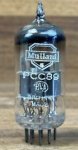
Just for those that have never seen one:

View attachment 126915
You might regret tossing valves into the equation because I have a mate into hi fi and he’s just spent something like 5 K CHF on a valve amp from a bloke in Zurich still making them .
It does blow normal transistor or new stuff chips or what ever into the weeds re sound quality.
He‘ s got the rest of the kit a vinyl deck player with some sort of 4 figure value needle and some fancy speakers to match .
But he informs me the valve amps are the best sound quality wise .
Julie Andrew’s “doe a deer “ never sounded so good ?.

So tech reduced sound quality , went the other way not improved it .

Edit it’s got a glass front and yes you can see then glowing .
 
Oh I see.

so it’s completely beyond the wit of man to upgrade the power supply to a house that wants to charge more than 1 can simultaneously.
I had no idea. I kind of assumed that people would look at their electricity supply and then say “well, that wasn’t designed for EVs, I’ll have to get it upgraded” and then get it done.
My mother has just been through that process. You wouldn’t get all that many tanks of petrol for what she had to pay to upgrade the electric supply to a house that was new when Henry the 8th was on the throne. The end result is a power supply that will easily cope with charging 2 cars simultaneously with spare capacity left over to run the rest of the house.
Do that across the whole country and you have a huge infrastructure problem.
Then look at how the grid is fed - the country would require a few more Hinkley Point Cs
OK - so it is doable but it would take ages.
The whole thing just hasn't been thought out.
 
On the plus side whilst all the roads were being dug up to lay new cables you wouldn’t be able to drive cars so that would cut down on emissions whilst destroying the economy. They ran a couple of extension leads from a sun station next to us into Slough. Chaos for a year and the road is now like a Namibian B road several years later.

The joy of hydrogen is that you can make it next to the power source (hopefully tidal) and then deliver it as per liquid fuel. The only trouble is you’d need a source of water to extract your 2 bits of hydrogen from using the tidal power. Not sure where you’d get that from ?
 
On the plus side whilst all the roads were being dug up to lay new cables you wouldn’t be able to drive cars so that would cut down on emissions whilst destroying the economy. They ran a couple of extension leads from a sun station next to us into Slough. Chaos for a year and the road is now like a Namibian B road several years later.

The joy of hydrogen is that you can make it next to the power source (hopefully tidal) and then deliver it as per liquid fuel. The only trouble is you’d need a source of water to extract your 2 bits of hydrogen from using the tidal power. Not sure where you’d get that from ?
hydrogen always sounds very attractive, but it has a teensy problem. Compressing it takes a lot of energy. Hurricane is concerned there is not enough electricity to run EVs - there is, but is there enough electricity to create hydrogen, distribute it and compress it etc - probably not.
 
From a diesel engined leisure motorboat (and yacht) perspective there is no need for electric propulsion in order to reduce CO emissions by 90%.
Simply change the fuel supply from diesel to HVO. And that can be achieved very soon.
HVO Fuel

.
 
Top
