First 6 months with no gas onboard

That is a ridiculous comparison.
On a boat there is a limited amount of space for solar. You have to work with that limitation. There is no more power available unless you burn diesel, gas or have a fuel cell. If you wish to run the boat from solar, as much as possible, then you have to make everything as efficient as possible. There will be compromises to make but if you are going to convert to all electric cooking you will be investing in a lithium battery bank, all the modification to the electrical system to accomodate those lithium batteries, an efficient electric oven and quality induction hob. If you can't afford the pans to go with it, what the point in all that investment. The cost of a set of good pans is about £150. Have a look on Ebay and you can find what you need for about £50.
Its a yacht, built primarily to be sailed from A to B. The advantages of Lithium are all documented.

If you want to make the yacht as efficient as possible then when you rewire to accomodate Lithium you also downsize your windlass motor to use less power, you run smaller power cables, you use smaller chain and reduce the weight in the bow - its a yacht not a means of carrying unnecessary weight across the Atlantic. You prioritise the galley, I prioritise sailing performance and comfort.


We use perfectly adequate galley equipment, but some of it is not induction compatible and use a induction conversion plate. Oddly that's exactly what these induction plates are sold for - to allow you to use non induction cookware. Its not about costs per se - its about not wasting money.

Our compromise would be using non compatible galley equipment. You are a Lithium disciple and have ignored the advantage of the lighter chain. - which extends beyond more efficient use of power.

I've been involved in making lighter chain rode, 1,000m so far - other people believe in better sailing performance.

"You have to work with that limitation. There is no more power available unless you burn diesel, gas or have a fuel cell.'

Interestingly one source of power you have not mentioned - Watt and Sea and other forms of hydro power generation.

Cruising 600 Hydrogenerator - Watt and Sea


An interesting data point would be - how much power do you produce daily when sailing, when crossing the Atlantic cf when at anchor. You can maximise solar at anchor, as you can align the panels and have no autopilot to feed. What uses the extra power when you are at anchor, what compromises do you make on the passage over (when the solars are shaded, by the sails etc.). Arguably you use more power when sailing, all the instruments, autopilot and still use all the domestic devices, the galley, So what 'extra' do you use when at anchor - to soak up the extra power you reap from a better aligned solar display.

Jonathan
 
Last edited:
There's thread drift, and then there's Neeves. 😄
Not many could bring anchor chain size into a discussion about gas/electric cooking choice. 😂

Its not only about cooking energy choice.

You illustrate the problem.

Its not about gas vs electric, nor lithium vs lead - though that is how many view it.

Its about the best compatible systems that make up 'your' yacht. Electric vs gas, in the galley, is simply part of a much larger equation. Geem omits to mention hydro generation - maybe because he sits at anchor for weeks on end, maybe because he simply overlooked it (I suspect the latter as he mentions, keeping to a ridiculous theme, - a fuel cell).

Jonathan
 
Its a yacht, built primarily to be sailed from A to B. The advantages of Lithium are all documented.

If you want to make the yacht as efficient as possible then when you rewire to accomodate Lithium you also downsize your windlass motor to use less power, you run smaller power cables, you use smaller chain and reduce the weight in the bow - its a yacht not a means of carrying unnecessary weight across the Atlantic. You prioritise the galley, I prioritise sailing performance and comfort.


We use perfectly adequate galley equipment, but some of it is not induction compatible and use a induction conversion plate. Oddly that's exactly what these induction plates are sold for - to allow you to use non induction cookware. Its not about costs per se - its about not wasting money.

Our compromise would be using non compatible galley equipment. You are a Lithium disciple and have ignored the advantage of the lighter chain. - which extends beyond more efficient use of power.

I've been involved in making lighter chain rode, 1,000m so far - other people believe in better sailing performance.

"You have to work with that limitation. There is no more power available unless you burn diesel, gas or have a fuel cell.'

Interestingly one source of power you have not mentioned - Watt and Sea and other forms of hydro power generation.


An interesting data point would be - how much power do you produce daily when sailing, when crossing the Atlantic cf when at anchor. You can maximise solar at anchor, as you can align the panels and have no autopilot to feed. What uses the extra power when you are at anchor, what compromises do you make on the passage over (when the solars are shaded, by the sails etc.). Arguably you use more power when sailing, all the instruments, autopilot and still use all the domestic devices, the galley, So what 'extra' do you use when at anchor - to soak up the extra power you reap from a better aligned solar display.

Jonathan
Crossing the Atlantic, you don't use the windlass. The power consumption of the windlass is totally irrelevant since it runs from the engine battery, not the lithium. The windlass will never get down sized. That is a crazy thing to do. Our 10mm chain is the correct size for our boat weight and I have zero desire for G70 chain. Our heavy boat crossed from Mindelo to Antigua in 13 days. If we had done the same crossing time on the ARC plus, we would have finished 4th.
We don't sail a catamaran where reduced weight is an advantage. We sail a heavy displacement bluewater boat designed to do the crossing which we have just completed. It was a rough crossing and the pedigree of the boat speaks for itself.
Crossing the Atlantic, I ran the generator once. That was to charge the batteries after 3 days of heavy cloud. In hindsight, I didnt need to, since we then got more sun form the following days.

A Watt and Sea generator would cost several thousand pounds. It's of no use at anchor. For the amount of charging we needed on our Atlantic crossing, it would have been a horrendous waste of money. We could fit new lithium batteries, new solar and an all electric galley with new induction pans for the cost of the Watt and Sea.

We made no compromises when sailing. We did everything we wanted to do. Showers every other day, as much fresh water as we wanted, made bread in the electric oven, cooked mahi mahi we had caught. Used the autopilot, starlink and any other power hungry device we cared to. The batteries and solar coped very well. I wouldnt change any aspect of the systems installed and i certainly wont be adding gas anytime soon.
at anchor we can use solar to make domestic hot water and run the high output watermaker. Similar to we do at sea but more so
 
Last edited:
Its not only about cooking energy choice.

You illustrate the problem.

Its not about gas vs electric, nor lithium vs lead - though that is how many view it.

Its about the best compatible systems that make up 'your' yacht. Electric vs gas, in the galley, is simply part of a much larger equation. Geem omits to mention hydro generation - maybe because he sits at anchor for weeks on end, maybe because he simply overlooked it (I suspect the latter as he mentions, keeping to a ridiculous theme, - a fuel cell).

Jonathan
I have had a hydrogenerator for 20 years. I no longer have a need for it so removed it before this trip. No regrets there
 
I have had a hydrogenerator for 20 years. I no longer have a need for it so removed it before this trip. No regrets there
We had a trailing impeller hydro generator - a bit of a faff to set up and seaweed could be a problem - but maybe the under hull mounted version would over come this issue.

Best thing since sliced bread, this was before Lithium was even a gleam in someone's eyes.

Obviously it does not give much of a return on your investment if you sit in one idyllic anchorage for 3 weeks in Caribbean or tropical sunshine - but if you are doing a UK circumnavigation (or a bigger challenge - rounding Australia) with a guarantee of inclement weather - possibly different story - horses for courses or power sources chosen for the typical weather and yacht usage.

There is no doubt pricey, but then its a yacht - everything is pricey. Compromises, compromises.

There is no one right answer what is ideal for Antigua might not work quite so well on the west coast of Scotland nor Patagonia.

Jonathan
 
We had a trailing impeller hydro generator - a bit of a faff to set up and seaweed could be a problem - but maybe the under hull mounted version would over come this issue.

Best thing since sliced bread, this was before Lithium was even a gleam in someone's eyes.

Obviously it does not give much of a return on your investment if you sit in one idyllic anchorage for 3 weeks in Caribbean or tropical sunshine - but if you are doing a UK circumnavigation (or a bigger challenge - rounding Australia) with a guarantee of inclement weather - possibly different story - horses for courses or power sources chosen for the typical weather and yacht usage.

There is no doubt pricey, but then its a yacht - everything is pricey. Compromises, compromises.

There is no one right answer what is ideal for Antigua might not work quite so well on the west coast of Scotland nor Patagonia.

Jonathan
I just sailed 5,600nm from Northern England. I didn't need one and wouldn't take one around the UK. 20 year experience with one suggests they of limited use since most cruisers spend 90% of their time not sailing. The Imoca's use them but they are probably spending 90% of their time sailing and often in locations with limited solar performance.
Sailing in the UK summer, there is up to 16 hours per day of sunlight. Our solar output was similar to what we harvest in the Caribbean winter. The Caribbean is not all blue skies. There is a lot of cloud. Even so, living here from solar alone with no gas is perfectly feasible in winter
 
We sail a heavy displacement bluewater boat designed to do the crossing which we have just completed. I

Not everyone sails a heavy displacement yacht, but there again how would we know. Recalling Sea Change' choice I think he does sail a lightwave yacht and again he might sail a yacht more common to everyone ( and lives on board 365?). He might benefit from a lighter rode, again I don't know - but its something that some of those who now use a lightweight rode committed to - and none have since complained that their chain is too light.

A 60kg weight saving in the bow is not insignificant, especially on a modern yacht, - and will improve sailing performance and comfort

Maybe if you didn't reject G70 out of hand you might have bettered 4th. :)


But as NormanS points out this is not a thread about ground tackle but about power generation, storage of power, and its use (with a focus on the galley).

Apologies.
 
Not everyone sails a heavy displacement yacht, but there again how would we know. Recalling Sea Change' choice I think he does sail a lightwave yacht and again he might sail a yacht more common to everyone ( and lives on board 365?). He might benefit from a lighter rode, again I don't know - but its something that some of those who now use a lightweight rode committed to - and none have since complained that their chain is too light.

A 60kg weight saving in the bow is not insignificant, especially on a modern yacht, - and will improve sailing performance and comfort

Maybe if you didn't reject G70 out of hand you might have bettered 4th. :)


But as NormanS points out this is not a thread about ground tackle but about power generation, storage of power, and its use (with a focus on the galley).

Apologies.
Maybe if I had been racing I would have gone faster. Maybe if we didn't have 500L of diesel, 800L of water, two bikes, 2 sets of dive gear, a paddleboard, two kiteboards, 7 kites, a wing board and two wings, two sewing machines, a 3.8 metre hard dinghy and a 15hp engine we would have gone faster, but hey, we are a cruising boat so who cares. We sailed conservatively with just two of us onboard.
It was a thread about living with no gas on a sailing boat so others could see that is works and it works well. Others may not adopt what we have done but it may give them some ideas. It wasnt about anchoring, anchors or anchor chain.
 
Last edited:
Yes it's hopefully a useful thread for those interested in moving away from gas.
I've met people who were quoted $20k to upgrade their boat to lithium. I've met people who have spent $80k on all singing, all dancing, Victron systems. Who are then at the mercy of customer support and whatever technicians they can find whilst cruising, because they don't want to void their warranties, or simply don't understand the systems they have had installed. But you don't have to spend anything like that to get the benefits.

I'm not sure exactly what my system has cost but it'll be in the region of £2k by now, maybe a bit over. It's not as comprehensive as Geem's system- my only means of heating hot water is in the kettle. But I would have spent a fair chunk of that money anyway simply upgrading to a system capable of running a fridge and freezer.

Five years ago, I nearly talked myself out of the whole project. I had enough on my plate getting the boat ready for bluewater cruising. And back then, the established wisdom was a far more complex arrangement where you had to involve relays etc, as it wasn't the done thing to run all your current through the BMS itself. Lithium batteries were considered so expensive that it was worth every measure available to preserve them from harm.
Today, they are cheaper than lead acid for the same usable capacity, and that means that systems can be simpler and easier to understand. There are some places where you simply cannot cut corners of course- fuses and cable sizes.
 
I've met people who were quoted $20k to upgrade their boat to lithium. I've met people who have spent $80k on all singing, all dancing, Victron systems
I know I'm tempting replies of "you can build it yourself for £1.23" here, but you can get 300Ah of Victron lithium for £1500 these days.
 
That's just insane money.
My first battery, 271Ah, cost me £407 to build, including all shipping, duties, etc. And that was in early 2021. Prices have tumbled since then.
And that battery from victron has no bms so you need to buy the very expensive Victron architecture to go with it. The victron cells in those batteries are nothing special. Just paying through the nose for the name
 
I know I'm tempting replies of "you can build it yourself for £1.23" here, but you can get 300Ah of Victron lithium for £1500 these days.
Just stopped for a cuppa whilst assembling a system for a customer, 314Ah of Grade A EVE cells with JK BMS. Assembled, BMS fitted and programmed, ready for me to drop in, cost 1/3rd of the Victron price and a better system.
 
And that battery from victron has no bms so you need to buy the very expensive Victron architecture to go with it. The victron cells in those batteries are nothing special. Just paying through the nose for the name
You get them in a blue box, that's worth the extra money I suppose :ROFLMAO:
 
Depends how you want your system to work.

I really wanted DVCC (Distributed Voltage and Current Control), so I could prioritise the charge sources and guarantee the charge current didn't exceed 1C for each battery, and that, when on shore power, solar was prioritised over the battery charger (the charger max current can also be set if necessary). The Victron GX devices control all charge sources and ensure charging priority, so the batteries will never see more than their max 1C charge current. It synchronises the charge cycle across all the charging devices, ensuring a single controlled 4 stage cycle regardless of charging source. It also allows for electrical loads to be taken into account, and will allow any unused charge capacity to service the loads, while still charging at 1C. My charging systems can deliver 15kW all together .... but each battery has a 100A max. recommended charge current, and DVCC will ensure it is achieved when possible, but never exceeded. I've saved myself a diesel generator with this setup.

On top of all that, I only need 1 app to monitor and control everything, it integrates with my plotters, and it is all remotely accessible over the VRM portal, which is free, and includes geofencing and the ability to shut the system down remotely if necessary.

I've had Victron on my last boat, my camper van, and now it's going on this boat too because it all just works, has a massive user base, an online community and an open source OS.

.... and it's blue and orange, has anyone already mentioned that? :ROFLMAO::ROFLMAO::ROFLMAO: ...

I agree it's not cheap, but different people have different wants and needs, why do something on a shoestring when you don't have to? I like bells and whistles.

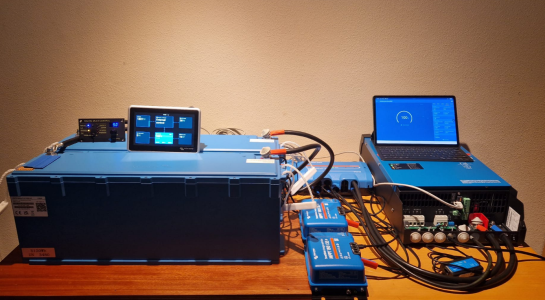
The components of the 48V Lithium battery system in this picture are ....

Lynx Class-T Power In (M10)
Lynx Distributor (M10)
Lynx Smart BMS 500 NG (M10)
Ekrano GX
MultiPlus-II 48/5000/70-50
2 x SmartSolar MPPT 150/35
Digital Multi Control 200/200A
2 x LiFePo4 battery 51,2V/100Ah - Smart NG

..... a present to myself to make my sailing more enjoyable. I remember sitting in my parents boat, with the car battery from my dads car as the only source of power for the nav lights, the echo sounder, the VHF, and the interior lights and it had no means of charging other than taking it ashore to a garage - no toaster, kettle, ice maker, air fryer, thermomix, coffee machine, or toastie maker on board back then.

1765821580182.png

I even have a Victron charger for my motorbike, which is sitting in my garden shed ensuring my battery doesn't die over winter - and it's broadcasting the charge state over BT so I can check it from the kitchen.
 
Depends how you want your system to work.

I really wanted DVCC (Distributed Voltage and Current Control), so I could prioritise the charge sources and guarantee the charge current didn't exceed 1C for each battery, and that, when on shore power, solar was prioritised over the battery charger (the charger max current can also be set if necessary). The Victron GX devices control all charge sources and ensure charging priority, so the batteries will never see more than their max 1C charge current. It synchronises the charge cycle across all the charging devices, ensuring a single controlled 4 stage cycle regardless of charging source. It also allows for electrical loads to be taken into account, and will allow any unused charge capacity to service the loads, while still charging at 1C. My charging systems can deliver 15kW all together .... but each battery has a 100A max. recommended charge current, and DVCC will ensure it is achieved when possible, but never exceeded. I've saved myself a diesel generator with this setup.

On top of all that, I only need 1 app to monitor and control everything, it integrates with my plotters, and it is all remotely accessible over the VRM portal, which is free, and includes geofencing and the ability to shut the system down remotely if necessary.

I've had Victron on my last boat, my camper van, and now it's going on this boat too because it all just works, has a massive user base, an online community and an open source OS.

.... and it's blue and orange, has anyone already mentioned that? :ROFLMAO::ROFLMAO::ROFLMAO: ...

I agree it's not cheap, but different people have different wants and needs, why do something on a shoestring when you don't have to? I like bells and whistles.

The components of the 48V Lithium battery system in this picture are ....

Lynx Class-T Power In (M10)
Lynx Distributor (M10)
Lynx Smart BMS 500 NG (M10)
Ekrano GX
MultiPlus-II 48/5000/70-50
2 x SmartSolar MPPT 150/35
Digital Multi Control 200/200A
2 x LiFePo4 battery 51,2V/100Ah - Smart NG

..... a present to myself to make my sailing more enjoyable. I remember sitting in my parents boat, with the car battery from my dads car as the only source of power for the nav lights, the echo sounder, the VHF, and the interior lights and it had no means of charging other than taking it ashore to a garage - no toaster, kettle, ice maker, air fryer, thermomix, coffee machine, or toastie maker on board back then.

View attachment 203609

I even have a Victron charger for my motorbike, which is sitting in my garden shed ensuring my battery doesn't die over winter - and it's broadcasting the charge state over BT so I can check it from the kitchen.
We sail a little more off the beaten track. Our experience has taught us that for the kind of sailing we do, simplicity is a good thing. We have back ups and alternatives. I don't want to be that guy with the T shirt that say on the front " No, I am not a local, I am just waiting for parts" 😄
 
We sail a little more off the beaten track. Our experience has taught us that for the kind of sailing we do, simplicity is a good thing. We have back ups and alternatives. I don't want to be that guy with the T shirt that say on the front " No, I am not a local, I am just waiting for parts" 😄
.... that's a very good point, I completely forgot about backups and alternatives, not to mention redundancy. Silly me :ROFLMAO: :ROFLMAO: :ROFLMAO: ... Alibaba and Temu also do worldwide shipping and have a second to none returns policy, including pick up at anchor, or so I have heard. ;)

.... I'm unfortunately that guy wearing this T shirt ... 😍

1765836312122.jpeg
 
.... that's a very good point, I completely forgot about backups and alternatives, not to mention redundancy. Silly me :ROFLMAO: :ROFLMAO: :ROFLMAO: ... Alibaba and Temu also do worldwide shipping and have a second to none returns policy, including pick up at anchor, or so I have heard. ;)

.... I'm unfortunately that guy wearing this T shirt ... 😍

View attachment 203624
I am sure you know everything
 

Other threads that may be of interest

Top