Skegbutcher
New Member
I believe I might now have the fastest Swift 18 out there (I have removed the shoebox shaped skeg which was a crime against hydrodynamics), faired around the keel root a bit in such a way that the keel still goes up and down, fitted a deeper rudder blade and fitted a slide in fairing for the keel aperture and a plug for the outboard well and it goes about 2 knots faster than it did... But I'd love to test sail it against another one!
I'm based in Southampton/ Hamble area, and my boat is still on the water, although autumn is beginning to bite.
Ps. The Swift 18 prototype was an aluminum mini cupper hence the hard chines. I talked at length to Colin Silvester about the design 12 years ago, he very kindly sent me a copy of the original drawings in a cardboard tube in the post, which are... Somewhere... In my loft. But I recall... No skeg on the original design!
Colin and I concluded that the shoebox was somehow added later by John Charnley or another member of the manufacturing team. Colin was horrified by the very idea of it, but didn't even know they'd butchered his design until I explained it to him in about 2013! If a manufacturer wants to 'tweak' any part of a yacht design before manufacture, for obvious reasons it's a good idea to go back to the the naval architect and get it done properly, not just stick a rectangular box underneath it! Of course they would have had to give Colin a bit more money for him to do a bit more maths!
Possibly it was a packaging exercise, so it is (very slightly) less tender with the keel winched up (important it isn't 'tippy' when the missus steps onboard at the boat show sporting her 1985 finger perm!). The shoebox contains 50kgs of lead plate, but it is very close to the hull so gives little righting moment. The shoebox also acts as support for the aft trailer roller when on the trailer, and to some extent protects the outboard when grounding. It gives very little in utility while taking a lot in performance.
The Swift handicaps AWFULLY in racing as the maths of its sail area, fractional rig, displacement etc suggests a quick boat (which it isn't). The speed it actually goes compared with how it looks like it might go is baffling for many and has caused much consternation to owners over the years!
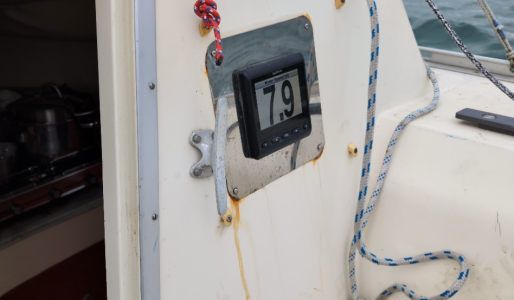
Until this afternoon! And the first shoebox-less Swift! ( I imagine) Ok, my log is perhaps over reading a bit, but showing 7.9 knots through the water in 12 knots true, beam reach, under white sails only... Is NOT how it used to go before! With the same log, I never saw more than 5.8 before.
The Swift 18 owners association Web forum appears to be broken. I guess just no longer managed? Shame I discovered how to make this boat sail tolerably well FORTY YEARS after it was built!
I'm based in Southampton/ Hamble area, and my boat is still on the water, although autumn is beginning to bite.
Ps. The Swift 18 prototype was an aluminum mini cupper hence the hard chines. I talked at length to Colin Silvester about the design 12 years ago, he very kindly sent me a copy of the original drawings in a cardboard tube in the post, which are... Somewhere... In my loft. But I recall... No skeg on the original design!
Colin and I concluded that the shoebox was somehow added later by John Charnley or another member of the manufacturing team. Colin was horrified by the very idea of it, but didn't even know they'd butchered his design until I explained it to him in about 2013! If a manufacturer wants to 'tweak' any part of a yacht design before manufacture, for obvious reasons it's a good idea to go back to the the naval architect and get it done properly, not just stick a rectangular box underneath it! Of course they would have had to give Colin a bit more money for him to do a bit more maths!
Possibly it was a packaging exercise, so it is (very slightly) less tender with the keel winched up (important it isn't 'tippy' when the missus steps onboard at the boat show sporting her 1985 finger perm!). The shoebox contains 50kgs of lead plate, but it is very close to the hull so gives little righting moment. The shoebox also acts as support for the aft trailer roller when on the trailer, and to some extent protects the outboard when grounding. It gives very little in utility while taking a lot in performance.
The Swift handicaps AWFULLY in racing as the maths of its sail area, fractional rig, displacement etc suggests a quick boat (which it isn't). The speed it actually goes compared with how it looks like it might go is baffling for many and has caused much consternation to owners over the years!
Until this afternoon! And the first shoebox-less Swift! ( I imagine) Ok, my log is perhaps over reading a bit, but showing 7.9 knots through the water in 12 knots true, beam reach, under white sails only... Is NOT how it used to go before! With the same log, I never saw more than 5.8 before.
The Swift 18 owners association Web forum appears to be broken. I guess just no longer managed? Shame I discovered how to make this boat sail tolerably well FORTY YEARS after it was built!