
Mini sandblaster for rust spots on keel?

By the way, this is the sort of thing I'm talking about. It does look a bit like a toy. But after watching a few youtubers using them, it looks perfect for the little spots that I have to tackle. Will there really be all that much dust from this? I'd have thought that a good shop vac could keep up.
The boat will be tented anyway for shade.Screenshot 2025-12-09 at 09.03.46.png
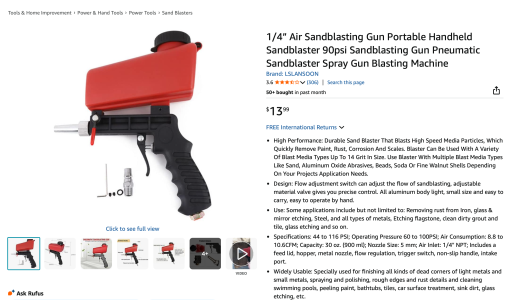
 
By the way, this is the sort of thing I'm talking about. It does look a bit like a toy. But after watching a few youtubers using them, it looks perfect for the little spots that I have to tackle. Will there really be all that much dust from this? I'd have thought that a good shop vac could keep up.
The boat will be tented anyway for shade.View attachment 203335
10 cfm is fairly big compressor, if you look at compressor specs some at that rating require 16 amps way more that a normal domestic supply!
 
All this seems a lot of effort for dubious return.

Clean rust spots as best you can, apply rust converter, and then red oxide paint. You can prime and anti foul

That's as good as it gets for me on a cast iron keel, and much less effort.

If the rust bleeds through at next lift out, simply repeat.
 
10 cfm is fairly big compressor, if you look at compressor specs some at that rating require 16 amps way more that a normal domestic supply!
That's interesting, I hadn't thought of that! I don't know how good the yard power supply will be, by the time we've daisy chained a bunch of extension leads together. And it's all at 110v which doesn't help.
 
All this seems a lot of effort for dubious return.

Clean rust spots as best you can, apply rust converter, and then red oxide paint. You can prime and anti foul

That's as good as it gets for me on a cast iron keel, and much less effort.

If the rust bleeds through at next lift out, simply repeat.
If I lifted out every year, I'd completely agree.
But I'm trying to future-proof the boat as much as possible. We're switching to Coppercoat and may not lift out again for several years.
(I've got a bit of a track record on this... I've owned yachts continuously since 2010 and have only lifted out six times, including the current time).
 
If I lifted out every year, I'd completely agree.
But I'm trying to future-proof the boat as much as possible. We're switching to Coppercoat and may not lift out again for several years.
(I've got a bit of a track record on this... I've owned yachts continuously since 2010 and have only lifted out six times, including the current time).
Not sure I would Coppercoat without blasting to the correct spec. my Bavaria was coppercoated from new, but the original factory coating was not compatible so the yard ground it off and then epoxied - all done under cover in the summer. The photo in post#26 is after 3 years and the light coloured patch is the CC patch done to cover localised breakdown after 2 years. Next year more patches so gave up and had it blasted. I really don't think you will ever get it clean enough manually to justify CC Many boats with iron keels use conventional AF on the keel and accept periodic patching.
 
Not sure I would Coppercoat without blasting to the correct spec. my Bavaria was coppercoated from new, but the original factory coating was not compatible so the yard ground it off and then epoxied - all done under cover in the summer. The photo in post#26 is after 3 years and the light coloured patch is the CC patch done to cover localised breakdown after 2 years. Next year more patches so gave up and had it blasted. I really don't think you will ever get it clean enough manually to justify CC Many boats with iron keels use conventional AF on the keel and accept periodic patching.
In an ideal world, yes I would have the boat blasted and the job done in a shed, etc.
Unfortunately that would cost me over £10k so it's simply not a viable option.
The incremental cost of Coppercoat vs ordinary AF isn't really all that high, where I am (E coast US) so whilst it's a bit more work (which we are doing ourselves) I think it's worth a go. And if it goes badly wrong, we've got ourselves an additional epoxy layer on the boat and we can just put AF on it.
We had Coppercoat on the previous boat and were pretty happy with it. It had indeed failed on the keel after a few years. However that keel seemed to be made of poorer quality iron, and had huge rust patches.
I'll do the best DIY job that I can and hope that my better quality keel on the new boat will stand up longer than the old one did. And if it doesn't, I'll be in the same position I was for the past few years, with more growth on the keel than the hull. Not ideal, but I want to at least try.
Anyway the Coppercoat is already purchased and the hull is back to the barrier coat, so I'm kind of committed at this point. The only bit we haven't done yet is to strip the keel, because we didn't want to leave it growing rust over the winter.
 
In an ideal world, yes I would have the boat blasted and the job done in a shed, etc.
Unfortunately that would cost me over £10k so it's simply not a viable option.
The incremental cost of Coppercoat vs ordinary AF isn't really all that high, where I am (E coast US) so whilst it's a bit more work (which we are doing ourselves) I think it's worth a go. And if it goes badly wrong, we've got ourselves an additional epoxy layer on the boat and we can just put AF on it.
We had Coppercoat on the previous boat and were pretty happy with it. It had indeed failed on the keel after a few years. However that keel seemed to be made of poorer quality iron, and had huge rust patches.
I'll do the best DIY job that I can and hope that my better quality keel on the new boat will stand up longer than the old one did. And if it doesn't, I'll be in the same position I was for the past few years, with more growth on the keel than the hull. Not ideal, but I want to at least try.
Anyway the Coppercoat is already purchased and the hull is back to the barrier coat, so I'm kind of committed at this point. The only bit we haven't done yet is to strip the keel, because we didn't want to leave it growing rust over the winter.
My pal has a Franchini 47. It has a cast iron keel but it's glassed over. Have you considered adding a couple of layers of glass then fill and fair the glass. You would then be coppercoating on epoxy. He has just coppercoated his boat including keel. He had one area where there was some corrosion come through the glass. He ground it out and added some more glass. Filled and faired then coppercoated
 
My pal has a Franchini 47. It has a cast iron keel but it's glassed over. Have you considered adding a couple of layers of glass then fill and fair the glass. You would then be coppercoating on epoxy. He has just coppercoated his boat including keel. He had one area where there was some corrosion come through the glass. He ground it out and added some more glass. Filled and faired then coppercoated
I don't really want to take it to that level of work. The keel has a good barrier coat on it (Tuff Stuff epoxy primer) and that's held up well with literally just a handful of tiny rust spots. So the plan is to try to leave as much if that on as possible, and just touch up where necessary. Coppercoat have told me that Tuff Stuff is a suitable base.
 
If you cannot coat the abraded surface, basically immediately, the exposed keel will start to rust and the timing is immediately. It will rust more slowly if humidity is low and more quickly if it is humid. Leaving the exposed surface overnight is a recipe for problems in the future.

Some surfaces to be galvanised cannot be acid washed and then grit blasting is used - but its a continuous process, grit blast and then hot dip as the gal coating will be poor if left. Gal only coats on clean steel. Thermal Diffusion Galvanising does not use acid (fears of Hydrogen Embrittlement) - its is grit blasted, loaded in the oven and TDG commenced in one smooth and quick operation.

You don't see this initial and immediate rust - but its there, on a micro scale ready to undo all your work.

Best to divide up the area, 'clean' (grit blast, angle grinder, acid wash (if you include this), dry and coat smaller areas) than try to clean a complete keel and then isolate the surface - as the first part you cleaned is already harbouring rust.

Two people, one grit blasting the other applying an isolation coating would work well
 
Let's hope no one tries to fully encapsulate their keel! oh, wait... :ROFLMAO:
I appied 3 coats of west epoxy to my keel 20 years ago. It is still absolutely rust free and completely adhered.
The preparation was removing all previous coatings to bare metal, chipping hammer to remove rust from deeper areas. Treat with zinc rich primer, sand again to bare metal using 36 grit sanding discs on a 4 inch grinder .Then applied car body Filler to any low spots. Then the 3 coats of epoxy and one coat of antifoul when surface was still tacky..
I then moved the keel support blocks and did the bare patches coating the whole keel.
 
Some year ago I had a Trapper 500 with a cast Iron fin keel and every year a few rust spots occured and pushed lititle bits of the antifoul off ( days before eroding antifoul) I went to see Blakes and get some advise. we discussed how the keel would have originally been primed. This would have been done immediately after casting and in controlled conditions. Blakes explained that you will never be able to reproduce that bond on a keel on a boatyard. There advise was "do not get rid of any antifoul that is well bound onto the hull just deal with loose stuff". They had a special paint that gripped well on Cast iron and was comaptible with antifouling. I followed that advise for 20 odd years and it was any easy cure, I very rarely had to retreat an area I had prvoiusly primed. But the message was clear do not blast the whole keel off just clean off the bits that have lost the grip with a scrsper. One year I saw a similar keel stripped off by blasting and then primed and the next year there were patches of antifoul loosing their grip.
David MH
 
If you are using a stainless steel rotating 'brush' on an angle grinder - they are vicious. Wear goggles and gloves and you will probably need more than one brush.

Jonathan
 
Some year ago I had a Trapper 500 with a cast Iron fin keel and every year a few rust spots occured and pushed lititle bits of the antifoul off ( days before eroding antifoul) I went to see Blakes and get some advise. we discussed how the keel would have originally been primed. This would have been done immediately after casting and in controlled conditions. Blakes explained that you will never be able to reproduce that bond on a keel on a boatyard. There advise was "do not get rid of any antifoul that is well bound onto the hull just deal with loose stuff". They had a special paint that gripped well on Cast iron and was comaptible with antifouling. I followed that advise for 20 odd years and it was any easy cure, I very rarely had to retreat an area I had prvoiusly primed. But the message was clear do not blast the whole keel off just clean off the bits that have lost the grip with a scrsper. One year I saw a similar keel stripped off by blasting and then primed and the next year there were patches of antifoul loosing their grip.
David MH
I've got absolutely no desire to strip the whole keel to bare metal. What's on there is really well adhered- certainly in comparison to my previous boat- so I just want to spot treat the small number of coin sized rust patches.

As I said up thread, I'm trying to future proof the boat for the next few years as I don't intend to lift out again for quite some time.
 
I've got absolutely no desire to strip the whole keel to bare metal. What's on there is really well adhered- certainly in comparison to my previous boat- so I just want to spot treat the small number of coin sized rust patches.

As I said up thread, I'm trying to future proof the boat for the next few years as I don't intend to lift out again for quite some time.
I think if you are doing the prep for coppercoating then stripping the coating off the keel realy is worth doing as it doesent take long with an angle grinder and 36 grit sanding disc. Be careful using any waterbased treatments on the bare keel as you mustn't trap any moisture under the epoxy. Use a spray can zinc based primer on the rust spots as it's thin and will will penetrate the rust.
You need 2 dry warm days. one to sand off the old coating and treat any deep pits. the second day to apply the 3 coats of fast cure west epoxy (making sure there is no overnight condensation dampness on the metal) and the 4 coats of copper coat to make sure you get a good bond. Use a roller but also a brush to tip off the surface to get a smooth finish . Copper coat will not adhere to cured epoxy unless the surface is first sanded with fine grit abrasive.
I think you have to abrade the coppercoat before launching to expose the copper surface.
You then should be good for many years without lift out. Just an annual scrub.
 
(I do actually have a rotating blaster already but I've never tried it out)
I bought a similar disk to the Teecoo blaster 20 odd years ago for my keels, I remember thinking it was quite expensive for what it was and it was pretty slow. I got it out a year or so later and noticed the rubber had started to perish around the tips so it got thrown away, those metal tips could be lethal flying out of the rubber.
 
Last edited:
I think if you are doing the prep for coppercoating then stripping the coating off the keel realy is worth doing as it doesent take long with an angle grinder and 36 grit sanding disc. Be careful using any waterbased treatments on the bare keel as you mustn't trap any moisture under the epoxy. Use a spray can zinc based primer on the rust spots as it's thin and will will penetrate the rust.
You need 2 dry warm days. one to sand off the old coating and treat any deep pits. the second day to apply the 3 coats of fast cure west epoxy (making sure there is no overnight condensation dampness on the metal) and the 4 coats of copper coat to make sure you get a good bond. Use a roller but also a brush to tip off the surface to get a smooth finish . Copper coat will not adhere to cured epoxy unless the surface is first sanded with fine grit abrasive.
I think you have to abrade the coppercoat before launching to expose the copper surface.
You then should be good for many years without lift out. Just an annual scrub.
I'm loath to strip the keel. The whole thing was done quite recently by the previous owner who treated some osmotic blistering at the same time. The underwater areas of the boat are really in excellent condition.

One of the reasons we are doing the job over there, and not upon our return to the UK, is the working conditions. The temperature, humidity, and precipitation that we should encounter in Virginia in April/May are vastly better than we could ever hope for in Scotland.
 
I did mine in Solomans MD in April 2006. The weather was prefect. And the keel is still rust free as well !
Doing small patch repairs leaves lots of edges which are potentially the next failure sites.
And If there's some spots now, probably others will appear soon.
 
Top