Mini sandblaster for rust spots on keel?

They're sold as a light DIY tool, but won't work to any useful degree on a DIY size compressor - so I'd indeed class them as useless.

No idea what you mean by "DIY size"? A tool has a specified consumption, your compressor must have that output or more. The figures are easy to check.
 
No idea what you mean by "DIY size"? A tool has a specified consumption, your compressor must have that output or more. The figures are easy to check.
In DIY jobs the demand will often be lower. When I do spray painting, for instance I never spray for more than a second or so. My brother is a pro and keeps the trigger down for much longer.

The compressor figure is recharge rate, not output rate. At a given pressure and hose size they’ll briefly supply the same air capacity. A larger vessel will help more than a larger pump, generally.
 
I have a grit blast gun that has a rubber cup that you press against the work piece.
The trigger is only pulled for a few seconds then you move the gun to check if the finish is as desired.
It is high pressure low volume so providing the compressor is up to pressure before you start a small low power compressor with a 25 litre tank does keep up.
 
I have a grit blast gun that has a rubber cup that you press against the work piece.
The trigger is only pulled for a few seconds then you move the gun to check if the finish is as desired.
It is high pressure low volume so providing the compressor is up to pressure before you start a small low power compressor with a 25 litre tank does keep up.

When I was with Shell - we had one of those guns supplied to us on a 300,000 ton tanker to test ....

Ships usually have an airline that runs around the decks to power tools rather than electrics.

I was Senior Cadet on the ship at the time and I was detailed to use the gun and report on it ... within less than a minute - the sand had run out ... the deck was a mess and any moisture in the air supply had literally created a wet patch ... despite the water / moisture trap fitted.

The gun was given to AB's to try .. same results whatever way used ...

On the water issue - no other air powered tools we used ... Needle Guns etc produced such
 
I have a grit blast gun that has a rubber cup that you press against the work piece.
The trigger is only pulled for a few seconds then you move the gun to check if the finish is as desired.
It is high pressure low volume so providing the compressor is up to pressure before you start a small low power compressor with a 25 litre tank does keep up.
That sounds quite useful- do you have a link?
 
Any edge or crack would let a small amount in, that will cause rust and expansion which will spread, sucking in ever more water until the whole thing becomes a soggy johnny around a keel that you can no longer see or maintain.

Happens all the time to things covered in plastic. Powder coated metals often show this exact behaviour. Your mistake is in believing the epoxy will permanently adhere to a degrading metal.
Please post examples of this happening. Exactly the opposite of my experience and the advice from people who apply epoxy to iron keels.

You do love sweeping unsupported statements like "happens all the time" and then give examples that are nothing to do with epoxy on iron keels.

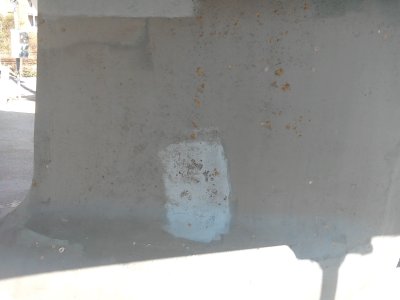
The photos of my Bavaria keel before blasting shows what I mean. The initial failure was local breakdown because of poor preparation - the keel was ground rather than blasted. The surrounding epoxy was still firmly adhered. The bottom of the keel was not coated and even after 4 years there was little sign of rust creeping under the epoxy on the bulb. Any rust on the bulb was from failure of the bond.

That is not waht happens with paint and plastic coating as you rightly say, so it is important to understand the difference.
 

Attachments

  • IMG_20200605_180213.jpg
    IMG_20200605_180213.jpg
    359.1 KB · Views: 12
people who apply epoxy to iron keels.
Epoxy is not normally applied thick, it’s painted on and repaired as required. In this capacity it’s essentially just another two pack paint.
You do love sweeping unsupported statements like "happens all the time"
Because it does happen all the time. If you’ve not seen metal with sheets of plastic coming away then you lack the experience to argue here. It literally happens all the time as anyone with even a mild interest will know.
 
Everybody tells me that the best way to prep the boat for a change of antifouling is to get it blasted. That's not an option for various reasons.

We've had some success using a formic acid based stripper followed by 80 grit, but when it comes to the cast iron keel I'm pretty wary. I don't want to expose any more bare metal than necessary. Fortunately the keel is currently in very good condition with just a handful of very small (coin sized) isolated rust spots.

I'm thinking about getting one of those super cheap handheld blasting guns just to hit the rust spots. My understanding is that grinding doesn't really eliminate the rust, and only blasting genuinely works. I know they're almost toys and you wouldn't do a whole body with one, but I've been seeing people on YouTube using them to strip things like bike frames, and they seem to work ok, just a bit slow.

Anybody tried using one?

Any suggestions for which media to use?
One of the YouTube channels I watched was a couple with a steel boat (wayward sailing? Canadian couple with a dog and steel Pilothouse) anyway, unsurprisingly they had rust and rated their Teycoo disk on a grinder

Look at this product that I found on google.com
https://share.google/FYdEBsd1jOKq37Jxq

Looks bloody lethal to me, but they seemed to rate it…
 
I used the Teecoo blaster when I did my keel a couple of years ago - worked ok, I had the triple version but it was slow, only managed one side in a day. I was doing it in sections about 8" wide from the top to the base, & immediately coating with anti rust. Seems to work quite well, only a few rust spots the following winter after liftout.
 
...
Epoxy is not normally applied thick, it’s painted on and repaired as required. In this capacity it’s essentially just another two pack paint.

Because it does happen all the time. If you’ve not seen metal with sheets of plastic coming away then you lack the experience to argue here. It literally happens all the time as anyone with even a mild interest will know.
I'm think you are confusing mild steel with cat iron. Totally different. You won't get flaking on cast iron like you do with mild steel. Where coating of cast iron fails, you get rust spots. It's all about epoxy thickness. That is why applying an epoxy filler over cast iron works so well.
 
Look up Tercoo rotating blaster. It gives a similar finish to a needle gun but from a rotating disc that fits into your drill.
My understanding is that there's a fundamental difference between blasting and other methods. I've read that blasting is the only method that genuinely cleans the cast iron, and others chase imperfections deeper in.

Regardless, I'm not trying to strip the whole keel. I'm just aiming to clean up small pockets of rust without disturbing a larger area. I thought that one of these little guns might be useful for this.

(I do actually have a rotating blaster already but I've never tried it out)
 
Did a whole cast iron keel during lockdown when there wasn't much else to do. Lots of wire wheels, flap discs etc. Grim dust and flakes everywhere.

Then rust converter, six coats of zinc rich epoxy, fill low points with filler, long board sand, final coat of epoxy to cover the filler and give a smooth outer surface and prime with promocon before antifouling. Still going strong with no rust leakage five years later.
 
Epoxy is not normally applied thick, it’s painted on and repaired as required. In this capacity it’s essentially just another two pack paint.

Because it does happen all the time. If you’ve not seen metal with sheets of plastic coming away then you lack the experience to argue here. It literally happens all the time as anyone with even a mild interest will know.
Why do you bother with posting things such as this? Who said anything about plastic coating? or claim that it is applied "thick". This is just a figment of your imagination.

The subject is epoxy coating on cast iron keels. This is applied by brush, or in the case of large areas such as this by roller in accordance with the manufacturers instructions. It behaves exactly the way I described. If the surface is prepared to specification it adheres well. It is not like "any two pack" which can have a range of .different properties. I have shown you an example of what happens if preparation is inadequate - rust forms in the spot where the epoxy is detached. You can clearly see that the rust DOES NOT spread under the surrounding area where the coating is still firmly attached.
 
Top