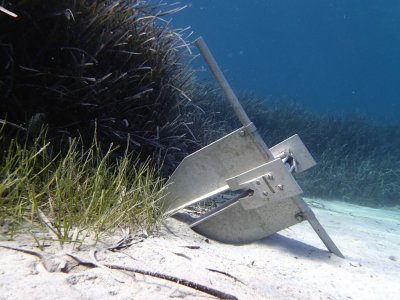
Is this any use as a kedge?

eddystone

Well-Known Member
Joined
18 Aug 2013
Messages
1,936
Location
North West Devon
Visit site
I have a Fortress FX16 (4.5kg) and was thinking it could be repurposed as a kedge on new (old) boat which is 13m and 8.5T. I think it’s a size smaller than ideal but looking at the design of the Fortress the question I ask myself is not will it hold but but how do I get it to release.
 
Hi,

I have a larger model weighing about 7.5 kg.

It comes loose easily, like other anchors, depending on the material of the bottom. You have to tie it to a rope and drive the anchor over the boat's mass, then lift it up with your hands. Sometimes it comes with a lot of mud.
 
Fortress is the ideal kedge. In the right substrate, it has exceptional holding power, so even a small model can hold a large boat.

However, keep in mind that in the wrong substrate (hard sand or thick weed), the holding can sometimes be very poor, and the lightweight design with its large fluke area can drag very rapidly. Also, exercise some caution if there is a significant change in the direction of pull, but this is usually not a factor when used as a kedge.

If you can use a trip line on a kedge this is ideal, but if not, a trick to release a well-buried Fortress is to exploit one of its weaknesses and to generate some sideways force. Pulling the rode at an angle from the direction of set the anchor will develop a large list, and it will release with less force.
 
I have a Fortress FX16 (4.5kg) and was thinking it could be repurposed as a kedge on new (old) boat which is 13m and 8.5T. I think it’s a size smaller than ideal but looking at the design of the Fortress the question I ask myself is not will it hold but but how do I get it to release.
Perfectly adequate.
 
I had a Fortress FX16 as a kedge on a 35 ft boat, 6 tonnes. Used frequently it was excellent. I would be surprised if it was not perfectly acceptable in this role for a bigger boat.

As noelex says, it can be difficult to set in hard seabeds but otherwise it rarely failed when simply thrown overboard from yacht or dinghy. Ours had 5 metres of 8 mm chain with 50 metres of 16 mm Octoplait.
 
If you store your Fortress assembled just be aware that without protection, Duralac, the stainless bolts and nyloc nuts will react with the aluminium (if damp) and lock solid.

We have never experienced seabeds so hard as to defeat, any, modern, anchor - hard seabeds seem to be like hens teeth where we have sailed. The FX 16 will be fine for your intended usage and will probably be better hold in soupy mud than your primary anchor. An excellent choice to deploy by hand or from a dinghy.

We used 10m of 6mm HT chain and 40m of 3ply 10mm nylon, 38' cat 22'6" beam, 7t. We stored the rode in, what I call, a milkcrate - with the textile coiled by hand inside the perimeter and the chain in the void developed in the coil. Perfect for stowage in a dinghy

Jonathan
 
We have never experienced seabeds so hard as to defeat, any, modern, anchor - hard seabeds seem to be like hens teeth where we have sailed. The FX 16 will be fine for your intended usage and will probably be better hold in soupy mud than your primary anchor. An excellent choice to deploy by hand or from a dinghy.

Jonathan
On the day we bought our FX16, many years ago, we attached it to our 8 mm chain and took it out to test it. We were in the Haringvliet, a fresh water inland sea in the Netherlands. It seemed to set ok under engine, wind very light. After an hour or so we realised that we were dragging, anchor skipping across the bottom without setting. The seabed was quite hard sand. This repeated several times.

The other place we experienced something similar was outside Pwllheli marina on what is in reality a surf beach. This was with a Delta, that despite half a dozen attempts simply refused to set on the rock-hard sand. Just around the headland it set first attempt.
 
I've found some places where a hard seabed wouldn't give secure anchorage. One is on very hard sand off a sometimes exposed beach. The problem there is probably not just the hard sand, there's also a slight but noticeable slope down into deeper water.
Another is off an island in the Outer Isles, where the seabed appears to be flat rock with a shallow layer of sand over it. I'm sure the sand will move, and some years will be better than others for secure anchoring.
 
Another is off an island in the Outer Isles, where the seabed appears to be flat rock with a shallow layer of sand over it. I'm sure the sand will move, and some years will be better than others for secure anchoring.
Yes, we found a couple of bays like that, one at the north end of Mallorca, the other in Amogos, Greece. Both looked to be perfect anchorages but in neither place would anchors set. Diving proved as you say - all rock with a thin layer of sand.
 
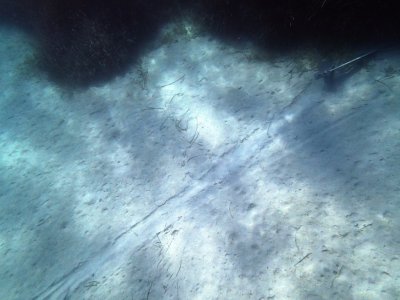
This is an example of a Guardian (the slightly simplified and less expensive version of the Fortress) struggling to penetrate hard sand. Despite a reasonable anchoring technique and giving the anchor plenty of opportunity, it only managed to penetrate with the toe. You can see the long setting distance in the second photo. 6m @4:1.

Nevertheless, the skipper stayed overnight. It shows how you can often get away with an anchor that in reality is performing poorly.

IMG_9027.jpeg
IMG_9026.jpeg
 
The other problem with the fortress is remembering what angle for what and how to set it
The shallower 32° angle is better for everything apart from very soft substrates.

Keep in mind that if you use the larger 45° setting in a firmer substrate, the anchor will not set, and the holding will be very poor. Making the opposite mistake and using the 32° setting in a very soft substrate is not as catastrophic. The anchor will set and have reasonable holding power, just not as high as it would have using the 45° setting.

This is the official recommendation from Fortress:

"Under most conditions, you will want to stick to the 32 degree fluke angle setting. These include hard or soft sand and mud. The 45 degree fluke angle setting should only be used in extremely soupy mud or silt. By extremely soupy, we mean almost liquid.

Some customers mistakenly believe that the 45 degree angle setting would lead to a stronger hold in sand or mud. This is not the case! As stated above, using the 45 degree setting in anything but very soupy mud or silt will lead to a failure to set."
 
Top