What lessons for this week

Been fighting with a keel today.
The offending item weighs 3 1/2 ton, made of lead and is attached to Victoria 38.

The issue is when we hauled her out we noticed a weep on the joint between hull and ballast.
Further investigation found some bad corrosion on one of the keel bolt studs inside and evidence of slight corrosion some of the others.
So the decision was made to drop the keel.
After some research and a phone call we acquired some keel plans from the original manufacturer but they weren't sure they were right as this particular keel was a prototype one off.
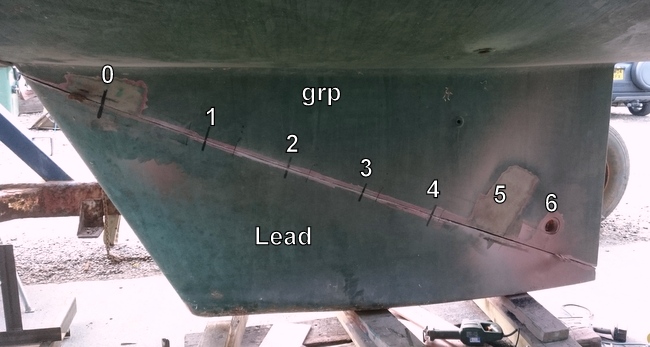
Looking at the photo below,
1,2,3 and 4 were reasonably easy to gain access too once the fuel tank and various other things had been removed.
1,2,3,and 4 were also in pairs.
We found 0 under the mast foot fitting on the hog, this was a single bolt.
5 and 6 were a bigger issue to find.
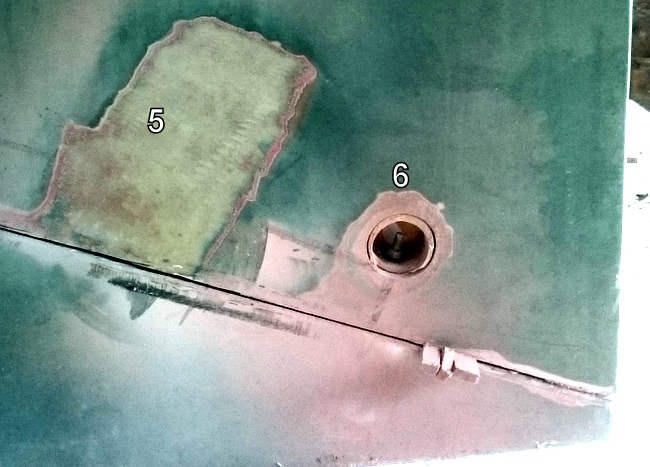
A moisture meter identified the location of 6 and after grinding back to glass we could see the round plug and got access to the bolt.
The location of 5 for some reason didn't come up on the moisture meter or the metal detector but tapping on the hull in the location did sound like something was going on.
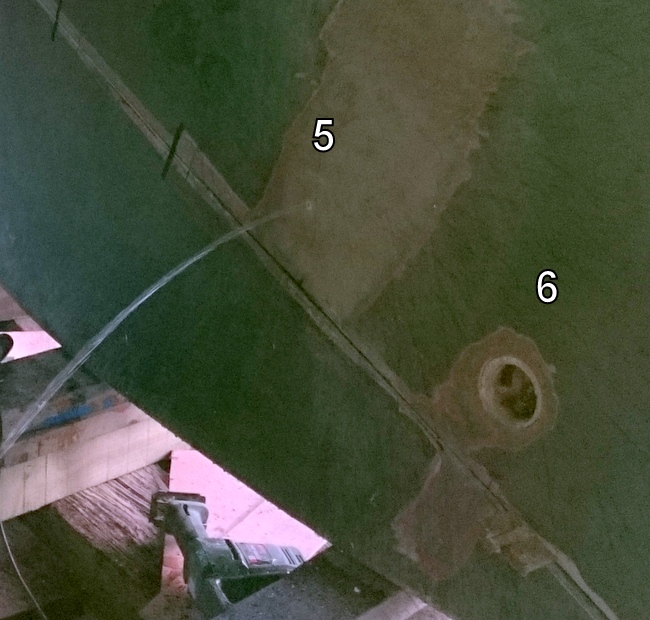
It didn't seem right that there would be a big gap between 4 and 6 so I took a flyer and drilled a hole and promptly got soaked as a jet of dirty foul smelling water shot out at almost 90 deg and drained for 10 minutes.
There's no access to this area inside so we've yet to work out how the water and oil (so obviously bilge water) got there.
We used a hole cutter similar to 6 and found the keel bolt.
Tomorrow we'll hopefully get our lifting frame under the keel and remove it.
DSC_0320.jpg

DSC_0321.jpg

DSC_0324.jpg
 
Been fighting with a keel today.
The offending item weighs 3 1/2 ton, made of lead and is attached to Victoria 38.

The issue is when we hauled her out we noticed a weep on the joint between hull and ballast.
Further investigation found some bad corrosion on one of the keel bolt studs inside and evidence of slight corrosion some of the others.
So the decision was made to drop the keel.
After some research and a phone call we acquired some keel plans from the original manufacturer but they weren't sure they were right as this particular keel was a prototype one off.
Looking at the photo below,
1,2,3 and 4 were reasonably easy to gain access too once the fuel tank and various other things had been removed.
1,2,3,and 4 were also in pairs.
We found 0 under the mast foot fitting on the hog, this was a single bolt.
5 and 6 were a bigger issue to find.
A moisture meter identified the location of 6 and after grinding back to glass we could see the round plug and got access to the bolt.
The location of 5 for some reason didn't come up on the moisture meter or the metal detector but tapping on the hull in the location did sound like something was going on.
It didn't seem right that there would be a big gap between 4 and 6 so I took a flyer and drilled a hole and promptly got soaked as a jet of dirty foul smelling water shot out at almost 90 deg and drained for 10 minutes.
There's no access to this area inside so we've yet to work out how the water and oil (so obviously bilge water) got there.
We used a hole cutter similar to 6 and found the keel bolt.
Tomorrow we'll hopefully get our lifting frame under the keel and remove it.
DSC_0320.jpg

DSC_0321.jpg

DSC_0324.jpg
What a weird way of attaching a keel.Bolts with no access?
 
Keel off today but to be honest not without a fight.
Nuts all found and undone but the power of Sikaflex is simply amazing at times.
It should be noted that none of the nuts were what we would consider as being tight.
Yes we used 3/4 drive sockets but we didn't have to apply much in the way of leverage let alone heat to get them to free off.
We used various methods to cut, gnaw, chew away at the joint without damaging either the hull or the ballast.
Having managed to cut well over 50% of the sika the 3 1/2 ton keel stubbornly hung on.
We made a number of oak wedges and resorted to a bit of what our chief engineer describes as nurturing, which involves carefully and professionally applying direct force to a wedge using ever larger hitting implements.
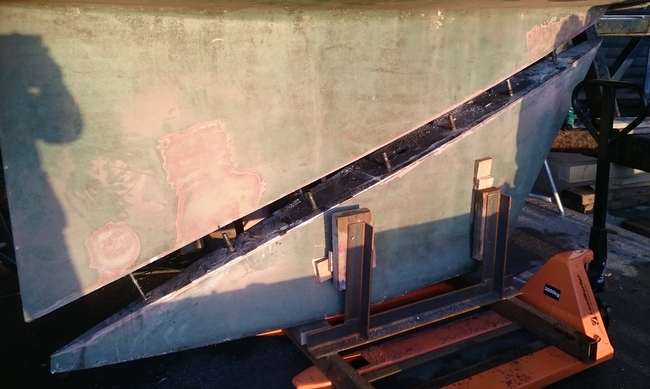
We had built a cradle out of steel mounted on 2 x 2 ton pallet trucks.
The idea being due to the keel bolt angle the keel needed to drop forward as well as down.
This worked a treat.
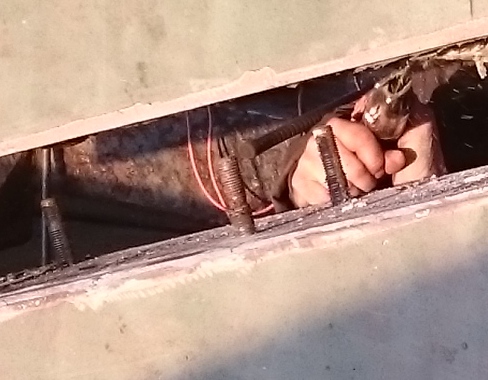
Looking carefully (sorry photo not great) you can see the wasting corrosion on one of the studs.
We'll pull all of them out tomorrow, replace all, clean up the ballast and hull joint and get it all ready to go back on.
Still need to locate the leak into the deep keel void and work on a solution to re seal the access holes.
DSC_0326.jpg

DSC_0327.jpg
 
Last edited:
Keel off today but to be honest not without a fight.
Nuts all found and undone but the power of Sikaflex is simply amazing at times.
It should be noted that none of the nuts were what we would consider as being tight.
Yes we used 3/4 drive sockets but we didn't have to apply much in the way of leverage let alone heat to get them to free off.
We used various methods to cut, gnaw, chew away at the joint without damaging either the hull or the ballast.
Having managed to cut well over 50% of the sika the 3 1/2 ton keel stubbornly hung on.
We made a number of oak wedges and resorted to a bit of what our chief engineer describes as nurturing, which involves carefully and professionally applying direct force to a wedge using ever larger hitting implements.
We had built a cradle out of steel mounted on 2 x 2 ton pallet trucks.
The idea being due to the keel bolt angle the keel needed to drop forward as well as down.
This worked a treat.
Looking carefully (sorry photo not great) you can see the wasting corrosion on one of the studs.
We'll pull all of them out tomorrow, replace all, clean up the ballast and hull joint and get it all ready to go back on.
Still need to locate the leak into the deep keel void and work on a solution to re seal the access holes.
DSC_0326.jpg

DSC_0327.jpg
Are the bolts threaded into the lead? I hope so or else it'll be a complicated job.
 
Why are keel bolts glassed over fer chrissake .
Any new video`s in the pipeline :cool:

That is not unusual. Some boats have the keel bolt tightened in a socket in the hull & the hole filled in( as in picture) & some have the socket in the keel. I have seen wooden boats where the bolts do not go right through the keel stub
I have also seen boats with a lead bulb on a cast keel where the lead & cast iron have been joined thus .
I saw a large Grand Soleil which had hit a rock & the lead had been pulled away from the stub a couple of inches & this method of fixing could be seen quite clearly
 
Last edited:
Are the bolts threaded into the lead? I hope so or else it'll be a complicated job.

It would be extremely bad practice if they were. Iead crushes & creeps under load so bolts may well need periodic tightening.
A threaded stud into lead would just strip & pull out eventually. Normal practice in lead keels is to either have the bolt go all the way through or into a gallery cut in the side of the ballast keel so a nut & washer can be put in from the side.
 
Another possibility is that the studs are bent into a J shape and were cast in. If that is the case its going to be a bugger of a job to replace them.
 
In this case nuts were welded onto plates and then the keel was cast around them.
So extracting the studs was just a matter of double nutting and winding them out.
In fact apart from the one corroded stud which prompted the removal, all the other studs look to be in good condition.
However we will make and fit new ones anyway.

We're having a bit of a discussion about how we will re seat the ballast.
In the past we've used Sikaflex, Saba, Aborcol and epoxy.
I'm leaning towards epoxy with a micro-balloons though round each of the studs we'll shamfer the holes and run a bead of Sikaflex.
The plan being that each bolt will then have its own "o" ring in effect and the epoxy will fill any gaps between the two faces.
An issue we've seen in the past with using Sika/saba is that the nuts need tightening on a regular basis.
With this keel three studs are not accessible at all and a further two are very hard to get at.
So final torque will need to be done before launching which means we need a hard infill.
With this in mind I'm adding four quite heavy layers of woven glass with epoxy on the keel stub to get a nice fair surface and provide a good key for when we re attach the keel.
 
In this case nuts were welded onto plates and then the keel was cast around them.
So extracting the studs was just a matter of double nutting and winding them out.
In fact apart from the one corroded stud which prompted the removal, all the other studs look to be in good condition.
However we will make and fit new ones anyway.

We're having a bit of a discussion about how we will re seat the ballast.
In the past we've used Sikaflex, Saba, Aborcol and epoxy.
I'm leaning towards epoxy with a micro-balloons though round each of the studs we'll shamfer the holes and run a bead of Sikaflex.
The plan being that each bolt will then have its own "o" ring in effect and the epoxy will fill any gaps between the two faces.
An issue we've seen in the past with using Sika/saba is that the nuts need tightening on a regular basis.
With this keel three studs are not accessible at all and a further two are very hard to get at.
So final torque will need to be done before launching which means we need a hard infill.
With this in mind I'm adding four quite heavy layers of woven glass with epoxy on the keel stub to get a nice fair surface and provide a good key for when we re attach the keel.
In 1994 I had to reattach a keel that had been broken off when the boat ran aground and was pounded by the surf for several hours leaving a hole big enough to walk through.The bottom was rebuilt and as the keel stub didn't come out very straight I placed the boat on a cradle,leveled it and applied a thick layer of epoxy and microfibers mix on top of the keel which was then offered to the stub and the nuts done lightly enough to squeeze the excess epoxy mix.A few hours later after the epoxy had hardened enough the nuts were fully tightened.The boat is still sailing with no movement on the keel at all. With hindsight I might have put in a layer or two of heavy rovings as well.
 
The location of [keel bolt] 5 for some reason didn't come up on the moisture meter or the metal detector but tapping on the hull in the location did sound like something was going on.
It didn't seem right that there would be a big gap between 4 and 6 so I took a flyer and drilled a hole …
We used a hole cutter similar to 6 and found the keel bolt.
Tomorrow we'll hopefully get our lifting frame under the keel and remove it.
This has only just occurred to me, but would a compass be sensitive enough detect a keel bolt buried in GRP?
 
In 1994 I had to reattach a keel that had been broken off when the boat ran aground and was pounded by the surf for several hours leaving a hole big enough to walk through.The bottom was rebuilt and as the keel stub didn't come out very straight I placed the boat on a cradle,leveled it and applied a thick layer of epoxy and microfibers mix on top of the keel which was then offered to the stub and the nuts done lightly enough to squeeze the excess epoxy mix.A few hours later after the epoxy had hardened enough the nuts were fully tightened.The boat is still sailing with no movement on the keel at all. With hindsight I might have put in a layer or two of heavy rovings as well.
Hansa bed keels in epoxy ( a marina neighbour found out ) to remove the keel & re-bed cost his insurers £5k. no damage done just a "look see"
 
A surveyor told me a scary story the other day about an anerobic bacteria that in the right conditions turns lead into smelly black water.
This happens inside the keel and essentially dissolves the lead from the inside out.
Apparently it is triggered by salt water travelling down the keel bolt into the keel.
This particular bacteria has a acid coating.
Don,t fully understand the process and need to research further but was told it's more common than you think but the cause has only recently been discovered.

The upshot is keel bolts and nuts need to be protected and Kept dry.
 
Well a new year is upon us and we're in a thankful position of being rammed with work, especially in our restoration workshops with four 40'+ classic motor yachts.
Yard work is obviously light this time of year as most boats are hibernating either in the yard or braving the elements on the river.
Repair and refit is busy with a full refit of a Vashti Class 38', keel work, new engine and fuel tank on a Vic38, new windows and headlining on a Colvic Countess, new deck on a epoxy wood 3/4 tonner and finishing off the full refit on the Fisher 25, with quite a list waiting for shed space.
As a result I'm running around quite a bit and not focused so much on one boat.

The new wooden masts/booms have been made and delivered for the Vashti Class and the Morris Griffiths 30.
They really look good and 2 thirds the cost of aluminium.
The challenge now is making the fittings, selecting track / slide systems.
We'll probably make the masthead crane, hounds, gooseneck fittings from stainless, locally to our own design.
For the track we're still not certain which ones we'll go with.
The issue being the more classic looking track don't have such good cars/slides, whilst the alloy track just doesn't look right.

Had a bit of a challenge with an old Colnebrook Jib furler.
I was pleased to be able to service it, turn up a new s/s spindle and bearings, put it back together and bench check, patting myself on the back for saving the customer many £'s.
Normally when I replace the forestay I keep the swaged end at the top, cut to length once attached to the mast and fit a sta-lok terminal at the bottom.
However I discovered with this particular furler you have to insert the forestay upside down with the sta-lok terminal at the top.
Opps, cost me 10m of 6mm wire and a wasted couple of hours.

Whilst on furlers we had a bit of a shock with a couple of early Selden Furlex furlers on a cutter rigged yacht.
The last few Furlex designs have used bottom ends made for them by Sta-lok where you fix the forestay wire but earlier ones (20 years old) they made in-house.
Some of these Selden made bottom ends also had variations as optional extras so you could adjust rig tension.
Of course you can't get these anymore, and one off manufacturing would be prohibitive but we believe the thread, wedge and collar are as close as dammit to the current ones.
I don't usually like reusing compression housing fitting either but we'll crack test and hopefully they'll be fine.
We'll get some wedges and collars in and run a bench check and hopefully again save around £6k in replacement costs.

All this talk on furlers reminds me,
I was trying and failing to service a couple of titanium Profurl furlers last year and concluded, just as the manufacturer states, that they are non-serviceable.
Well I bumped into somebody recently who put me right.
Apparently you can get the main bearings out but you need to remove the ball bearing from the casting to get access to the pin that holds them in place.
Not actually tried it yet but have an old one on the bench so will have a go at some stage.
 
Last edited:
Top