
ghostlymoron
Well-Known Member
Don't be so hard on yourself Javelin, not many sailors prepared to wait for a wind these days.


I would make sure the heater was in good order this time of year, i hate the cold & rain for that matter.Don't be so hard on yourself Javelin, not many sailors prepared to wait for a wind these days.


What a weird way of attaching a keel.Bolts with no access?Been fighting with a keel today.
The offending item weighs 3 1/2 ton, made of lead and is attached to Victoria 38.
The issue is when we hauled her out we noticed a weep on the joint between hull and ballast.
Further investigation found some bad corrosion on one of the keel bolt studs inside and evidence of slight corrosion some of the others.
So the decision was made to drop the keel.
After some research and a phone call we acquired some keel plans from the original manufacturer but they weren't sure they were right as this particular keel was a prototype one off.
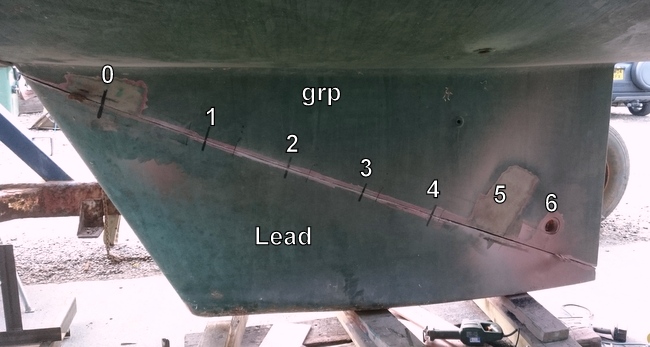
Looking at the photo below,
1,2,3 and 4 were reasonably easy to gain access too once the fuel tank and various other things had been removed.
1,2,3,and 4 were also in pairs.
We found 0 under the mast foot fitting on the hog, this was a single bolt.
5 and 6 were a bigger issue to find.
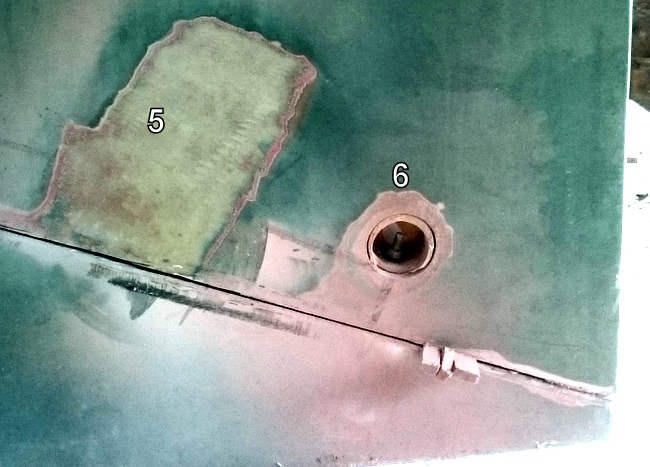
A moisture meter identified the location of 6 and after grinding back to glass we could see the round plug and got access to the bolt.
The location of 5 for some reason didn't come up on the moisture meter or the metal detector but tapping on the hull in the location did sound like something was going on.
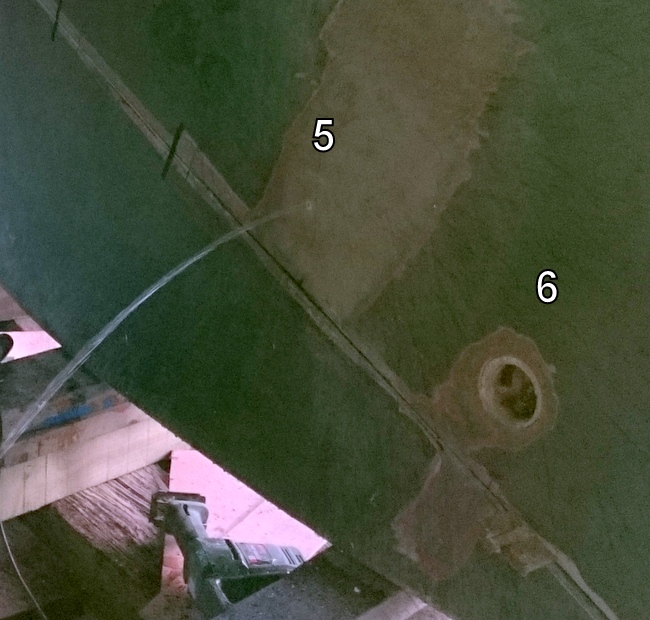
It didn't seem right that there would be a big gap between 4 and 6 so I took a flyer and drilled a hole and promptly got soaked as a jet of dirty foul smelling water shot out at almost 90 deg and drained for 10 minutes.
There's no access to this area inside so we've yet to work out how the water and oil (so obviously bilge water) got there.
We used a hole cutter similar to 6 and found the keel bolt.
Tomorrow we'll hopefully get our lifting frame under the keel and remove it.


Are the bolts threaded into the lead? I hope so or else it'll be a complicated job.Keel off today but to be honest not without a fight.
Nuts all found and undone but the power of Sikaflex is simply amazing at times.
It should be noted that none of the nuts were what we would consider as being tight.
Yes we used 3/4 drive sockets but we didn't have to apply much in the way of leverage let alone heat to get them to free off.
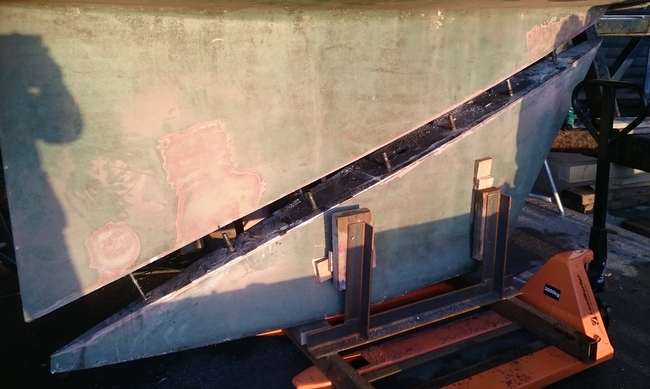
We used various methods to cut, gnaw, chew away at the joint without damaging either the hull or the ballast.
Having managed to cut well over 50% of the sika the 3 1/2 ton keel stubbornly hung on.
We made a number of oak wedges and resorted to a bit of what our chief engineer describes as nurturing, which involves carefully and professionally applying direct force to a wedge using ever larger hitting implements.
We had built a cradle out of steel mounted on 2 x 2 ton pallet trucks.
The idea being due to the keel bolt angle the keel needed to drop forward as well as down.
This worked a treat.
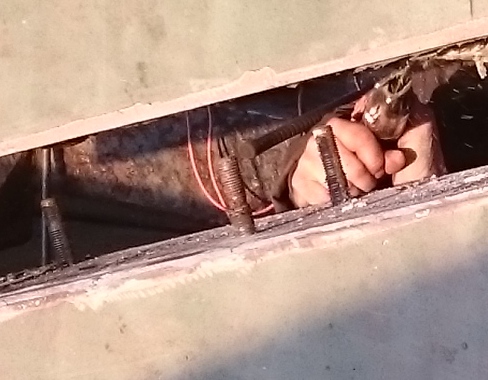
Looking carefully (sorry photo not great) you can see the wasting corrosion on one of the studs.
We'll pull all of them out tomorrow, replace all, clean up the ballast and hull joint and get it all ready to go back on.
Still need to locate the leak into the deep keel void and work on a solution to re seal the access holes.
Why are keel bolts glassed over fer chrissake .
Any new video`s in the pipeline
Are the bolts threaded into the lead? I hope so or else it'll be a complicated job.

In 1994 I had to reattach a keel that had been broken off when the boat ran aground and was pounded by the surf for several hours leaving a hole big enough to walk through.The bottom was rebuilt and as the keel stub didn't come out very straight I placed the boat on a cradle,leveled it and applied a thick layer of epoxy and microfibers mix on top of the keel which was then offered to the stub and the nuts done lightly enough to squeeze the excess epoxy mix.A few hours later after the epoxy had hardened enough the nuts were fully tightened.The boat is still sailing with no movement on the keel at all. With hindsight I might have put in a layer or two of heavy rovings as well.In this case nuts were welded onto plates and then the keel was cast around them.
So extracting the studs was just a matter of double nutting and winding them out.
In fact apart from the one corroded stud which prompted the removal, all the other studs look to be in good condition.
However we will make and fit new ones anyway.
We're having a bit of a discussion about how we will re seat the ballast.
In the past we've used Sikaflex, Saba, Aborcol and epoxy.
I'm leaning towards epoxy with a micro-balloons though round each of the studs we'll shamfer the holes and run a bead of Sikaflex.
The plan being that each bolt will then have its own "o" ring in effect and the epoxy will fill any gaps between the two faces.
An issue we've seen in the past with using Sika/saba is that the nuts need tightening on a regular basis.
With this keel three studs are not accessible at all and a further two are very hard to get at.
So final torque will need to be done before launching which means we need a hard infill.
With this in mind I'm adding four quite heavy layers of woven glass with epoxy on the keel stub to get a nice fair surface and provide a good key for when we re attach the keel.
This has only just occurred to me, but would a compass be sensitive enough detect a keel bolt buried in GRP?The location of [keel bolt] 5 for some reason didn't come up on the moisture meter or the metal detector but tapping on the hull in the location did sound like something was going on.
It didn't seem right that there would be a big gap between 4 and 6 so I took a flyer and drilled a hole …
We used a hole cutter similar to 6 and found the keel bolt.
Tomorrow we'll hopefully get our lifting frame under the keel and remove it.
Hansa bed keels in epoxy ( a marina neighbour found out ) to remove the keel & re-bed cost his insurers £5k. no damage done just a "look see"In 1994 I had to reattach a keel that had been broken off when the boat ran aground and was pounded by the surf for several hours leaving a hole big enough to walk through.The bottom was rebuilt and as the keel stub didn't come out very straight I placed the boat on a cradle,leveled it and applied a thick layer of epoxy and microfibers mix on top of the keel which was then offered to the stub and the nuts done lightly enough to squeeze the excess epoxy mix.A few hours later after the epoxy had hardened enough the nuts were fully tightened.The boat is still sailing with no movement on the keel at all. With hindsight I might have put in a layer or two of heavy rovings as well.
Who takes the keel out just for a look see? Ultra sounds would have been much cheaper.Hansa bed keels in epoxy ( a marina neighbour found out ) to remove the keel & re-bed cost his insurers £5k. no damage done just a "look see"


