Vosper Mini Fins Stabilisers retrofit on MiToS

  • Thread starter Thread starter vas
  • Start date Start date
me again!

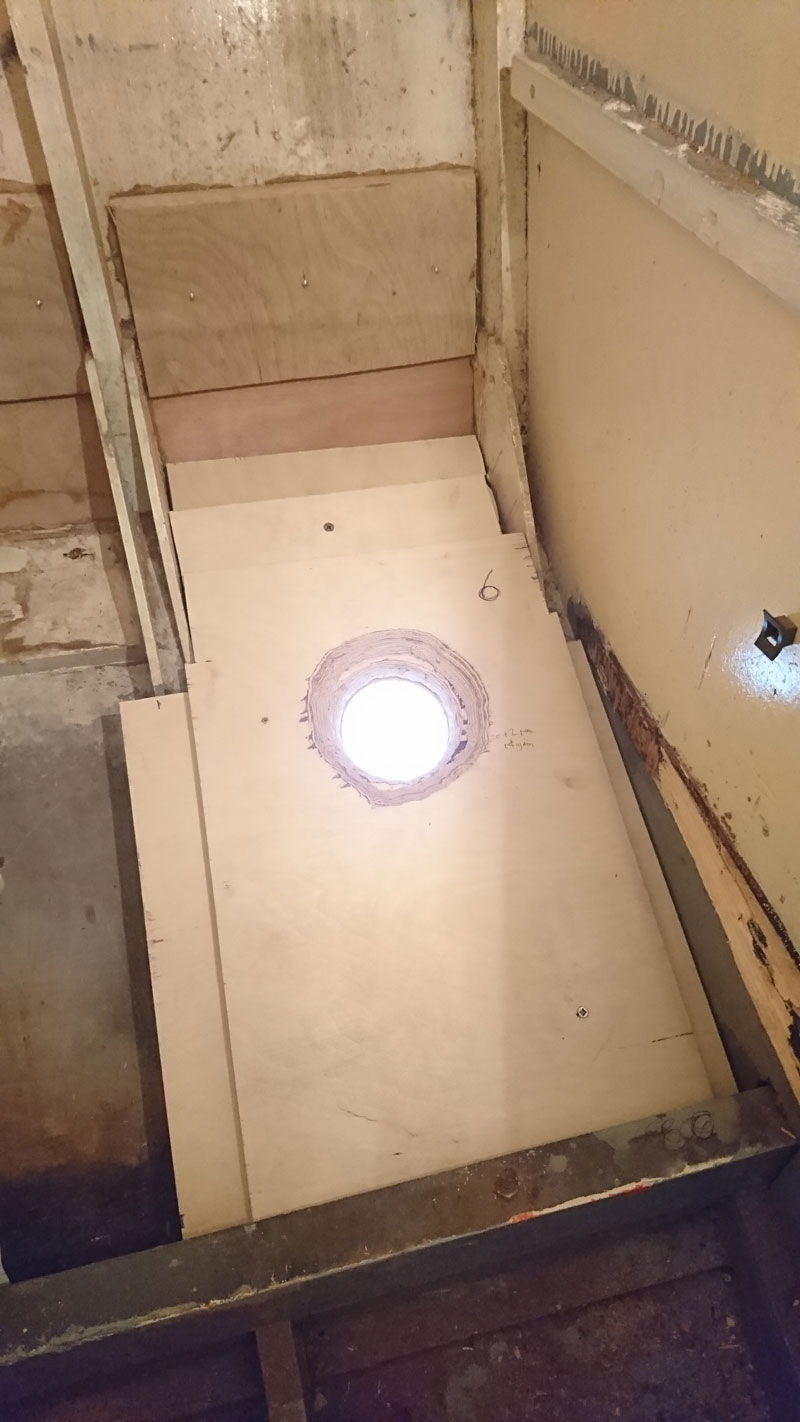
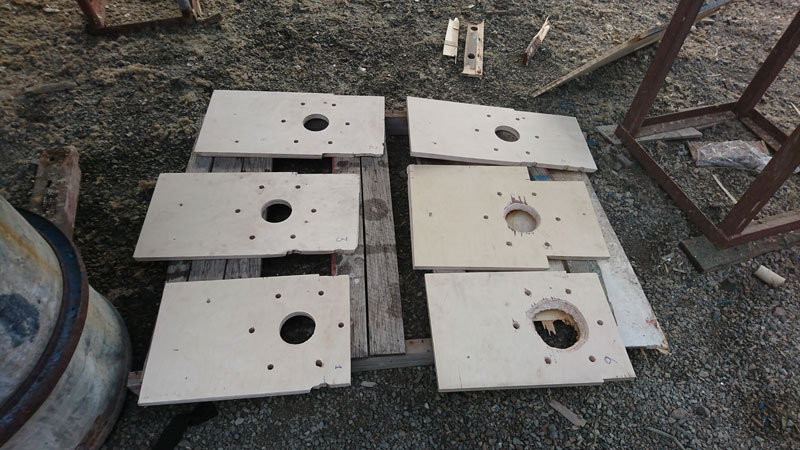
epoxied all 6 20mm ply pieces added the backplate (hull side) and the housing and bolted them with the 6 1/2inch studs.
Just to be safe I wrapped ALL of the pieces (even the studs) with cling film so that tomorrow evening I'll be able to take the thing apart.
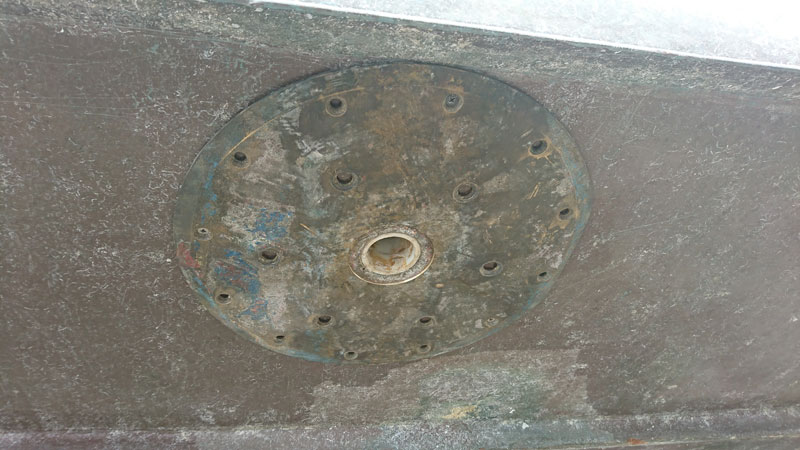
Re drilling the 6mm (or more!) bronze 400mm dia backing plate and tapering the holes was good fun, not!
Need to clean check and then refit with appropriate sealant.
Which brings me to the first Q of the post:

Q1
WHAT sealant I'll use on this 92mm dia X 135mm high hole? If I do use Sika 291i or equivalent, I fear I wont be able to remove the housing EVER. I'll probably have to use a chainsaw to separate it from the hull which is neither useful, nor smart.
I'm thinking of using Sika 291 on the last couple of layers of ply, and use old school black mastic they use to seal old style car windshields. I'm told this thing NEVER sets completely. IS that OK, or I shouldn't bother?
Option 2 is to use SIKA at the bottom and nothing throughout the rest of the thickness of the hull.
What does the panel think?

Q2
manual does mention that the 5gal oil tank should be higher than the pump. They say: "Min. pump suction (i.e. height of oil tank above pump) 2ft"
There's no way I can do that, el. motor and pump will be at the edge of being above or below the w/l, tank may be able to be placed in a way that the bottom of the tank is 30-40cm higher than the pump. Would that work? Don't see any reason NOT to tbh!

Q3
I asked that last week, no one replied, maybe it's really an issue none knows:
higher output pump running at lower pressure or vice versa? What should perform better with these stabs I wonder!
14lpm pump @120bar or 16lpm pump @ 100bar??? [for the record, it's now at 14lpm@120bar, system safety limits are 130bar or so with an adjustable pressure release valve]
Volume or pressure is more important in moving the fins quicker?

Tomorrow is routing the oil pipes to the port actuator, motor/pump assembly (not ordered yet!) will be on port side of the e/r and getting cables from the helm area to the port actuator, effectively finishing off the messy part of the installation to port.
Then lots of head scratching on how to move/remove the air con unit so that I can start preparations for the stbrd side

cheers

V.
 
Last edited:
Been watching this carefully ,
According to Lindsay Lord in his book - Lord L. NAVAL ARCHITECTURE OF PLANING HULLS,
You need as a rule of thumb about 75 Hp / ton for a planning hull to get up and plane .
A good balanced hull in terms of kg,s Hp and lift planes easily without trim tabs and indeed runs without tab when up being able to run at between 1 and 3 degrees planing attitude .

You say in post #1 you have 11.5 tons , then later 11 and say the stab kit is heavy especially the fins , which we understand have been reduced in area and kg,s .
Buts that’s not principally over worrying me the extra kg ,s as such .

A clue is how much tab you sans fins use to get it up so to speak and how much tab is needed in cruise to get near the 1-3 degree planing angle .
Reason why ( no doubt to the annoyance of JFM / MapishM :) ) I,am raising this spector is this ——

Position of the fins

You’ve put them smack bang in the centre of where most likely is the most lift is generated in a planning hull .
Planning hull - does not matter in a D or SD like the donor .,because those boats don,t need that lift in that place as crucially as yours ,indeed they will not notice any lost lift at all bumming round below 15/18 knots ,just burn more fuel .

As it is in your boat a planning boat the water needs to flow out in a V kinda shape towards the chine, and now it will be interrupted.
So there’s a distinct possibility——- depending on how near you are to the empirical 75 Hp / ton and how much tab you currrently deploy to get up and stay up
Following items from this menu may apply
Loss of lift where you need it most ( due to the stabs- cocking up the flow ) = imbalance and the stern suction will exaggerate the attitude raising the bow as the stern sinks trying to plane
1 - need more tab —- if more is available? To plane
2- extra tab = more drag

Extra drag slows it so it never actually reaches planing speed .

This is over and above the extra kgs increase in WL as it’s sat in the marina cos it’s sitting deeper .
And I,ve not taken any extra drag of the fins themselves into account .

Purely focusing on the loss of dynamic lift where you need it most to plane .

In a bigger planning boat like JFM,s squaddie the relative fin area / lift area - ratio call it lift disruption ratio is less due to the simply longer hull and the extra headroom in the Hp .
Suspect because it was not designed for fins needs a bit more tab than a none finned identical hull .Less so at higher speeds he top end where the tabbing differences will be reduced as the lift forces increase.
Ultimately the drag will reduce the top speed of the finned vs none finned in identical hulls kg,s ,Hp etc .


So with your set up Vas fitting these in a 13 M shorter hull with marginal Hp it may never plane !
This is a dynamic effect at the interface of getting up due to a significant loss of lift in the greatest lifting part of the hull leading to the stern sinking and bow rising leading to more draggy tab in an attempt to raise the stern - slowing it more as well as the poorer attitude ( extra drag to overcome) and not enough Hp on tap to compensate.

Also if it does plane ,you may notice as well as masses of extra tab it easily gets knock off the plane in head seas with much annoyingly smaller waves .

Just something I thought to mention .
Sorry I can,t directly answer the Qs above as there are many answers so I,ll leave up to others .
 
Last edited:
Reason why ( no doubt to the annoyance of JFM / MapishM :) ) I,am raising this spector is this
...
Got a chip on your shoulder, PF?
There are much worse things in life than your posts (or anyone else's for that matter) to get annoyed about...
I might have disagreed (as I am now - see below), but that's a different matter altogether.

As it is in your boat a planning boat the water needs to flow out in a V kinda shape towards the chine, and now it will be interrupted.
I understand what you mean, but I don't think you can translate such flow interruption quite simply into more drag and loss of lift.
There is some additional drag obviously, but if the fins, in their position, resist against the outward water flow, it's not like they are just "braking down" the hull.
Newton's third law, remember? If the fins when centered (they never are in practice, but let's leave that aside) resist the water flow, since the boat has nowhere to go but up, such resistance can only translate into an upward force component (aka lift) in the position where the fins are placed. In other words, exactly the opposite of what you are saying.

Otoh, I agree that if powerwise the boat would so borderline that the additional drag is enough to impede getting over the hump of her own bow wave, Vas would have a problem.
But in his boots, I wouldn't be too worried. Time will tell, I reckon... Can't wait to hear from him.

Btw, that Lord whatever rule is a helluva sweeping generalization, if I've ever seen one.
According to him, my DP is some 300hp short of what she should have, yet she has zero problems jumping into plane.
Otoh, my old fountain had 260hp more (i.e. a whopping 240%), but putting her on the plane required a fine balance of throttle, trim and tabs.
You could have easily wrecked her engine by just hammering the throttle and wait.
Yet, she made 70+ mph once up and running...

Ref. Vas questions, I'm also not answering them - not because there are too many answer, but rather because I have none... :p
 
The 75hp / ton is for a planer at 40 knots , indicative of a relationship between Hp and planning and speed , there’s clearly documented graphs depends on the aspect ratio that’s B/L .The beamer ( within reason .25 to .35 ) the less Hp is needed .
A more relevant Hp would be lower .
How ever the point is at the mo the Hp is fixed and I suspect not very high because the of the aspect ratio ,suspect it’s a Beamer boat ?

I think you have missed the point about the fin position reducing lift .
As said I’ve not included there drag or any twisting underway increasing underway , that’s just gonna reduce speed at a given rpm -
When I said “ And I have not taken any extra drag of the fins themselves into account “—- about 1/2 way down .

Basically in a planning hull like Vas s a small hull the position of the fins ( perfectly lined up parallelism you like . ) are interrupting the flow of displaced water which creates lift at the outer sections of the hull .

That displaced water flows out laterally in the shape of V with the ve being at the front in the horizontal plane and the wings further back , like lay a V on the floor with the point at the where the water meets the air on the “ keel “
Not to be confused by V when talking deadrise and opologies for not making that distinction.

The most lift being at the outer sections - exactly where they are sited right into the path of the horizontal flow of water .
The most forward area where most lift is made is the point where the hull deflects the flow most sharply.

Succeeding aft sections underwater ,encounter a water flow allready deflected from the horizontal and therefore tend to reduce there potential angle of deflection ( Newton’s laws as you say ) ,As smaller units of resistance force are changed to kinetic energy ,LIFT decreases tending to eventually become negative .
The pattern of pressure of a hull advancing at speed varies with the aspect ratio .

Hope that clarifys my post .
 
Perhaps folks can start to see why as boat L decreases gyros as stabs start to rule the roost over fin s In PLANING boats ,
There’s a reason , you can,t afford to lose “that proportion “ of dynamic lift for a given effective fin area to achieve a good stab .
“ that proportion “ being greater in smaller L .
Bigger boats the proportion is less and planing do able .

Ideal fin position for stab is Antagonist with lift generation in a planing hull .
As the hull L decreases to zero at some point you will end up with not enough lift to get it up planing well before you get close to zero .
 
Perhaps folks can start to see why as boat L decreases gyros as stabs start to rule the roost over fin s In PLANING boats ,
There’s a reason , you can,t afford to lose “that proportion “ of dynamic lift for a given effective fin area to achieve a good stab .
“ that proportion “ being greater in smaller L .
Bigger boats the proportion is less and planing do able .

Ideal fin position for stab is Antagonist with lift generation in a planing hull .
As the hull L decreases to zero at some point you will end up with not enough lift to get it up planing well before you get close to zero .
Gyros will never rule the roost for underway stabilisation. They cannot hold an antiroll torque for more than a second, after which they must stop doing anything, and that is pitifully too short a time for underway stabilisation. They're awesome at anchor

75hp per ton is bollox. My boat is 50 tonnes light/60 tonnes heavy. I need 4500 hp then. But I have 3244
Hp and easily on the plane without using anything like WOT.
 
Last edited:
Q1. Imho use 3m 4200 or another good polyurethane. Softens with heat gun and the metal nicely conducts the heat for you- that's how you remove. I would put seal on bottomplate and in the tube, for adhesion reasons more than water seal

Q2. I would take a chance and guess the "2foot" is a safe hunch not science. Less will be fine. You want top of oil to be a bit above pump intakes, obviously, but 1 foot feels ok to me. The shorter the pump feed pipe length, the lower the tank can be

Q3. Hard to say. I would want to meet both flow and pressure specs. Are you fitting an accumulator? I realise they are more relevant in STAR than underway but they help in underway mode when the fins suddenly demand a lot from the pumps. So if you're fitting an accumulator you can sail closer to wind on pump specs.

Great project Vas

I don't see why you want the winglets parallel to sea floor btw. I would have ignored that and chopped the fins straight. My winglets are an upside down V, in cross section. See picture post #30. Silver E in that picture and my boat have the same fins- Sleipner 1.05 m sq
 
Last edited:
Gyros will never rule the roost for underway stabilisation. They cannot hold an antiroll torque for more than a second, after which they must stop doing anything, and that is pitifully too short a time for underway stabilisation. They're awesome at anchor

75hp per ton is bollox. My boat is 50 tonnes light/60 tonnes heavy. I need 4500 hp then. But I have 3244
Hp and easily on the plane without using anything like WOT.

“ As L decreases “ see post #45 , not sure what the WL or more relevant the wetted L when planing is on Vas s boat is
LOL approx 14 m , wetted L 10-m depends on loads ? Attitude etc .

75 Hp / ton is for 40 knots + well 42 exactly and you are right with your boat only 3444 Hp and 50-60 tons it ain’t gonna make N of 40 knots .- and it doesn’t,t - see post #44 .
But this not relevant here the 40 + knot speed agree .

As said being a little boat with fins there’s a danger of running out of lifting force and not being able to plane .,with the Hp available.
Unless it’s got bags of Hp spare ,which I suspect it hasn’t .

Typically with an aspect ratio of .35 for a planing hull to compare the sq ft of planing area available
For a 80 ftr Lol with a chine beam of 20 ft , mean WL ( planing ) 57 ft we have 1140 sq ft
Where for a 44 Fr LOl with a chine beam of 11 ft , mean WL 32 ft , we now have 350 sq ft

Drop down a bit more
Lol 40 ft , chine beam 10 ft , mean WL 29 ft the sq ft of plane drops to 290sq ft .

Amount of lift is variable it’s not the same over every sq ft as explained earlier.

This diagram may help - it’s not exactly Vas but illustrates the principles of fin position in a planing boat knackering lift potentially.
The blue area is negative lift or suction drawing down the stern
The red fin position .
The “ ship “ is a typical planing hull with deadrise .
The lower is a plank of wood no deadrise.
.View attachment 70617

Below is a diagram to illustrate the variable lift and how important the lateral part is - exactly where Vas s fins are - knackering lift

View attachment 70618
 
Last edited:
although I'm knackered, I'll try and help (?)

PF, MiToS is 11tons as calculated by the water disposed, in other words, I plotted sections every half a meter I think the first time I got her out of the water after the rebuilt. Then I built that in 3D in AutoCAD and used it to calculate the volume. So it's pretty accurate. From that point 2yrs back, MiToS now sports a bit more upholstery, the fin assembly (circa 300kg) heavier anchor chain (say 50kg...) a heavier jetrib (say 150kg more than the valliant) and another 200kg of hardtop and solar panels. No need to start splitting hair, say 12tons with half fuel and water.

The IVECO AIFO 6cyl 7lt turbodiesels are 330bhp each. She's happily on the plane without any effort tbh, and with no tabs runs OKish and relatively flat. I assume with the extra 50odd kilos in the chain locker she'll be a bit better (although at the other end there's an extra 150kg worth of tender) Mind the stabs extra weight is smack in the middle so wont affect much.
According to this lord guy, I'd need 900 horses to do what do 40kn? That's the last thing I want (together will looking at the 1200lt tank gauge going down at alarming rates!) haven't even bothered doing a WOT run yet. May do this year though now that all my gauges are wired and working, so got to come down to earthling speeds and expectations from a moving apartment I think. IF MiToS fails to plane (which I'd be extremely surprised tbh!) then I'll still enjoy going places but will think about it if it happens.

Waterline length is 10.5m.
Widest part of the hull at WLL is slightly in front of the fins and it is 3.6m wide (in plan).

And now to completely disappoint you PF, I use MiToS 85% of the time at D speeds (7.5-8kn), I know awful...
Another 10% at approx 9-10kn and only 5% planning at 17-18kn.
MiToS features two stuck solid wastegates and at 700euro a pop (FFS!) it's going to be with them for a while longer. So I do a few fast bits of travelling at the beginning of the season when she's clean and that's it. Rest of the time it's A/P and relaxing. Last week I managed to get a garmin remote for the a/p and I can now enjoy helming from the bow sunpad :p

The pinned centre position for the stabs is a degree or two toe in (in car speak) so tracking end of the fin is outwards a bit. I assume that this way the V shape of the flow of the water wont be affected substantially (if at all tbh)
Further you got to take under consideration the fact that the fins are true to the hull (deadrise at that point is 19deg) This may make bugger all difference, or it may create a bit of lift, I just don't know.

To a great extend all that is an interesting experiment, cannot believe it will fail, it will definitely wont achieve the level of stabilisation on Match or BA or the gyro stabilised boats in the forum, but it will help for sure. It will also be an interesting testbed for programming and playing with winglet shapes and stuff...

We shall see, atm it's slowly getting shape, so I'm happy!

John, I'll check a few things and reply to your points tomorrow

cheers

V.
 
thanks John!

Q1. Imho use 3m 4200 or another good polyurethane. Softens with heat gun and the metal nicely conducts the heat for you- that's how you remove. I would put seal on bottomplate and in the tube, for adhesion reasons more than water seal
I've got a almost new tube of 291i on the freezer, so I'll probably use that, it's also polyurethene, don't get 3M products easily in Volos (or haven't found them as yet!)
Slightly confused with the "seal on bottomplate for adhesion", do remember that we have 6 half inch 180mm long bronze through bolts from the plate all the way to the housing plus a dozen bronze woodscrews around 100mm long (a bitch to drive fully in-just did some tests, will have to resort to greasing the bolt after drilling to get them in) I'm planning to add 291 on the plate, keep it in place but not fully bedded in for a day and then get the housing and the full tension on the through bolts. This way there's going to be a mill or so of continuous seal compressed upon the hull ply. Shouldn't leak ever! I'll also use the traditional cotton rope round the tapers of the bolts. Belts and braces...

Q2. I would take a chance and guess the "2foot" is a safe hunch not science. Less will be fine. You want top of oil to be a bit above pump intakes, obviously, but 1 foot feels ok to me. The shorter the pump feed pipe length, the lower the tank can be
Yes, well adding this kit (and the calorifier after it) is one way I have to balance loads and correct a minor listing to stbrd I have. So I'm planning NOT to get the pump and 3p motor in the centre but place them between hull and port engine. There no matter how hard I try, I'm only 600mm max from the salon floor. Plan is to place the big oil tank over the motor-pump assembly but still I need some space above the top of the tank to be able to remove the lid and pour oil in, don't I? Once you get all in place, I think I'm going to be top of oil 350mm above top of pump body. Should be plenty!


Q3. Hard to say. I would want to meet both flow and pressure specs. Are you fitting an accumulator? I realise they are more relevant in STAR than underway but they help in underway mode when the fins suddenly demand a lot from the pumps. So if you're fitting an accumulator you can sail closer to wind on pump specs.
I know John, in an ideal world I'd have a couple of pumps and motors to try :D Now I'm tempted to getting the larger pump 16lpm and a large 3p motor. Depending on whether you do have a suitable inverter or not, I'll get something to start (can route it to the watermaker inverter, only it wont be able to get the full pressure out of it. Then see how much I want and sort it out.
Never thought of adding an accumulator. I like the idea as it will be a "bank" helping in high demand situations. Wonder though how bit would that have to be then? More questions... I'll probably skip that atm, see how it goes as is, and then consider it together with progressive solenoids and other bits later on. Though there's a small chance I'll go straight to PWM (I guess) solenoids to avoid difficult h/w on the arduino project.


Great project Vas

I don't see why you want the winglets parallel to sea floor btw. I would have ignored that and chopped the fins straight. My winglets are an upside down V, in cross section. See picture post #30. Silver E in that picture and my boat have the same fins- Sleipner 1.05 m sq

Interesting project I'd call it, will be great when it works properly :D
Yes, I've seen the winglets on straight fins and your curved ones, and that's where I got the idea of getting the free end of the fin parallel to the sea. Plan is to get some loooong M6 M8 holes threaded on the fins true to the slanting cut and bolt an assymetrical winglet that will help mainly in the outward movement of the fin by creating a larger surface pushing the boat down- effectively operating as slightly curved ones! If I don't like it, I can remove it and see how it behaves without it, then chop (or add!) and try again. No need for a liftout for all that, just warm clean seas... Further this way I can artificially lengthen the fin (strength will be an issue, we shall see)

I'd like to finish this coming week with the hardware installation and pipework. S/W can wait, although I doubt I wont have a go at the arduino once the 3 different 9-10DOF/gyro chips arrive from China in a couple of weeks :D

cheers

V.
 
Last edited:
Vas here is the vfd. Schneider. 7.5kw.


]m
948174E5-EDB6-4BAA-933A-68F2BC51B64F.jpg


713D0E26-4547-44F0-A194-A84CD2269A89.jpg


]m
ABA7D1F4-ACDB-4649-9B8E-90BFAF927417.jpg
 
Vas here is the vfd. Schneider. 7.5kw.


]m
948174E5-EDB6-4BAA-933A-68F2BC51B64F.jpg


713D0E26-4547-44F0-A194-A84CD2269A89.jpg


]m
ABA7D1F4-ACDB-4649-9B8E-90BFAF927417.jpg

Hm,

John, i'd very much like to have it, BUT!

Do you have one like that installed already on Match? Are you sure?

I'm asking as according to the literature this is 3ph in 3ph out.
Smaller ones up to 2.2KW are 1ph in 3ph out.

Am I missing something?
You do have a single phase generator(s) right?

If there's a way to wire it and use it on my 8KW MASE generator I'd definitely have it!

cheers

V.
 
You do have a single phase generator(s) right?
Vas, I'm pretty sure that Match ain't a 3ph boat, but I don't think that restricts jfm from using that device.

Far from claiming to be an expert electrician, but some years ago I had a chance to debate the very same issue with a person who is.
And he explained me that (for some complicated reasons which I'll refrain to post, both because I'm not sure to remember them correctly and they aren't so relevant anyway) normally there's no restriction to use a 3ph in/out VFD when you only have a 1ph source.
Ironically, the only problem is that the load on the internal VFD components is much higher with single phase, for any given output.
As a consequence, a 3ph in/out VFD, when wired and feeded with single phase, has to be drastically de-rated.

I can't remember by heart what the difference was with the VFD we were dealing with back then (and it was a Toshiba btw, so not comparable - though according to that electrician the principle as such isn't brand-specific), but it was not much than half of the 3ph rating.

This doesn't mean that you can't feed a 3ph 7.5kW VFD with an 8kW 1ph genset, though.
It just means that on the output side you can't attach a motor which draws more than 4kW (or whatever).
Anyway, all this stuff, including the 3 vs. 4 cables wiring on the input side, should be specified in the manual.
Maybe you can find it online...?
 
I'm sure it is 1ph in and 3ph out. 100% sure. I have connected them myself. It comes as part of my dometic airco chiller kit. Each chiller has this to drive its 3ph motor and my gensets and shore wiring is 1ph. I have two of these, and we had a chiller problem in warranty, and this got swapped out but we think problem was something else. I never swapped this vfd back in to prove it is ok but I'm pretty confident it is.
Anyway, I was in hurry when read your post so I shoved it in suitcase and it is now in the aircraft hold. When I get to EU perhaps in a week I will mail it to you.
Just to be clear it was used as soft start device. NOw you don't want that for STAR fins unless you have an accumulator. But you can change the parameters. Also you could set it to say 40hz to slow down your motor on quiet days. Haven't checked but I guess you can remote mount the control panel.
The vfd that drives my 3ph STAR motor (made by ABB) does full automatic inverter control of motor rpm based on demand and I don't know if this Schneider unit does that but it will still be a good thing if you can integrate it.
I'll post another data label (plane is delayed) and I might be able to send a PDF manual. AnywY I hope to get it to Greece in about 2 weeks. Pity I missed the shipment that my brother made!

Ps the day my airco (one chiller) failed was when top gear were on board filming. So this vfd has been attended to by JC. His contribution was mostly words not spanners :) but the thing is famous.
 
Last edited:
Here is some data on the schneider vfd.
It clearly comes in a "3ph in" version because it has 3input poles but my one is the "1ph in" version.

50EBEF86-012B-414F-8B20-F017B5C33FC8.png


D206CDF4-24A8-45BE-85DB-5FCC66AF77A0.jpg
 
Here is some data on the schneider vfd.
It clearly comes in a "3ph in" version because it has 3input poles but my one is the "1ph in" version.

50EBEF86-012B-414F-8B20-F017B5C33FC8.png
OK, it's v.clear, obviously the online version of the manual I got was for some other incarnation of this inverter.

I'll order the motor/pump combo tomorrow, got a week or so to finish with the h/w installation and then a few days to built a few new hoses and route the lot in place.
By that time hopefully it will arrive and I can do some checking and testing.

again many thanks John!

V.
 
Just to be clear it was used as soft start device. NOw you don't want that for STAR fins unless you have an accumulator. But you can change the parameters. Also you could set it to say 40hz to slow down your motor on quiet days. Haven't checked but I guess you can remote mount the control panel.
The vfd that drives my 3ph STAR motor (made by ABB) does full automatic inverter control of motor rpm based on demand and I don't know if this Schneider unit does that but it will still be a good thing if you can integrate it.
I'll post another data label (plane is delayed) and I might be able to send a PDF manual. AnywY I hope to get it to Greece in about 2 weeks. Pity I missed the shipment that my brother made!

John, I spent sometime studying inverters when I bought (s/h of course!) the one I use on the watermaker. There I just wanted to soft start and stop to avoid having to manually reduce and up the pressure on the membrane. Trevor helped me there, now works a treat!

Indeed all these inverters are configurable in two-three different ways so my arduino can indeed up and lower the Hz, hence rpm on the motor and smooth the action. Only issue (apart from programming it, which isn't such a big deal tbh!) is that the 3p el. motor MUST support running at low Hz for long periods. Searching around, I realised that in order to do so, some motors (typically twice the price of normal 3p motors) do have this feature by simply REMOVING the fan stuck at the back end of the motor, and adding a smallish separate motor that runs at constant speed a fan cooling the poor main motor working at lower rpm (Hz)

So why I'm mentioning that?
Since I'm at loss as far as power/flows/pressures needed on my application, I'm sticking to max pressure (as specified in the Vosper manual), upping the flow a bit and getting an expensive such motor (overspecifying it a bit) that will give me good ground for experimenting different pressures (especially once I get progressive solenoids-actually sooner than later)


Ps the day my airco (one chiller) failed was when top gear were on board filming. So this vfd has been attended to by JC. His contribution was mostly words not spanners :) but the thing is famous.
that's v.nice, I explain to all visitors that all the GMIs came from a 24m 2mu Fairline, now I can claim that the inverter was attended to by JC, cool!

on a serious note, some good progress to report:

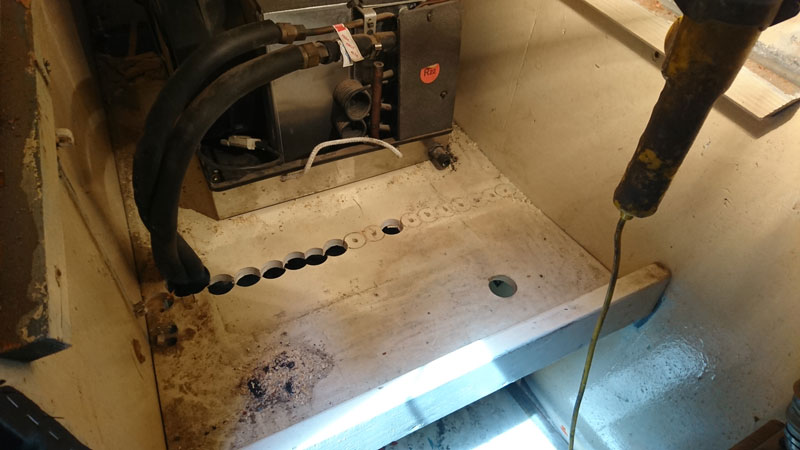
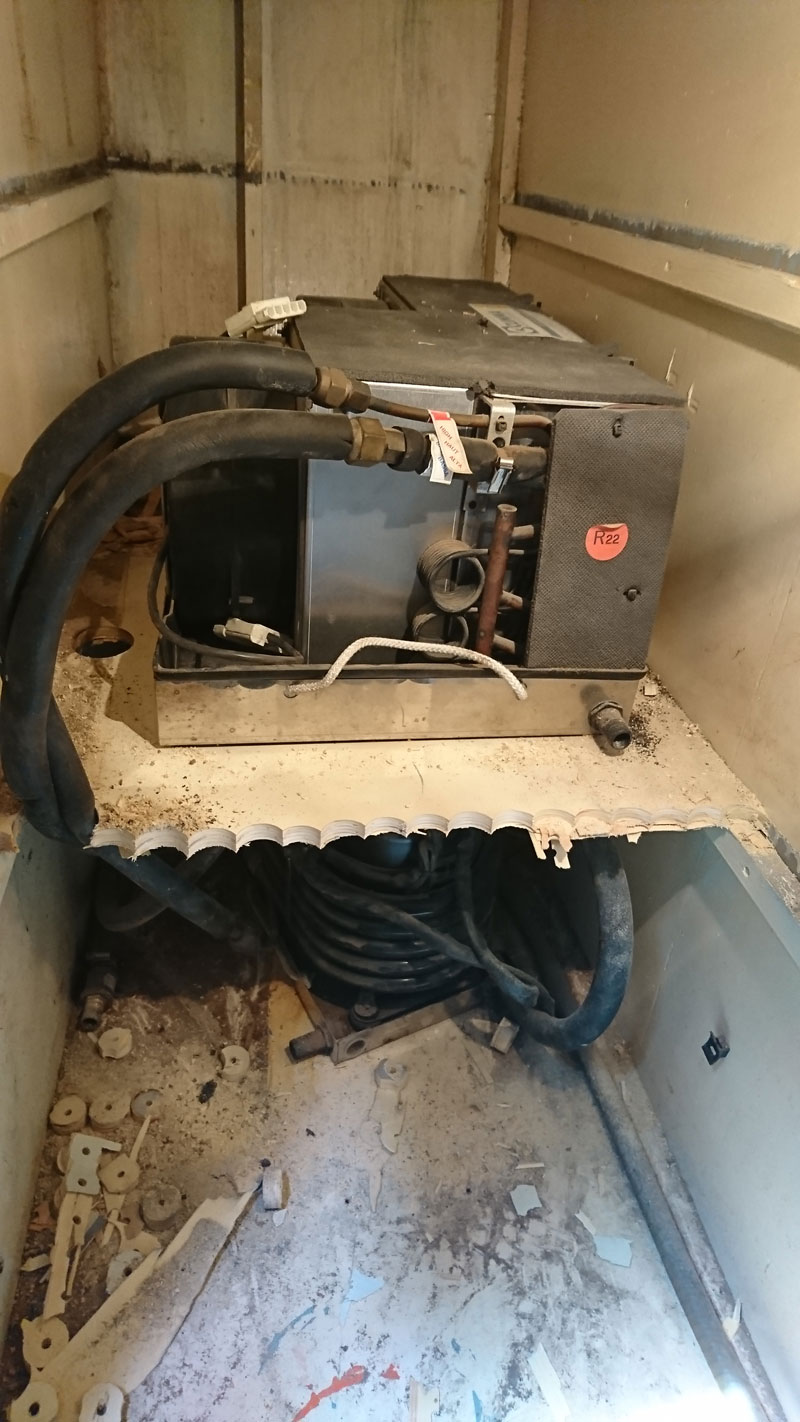
Air con removed from the stbrd side, note the lazy approach to cutting the shelf to release the freon pipes connecting the pump to airhandler unit on top:

aircon_assembly_removal1.jpg


aircon_assembly_removal2.jpg


aircon_assembly_removal3.jpg


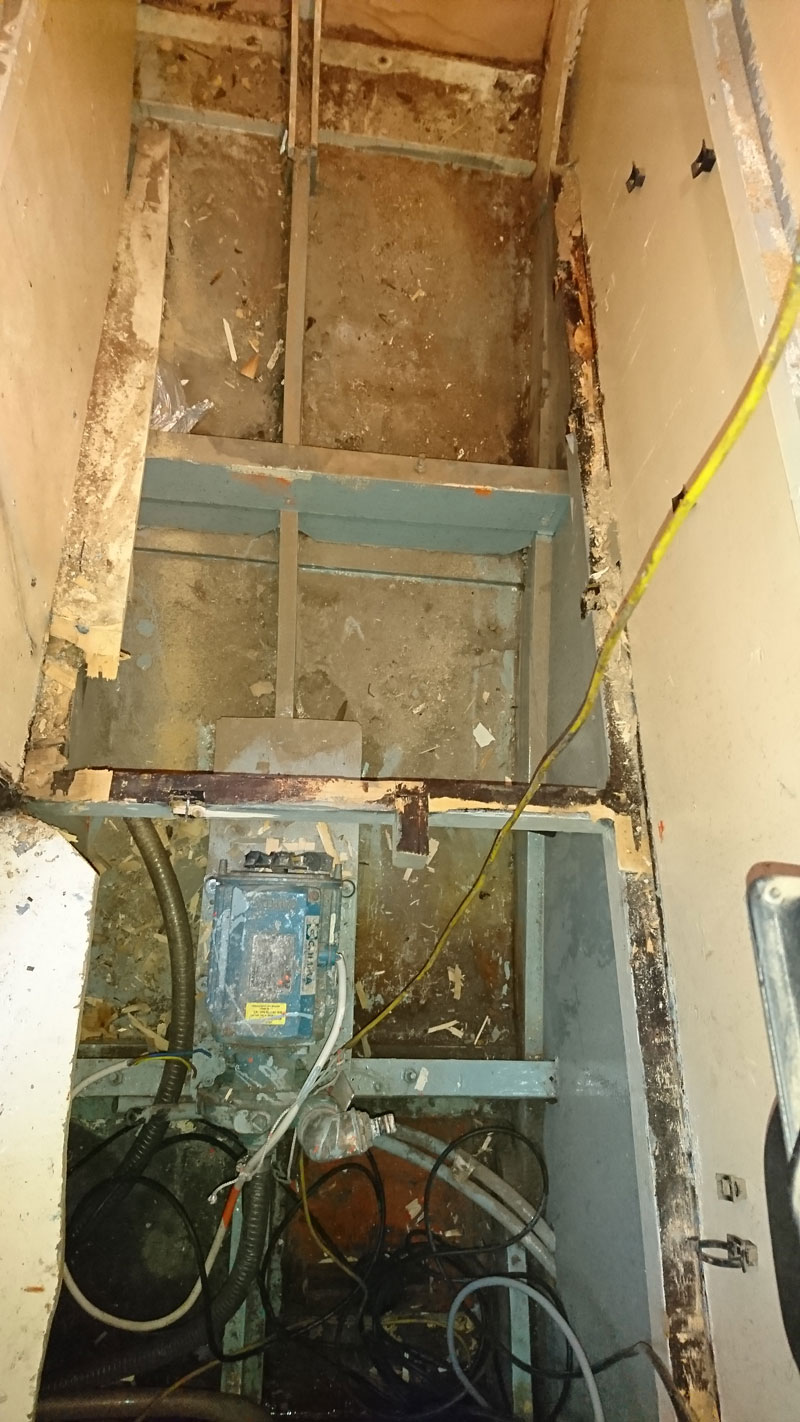
so now I have freed the space where the stbrd fin assembly will be fitted with the rest of the space becoming a second tight bunk on the stbrd cabin:

new_bunk_space1.jpg


new_bunk_space2.jpg


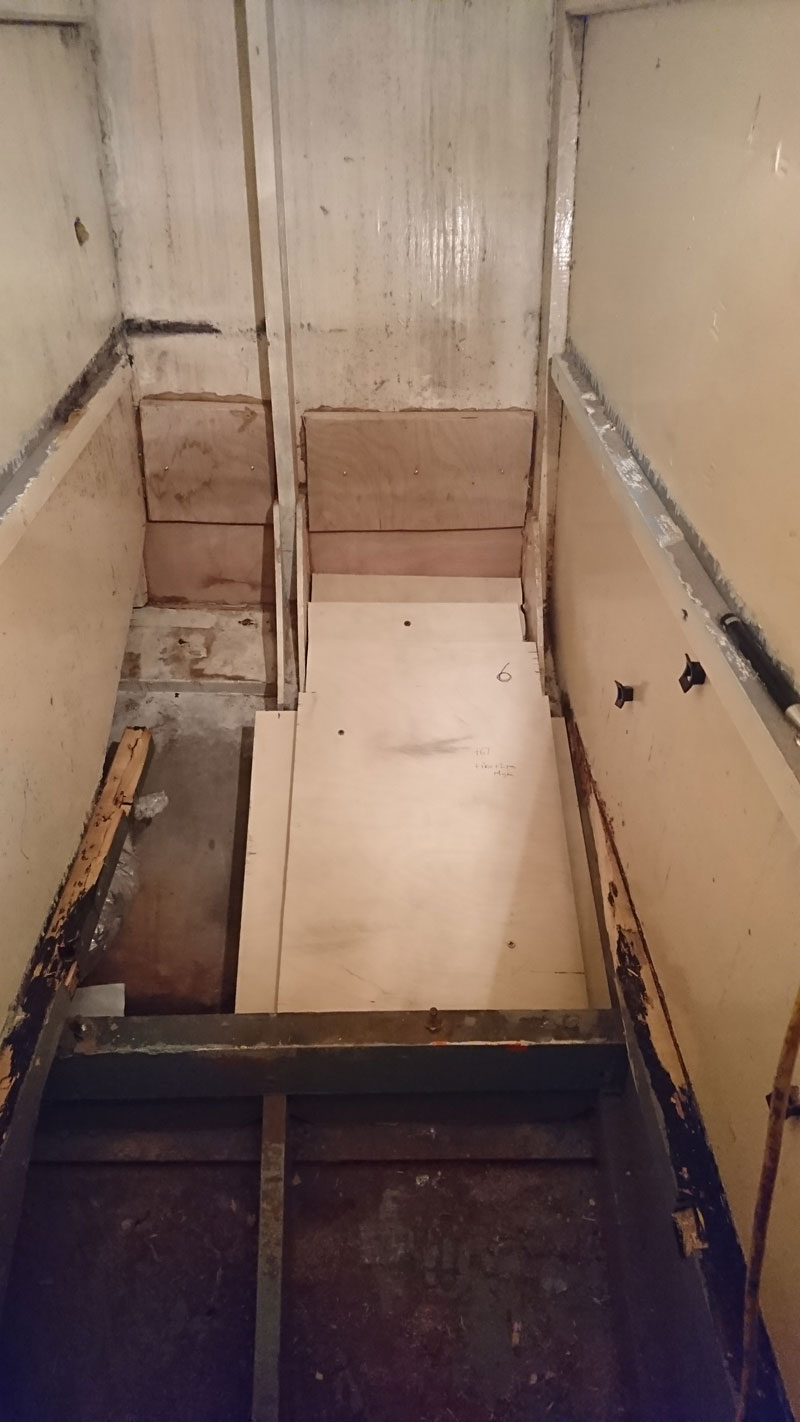
then I started all the work done on port side, 6 layers of 20mm ply shaped and fitted:

stbrd_stab_reinforcement1.jpg


stbrd_stab_reinforcement2.jpg


stbrd_stab_reinforcement3.jpg


marking the cut on the top two layers with the slanting of the housing:
stbrd_stab_reinforcement4.jpg


all in place:
stbrd_stab_reinforcement5.jpg


housing in place:
stbrd_stab_reinforcement6.jpg


outside reinforcement plate test fitted:
stbrd_stab_reinforcement7.jpg


finally all layers coated with two layers of thinned epoxy (three on the endgrain all around for good measure):
stbrd_stab_reinforcement8.jpg


Tomorrow morning I'll epoxy them in place and add the housing and the 6 long bolts to tighten and squeeze it down.

By mid day I should have the two shafts with the bearings on the tillers replaced (resized actually to metric), new pins and circlips and ready to be fitted for good.
Will also check the seals on the four pistons and replace if needed.

Plan has slipped to having both assemblies and back plates bolted and polyurethened for good in place by Monday, with shafts and rams also in place the day after.

Then I have to scratch my head a bit more and find decent spots for the water circulation pump, cooler, oil filter as well as the big oil reservoir.

In theory I could be in the water in a couple of weeks but I'll be on a study visit then so relaunch delayed to mid June.

cheers

V.
 

Hi Vas,
that space must have been the last remaining "un touched" compartment in Mitos, after your major rebuild project ? ;)

do you still NOT have a "Fein " tool ?
this probably is the most used and most handy tool I ever bought !

good going on the stab fin fitting,
very nice project ! love it !
 
Hi Vas,
that space must have been the last remaining "un touched" compartment in Mitos, after your major rebuild project ? ;)

do you still NOT have a "Fein " tool ?
this probably is the most used and most handy tool I ever bought !

good going on the stab fin fitting,
very nice project ! love it !

indeed Bart, it was a v.difficult to access spot, full of the aircon in these shallow shelves. Actually these 400X1200mm of hull are the only ones not cleaned and treated properly during the rebuilt. Will attend to now of course!

You know I'm a cheapskate, I do have a fein copy (by Einhel, by far the worst series of tools I've ever used!) which failed after the first 10cm (on a previous cut), so I used the perforation trick :D

Weather was v.wet over the last couple of days so didn't glue down the stbrd side reinforcement. Hope I'll do it on Tue and permanently fix the housings the next day. Working on the hydraulics as well as cutting this hole and regaining the top space for a tight bunk.

cheers

V.
 
Top