Vosper Mini Fins Stabilisers retrofit on MiToS

  • Thread starter Thread starter vas
  • Start date Start date
The 42 &43' Aquastar has been fitted with stabilisers for a number of years: claimed to be the smallest boat available with this option. The fins look tiny.

They work because it’s a “round bilge +long keel “

https://www.devalk.nl/en/yachtbrokerage/200674/AQUASTAR-43-AFT-CABIN.html

See my post #74 second and third line “ emphasis on planning “


Mitos is a classic hard Chined planing hull design,

It needs lift to plane that’s how it was designed. There’s not a potential to disprupt essential lift to plane in the “ round bilge “ of the Aquastar .


Mitos - It has not got a long keel to help the steerage point .Aquastar will track very nicely with the “ long keel “ the small fins not really bothering the rudders with regards steerage .

Incidentally from the pic the fin L does not look long near 0.5 M L and you can see the fin / rudder sq M proportion.
Rudders which two move together remember in my eye just a tad smaller than the fins , but a huge long keel which kicks into the long grass my concern with steerage .

Mitos has not got a long keel -
Interesting to see the rudder / fin pic :encouragement:

Here’s a pic of it going fast
As you can see it never gets up really on the plane the Fwds wave resistance can’t be overcome it’s trying to rise - so the AoA increases which increases drag and even you can see the -ve lift at the stern - it’s sinking .
Pretty high fuel burn and pushing a lot of water about but little speed gain between 18-22 knots , just bogs down .
Without hard chines there’s just not enough lift - it’s does not matter anyhow if the tiny ( but effective fins ) comprise any lift as there’s not much deliberately anyhow .

Repeat - emphasis on planing like Mito ps

View attachment 71544
 
Last edited:
The dynamics of a boat hull is a complex issue and even naval architects can get it wrong; lots of boats have moulded on swim platforms ' to improve performance' which is a nice way of saying their weight calcs were so far off the boat wouldn't plane properly without added lift surfaces.

Not only complex, but counter-intuitive . A deep-vee hull you find on an offshore rib doesn't track straight at slow speeds; have you ever seen one 'hunting' from side to side at 8kts. One would imagine it would track true and straight the deeper the vee.

Vas' boat is a medium vee so it should have lots of dynamic stability at displ speeds where the fins come most into play, so I would expect to track straight with very little yaw. At planing speeds a low deadrise could potentially make the boat directionally unstable: unless you've got a tank to test the hull out it's going to be suck it and see!
 
Vas I'm pretty sure the vfd was shipped to you last week. From uk by my brother's office, so no Eu-import hassle. I also included a dsm 250 in the box, broken but you will be able to fix. However I now have a better condition broken dsm250 so I will mail that to you. Wait for the less broken one before spending time fixing the more broken one, if you see what I mean!
I don't agree a word of what portofino writes on stabilisers ( the absence of science beggars belief) but can't be bothered arguing so I'm just ignoring it all. Your boat will be fine with the vosper fins.
 
Last edited:
Vas I'm pretty sure the vfd was shipped to you last week. From uk by my brother's office, so no Eu-import hassle. I also included a dsm 250 in the box, broken but you will be able to fix. However I now have a better condition broken dsm250 so I will mail that to you. Wait for the less broken one before spending time fixing the more broken one, if you see what I mean!
I don't agree a word of what portofino writes on stabilisers ( the absence of science beggars belief) but can't be bothered arguing so I'm just ignoring it all. Your boat will be fine with the vosper fins.

John,

re VFD, talked with James, got his PA on the case, parcel stuck in PO in the UK for some odd reason, should be on it's way soon. Did my leak tests, so now need to work my s/w (and do the antifoul and anodes as well as refit the aircon and tidy up the kids cabins...) before she's back in the water, so a week more is fine for me!
re DSMs very kind of you, thanks once more! You have to tell me the trick to breaking Maretron displays though :rolleyes: [at least so that I wont do it!]
Serious, it's going to be v.useful in terms of getting EGTs and a few other temps and pressures on the f/b. Was working on an arduino for that, but cannot find a waterproof touchscreen so project scrapped...

Sketching the code and thinking of the variables and how I'm going to deal with them, so will be back for discussion during the week.

cheers

V.
 
BTW, didn't realise that once the system is up and running, fins "lock" to whatever position you give them and even when pump is turned off, fins wont move about.
MM is that how the NAIDs worked? I remember you mentioning that you could swim and move them about when engines were off!
Nope, V.
In the Naiad fins of my old lady (1995 vintage, remember!), the only control was a three position switch:

Off: clutch of the belt driven pump disengaged, whole system off, zero pressure anywhere. In this position, the fins were totally free to move - very easily by hand, as you correctly remember.
It was anyway possible to cruise with the system off, because due to the shaft position slightly forward of the fins center (even if not as much as in STAR fin stabs), the fins were self-centering while cruising.

Centered: in this position, the pump was engaged, but the fins were hydraulically center locked. This was the position normally used for maneuvering, because by leaving the system off while reversing, the fins could unpredictably go either way, potentially affecting the maneuverability. That was not so relevant in practice, because the boat was heavy and with a deep keel, but in principle you can see the rationale of this mode.
The manual also suggested to turn on the system in centered position first, to warm it up before turning it "fully" on.

On: pump engaged, fins 100% operative regardless of speed. They did nothing to stop rolling at rest obviously, but they kept trying (even in reverse!), if you should have left the system on.

The whole system was MUCH less sophisticated compared to more modern ones, but in practice, while cruising, you just left them on at all times and you could forget them.
God only knows if a modern system would have been better on the same boat, but one thing I can be 100% positive about is that the difference that old system made was like night and day, in rough seas.
Zero speed aside, any further improvements could have only been measured instrumentally, because anyone onboard has always commented that the rolling cancellation was simply unbelievable.
 
What I don,t like is the dogmatic attitude that one system is superior in everything, and the mental in elasticity to accept an alternative view.
Porto, I'm with jfm in not wishing to expand further a debate which you pretend to bring at technical level, while it's crystal clear that neither of us have half the competences which would be necessary to tackle it that way.
But considering our recent debate on another thread, I have a funny feeling that you are referring also to myself with your quoted comment above, so here's my (last) 2c on this topic:

I never said that fin stabs are the be-all and end-all of boating.
To my memory, I'm the asylum member with the longer experience of fins stabilized boat ownership (from 2000 to last year), and when I say that fin stabs are amazingly effective while cruising, I'm not making that up based on google searches or whatever.
In spite of this, when for instance Deleted User was considering stabs for his boat, which is pretty fast for her type/size, and he was mostly interested in stabilization at rest, I suggested him to go for a gyro.
And last year, for reasons which had nothing to see with stabilization, I decided to change boat and went for one which has no stabs at all, because my boating style allows me the luxury of not caring too much about boat stabilization - neither at rest nor under way.

Bottom line, feel free to call this a "dogmatic attitude", if you think that this is an effective way to dismiss views different from yours.
But at least, don't say that you don't like it, because it's obvious that you enjoy these somewhat pointless debates... :rolleyes:

PS: ref. Vas boat specifically, my post #69 was already "all I have to say about that", if I may quote Forrest Gump! :D
 
That’s ok JFM and MapishM, there’s nobody forcing you both to comment / discuss in a light friendly manor the two issues I have raised —— er so far :)

1- The effect on lift , potentially comprising the ability to plane , in this particular application
2- steerage potentiality being comprised with this particular application.

Just thought it would be interesting to “ do “
@ JFM I think the wording “ argument “ is a bit strong - was thinking discussion myself .

Fascinating thread Vas ,
Sticking my neck out ( as if it’s not out enough , I hear you all :)- I,am allready working on solutions for 1
But no point wasting keyboard time until after the sea trail .

Annoyingly
There’s potentially a 3 rd issue for hard chined SMALL planing boats with fins .
It’s revolves around cavitation
If the fins are not centred exactly when going fast , due to the SMALL ness of the boat the props are effected , ie close to the first wash , and or the planing surface ( which is smaller on a 14 boat than a 24 M boat is comprised.

If that happens either or both
The props cannot get enough thrust as the incoming water pressure is reduced
And or once agian lift calc s go to pot rear of the fins .

Problem 3 only manifest in SMALL hard chines planing hulls .
 
Re: SMALL planning hulls issues

PF, I really struggle to see a point you make that DOESN'T come back down to proportions.

Your last point (cavitation) is IMHO again nothing to do with large vs small hulls.
I mean M2 is 24odd m and has 1sqm fins, say fins are 8-10m from props, and props must be close to 1m in dia, fins offset to props by say circa 3m.
MiToS is 13m with .35whatever (I'm forgetting now with all these numbers...) fins, which are 4-5m from props which are only .5m in dia, fins offset to props by circa 1.7m.

since both fins and props are not cutting through custard or something thick, just molecules of water (relation of which vs even .5m or 1m prop dia is almost infinite!), I fail to see how the larger vs smaller turbulence is not proportional and don't sort themselves out before reaching the proportionally sized props, rudders, et al.

IMHO, there's an exaggerated stress on the size of things vs proportions and behaviour. and from my (OK souped up - only did 2yrs structures/physics at uni) engineering background, this doesn't really hold. It's also impossible for me to grasp the sin sqr et al you mention regarding wetted surfaces and other such issues. Not sure what your theoretical and professional background is but there doesn't seem to be a coherent train of thought backed up with enough science to help me follow it (and persuade me).

Now on top of all that (and first para of rustybarge in post #82) you have to keep in mind that MiToS was built and I'm pretty sure worked fine with Detroit Diesels and whatever gboxes came with them replaced by PO with IVECO AIFOs 330hp and twindisk gboxes. This cut something like half a ton out of the boat (IIRC what Alf mentioned in the main rebuilt thread some years ago) and it did show on waterline compared to pics of other Mystere's I've seen in the water.
Passerelle, large platform, h/t, fins, heavier tender, all that add to approx the same amount, so oddly MiToS now should be where it were out of the factory (hence I have to up the waterline a/f.
This means that it should behave as designed back then, no bow high ride (for whenever I do bother with planning...) and it does indeed.

So, I suggest we pause that discussion for a while, see how it behaves in the water and give me some time to built at least a simple controller (similar to the analogue it had originally) to test the fins moving. Then (and if it's needed) we resume, hopefully with some more concrete claims.

Having said all that, I don't really see how we, (If I'm right we have no naval architects on board) can draw conclusions on such a topic...

cheers

V.
 
Nope, V.
In the Naiad fins of my old lady (1995 vintage, remember!), the only control was a three position switch:

Off: clutch of the belt driven pump disengaged, whole system off, zero pressure anywhere. In this position, the fins were totally free to move - very easily by hand, as you correctly remember.
It was anyway possible to cruise with the system off, because due to the shaft position slightly forward of the fins center (even if not as much as in STAR fin stabs), the fins were self-centering while cruising.

Centered: in this position, the pump was engaged, but the fins were hydraulically center locked. This was the position normally used for maneuvering, because by leaving the system off while reversing, the fins could unpredictably go either way, potentially affecting the maneuverability. That was not so relevant in practice, because the boat was heavy and with a deep keel, but in principle you can see the rationale of this mode.
The manual also suggested to turn on the system in centered position first, to warm it up before turning it "fully" on.

On: pump engaged, fins 100% operative regardless of speed. They did nothing to stop rolling at rest obviously, but they kept trying (even in reverse!), if you should have left the system on.

The whole system was MUCH less sophisticated compared to more modern ones, but in practice, while cruising, you just left them on at all times and you could forget them.
God only knows if a modern system would have been better on the same boat, but one thing I can be 100% positive about is that the difference that old system made was like night and day, in rough seas.
Zero speed aside, any further improvements could have only been measured instrumentally, because anyone onboard has always commented that the rolling cancellation was simply unbelievable.

P.,

that's what I was expecting for mine as well. However, turned them off (as in pump off!), no el. to the controlling relays, nada, fin is rock solid. Rather was when I left yesterday, maybe pressure drops slowly and when I try later on today (doubt it) moves freely.
Got to study a bit more the control stack on each fin, as this behaviour is not what OPEN CENTER defines...
OTOH, it's more suitable as I wont have to start and center fins everytime I want to moore stern to.

I'll come back on that

cheers

V.
 
That's very odd, V.
There are only two reasons I can think of, which could explain the center locked fins with the whole system off:
1) a purposedly closed hydraulic circuit, possibly also with non-return valves. You know, like in the passerelles: you want them to stay in whatever position you leave them, not to move freely! But I can't see any sense in such feature with fin stabs.
2) a mechanical pin meant to lock fins in their central position, in case of failure of the hydraulic system. I'm pretty sure that there are some stabs with this feature (can't remember if ABT, Wesmar, or whatever). But from what you are saying, if you've got that in your system, it's also engaging automatically unknown to the operator, and again, I can't figure why it should… :confused:

But I'm sure you will find out the reason, eventually. Looking fwd to hearing about it!

Ref. the risk cavitation because of fins, I wouldn't lose any sleep over it.
In fact, the fins are placed well outboard of the shafts/props line. Of course they will leave a somewhat disturbed water flow behind them, but in order to reach the prop this flow should move inboard towards the keel, which is exactly the opposite of what happens.
If I should really play devil's advocate, the only two drawbacks I would fear in a fins installation on a boat like yours are on one hand a somewhat limited effectiveness at zero speed, compared to larger boats with more inertia and longer roll period, and otoh a bit of fishtailing at D speed.

But as you say, we are all excellent armchair naval architects here in the asylum, so any of our guesses is subject to your final proof of the pudding! :encouragement:
 
Re: SMALL planning hulls issues

PF, I really struggle to see a point you make that DOESN'T come back down to proportions.

Your last point (cavitation) is IMHO again nothing to do with large vs small hulls.
I mean M2 is 24odd m and has 1sqm fins, say fins are 8-10m from props, and props must be close to 1m in dia, fins offset to props by say circa 3m.
MiToS is 13m with .35whatever (I'm forgetting now with all these numbers...) fins, which are 4-5m from props which are only .5m in dia, fins offset to props by circa 1.7m.

since both fins and props are not cutting through custard or something thick, just molecules of water (relation of which vs even .5m or 1m prop dia is almost infinite!), I fail to see how the larger vs smaller turbulence is not proportional and don't sort themselves out before reaching the proportionally sized props, rudders, et al.

IMHO, there's an exaggerated stress on the size of things vs proportions and behaviour. and from my (OK souped up - only did 2yrs structures/physics at uni) engineering background, this doesn't really hold. It's also impossible for me to grasp the sin sqr et al you mention regarding wetted surfaces and other such issues. Not sure what your theoretical and professional background is but there doesn't seem to be a coherent train of thought backed up with enough science to help me follow it (and persuade me).

Now on top of all that (and first para of rustybarge in post #82) you have to keep in mind that MiToS was built and I'm pretty sure worked fine with Detroit Diesels and whatever gboxes came with them replaced by PO with IVECO AIFOs 330hp and twindisk gboxes. This cut something like half a ton out of the boat (IIRC what Alf mentioned in the main rebuilt thread some years ago) and it did show on waterline compared to pics of other Mystere's I've seen in the water.
Passerelle, large platform, h/t, fins, heavier tender, all that add to approx the same amount, so oddly MiToS now should be where it were out of the factory (hence I have to up the waterline a/f.
This means that it should behave as designed back then, no bow high ride (for whenever I do bother with planning...) and it does indeed.

So, I suggest we pause that discussion for a while, see how it behaves in the water and give me some time to built at least a simple controller (similar to the analogue it had originally) to test the fins moving. Then (and if it's needed) we resume, hopefully with some more concrete claims.

Having said all that, I don't really see how we, (If I'm right we have no naval architects on board) can draw conclusions on such a topic...

cheers

V.

Yes it’s about time I paused about the 3 points raised and wait for the seatrail .
I realise setting up / calibration / control is gonna take time ,and potentially mask full evaluation for while .

Here’s a declassified paper it mentions the fin / prop cavitation issue , in HARD CHINE planing boats .
This ones 65 ft L and has a smaller aspect ratio , buts yours is a lot smaller and the aspect ratio increase, may not be enough for some fin / prop interaction .This ones doing 14 knots so reasonably relevant .
The inference faster boats could get more fin / prop interaction .

There’s just one thing in your very clear. ” proportion/ scale - should be ok “
line of thinking you eloquently put Fwds ^^^ and touched upon it re “custard / water “

the medium ——- that’s sea water density - viscosity etc ——- that’s not scaled down , and it the same for 14m and the 24 M planing hulls .
Additionally another crucial diffenrce i,ll briefly touch upon is the resurgence of water , it the tendency of water to return to its original level .This tendency is an important cause of increase of planing angle in wider aspect ratios or in your case a shorter hull .A short hull has less time over a given spot to benefit from resurgence.
Resurgence takes place entirely according to the distance through which particles ( same as JFM.s:)) of water must return to reach normal levels .
This distance depends on the initial rate of acceleration with which they were forced downwards.
This depends on the shape of the hull at that point .( sorry guys hull shape - I hear you again :))
So short fast bottoms can pass there entire L over a displaced water particle before the water has had time to flow back .
If it does not manage to flow back and “ bounce “ off the hull bottom it can,t exhert a lifting force - hence the inc in planing angle if it planes with drag considerations or AoA as allready mentioned earlier and illustrated with the Aquanaut pic if it can,t manage plane .

So there’s a distinct possibility the fins in a small hard chines planing hull might interfere with resurgence lift .Less so straight , more so the bigger the angle .

That’s why it’s tricky to simply scale down dimensions- water is the constant


Happy reading and I do hope this enlightens people

Been reading around the subject here’s just one example of the calibre

http://www.dtic.mil/dtic/tr/fulltext/u2/a062561.pdf

PAUSEDuntil invited back :encouragement:
 
Last edited:
That's very odd, V.
There are only two reasons I can think of, which could explain the center locked fins with the whole system off:
1) a purposedly closed hydraulic circuit, possibly also with non-return valves. You know, like in the passerelles: you want them to stay in whatever position you leave them, not to move freely! But I can't see any sense in such feature with fin stabs.
2) a mechanical pin meant to lock fins in their central position, in case of failure of the hydraulic system. I'm pretty sure that there are some stabs with this feature (can't remember if ABT, Wesmar, or whatever). But from what you are saying, if you've got that in your system, it's also engaging automatically unknown to the operator, and again, I can't figure why it should… :confused:

But I'm sure you will find out the reason, eventually. Looking fwd to hearing about it!

hydraulics...

two days without running the motor and fins are still stuck and wont move. So it's a design feature of some sort, of a stupidity on my part, so bear with me...

Doh, was meant to also answer your 2 points P, so
1. that's the problem it's open circuit (or at least that's what I understand)
2. mech pin is obviously not on, it's a manual process, you got to go down there (OK, easy, just lift a bed board on each side) and slide the pin in place (after messing a bit about getting the shaft in the right spot to be able to fit the pin that is!)

Using a normal fixed displacement pump rated at 16lpm.
So oil flow is:

A. from tank OUT to pump IN
B. from pump OUT to port fin IN (includes pressure release bypass valve, and control solenoid mechanism)
C. from port fin OUT to stbrd fin IN (same as B)
D. from stbrd fin OUT to oil filter IN
E. from oil filter OUT to cooler IN
F. from cooler OUT to tank IN (there's a non return valve there)

Normal operation is OPEN CENTER 4 port control valve, which means oil goes all around, same pressure to either ram (at least me thinks so)
And that's where I'm loosing the plot as I'd expect that pressure is released back to tank and system sort of runs out of pressure making things simple to move fins about. One thing I've not done (just thought of it) is to press the manual operation of the two solenoids and see if after that fin moves.
Second thing I have to do is release a bit a connector (say at the filter or cooler as they are easy to access and e/r bilge is still dirty :D ) and see if there's pressure there.
Third thing to do is temp fit a wika pressure gauge and see what values I get.

Still don't think I have the concept just right! Will work on it. if anyone is interested, this link is v.helpful https://www.youtube.com/watch?v=Ux7WHgYngZE&index=37&list=PLbFliBZXWa8DFgoAWQHzK46M4qCL_bA-n&t=0s


Another issue to solve is finding suitable solid state relays that can be triggered with 3.3V DC (from the arduino Teensy I'm using) and operate the 24V DC solenoids.
Turns out to be much simpler that getting a decent quality relay from farnell or similar e-shop as the vast majority of them expect AC current on the load side to operate (not the trigger current that can be DC).
Doubt the solenoids will survive 24V AC (if they operate at all!) and having a dropper for 220VAC -> 24VAC and then the four SSR and then 4 AC-DC converters is getting way too much.
Did eventually find a couple of DC to DC SSR and will be carefully checking the specs before committing (approx 25euro each).

If everything turns according to plan (rarely does...) I should be cutting the stbrd fin tomorrow. Currently tidying up cabling and rerouting a dozen or so supply and sensor cables out of the new bunk area.

cheers

V.
 
Last edited:
a shortish update!

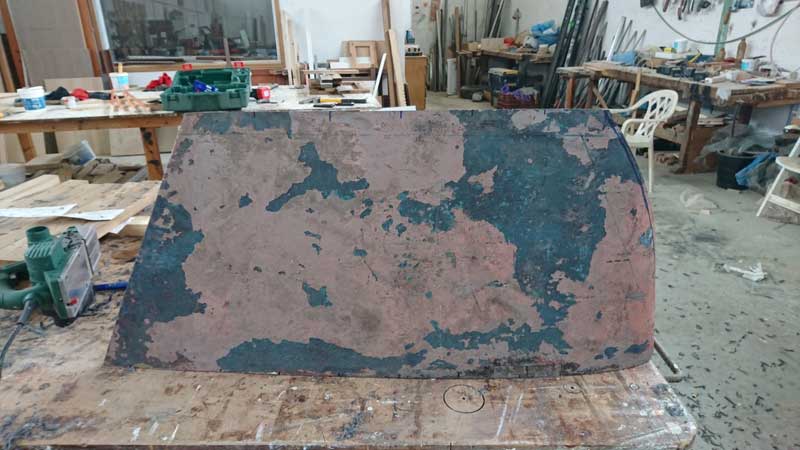
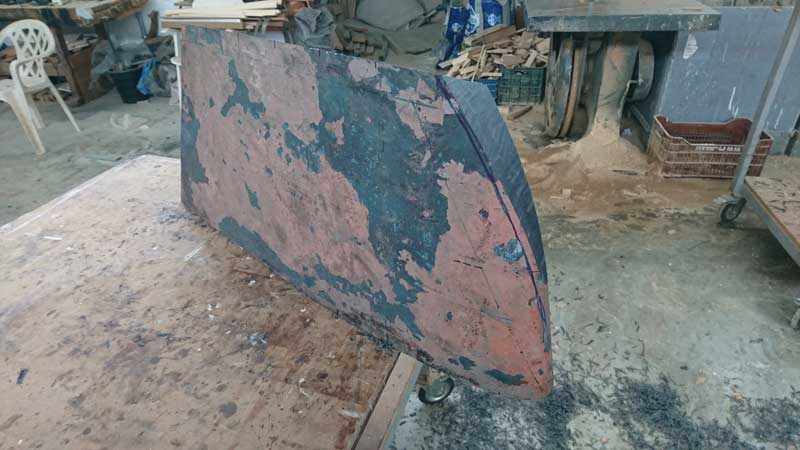
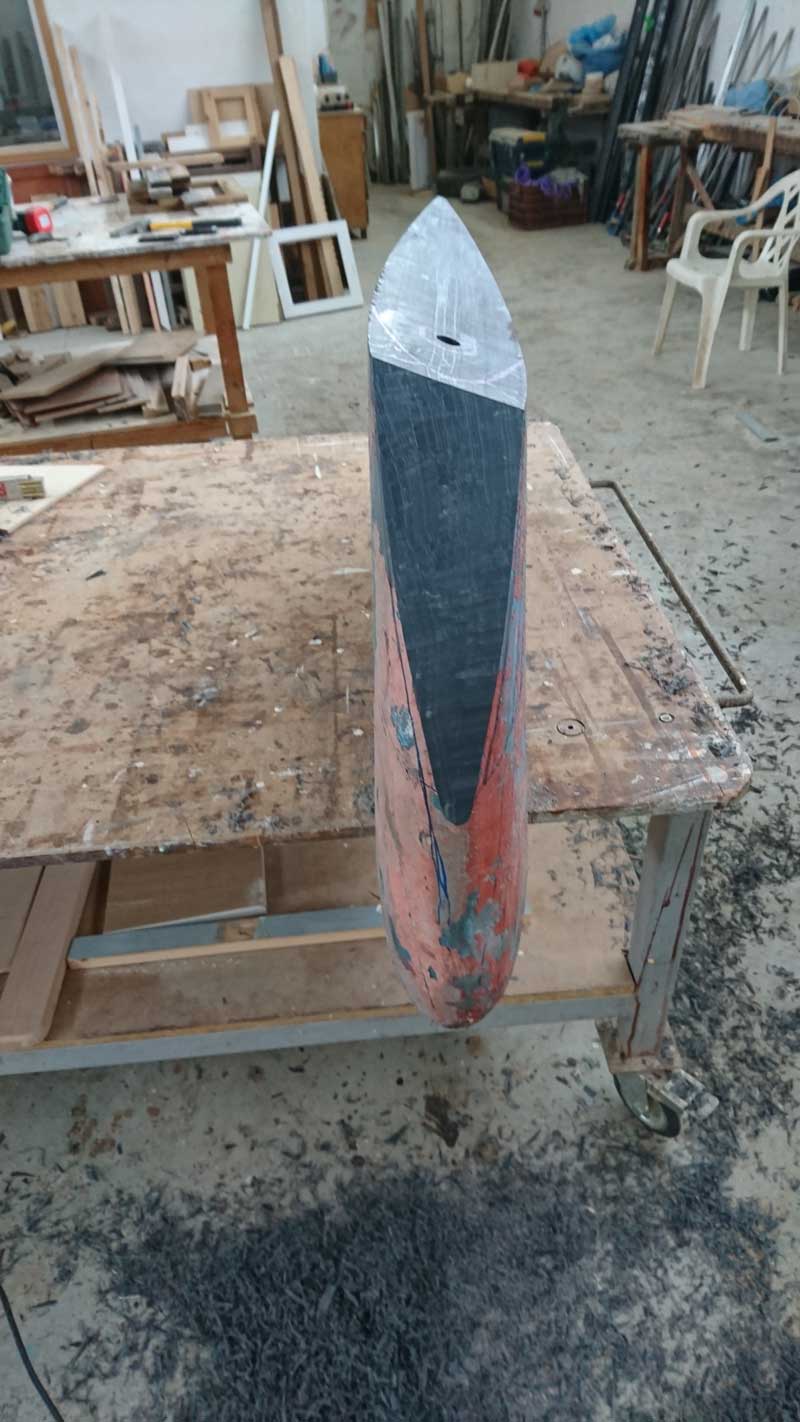
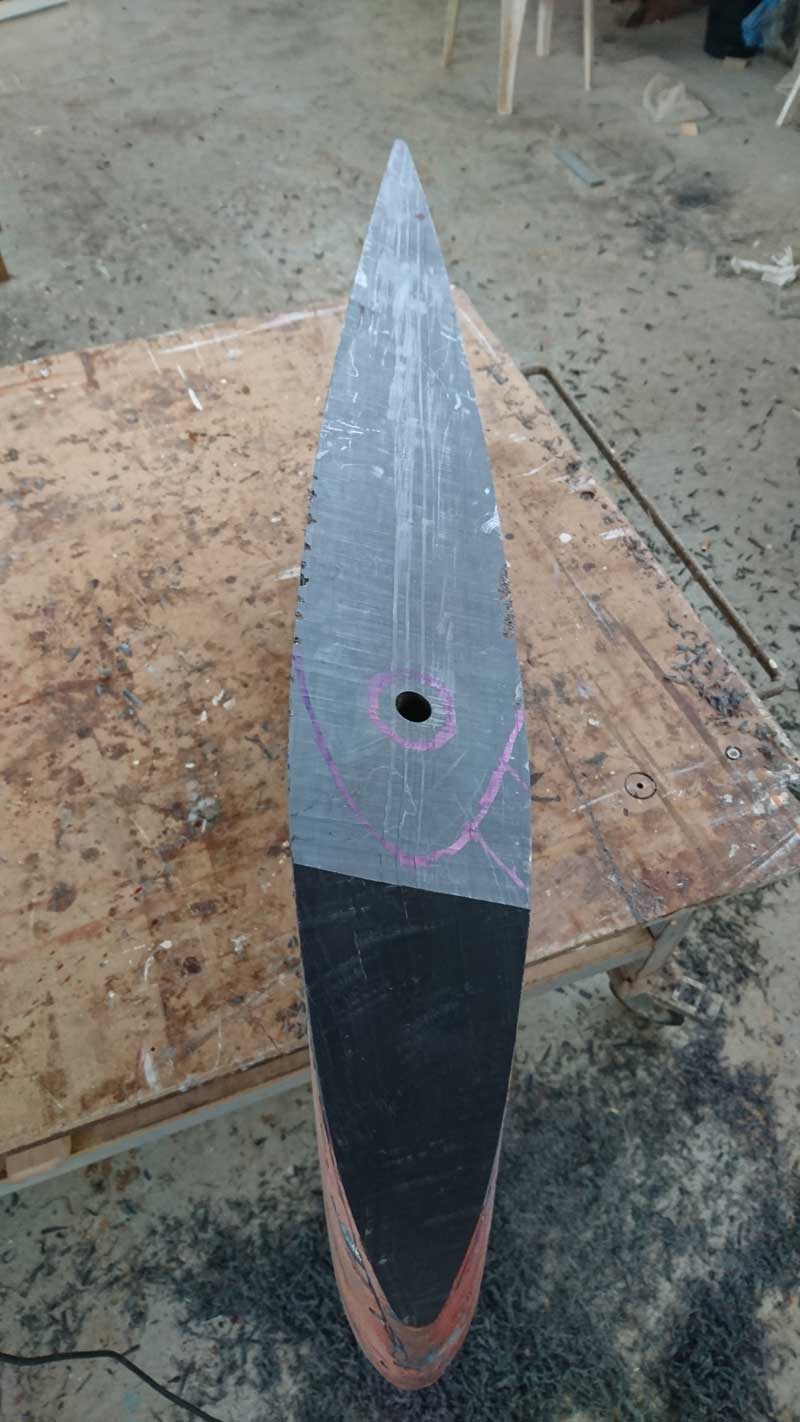
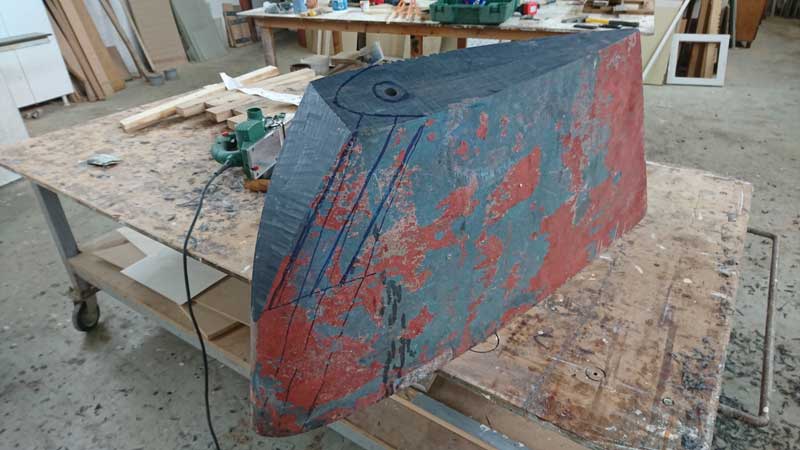
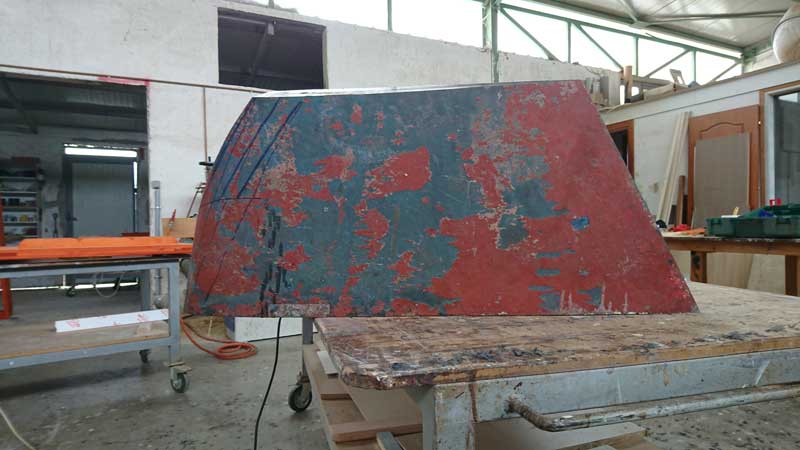
stbrd fin cut to size, matched the port one, so hopefully will be all symmetrical :p

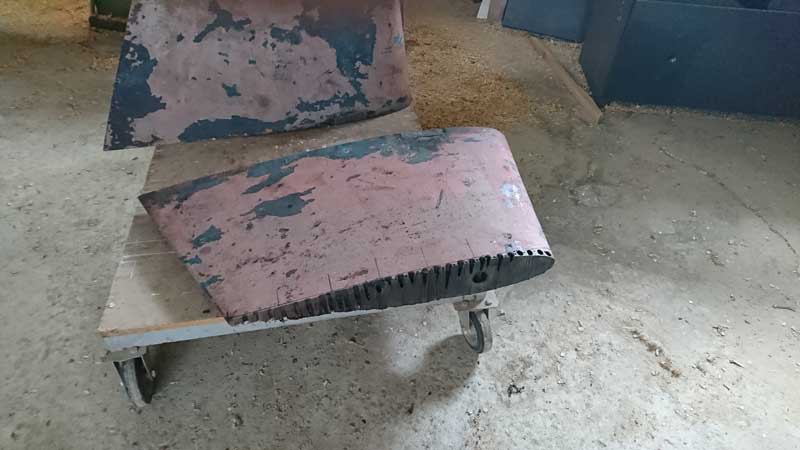
using a handheld electric plane, had a go at smoothing and curving the entry edge of the port fin. Went quite well, so tomorrow or on Monday I'll finish up the curve on this one (after making a matching curve on the stbrd one as well...)

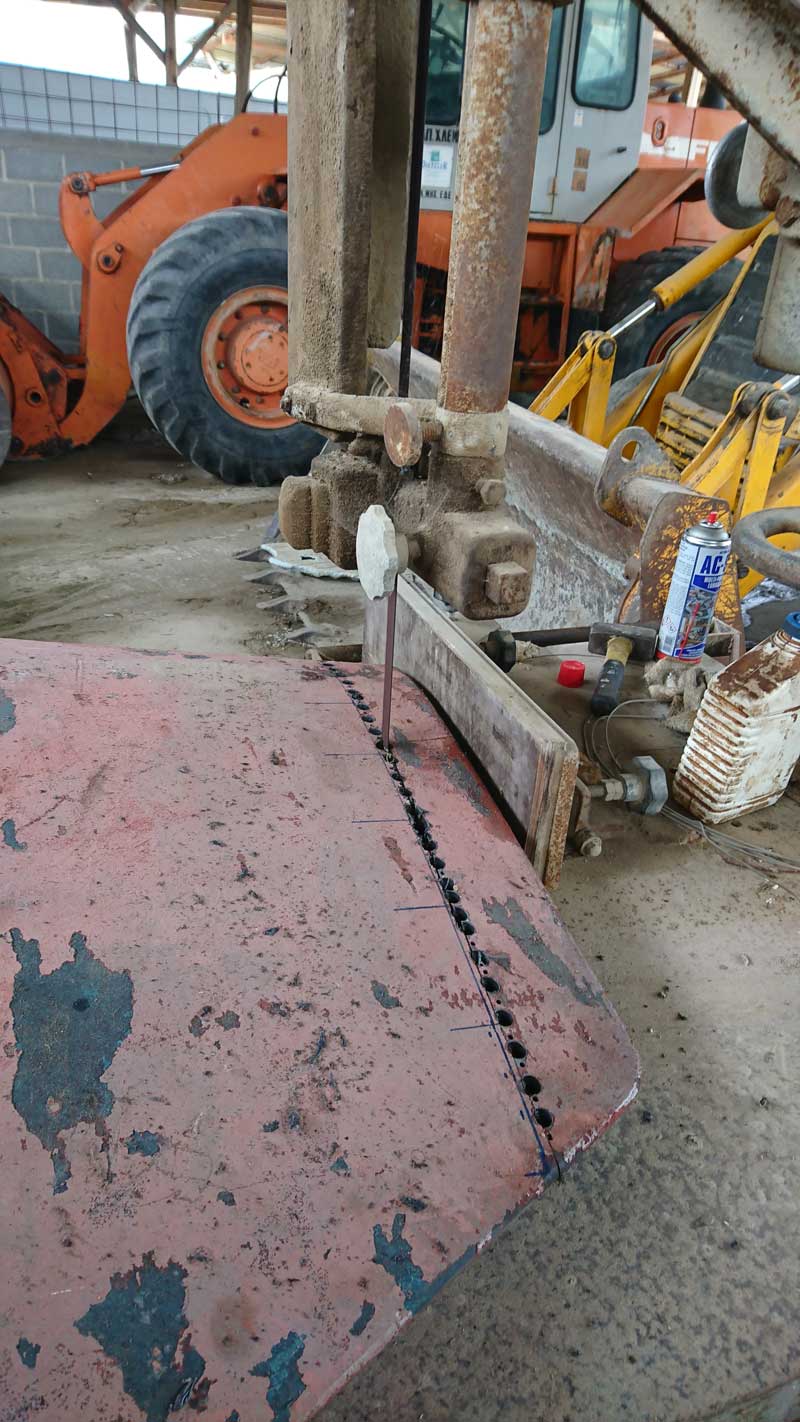
first did again the perforation using a bench drill this time, then on the old saw:
stabfin_design10.jpg


stabfin_design11.jpg


then the old plane (good thing that Dimitris has a large workshop with redundancy on tools :D ). Note the wooden block with the right slope to lead us to the right cut:
stabfin_design12.jpg


curved entry to the fin (roughly done within half an hour):
stabfin_design13.jpg


stabfin_design14.jpg


NOT finished, will be smoothed all round, but not before I get a matching curve on the stbrd as well!
stabfin_design15.jpg


stabfin_design16.jpg


lines more or less showing where the curving will start:
stabfin_design17.jpg


stabfin_design18.jpg


BTW, on the electronics front solid state relays that I bought on Wed from DE, arrived on Fri lunchtime, so tomorrow will do a first test of moving the fins using an arduino. Just a crude test of moving them about to establish that the relays are game. Basically, move both fins to stbrd for a sec, then wait for 3secs then move to port for a sec, and loop...
If I'm lucky, I should have a crude tilt sensor driven reaction during the week.
Working on deciphering the feedback angle sensors that look worn around their center position, so plan is to move them to an area that they give reliable results over the 50-60combined degrees and compensate on the code.

Regarding fins not moving when system is off, James says that's how he thinks they used to work, I guess the non-return valve is keeping a certain amount of pressure on the circuit and that's to blame. Will check this hypothesis once I find my WIKA gauge and manage to plumb it in (don't hold your breath and I'm NOT buying yet another WIKA, must have 3-4 around but on different missions and ranges...)

cheers

V.
 
Great stuff vas
As the bottom edge of the fins are flat and straight, why not add a winglet? Make from 12mm nylon sheet and attach w self tappers and 5200 polyurethane glue. I can post some close up pics of winglet shapes if you want.
 
Great stuff vas
As the bottom edge of the fins are flat and straight, why not add a winglet? Make from 12mm nylon sheet and attach w self tappers and 5200 polyurethane glue. I can post some close up pics of winglet shapes if you want.

J,

plan is to do winglets (that's why it's flat), was thinking a 6mm ply and mat epoxy to get up to 12-15mm, but your idea of a nylon sheet is better (as in easier ;) )
Not too happy with self tappers, ertalon is strong, so can machine threads easily. Was thinking of M6 and a few M8 properly threaded and countersunk on the winglet. Some of them can be as long as 80mm if not more!
Running out of time, so was thinking of adding it next year, will have a look around the local shops, if I find material I'll do it on Tue-Wed!
Re sizing the winglet, say full length by 250-350mm width? Seen pics of a few and that's what they look like.

cheers

V.
 
Running out of time, so was thinking of adding it next year
That's actually a nice opportunity, V.
This way, you'll be able to test how they work without winglets first.
In fact, while in principle it's rather obvious that winglets make sense for zero speed stabilization, I've always been a bit skeptical about the relevance of their contribution.
I would stretch the reasoning to suggest that if you should be already happy of the performance this year with no winglets, you might as well not bother fitting them at all.
Then again, I've always been skeptical also about the relevance of curved fins, but don't tell this to jfm ... :p :D
 
That's actually a nice opportunity, V.
This way, you'll be able to test how they work without winglets first.
In fact, while in principle it's rather obvious that winglets make sense for zero speed stabilization, I've always been a bit skeptical about the relevance of their contribution.
I would stretch the reasoning to suggest that if you should be already happy of the performance this year with no winglets, you might as well not bother fitting them at all.
Then again, I've always been skeptical also about the relevance of curved fins, but don't tell this to jfm ... :p :D

:D

unless I find the right material at the right price tomorrow, winglets are out for this year, to do list is too big as it stands to increase it further...

Anyway, happy to report that my crude and simple programming on moving the fins about using my favourite arduino (teensy 3.5) worked, so proof of concept passed!


Now got to program the feedback mechanism so that it moves UP TO the end of travel (and not hit that with a bang each time...) as well as being able to park the fin in centre position.

cheers

V.
 
:D

unless I find the right material at the right price tomorrow, winglets are out for this year, to do list is too big as it stands to increase it further...

Anyway, happy to report that my crude and simple programming on moving the fins about using my favourite arduino (teensy 3.5) worked, so proof of concept passed!


Now got to program the feedback mechanism so that it moves UP TO the end of travel (and not hit that with a bang each time...) as well as being able to park the fin in centre position.

cheers

V.

Mind.....Blown! :eek::ambivalence::encouragement: What kind of Architect are you Vas? I would also love to see your guys workshop, more so that metal plane he has, outstanding work!!!
 
Mind.....Blown! :eek::ambivalence::encouragement: What kind of Architect are you Vas? I would also love to see your guys workshop, more so that metal plane he has, outstanding work!!!

sorry, didn't reply earlier as I wanted to have some to report.
Type of architect? The rare down to earth variety, happy to work both manually and digitally who likes to design buildable things :p
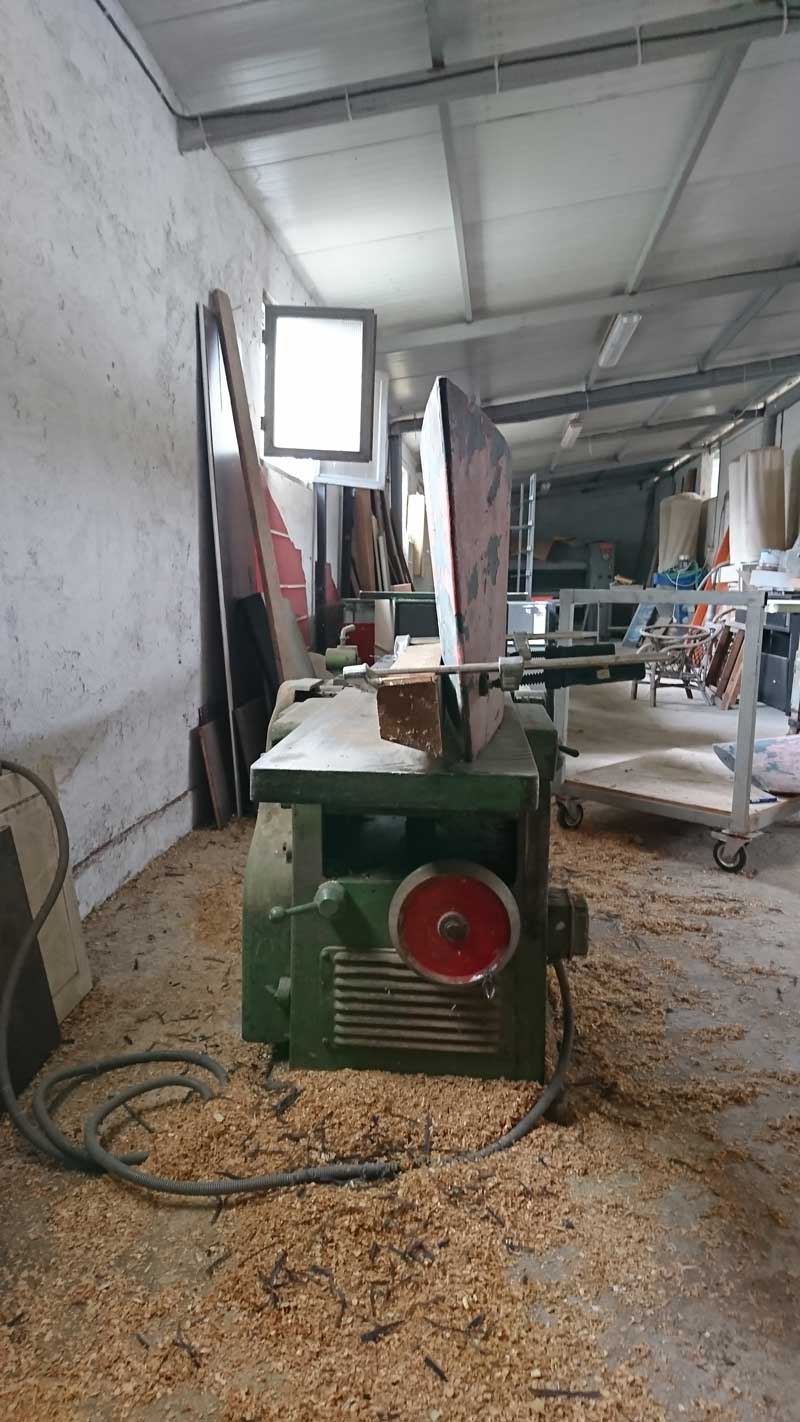
btw, Dimitris plane is a normal wood plane from the 60s that he uses for the rough cuts on old timber that may have a nail or two hidden somewhere...

Spent approx 8h on and off over the last week and I now have a fin centering routine, as well as move fin to such and such position working.
Also got the 3euro v.accurate (not kidding that's the prices of this stuff now...) gyro to work and I'm using the accelerometer atm only. It's enough to send the fins left or right accordingly.
NMEA2K connection for power as well as data retrieval is also on, so I now have speed over ground, wind and all sorts of other useless info on the arduino. Speed is going to be useful, not sure which of the rest of the data on the NMEA bus is going to be of any use.
Probably going to spend another 8h getting the various connectors around the alloy box with the arduino and soldering 20odd cables on the board.

Last important issue to solve is integrating a 7inch el cheapo touch screen so that I can give instructions to the thing as well as get feedback (fin position, oil temp, oil pressure, etc) Cable length from arduino board to screen on lower helm will be around 4m so looking for options :(

weather will be awful till Thu, busy at work tomorrow, so Tue should have that lot tested on the spot and probably up another video with them working.

cheers

V.
 
Top