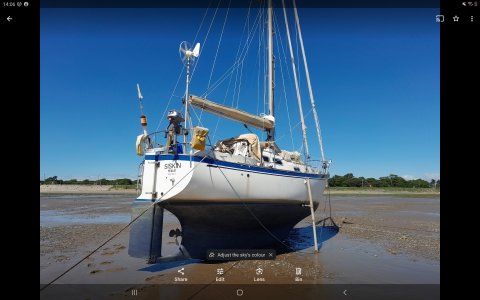
how do you beach a twin keel ?

petibonvm

Active Member
Joined
28 Nov 2023
Messages
56
Visit site
how do you beach a twin keel on a beach ? go up to touch, lower the front anchor go with the dinghy cast the rear anchor.

Thank you for your advice
 
No one way as it depends on such factors as tide, wind type of seabed. Key things are to ensure the seabed is suitable and that you time your landing such that the next tide will have enough rise for you to float off.
 
how do you beach a twin keel on a beach ? go up to touch, lower the front anchor go with the dinghy cast the rear anchor.

Thank you for your advice
Make sure you have surveyed your spot with the tide out in advance then motor towards shore until the keels dig in and leave the engine running to hold the boat in position until the tide goes out enough to be sure that you won't be turned around by the wind or the tide. Ive never needed to use an anchor.
 
As Mister E says, assuming it's a sandy beach, wait until an hour after HW, then gently motor the boat up the beach until it grounds. Keep the motor on in tickover forwards for 10 minutes and the tide will have gone out far enough that you will be stuck. Then once you can get off, dig your anchors in and go to the pub.

Make sure you put a stern anchor out, otherwise when the tide comes in, it will push the boat up the beach and you won't get off.
 
As a long time owner of Bilge keel boats ... At High Tide time - I do not motor in till keels touch and let boat settle there. I back off till boat is afloat again ... drop bow anchor ... keep engine on low so boat is held between anchor and engine ... let tide settle boat. Stop engine when keels are on bottom ...

Why ? I do not wish to be stranded because of high pressure weather or other reasons of reduced high tide when wanting to depart. If tide has reduced a bit ... ie I am later than High Tide - then OK .. touch keels and stop .. but at HT time - no - back off giving you that bit of water extra just in case.
 
Planning the departure time is key for me. I want to be able to leave at my convenience to match my ongoing schedule. I choose where to ground by having sufficient depth at departure time, not where I would grounding at 1hr after high water.

Bear in mind that there can be significant differences in the height of two consecutive tides, the tides 24hr apart can be more similar than consecutive ones.
I sail the SW Celtic fringes where the tidal ranges are much bigger than the South and East coast or even West coast of Scotland and the difference in consecutive AM and PM HWs can be double the diffference in AM to AM or PM to PM HWs.
 
Only done it in a long keel with legs , same principle. I like to set an anchor down hill in the direction of my exit so once I start to float I can quickly pull myself into deeper water . Prevents any bouncy bouncy on the flood
 

Attachments

  • Screenshot_20250127-140644_Photos.jpg
    Screenshot_20250127-140644_Photos.jpg
    961.9 KB · Views: 23
As a long time owner of Bilge keel boats ... At High Tide time - I do not motor in till keels touch and let boat settle there. I back off till boat is afloat again ... drop bow anchor ... keep engine on low so boat is held between anchor and engine ... let tide settle boat. Stop engine when keels are on bottom ...

Why ? I do not wish to be stranded because of high pressure weather or other reasons of reduced high tide when wanting to depart. If tide has reduced a bit ... ie I am later than High Tide - then OK .. touch keels and stop .. but at HT time - no - back off giving you that bit of water extra just in case.
We too like more than an hours worth of tide fall, therefore potential rise, before we ground. The fear of being neaped is strong🤣
Often we’ll drop the kedge at a crucially judged distance off, pay out til we touch. Then I’ll hop off the bow with the main anchor, bed it in on the beach, and haul us properly afloat with the kedge. Maybe not with deeper draught…
 
Won't disagree with many good posts. I preferred to beach our lift keeler at half tide.
At half tide in our area the tide goes at at an inch every minute. This means your boat dries rapidly in your intended place.
I preffered to reverse into position laying a bow anchor during or after beaching.
These precautions will protect you on the incoming tide as your boat floats free rapidly to the safety of your anchor in deep water and away from any potentially damaging breaking waves.
 
how do you beach a twin keel on a beach ? go up to touch, lower the front anchor go with the dinghy cast the rear anchor.
First, what you describe is beaching (which is different from drying out). The way I do it is to drop the stern anchor first which allows it to dig in as I approach the beach and keeps my stern pointing out to sea so the boat can't broach. Once I have landed, I drop my bow anchor, go ashore and walk the anchor up the beach a bit. This way, you don't need to use a dinghy.
 
Most of our mooring holders who lay up at our club are bilge keelers. There is no point in messing about with anchors etc. Just makes things difficult
The hard is concrete anyway & if we want to secure a boat we lay a sinker & tie to that
Just motor the boat gently to the hard about 1 hour after HW so tide has started to fall significantly so boat is not left bouncing waiting for the drop.
As the keels touch as square as possible open the throttle a bit to get it to bite & hold the boat there on the engine until secure. No need for anchors etc.
When leaving wait until the engine inlet is well under water & put it on tickover once there is indication that the boat is begining to rock. Open up the revs as she moves & the boat will bounce off with any small swell. No need for anchors etc. We have found that wasting time pulling in ropes etc cause delay & can cause hassle & cause the boat to swing sideways to the shore thus making departure difficult. The anchor does not always bite if not properly set having just been dropped overboard anyway.

It is better to be on the boat in plenty of time. Our harbour master, of all people, likes to cut things fine & twice now has disappeared for lunch,only to come back to find his boat drifting down river. It has caused some mirth to see him chasing after it in his dinghy 300 yds down river following a phone call from club members.
 
Last edited:
I preffered to reverse into position laying a bow anchor during or after beaching.
On the boats I've had, the skeg would get bounced going in astern, so always bow in for me, though that has meant we sleep heads to the bow in the V-berth.

On a falling tide, having made sure the next HW will allow me off*, I'll drop a stern kedge, and motor forward as slowly as the wind allows until we touch. Leave it in gear until we're well aground and pull the kedge line to dig the anchor in. Chill until I can get off with dry feet, walk the bow anchor out and dig it in by hand.

Before leaving, while still dry, take in the bow anchor and get ready. As the stern starts to lift, start the engine and go dead slow astern. When the boat starts to move, back into neutral (don't want the kedge line round the prop), and pull on the kedge line to bring the boat out. Retrieve the kedge, and off we go.


* A cautionary tale: Some years ago, a large yacht needed a spring tide to get on the Hardway scrubbing grid. Unfortunately, it was the top of springs, and the next tide wasn't as high. He was stuck there for a month, and much piss was taken. Fortunately, the next spring tide was a bit higher, and he was able to get off, but he never used the grid again
 
On the boats I've had, the skeg would get bounced going in astern, so always bow in for me, though that has meant we sleep heads to the bow in the V-berth.

On a falling tide, having made sure the next HW will allow me off*, I'll drop a stern kedge, and motor forward as slowly as the wind allows until we touch. Leave it in gear until we're well aground and pull the kedge line to dig the anchor in. Chill until I can get off with dry feet, walk the bow anchor out and dig it in by hand.

Before leaving, while still dry, take in the bow anchor and get ready. As the stern starts to lift, start the engine and go dead slow astern. When the boat starts to move, back into neutral (don't want the kedge line round the prop), and pull on the kedge line to bring the boat out. Retrieve the kedge, and off we go.


* A cautionary tale: Some years ago, a large yacht needed a spring tide to get on the Hardway scrubbing grid. Unfortunately, it was the top of springs, and the next tide wasn't as high. He was stuck there for a month, and much piss was taken. Fortunately, the next spring tide was a bit higher, and he was able to get off, but he never used the grid again
Can't get my head around the purpose of your bow anchor. If it never gets wet or am I reading it wrong
 
Make sure you have a means of getting off (and more importantly back on) the boat. Even my 20 foot Vivacity was too high to easily get back on without a ladder or something to step on. It's a very dull wait if you can't get off of the boat!
 
Can't get my head around the purpose of your bow anchor. If it never gets wet or am I reading it wrong
It's only needed if you're staying more than one tide.

Thinking about the beach in Bembridge Harbour, I'd want to take the rising tide towards the harbour and arrive a bit after HW. I'd beach as above but, staying overnight, I quite hope I'll be asleep at the next HW, and I don't want to go floating off, only anchored by the stern kedge. The bow anchor holds us straight while we're afloat.
 
Won't disagree with many good posts. I preferred to beach our lift keeler at half tide.
At half tide in our area the tide goes at at an inch every minute. This means your boat dries rapidly in your intended place.
I preffered to reverse into position laying a bow anchor during or after beaching.
These precautions will protect you on the incoming tide as your boat floats free rapidly to the safety of your anchor in deep water and away from any potentially damaging breaking waves.

Depends on the boat ... my bilge keel Sunrider - the rudder extends past the transom and would be vulnerable going stern in ....

My Snapdragon and Alacrity had external transom hung rudders - again same ... not good going stern in ..
 
And if in doubt its the seaward anchor that should be the big one. A small stern kedge may not be enough to prevent swell from bouncing one up the beach on the rise - found out the hardway in Barry Old Harbour where I wrong assumed the ground was Bristol Channel Anything Will Dig In Mud. We still enjoyed our earlier ice cream ashore however

Next time I walked my new generation anchor round to the stern once dried
 
Top