Beginning to think we need a bigger boat

Basically it is all down to good luck or bad luck. Small open boats have made it round the world yet the Titanic did not make it even once across the Atlantic.

For pure happiness and safety everyone should buy a Prout 37 Snowgoose elite with four truly watertight bulkheads to protect the bows and stern gear. No keel to fall off. Etc. When this simple fact percalates through the fluff they will treble in price offered. I say this not because I already own one.
 
Basically it is all down to good luck or bad luck. Small open boats have made it round the world yet the Titanic did not make it even once across the Atlantic.

For pure happiness and safety everyone should buy a Prout 37 Snowgoose elite with four truly watertight bulkheads to protect the bows and stern gear. No keel to fall off. Etc. When this simple fact percalates through the fluff they will treble in price offered. I say this not because I already own one.
Just a thought. Some Cats used to be seen with a cotton reel float atop the mast. Not seen now. Did they turn out to be ineffective or unnecessary ?
 
Ѓ
Just a thought. Some Cats used to be seen with a cotton reel float atop the mast. Not seen now. Did they turn out to be ineffective or unnecessary ?
Well, my post was made with tongue-in-cheek. Solving one problem can create another. The example of masthead floats demonstrates that because the windage from a masthead float actually made the risk of capsize much greater. Donald Crowhurst came up with the solution with a design that was automatically inflated when his tri passed a certain angle. Trouble was it was too complicated.

The desire for a bigger boat has the same inherent problem and it runs the risk that a bigger boat may create a particular problem that is unacceptable to the new owner. There is a lot of truth in the simple aphorism that a bigger boat has bigger problems. Nothing wrong with that. It may be necessary to get a bigger boat for an anticipated project. Threads like this are good fun and can actually solidify the OPs target boat with less risk of getting stuck with a "lemon",

My problem is the exact opposite because I am always eyeing smaller boats. But a smaller boat will prevent me doing what I can with the present boat. Such is life.
 
So we have kind of covered the aft cockpit boats but thinking about CC we have Westerly Corsair and Oceanranger already mentioned, Moody 36, Countess 37 and Bavaria Ocean 38. The layout seems pretty similar on all of them. Countess 37 is a cutter which may help I guess and I have seen a deck saloon version which felt very spacious. Was there a version of Bavaria Ocean 38 with two heads? Any thoughts on how they all compare ?
 
I have seen lots of these which boat threads. It goes two ways

Someone asks for suggestions for a newish, cruising boat, for coastal trips with lots of room for family. He gets loads of suggestions for this boat and that. A few nut jobs or trolls might suggest a Folkboat or two but there is generally no controversy.

On the other hand someone asks for suggestions around this sort of thing:

" - rather heavier than lighter
- rather more ballast than less
- Headroom of 1.85m in the saloon and the galley
- No teak
- at least 2 separate cabins
- Shaft rather than sail drive "


Almost immediately unsuitable boats are suggested that don't meet the even the spirit of the criteria. The underlying sense is that the OP priorities are wrong, and if he only saw sense he would buy something approved by the forum claque.

The same people, owners of inshore family boats or designs which were largely specified for chartering in the Mediterranean Sea, then get upset when their ideas are dismissed. They end up dreadfully hurt and start claims for victimisation on the grounds that their favourites are faster, lighter, heavier, stronger and really just as suited to breaking ice as anything else.
And so it goes.

.
 
Last edited:
So are they or are they not ? ;)
Not necessarily in isolation but in relation to your planned cruising the list of characteristics leads to a narrower range of boats than is potentially suitable for the job. Many suggestions, supported by plenty of evidence suggests you can cast your net wider. There are some of course that believe that only a certain type of boat is suitable, but often those have no direct ownership experience of alternatives.

The thread has covered a fair spread of views which may either help or confuse you, although I suspect the former.

No the ocean 38 and 40 do not have a 2 head option. When you get inside one you will see why as the pay off is a much larger heads and shower plus a bigger galley. There are some boats of this size/type that do cram in 2 heads, but most end up cramped, particularly the second head and some owners actually remove one and turn the space into storage or even installing a washing machine.
 
Just an observation as a former Bavaria owner -if looking at a 36 from early 2005 ish just see if you can live with wheel size and stepping up on seat to get round wheel -I hated it having chartered one a few times-it might not be an issue for the earlier 37 etc and wasn’t on our 34 but it just seemed a bit of a pain to me when reversing having got used to steering backwards from forward side of pedestal. If you are looking at early Bav make sure as said the engine is larger for size ideally - I regretted not having a 29hp on our 34 . Other things are do check it has a shower in heads plus installed windlass -Bav had a long extras list so many early boats might be missing some options - again a personal choice perhaps depending on agility and preference but I would avoid in mast furling on a 36 -clearly if you go for a ocean 40 it might not be a choice given numbers. Also on all boats this age be wary of those Bav teak decks if you find one so fitted . It’s really hard to compare unless say you have raced or sailed in company -our Bav left a similar size Hallberg standing until it was a force 5ish -I could live with a quicker boat for size in lighter airs -others might be sailing more often in F5 plus I guess .
I wasn’t a great fan of centre cockpits but as yet get older maybe they grow on you -perhaps not so good if loads of small crew who each grow up and want own cabins though as they age.
 
Just an observation as a former Bavaria owner -if looking at a 36 from early 2005 ish just see if you can live with wheel size and stepping up on seat to get round wheel -I hated it having chartered one a few times-it might not be an issue for the earlier 37 etc and wasn’t on our 34 but it just seemed a bit of a pain to me when reversing having got used to steering backwards from forward side of pedestal. If you are looking at early Bav make sure as said the engine is larger for size ideally - I regretted not having a 29hp on our 34 . Other things are do check it has a shower in heads plus installed windlass -Bav had a long extras list so many early boats might be missing some options - again a personal choice perhaps depending on agility and preference but I would avoid in mast furling on a 36 -clearly if you go for a ocean 40 it might not be a choice given numbers. Also on all boats this age be wary of those Bav teak decks if you find one so fitted . It’s really hard to compare unless say you have raced or sailed in company -our Bav left a similar size Hallberg standing until it was a force 5ish -I could live with a quicker boat for size in lighter airs -others might be sailing more often in F5 plus I guess .
I wasn’t a great fan of centre cockpits but as yet get older maybe they grow on you -perhaps not so good if loads of small crew who each grow up and want own cabins though as they age.
I often sailed in company with a friend in my HR34 and his Bav34. The Bav (early 2000s) was a good foot longer and more on the waterline and so was a bit faster off the wind but I could leave him behind going to windward in any wind.
 
I would look at a deck saloon or pilot house. There’s much talk of the crew being the weak point compared to the boat in a blow. Being able to duck below for some respite can only be a good thing - maybe a lifesaver if it saves you getting cold, hungry and making bad decisions. I think such a boat would feel instinctively reassuring.
 
I am not too convinced either but the aft cabin is tempting


I couldn't see any deck saloon yachts in that size range other than Colvic Countess 37 ? I like Moody Eclipse but it is a bit too small.
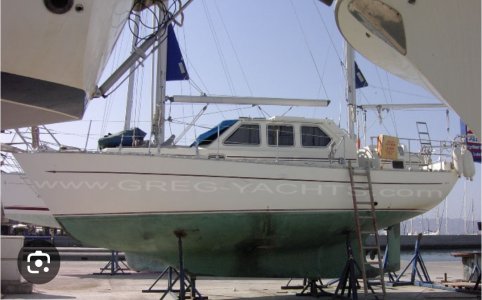
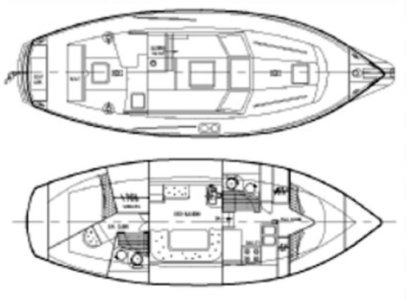
I went for one of these. It's probably too much towards motorsailer but is rewarding to sail except to windward below F3. Deck saloon is a real asset at anchor, for watch keeping and navigation and for shelter. If I hadn't found this, I would have looked at LM, Fisher or Westerly/Moody with a large sprayhood/windscreen. Beneteau 36 or 40 CC is another nice centre cockpit.
Screenshot_20231222_142810_Google.jpgScreenshot_20231222_142855_Google.jpg
 
I couldn't see any deck saloon yachts in that size range other than Colvic Countess 37 ? I like Moody Eclipse but it is a bit too small.
Ah, that's the problem. Couldn't think of anything either, sorry (Eclipse 38 - few about, Nauticat 331 - expensive). There must be a big downside to them if they're such rare beasts. Don't know what it is though (expensive, slow maybe) - seem such a logical thing to me.

Maybe most of the boat sales volume goes to sunny climes and it's not economically viable to support small scale northern niche markets.
 
For the OP: Buying a boat is a minefield, and you will basically have to navigate two camps who will always give conflicting advice, but I guess you know that by now ....

Camp1, the traditionalists. These people will generally advise that a boat must be heavy, strongly built, conservative in both looks and hull shape, that an encapsulated keel (ballast enclosed in fiberglass and moulded in the hull) is preferable to a bolted on keel, skeg for the rudder protection, center cockpit for "safety", shaft rather than saildrive, slab reefing rather than roller. Some might compromise on a few of these points but that pretty much sums up the view of this type of forum member. Phrases like "good in a seaway" and "row away factor" crop up a lot. Their perceived use-case dates back to pre-internet so 1970s to mid 1990s - inadequate weather forecasts, no GPS, paper based navigation - willing to sacrifice comfort and convenience for perceived seaworthiness. Preferred boats are usually boats over 20 years old, Moody, Westerly, Older HRs or Najad, Contest, Contessa, Nicholson - or eye-wateringly expensive modern boats built for the top end of the cruising market with conservative styling and design.

Camp2, the pragmatists. These people will generally advise that modern production boats are perfectly capable of delivering years of safe and comfortable cruising. These people are generally leisure sailors who enjoy messing about on boats and want the boat to be a cost-effective holiday home for either short or long term use. Not bothered about tradition, happy to do an Atlantic circuit on a production boat. Tend not to favour older boats because on the whole they are outdated, both in design and equipment - modern boats are generally spacious, with creature comforts, and due to their age tend to have fewer hidden problems than lead to expensive repairs and time on the hard. Pragmatists will advise that production boats from Bavaria, Jeanneau, Beneteau, Dufour, Hanse etc. are all fine and will be more than capable of giving years of sterling service.

The two camps will never agree.

Basically, work out how you feel yourself, what type of sailing you will be doing, and where.

If you feel happier in a more traditional style boat then get one - it might take a while to find one in really good condition, but they are out there as even the most fastidious owners die or give up due to poor health. If you prefer clean, new and contemporary, then get a modern boat.
If sailing in tidal waters in northern Europe then you won't get much use out of a swim-platform with swim ladder, or a sun-pad on the foredeck. When sailing in Scotland I avoid getting wet at all costs, all year round. In the Med I sail in shorts and T-Shirt most of the year and jumping off the swim platform is the first thing I do after the anchor has set - in winter it can be just as grim as up north.
In northern climes a comfortable, protected place for crew to sit outside is very important as cleaning vomit off the upholstery is no fun - so hard dodger, big sprayhood with additional protection is a good idea.
Do you sail with family or like minded crew? Northern climes, well actually anywhere - big motor a plus ... thrashing to windward under sail might be fun for the skipper but subject an unwilling crew or family to it too often and you'll be single handing before you know it. Big motor is even more important on modern boats as they tend to have more windage, and in tidal areas due to tidal races.
Do you entertain? If you are the life and soul of the party, then modern boats have more space, but for a smaller group, traditional works fine - as a kid we crammed 9 of us in a Westerly Centaur.
How do you feel about safety? Safety IMO has more to do with deck layout and sail controls than hull shape. By deck layout I mean size of toe-rails, placement of winches, storage of ropes when under sail, height of boom, controls in cockpit or at the mast, entry in and out of the dinghy, trip hazards, handholds on deck, comfortable cockpit - as an example, having slab reefing at the mast and lots of cabin-top windows means you're up on the highest point of the boat, standing on a slippery surface in bad weather, but lots of cabin top windows with roller furling from the cockpit means you aren't on deck at all - same boat, but layout and type of sail controls makes the difference.

Basically, get out there looking at as many different boats as you can, old and new - you will eventually find the one that feels right for you and then you'll spend a good few years adapting to it's strengths and weaknesses. The next boat after that will be much easier to decide on.
 
Top