kashurst
Well-Known Member
Have you ever seen the wiring in some Med Marinas? Plugging in is always an "adventure"Jake, the two 16 amp plug scenario cannot really happen in a marina as the post on the pontoon must be from the same phase.

Have you ever seen the wiring in some Med Marinas? Plugging in is always an "adventure"Jake, the two 16 amp plug scenario cannot really happen in a marina as the post on the pontoon must be from the same phase.

But marinas only have one outlet per berth. So knowing this why do builders do it ….double inlet ?No, perfectly safe to have two 16a inlets on a boat, provided both are for independent systems.
The dangerous ones being talked about are cables that have 2 x 16a inlets to a single 32a outlet.

These are the guys who built my boat if you care to ask themBut marinas only have one outlet per berth. So knowing this why do builders do it ….double inlet ?
Still waiting for a logical , workable in every day use and safe (if you like ? ) answer as to why ?


A lot of UK marinas don’t have 32A outlets.But marinas only have one outlet per berth. So knowing this why do builders do it ….double inlet ?
Still waiting for a logical , workable in every day use and safe (if you like ? ) answer as to why ?


My money is on #3.Solved at #5, your welcome.

By the shore supply breaker (aka OCPD), actually.Any overload is protected by the shore supply RCD.

OK - point taken but I think you got my point.By the shore supply breaker (aka OCPD), actually.
Sometimes bundled in a single component that does both functions, but the RCD as such is not affected by load, as long as there's no current dispersion.
[/pedantic mode]...
If I agree with you we would both be wrong.My money is on #3.
I'll let you know in a couple of weeks when I'm onboard.If I agree with you we would both be wrong.


The issue is not fitting a single phase plug in to a three phase socket or vice versa, it's what happens if the single phase sockets on the pedestal are on different phases.""how would you check if there were two (or three) phases on your pontoon box.""
Single and multi phase plugs and sockets are different and will not fit into each other.
Other that waiting for the bang, how would you check if there were two (or three) phases on your pontoon box. The phase split could be done between different boxes on the pontoon.
I’m assuming a 2 to 1 blue plug and socket.
I remember buying (on @Hurricane recommendation) a very useful testing plug but I don’t think that can recognise a particular phase, just polarity and other stuff I assume.
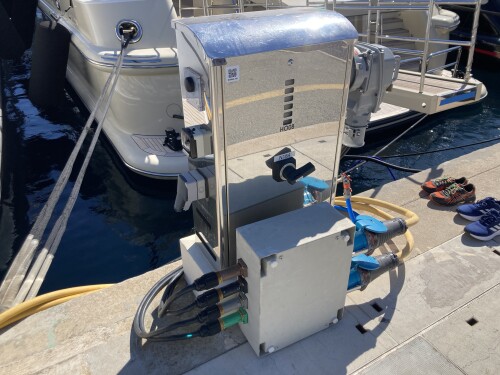
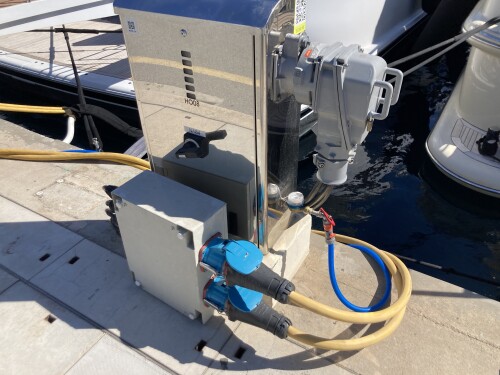
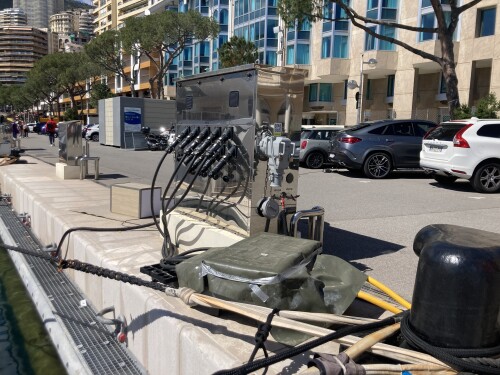


Is the electricity included in the berthing fee...or is it metered separately ?Being a total nerd I couldn't help but looking at how the superyachts in Monaco were plugged in yesterday (much to my gf's annoyance)
You know you've made it when your boat requires 660A powerlocks to light it up
In this photo you can see three phase and earth powerlocks being fed into a converter box which is changing it into 2 x 125A three phase and earth ceeform style sockets.
Presumably the boat has two totally separate systems internally for situations when the biggest socket it can find is 125A.
Note how there is no neutral, so they must have big transformers on board to drop it down to 230V / 110V for domestic style appliances.
But then you look across at your neighbour and realise he's made it even bigger time than you, as his boat requires these monsters. Anyone know what sort of connectors they are?
Nothing that you’d notice. It’s just something people get in a tizzy about.The issue is not fitting a single phase plug in to a three phase socket or vice versa, it's what happens if the single phase sockets on the pedestal are on different phases.
