vas
Well-Known Member
belated reply, too busy doing all sorts of other things as well as eating and drinking...
in the meantime I tried a combo of algorithms to smooth this midpoint curve and the results I'm showing below are much better, so looks like I'm ok for the time being.
Now new set of pics taken on the lovely evening of the 23rd, too bloody cold now to do more testing let alone the fact that I've not improved anything since then and yanmar 2GM20F decided it had enough, so about to take it apart next week onwards, so no testing for a month I recon unless I bother to connect to the shore power and test it.
First graph shows fins on, boat rolling v.little (just before the liner wake hits MiToS):
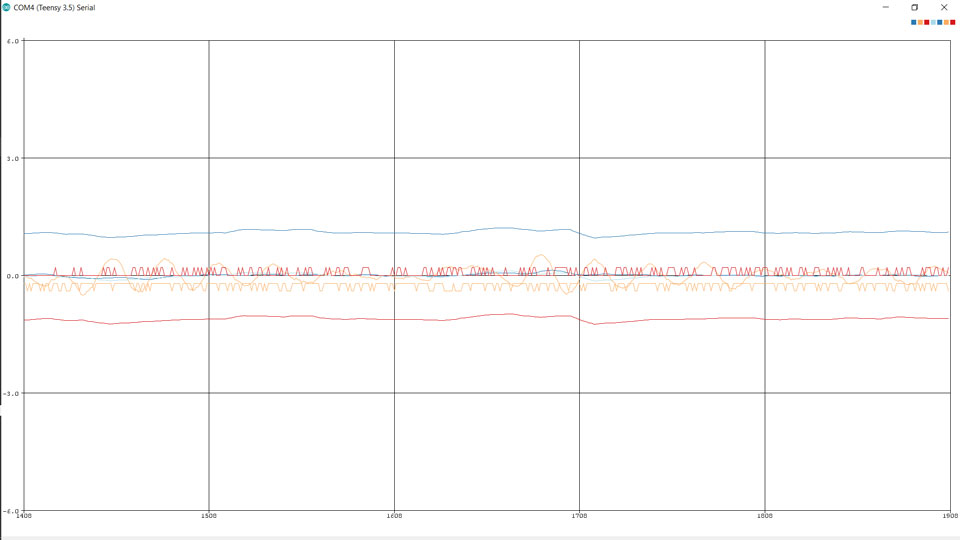
preliminary wave comes, fins start moving. Note we have three parallel lines running, that's the midpoint/average call it as you like of the roll accell value, and the shifted up and down curve. Once roll accell peaks reach outside these two limits, fins are triggered and move (on the next half roll as this calc is a trigger point and and fins cannot move before the next loop check. Note I started with smallish fin movement and then I manually uped it up to max where I did most testing on the day iirc.
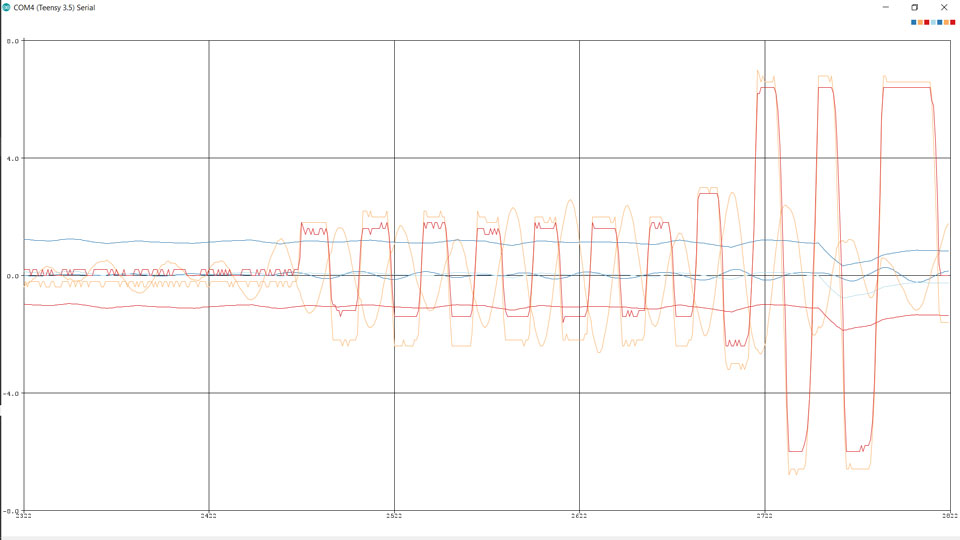
That's the MAX wake, would be a 10-11 in my scale now you see that although fins don't miss a beat and get to work as soon as they can (well according to my programming at least...) roll accel goes to 7+ before dropping to a 3.0 in around 7 fin manic flapping period
I'd really like the fins to be able to keep roll accel to 4 at max and then drop to 2-.
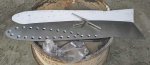
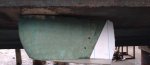
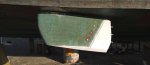
Could be the size of fins, the pressure and hydraulic routing to blame. I'll do the hydraulics again, up pressure and test before deciding that I need to up the fin size (which is a possibility), or add winglets and increase the aft section of them, we shall see.
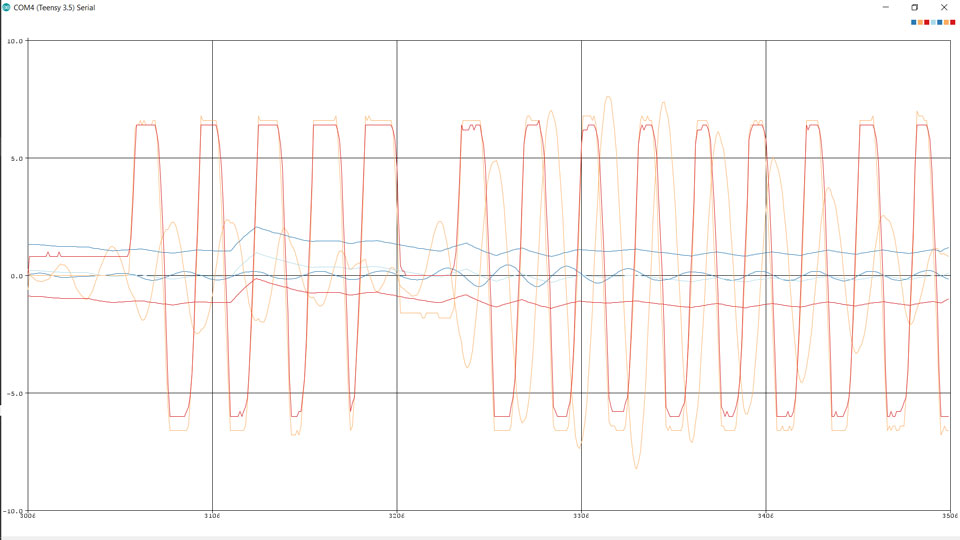
now roll is vastly reduced, fins are on or off and on again. Note that I had another clear mind moment and realised that I can simply bring the fins back to centre when roll accel is less than 1.5 and still only do it at the right time to balance even that little roll, not whenever roll drops below the limits. This worked absolutely fine, with fins coming to midpoint rest without overshooting roll correction and more often than not staying like that for a few periods. That's instrumental on getting a reasonable system while on the way.
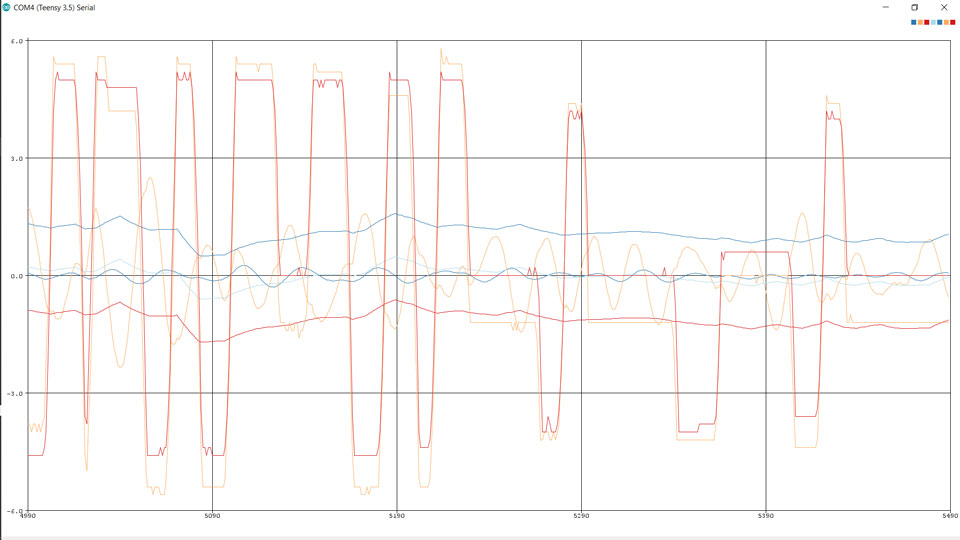
some testing with varying amplitudes, not bad, simple fact, at rest you MOSTLY move the fins as far as they go
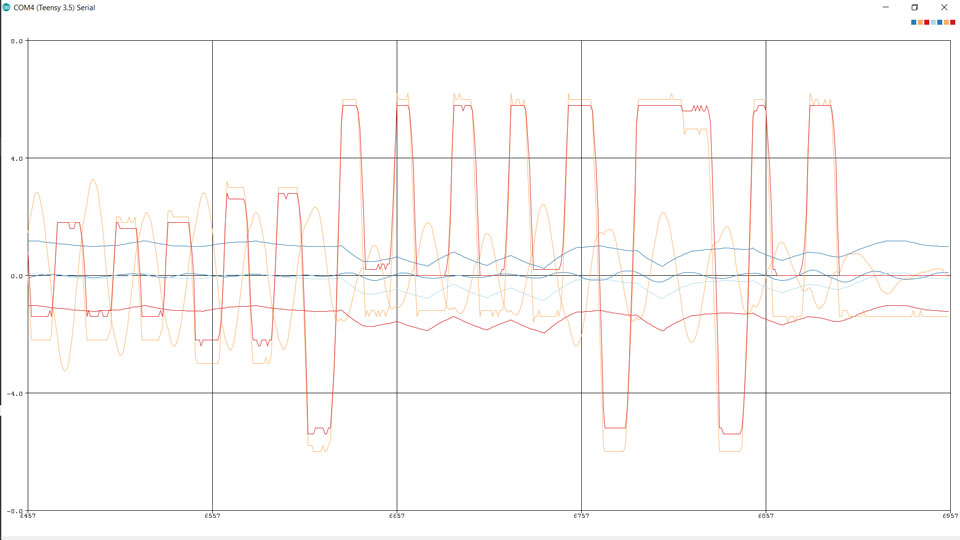
and now fins off, boat rolling (actually bloody generator died on me and yanmar wouldn't fire again )
)

Now took the very strong roll calculations image, brought it in AutoCAD and scaled it properly to measure time on the X axis:
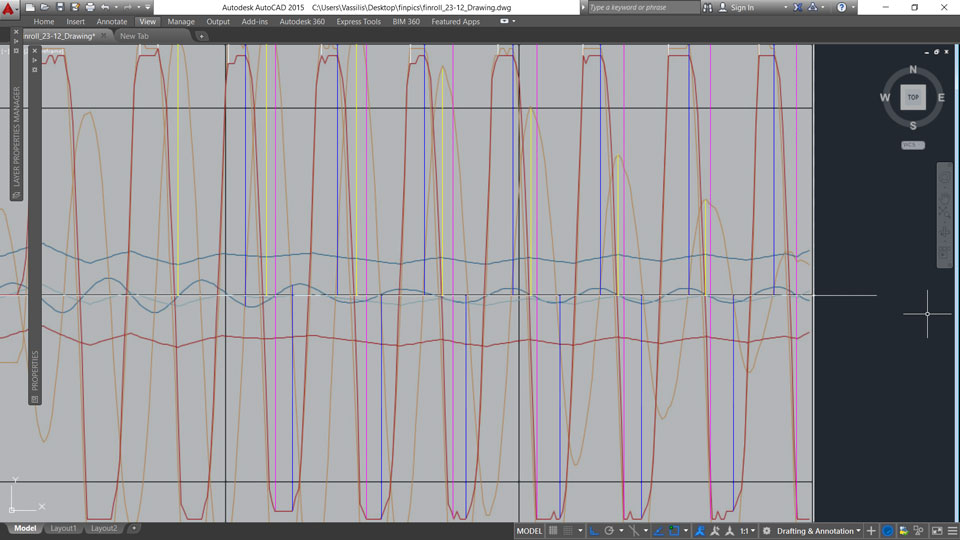
Results:
Movement of fins from end to end with fins at full travel is 0.8 to 1.0 sec
Fins stay idle at either end for approx 0.6 to 0.7secs
this is consistent with the roll period that for full travel of fins and a roll accel of 4 to 5 (aka 0.4 to 0.5rad/sec) was 2.95 to 3.05secs
even managed to measure response from my theoretical trigger point (you know roll accell hits the mid roll curve) and it's typically less than 50ms (although a few flaps were at almost 80ms...)
Overall, I'm very happy with the results (would be happier if I hadn't had to take the geny apart) and I'd be interested to compare these numbers with JFM, Bart or whoever else has some hard data on roll (and preferably not on a boat double the size of MiToS, mr FourtyTwo, get a MPU chip and wire up your Pi to do something useful )
)
happy new year to all!
cheers
V.
thanks for that, I wasn't aware of this function, don't remember seeing any mention in any of the libs I tried, so probably not implemented. Will try again at some point!It's a couple of years ago I was playing with an MPU 6050, and recalled that being referred to. I didn't get to the point of investigating how to make it work that way, and I don't know whether any of the available open source libraries access those functions. I think it is that sort of functionality that enables the nav systems of all the drones people like to play with.
If you check the pics I posted in my last post, note that one before the last has the whole rate of roll sinusoidal curve shifted up by a unit (more or less) hence, I need to have a reliable midpoint of this curve to check against in order to calculate the point where roll accel zeroes itself and boat starts rolling the other way. That's all.I think I have missed where you explained how you calculate "mid-point curve of roll rate values", and what you use it for. I guess it has some "numerical" lag built in to it as it is probably based on history.
in the meantime I tried a combo of algorithms to smooth this midpoint curve and the results I'm showing below are much better, so looks like I'm ok for the time being.
thanks, actually by checking this and that, rethinking optimising, removing unnecessary code and ifs fins now don't miss any flaps and by analysing the printouts of the teensy plot response and general performance looks v.good.Once I had kept reminding myself that your graphs were all at rest, it looks like they are pretty good. It looks as though the system response is fast enough, and that they are being moved at about the right time.
I'm looking forward to the in-motion stages later too.
Now new set of pics taken on the lovely evening of the 23rd, too bloody cold now to do more testing let alone the fact that I've not improved anything since then and yanmar 2GM20F decided it had enough, so about to take it apart next week onwards, so no testing for a month I recon unless I bother to connect to the shore power and test it.
First graph shows fins on, boat rolling v.little (just before the liner wake hits MiToS):
preliminary wave comes, fins start moving. Note we have three parallel lines running, that's the midpoint/average call it as you like of the roll accell value, and the shifted up and down curve. Once roll accell peaks reach outside these two limits, fins are triggered and move (on the next half roll as this calc is a trigger point and and fins cannot move before the next loop check. Note I started with smallish fin movement and then I manually uped it up to max where I did most testing on the day iirc.
That's the MAX wake, would be a 10-11 in my scale now you see that although fins don't miss a beat and get to work as soon as they can (well according to my programming at least...) roll accel goes to 7+ before dropping to a 3.0 in around 7 fin manic flapping period
I'd really like the fins to be able to keep roll accel to 4 at max and then drop to 2-.
Could be the size of fins, the pressure and hydraulic routing to blame. I'll do the hydraulics again, up pressure and test before deciding that I need to up the fin size (which is a possibility), or add winglets and increase the aft section of them, we shall see.
now roll is vastly reduced, fins are on or off and on again. Note that I had another clear mind moment and realised that I can simply bring the fins back to centre when roll accel is less than 1.5 and still only do it at the right time to balance even that little roll, not whenever roll drops below the limits. This worked absolutely fine, with fins coming to midpoint rest without overshooting roll correction and more often than not staying like that for a few periods. That's instrumental on getting a reasonable system while on the way.
some testing with varying amplitudes, not bad, simple fact, at rest you MOSTLY move the fins as far as they go
and now fins off, boat rolling (actually bloody generator died on me and yanmar wouldn't fire again
)
Now took the very strong roll calculations image, brought it in AutoCAD and scaled it properly to measure time on the X axis:
Results:
Movement of fins from end to end with fins at full travel is 0.8 to 1.0 sec
Fins stay idle at either end for approx 0.6 to 0.7secs
this is consistent with the roll period that for full travel of fins and a roll accel of 4 to 5 (aka 0.4 to 0.5rad/sec) was 2.95 to 3.05secs
even managed to measure response from my theoretical trigger point (you know roll accell hits the mid roll curve) and it's typically less than 50ms (although a few flaps were at almost 80ms...)
Overall, I'm very happy with the results (would be happier if I hadn't had to take the geny apart) and I'd be interested to compare these numbers with JFM, Bart or whoever else has some hard data on roll (and preferably not on a boat double the size of MiToS, mr FourtyTwo, get a MPU chip and wire up your Pi to do something useful
)happy new year to all!
cheers
V.


 . Ferretti have sleipner fins combined with seakeeper gyros as a tick box option on the 920 and maybe other models but not on combined software.
 didn't have such things in the 80s in Greece I'm afraid.