Switch panel

You win!

"There I was, upside down wi' nothing on the clock but the makers' name...."

and, as 'Mr Canberra' S/Ldr Bruce Bull once put it - "Is that 18,000hrs repeated once, or 1000hrs repeated 18 times?"

;)

Old flight training joke : (I grew up in an Aircraft family..... )

Student and Instructor up in the Tiger Moth ....

Instructor : "Alter course 1 deg to port...."

Student : "Its impossible to manouevre such a small amount in this old crate ... "

Instructor : "Ok smart-arse ... 10 deg to port then 9 deg to stbd ...."
 
Thanks, PaulR.

I'll phone them in the week, and ask.

Meanwhile....

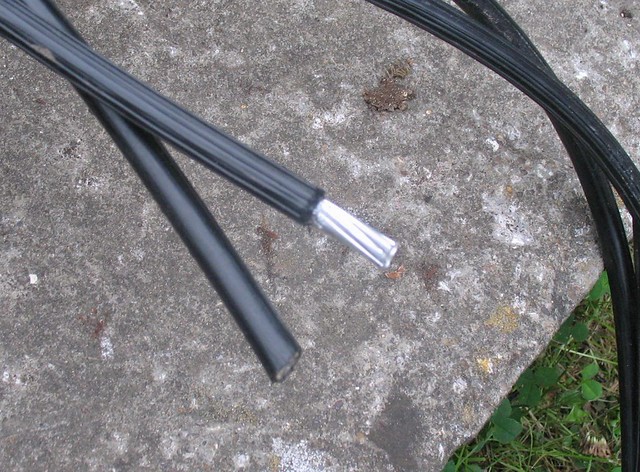
I've just tripped over a few metres of cable given to me by some SSE engineers last month, when they were replacing a 'stuffed' 11kVa transformer nearby. The core is 7x What Looks Like Dyform But Aluminium, and measures 8mm by calipers. What could I use that for...?

54637252556_797033f267_z.jpg


:cool:
Weigh it in.
 
Waht a foolish argument regarding wings on aircraft. They are what they are. A tiger moth for instance has wings (4) attached to the fuselage. A DC3 has a huge cntre section attached to fuselage with wing sections bolted on outboard of engines. A high win Cessna has wings attached at fuselage. An Aero Commander has one continuous wing attached to the top of the fuselage. All different.
Anyway my earlier argument relateed to the compromise between likely hood of failure by short circuit of a system the cost and fault likely hood of complex fusing versus danger to life (small) of large scale electrical failure. Unlike an aircraft I see simplicity wins out. ol'will
 
I think the concept of individual fuses or circuit breakers for individual circuits is in it self flawed. It assumes that you can not survive if you lose a lot of electric circuits. So individual circuit breakers means one system can be broken while all others remain serviceable. Well that may be the case for an aircraft but IMHO most of us yachties could survive quite well with all electrics failed. (together due to one wire (system) failure. Then all this against the very remote likely hood of a short operating a circuit breaker anyway. In other words multiple CBs are only supplied to make it look more technical.
Yes of course wiring must be protected by a fuse or circuit breaker somewhere in the current path of a rating to suit smallest wire. (heavier wire will provide longer life in a boat anyway) But my little boat has just one fuse covering every thing. Even then a fuse holder is a likely source of failure.
So OP has been mesmerized by complexity. Ok if wants to impress people or himself but unnecessary. ol'will
This is just unworkable for virtually any boat, with the exception of something that is so simple that it only has a single, small wire feeding a very basic set of equipment. Like a light or two, a VHF and a depth sounder, for instance. It's just a silly concept and suggesting that fuses are only there to impress people is beyond belief !
 
Interesting spectrum of views.
The panel in question was offered to me 'new/unused' at close to half the price shown in Wonkywinch's #16 link. It may well prove a sound replacement for the smaller, elderly and decidedly worn switch panel currently fitted.


Should I find a suitable space, I'll fit my switch panel, connect my handful of devices, and occasionally contemplate the several spare circuits/connections available to me should Santa bring me a spare Autohelm or AIS unit in my christmas stocking.

:cool:
When I fitted a new switch panel I allowed for "growth" so had and have 4 spare fused switches.
I also prefer having items like navigation lights having their own switches / fuses. If one circuit fails I can still have navigation lights.

My main instruments are on a single switched circuit and then my VHF, radar and secondary GPS all have their own circuits. A pain turning it all on !
 
Oh, for the simplicity of 'the good old days'....
.... of lighting the paraffin nav lights and the ritual of 'trimming the wicks'....!

'Lead, log and lookout'. Them were the days.

:LOL:
 
Top