Switch panel

I think the concept of individual fuses or circuit breakers for individual circuits is in it self flawed. It assumes that you can not survive if you lose a lot of electric circuits.
An alternative point of view is if there is a fault such as a short in one circuit, ideally this fault should not disable multiple systems.

It is cheaper to engineer a yacht with minimal independent electrical circuits, but a single failure can therefore disable many systems.

As a simple example, if there is a short/fault in a tricolour light that trips the circuit breaker, ideally the lower navigation lights are on a separate circuit and therefore continue to function as a viable back up alternative. This is not always the case with yachts that attempt to minimise the number of circuit breakers and independent circuits.
 
Last edited:
if functioning the 4A device will only call for 4A, but if it shorts internally and calls for 8Amps (let us say for argument’s sake) the 30 A breaker will not blow but the device itself could overheat and cause fire?

So by swapping the breaker for a 5 A one, I thought was sensible and safe.

Do you agree?
Do you have 4 amp breakers in your house to protect LED table lights? Obviously not. A read of the standard will reveal why.

...

There is a logic for not ganging all critical circuits on a single breaker. But that does not mean every item needs a separate breaker, any more than you need that many separate breakers in a home. A compromise is simple.

...

Another thing to consider. Why would you control all the systems from breakers instead of switches where you need them? Anywhere but a boat we would consider this proposal hysterical and unacceptable. Why on earth would I have to duck below to turn on lights? Weird, if you think about it.
 
I think the concept of individual fuses or circuit breakers for individual circuits is in it self flawed. It assumes that you can not survive if you lose a lot of electric circuits. So individual circuit breakers means one system can be broken while all others remain serviceable. Well that may be the case for an aircraft but IMHO most of us yachties could survive quite well with all electrics failed. (together due to one wire (system) failure. Then all this against the very remote likely hood of a short operating a circuit breaker anyway. In other words multiple CBs are only supplied to make it look more technical.
Yes of course wiring must be protected by a fuse or circuit breaker somewhere in the current path of a rating to suit smallest wire. (heavier wire will provide longer life in a boat anyway) But my little boat has just one fuse covering every thing. Even then a fuse holder is a likely source of failure.
So OP has been mesmerized by complexity. Ok if wants to impress people or himself but unnecessary. ol'will

Not untrue but surely depends on the boat and its equipment.

Separate lines and fuses simplifies error tracing and remedy. Plus, most of the larger consumers require vastly bigger amps that would blow fuses correct for smaller devices.
 
Interesting and makes sense, thank you.

So if my wiring could handle 30 Amps but at the end of one or two wires I had device or two that would blow or burn if it ever received more than 4 Amps, you are saying I need not make any changes? Not even an in-line 5 Amp fuse to the small device for example? Or change the breaker to a 5 Amp breaker (which is what I did).

I am not an electrician as you can tell.

OK .. my 2p's worth :

Fuses / breakers protect wiring .. and in so doing also the item that fails .... sounds daft I know .. but bear with me.

Your 20A breaker looks after 30A wire ... the 5A item fails and starts to 'heat up' ... it will need to be short circuited failure to 'burn' so the ampage passing through wil very quickly exceed the 20A ... breaker trips. If the item fails and does not 'short circuit' - the circuit will no longer be active.
 
Interesting spectrum of views.
The panel in question was offered to me 'new/unused' at close to half the price shown in Wonkywinch's #16 link. It may well prove a sound replacement for the smaller, elderly and decidedly worn switch panel currently fitted.

My issue is one of efficient use of available space, and my small boat is most certainly NOT something that is likely to impress; nor is it complex.
One might say it rather reflects myself and my role in the world - modest, unassuming, really quite simple.

But.... my surviving earlier incarnations in e.g. military aviation persuades me of the value of 'redundancy of function' and, where practicable, each tool and device carried can be bent to more than one use. So it is with my OTT switch panel.

E.g. aircraft have more than one wing, and more than one wheel. Two heads being better than one - which is certainly true of military pilots. I carry two anchors, two mooring lines, two fenders, two oars for my dinghy and certainly two heavy glass tumblers for the social occasions when someone joins me in a sunset snifter. I have more than one sail. I often seek more than one opinion on a topic and indulge the habit of having both a 'Plan A' and a 'Plan B'.....

And, incidentally, I can sail my modest wee boat with BOTH batteries depleted and no 'lecky at all.

Should I find a suitable space, I'll fit my switch panel, connect my handful of devices, and occasionally contemplate the several spare circuits/connections available to me should Santa bring me a spare Autohelm or AIS unit in my christmas stocking.

:cool:
 
Last edited:
Switch Panels ..... what a mix of rubbish and overly priced nice items !!

Think we've all had those cheap 4 .. 6 gang jobs with the pop out fuses .. great for a year or so then forever needing repairs !
@petem of this parish makes up customised switch panels, he did a fabulous job on the new panel for Tolerance for what I consider a very fair price.
 
.. aircraft have more than one wing ..
The "other" wing isn't there for redundancy. The plane can't fly without it. In any case, the concept of two wings is from most people's "locate and cement" Airfix model building days. On most aircraft, the entire wing is a box section structure with the fuselage built around it.

 
That is one expensive panel.
Not really. The switches are Carling Visi switches, which cost £5 or so each, so £60. If the breakers are also Carling that's another £60 or so. Leaves £30 for the panel, wiring and putting it all together.
In light of what I have been postulating, and the replies received that all breakers being the same rating and not wasteful,

why do the providers supply it with breakers of different capacities, do you know? (Supplying it thus is a good thing in my opinion). My cheaper and smaller panel had all high rated breakers (some of which I swapped for lower ones) which some are saying I need not have done.
The reason some suppliers supply with different breakers is that they don't know what you're going to use it for. If you have some circuits connected to the panel with 2.5mm wiring (rated at 32A typically) you could use all 30A fuses. But, you probably wouldn't have many, if any, devices that would be rated at 30A, it may be that the highest current draw for any device is, say 8A, so just fuse them all at 10A. If some circuits are only wired with 1.thinner wire then fuse accordingly.

It's worth noting that in general, on a boat, we don't use different size wire for each device, based on it's current requirements. I use 1.5mm wire for anything up to the current rating of the wire, making due allowances for voltage drop. Then 2.5mm wire for anything that 1.5mm isn't rated high enough for, up to the rating of the wire, again making allowances for voltage drop. There isn't much on a boat that needs more than 2.5mm wire, but for those things that do they are wired individually with appropriate wire.
 
I've bought a 12V 12-gang switch panel and the rearwards projection of the cables is a problem.
Can I safely 'loop' these as shown in the low-left example?
Is there a better way?
Out of interest, can you confirm the make of the switches and breakers please ?
 
Not really. The switches are Carling Visi switches, which cost £5 or so each, so £60. If the breakers are also Carling that's another £60 or so. Leaves £30 for the panel, wiring and putting it all together.

The reason some suppliers supply with different breakers is that they don't know what you're going to use it for. If you have some circuits connected to the panel with 2.5mm wiring (rated at 32A typically) you could use all 30A fuses. But, you probably wouldn't have many, if any, devices that would be rated at 30A, it may be that the highest current draw for any device is, say 8A, so just fuse them all at 10A. If some circuits are only wired with 1.thinner wire then fuse accordingly.

It's worth noting that in general, on a boat, we don't use different size wire for each device, based on it's current requirements. I use 1.5mm wire for anything up to the current rating of the wire, making due allowances for voltage drop. Then 2.5mm wire for anything that 1.5mm isn't rated high enough for, up to the rating of the wire, again making allowances for voltage drop. There isn't much on a boat that needs more than 2.5mm wire, but for those things that do they are wired individually with appropriate wire.
Yes, all that.

In the US, ABYC and USCG specify 16 AWG (1.3 mm2) minimum for all circuits, excepting very short minimum 22 AWG (0.33 mm2) device pigtails. Some of that is ampacity, but in large part it is to insure a certain basic sturdiness. In my expereince, the most common failure is at the 16/22 trasition if not well suported. Likewise, the permitting of small pigtails relates not just to practicality, but that that if the device is current-limiting (an LED for example) the max current just isn't enough to put much heat in a 22 AWG wire. Even in a dead short it fries fast. Although it is not in the code, to my knowledge, these pigtails should be in open panel space, not under a carpet or passing through a bulkhead; this also reduces wear, heat build up, and risk.

I once had an incpient fire because a numbscull ran the small pigtail for a fan under a carpet and just jammed the wires into a quick-connect. A little scary, since we were well offshore. The fan made it a little hard to find, because the smoke was instantly distributed boat-wide. No real damage, other than our nerves.

But back in the day, with a lot of incandescent loads and long runs, I used mostly 14 AWG.
 
The "other" wing isn't there for redundancy. The plane can't fly without it. In any case, the concept of two wings is from most people's "locate and cement" Airfix model building days. On most aircraft, the entire wing is a box section structure with the fuselage built around it.

Actually most aircraft - the wings are separate items and fuselage is not built around them ... but the central spar may traverse the two.
 
Last edited:
In that case, the manufacturers are misleading. On their website they state that the switches are "Visi switches". Visi switches are made by Carling and are good quality.

12WAY PANEL

They sell the "Visi" switches separately for £2, which gives a clue as to their quality VISI ROCKER SWITCH

I was gifted a Work Box by an employee of mine some years ago ... her Father had just passed away ... he was an Engineer and during Soviet time - was in military maintaining electronic gear.
The switches / rotarys etc in the box are 'bomb-proof' !!

I used a couple to switch the nav lights and search-light on the ex Soviet speedboat ... years later despite out in all weathers unprotected .. still work same !!
 
Actually most aircraft - the wings are separate items and fuselage is not built around them ... but the central spar may traverse the two.
I bow to your knowledge, my experience is limited having only flown 18,000 hours on a good handful of Cessna, Beechcraft & Piper light aircraft followed by the cast iron HS748, the B757, B767, B747, A320 series and finally the B787 before retiring.
 
In that case, the manufacturers are misleading. On their website they state that the switches are "Visi switches". Visi switches are made by Carling and are good quality.
Thanks, PaulR.

I'll phone them in the week, and ask.

Meanwhile....

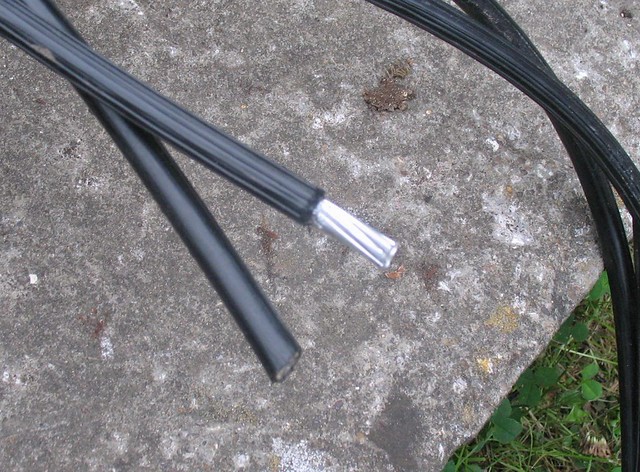
I've just tripped over a few metres of cable given to me by some SSE engineers last month, when they were replacing a 'stuffed' 11kVa transformer nearby. The core is 7x What Looks Like Dyform But Aluminium, and measures 8mm by calipers. What could I use that for...?

54637252556_797033f267_z.jpg


:cool:
 
I bow to your knowledge, my experience is limited having only flown 18,000 hours on a good handful of Cessna, Beechcraft & Piper light aircraft followed by the cast iron HS748, the B757, B767, B747, A320 series and finally the B787 before retiring.
Pah; pathetic! Couldn't you master any of them before you were 'moved on'....?;)
 
I bow to your knowledge, my experience is limited having only flown 18,000 hours on a good handful of Cessna, Beechcraft & Piper light aircraft followed by the cast iron HS748, the B757, B767, B747, A320 series and finally the B787 before retiring.

Drop in the ocean compared to the overall number of different aircraft out there ....

I could if bothered about it - quote many aircraft that do not have fuselage built around wings ... which would include many military aircraft from fighters through bombers ..... as well as civilian ...
 
I bow to your knowledge, my experience is limited having only flown 18,000 hours on a good handful of Cessna, Beechcraft & Piper light aircraft followed by the cast iron HS748, the B757, B767, B747, A320 series and finally the B787 before retiring.
You win!

"There I was, upside down wi' nothing on the clock but the makers' name...."

and, as 'Mr Canberra' S/Ldr Bruce Bull once put it - "Is that 18,000hrs repeated once, or 1000hrs repeated 18 times?"

;)
 
Top