Correct BNC Connector for AIS Antanna

I don't recommend it, but I've transmitted high quality colour video from an ROV by croc-clips; connecting a paper clip from the coax centre to the BNC panel centre, the screen sellotaped to the outer on the panel.
When needs must etc.etc..., but I'd always go with what the manufacturer has already, which is what the OP desired.
As an aside, until today I'd always believed that it was the British Naval Connector, and had never realised that there were credible alternatives in Bayonet Nut Connector or Bayonet Neill Concelman.
I was walking along the harbour when I got asked why there was no video from the towed array camera on a commercial dive boat, I went down on board and had a look, they had snagged the umbilical and ripped the coax and power cable apart then tried to splice it back together like a rope :) I sorted out the shorts, reconnected the cables and showed the system working they then potted the joint in epoxy and let it set.
I got invited out on their seabed search in the Pentland firth, was a great experience, and we found the "treasure" they were looking for later on the videos we recorded.
 
Flippen heck, this is getting complicated!

This plug:
View attachment 169080

goes on the end of the the coaxial cable from the gps antenna of this:

View attachment 169081

View attachment 169084


Here:

View attachment 169085

I had to cut it off to get it through a bulkhead and the deck and hatch garage to my instrument panel.

I've had the instrument for a few years with the gps antenna fixed above the panel, but something has made it interfere with my Garmen GPS126. Moving the antenna soles the issue.


So I need to know what the right plug is to re do it...


Thanks
A.
It’s a TNC. I’ll stake half my kingdom etc. on it being a TNC.

Where are you? They’re not as simple to fit well as they look.
 
Flippen heck, this is getting complicated!

This plug:
View attachment 169080

goes on the end of the the coaxial cable from the gps antenna of this:

View attachment 169081

View attachment 169084


Here:

View attachment 169085

I had to cut it off to get it through a bulkhead and the deck and hatch garage to my instrument panel.

I've had the instrument for a few years with the gps antenna fixed above the panel, but something has made it interfere with my Garmen GPS126. Moving the antenna soles the issue.


So I need to know what the right plug is to re do it...


Thanks
A.
It's a 50 ohm TNC connector, a threaded version of a BNC.
RS PRO, Plug Cable Mount TNC Connector, 50Ω, Clamp Termination, Straight Body | RS
 
Flippen heck, this is getting complicated!

This plug:
View attachment 169080

goes on the end of the the coaxial cable from the gps antenna of this:

View attachment 169081

View attachment 169084


Here:

View attachment 169085

I had to cut it off to get it through a bulkhead and the deck and hatch garage to my instrument panel.

I've had the instrument for a few years with the gps antenna fixed above the panel, but something has made it interfere with my Garmen GPS126. Moving the antenna soles the issue.


So I need to know what the right plug is to re do it...


Thanks
A.
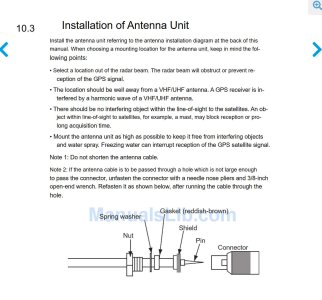
As it says in the manual for the device the GPS can be interfered by harmonics from the VHF and to keep the antennas well apart
HP33A_1.jpg
 
Flippen heck, this is getting complicated!

This plug:
View attachment 169080

goes on the end of the the coaxial cable from the gps antenna of this:

View attachment 169081

View attachment 169084


Here:

View attachment 169085

I had to cut it off to get it through a bulkhead and the deck and hatch garage to my instrument panel.

I've had the instrument for a few years with the gps antenna fixed above the panel, but something has made it interfere with my Garmen GPS126. Moving the antenna soles the issue.


So I need to know what the right plug is to re do it...


Thanks
A.
Wouldn't it be easier to connect the NMEA out from the Garmin GPS126 to the data port NMEA in of the AIS with two pieces of wire rather than moving the AIS GPS aerial outside? Worked for me.
 
Wouldn't it be easier to connect the NMEA out from the Garmin GPS126 to the data port NMEA in of the AIS with two pieces of wire rather than moving the AIS GPS aerial outside? Worked for me.
I'm note sure the AIS transponder will take a NMEA gps feed in.

Have routed the cable already anyway....
 
Your first two sentences are accurate.

Your final paragraph is… (can’t think of a polite word).

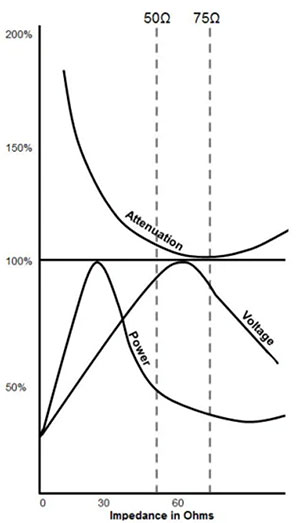
Rather than me going into explanation of how power handling is actually frequency dependant and then also depends on the conductor etc.

WATTS Power Handling for Coaxial Cables and Amplifiers

(It’s a few years since I was a scientific officer at what wax the Roysl Radar Establishment but I think I remember some things…)
Really, my uni textbooks on microwave engineering must all be wrong then
the-reasons-for-50-ohm-and-75-ohm-transmission-lines-img2.jpg


The Reasons for 50 Ω and 75 Ω Transmission Lines—And Why You Should Choose Carefully
Or
Microwaves101 | Why Fifty Ohms?
Or
https://www.rellpower.com/wp/wp-content/uploads/2018/11/A-Guideline-to-select-Coax-Cable.pdf
 
Might sound daft, but why not reuse the plug you have? The coax core is most likely soldered to the centre pin but the rest is assembled by hand, nipped up with a small spanner or pliers.

It looks like a TNC.

https://cpc.farnell.com/amphenol/t1141a1-nd3g-1-50/rf-coaxial-tnc-straight-plug-50ohm/dp/CN20238
I have tried to get the pin off and it won't come. No sign of solder, but does not look like a crimp.

Have found a replacement for £6 so hopefully lopping 20cm of the cable will not cause a problem to the GPS.

If that does not work will try joining the bit I cut off with another connector.

If that fails its a new antenna.
 
I have tried to get the pin off and it won't come. No sign of solder, but does not look like a crimp.

Have found a replacement for £6 so hopefully lopping 20cm of the cable will not cause a problem to the GPS.

If that does not work will try joining the bit I cut off with another connector.

If that fails its a new antenna.
I don't believe the cable will be any part of the antenna tuned circuit so shortening should be no issue.

Have you applied heat with a soldering iron to the pin? You may find it drops off then although this is academic if you've ordered a new one. Don't join the cable (as you and others suggest here), it will do more harm than good. My AIS stopped working because someone had fitted the wrong VHF connectors (F type rather than BNC or N type) as a cable joiners at the base of the mast such was the effect of a dirty signal path to/from the antenna.
 
They’re not wrong: just based on theoretical transmission lines that don’t exist in the real world. My knowledge is old and I confess I’d forgotten that bit of analysis. In the real world power handling is dependent on frequency as my previous reference showed. Power handling is irrelevant to this thread anyway.

In the real world we used Andrew’s Heliax filled with dry nitrogen or silver plated waveguide.

PS Some of the ‘logical arguments in some of those articles are self admitted ‘educated guesses’.
 
Top