boat brands - prejudice or reality

Although I am generally in favour of a tiller for boats of this size, a wheel is actually more comfortable for a downwind passage of any length. My 34 with a tiller is not hard to steer downwind, but holding the helm while turning to look forward soon becomes a strain, and I would regularly end up with a stiff neck. You might say use an autopilot, but for me this is not what sailing is about.
Our boat has tiller steering but I had a Cape Horn (https://caphorn.com/en/capehorn-eng/) windvane self-steering system installed in 2007 which has made life much more tolerable in all subsequent long distance passages. It has a nifty little attachment point for any of the piston type tiller pilots. To use it you remove the wind vane and attach the tiller pilot and, since the tiller pilot is operating the same part as the windvane (from a different angle) it doesn't require a lot of force to deflect the Cape Horn servo paddle which is what exerts the needed force on the lines to the tiller. A clever, simple and relatively maintenance free system. If you click on the "Documentation" button at the top of the main page it takes you to the Owner's Manual which illustrates how it works. I use the wind vane to operate the self steering far more than the tiller pilot but the latter has its occasional uses (motoring through calms, for example).
 
And, we're off to the apples & oranges again.
While I have done some ocean racing, including one race of over 3500 miles, I am only really interested in cruising performance, notably of the passage making variety.
When I refer to cruising, I mean living on board for extended periods of time and a boat equipped with all the necessary accoutrements, a dinghy & outboard, proper and redundant ground tackle, a cast iron crock pot, full tanks and a complete and intact tooth brush.
We can also, I guess, agree that we are now talking about displacement speeds, up to a relative speed of no more than 1.5, as spectacular as that in itself may be.
In this context, absolute speed potential is of less interest, rather than the ability to maintain reasonably high averages. The most important factor here is SA/D and DWL.

To put this into some realistic context:
While there is absolutely nothing about our tub that even remotely whispers speed, we quite consistently average 6.43 kn or thereabouts on multiday passages. We weigh in at a ridiculous 8.5t on a DWL of 28.25' (D/L 360) and have a SA/D of not quite 18.
While 6.43 kn may not sound like much, it should be noted that this represents 90% of the boat's nominal hull speed and, to be clear, a modern 40 footer would have to average (!) 8 kn to equal it. In light airs, though not to windward, we quite frequently keep up with or beat similar size "modern" designs. This is not a miracle, but simple physics.

To note: 0.9 (1.63, if you prefer metric) is considered to be the "indisputable" (I quote from a variety of sources) average, relative speed for sailing yachts.

When it comes to displacement speeds, not much has changed over the last hundred years. The physics have stayed the same and not all "older" designs had an artificially reduced speed potential, to make them "relatively fast" in the context of rating rules either.

Yes, "modern" designs are much lighter and this will allow them a much higher, ultimate speed potential, given enough wind that is. Many also have much higher SA/D ratios than some of the "older design" examples commonly quoted.
However, once loaded to the same extent, as I've outlined, and in a comparable relationship as to size, much of that advantage disappears. I think it rather disingenuous to insist on comparing, not only stripped out racers, but often considerably larger boats with one another and in complete disregard to the laws of relativity and similitude.

I am not surprised that you find your newer and beamier boat to be a lot stiffer and, consequently, faster. As I have previously pointed out: stability increases to the forth power of the beam and therefore even a small increase in beam makes a marked difference. Add to this a hull shape that moves volume and hence buoyancy to the beam ends and you end up with a considerably stiffer boat. After all, RM = GZ x G. Alas, as with all things, there are tradeoffs. The last time we were in Bas Sablons, I watched a local evening race, where a much narrower X-Yacht sailed circles around a larger, not to say beamier, Pogo in light conditions.
I’m convinced that your boat is rapidly supplanting the mythical A22 is the forum byword for pure speed.

Literally nothing you say is surprising, or relevant to the point I’m actually making. Nobody who’s ever done any sort of competitive sailing in light winds would be in the slightest bit surprised that you saw an X pass a pogo. And nobody who’s ever seen the same boats in 20 knots should be at all surprised when the Pogo is way faster. I once passed a class 40 as if it was standing still in 6knots of breeze in the elan. Because it basically was standing still. Wetted surface area is not your friend in light airs. Which is why venues globally that are predominantly light wind venues have strikingly different fleets than venues that are predominantly heavy air. The Swiss lakes are the absolute extreme of light air flyers.

Please do try and answer the actual words written, rather than ones you imagine I have written. Remember that what I’m talking about is chines on bog standard boats. Witness, for example, my comments on the direct match up between the heavily chined Sunsail AWBs and the same size of slimmer direct predecessors.

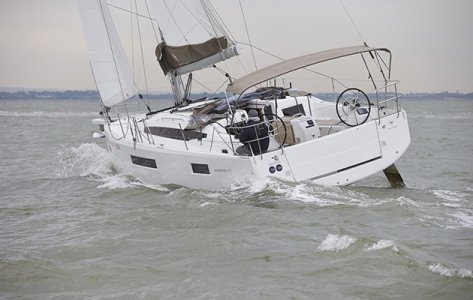
These are not chimes as the old plywood “straight panel” boats. At rest these chines are not in the water. As the boat heels and they start to immerse, the latest designs are sailing more like a narrow boat at this point, as everything to windward of the centreline is now out of the water. Sometimes even more than that. And that’s kind of the point, go upwind as if you’re an IACC boat, go downwind as if you’re a pogo. Here’s a pic of that AWB, the jeaneau sun oddessy 410. Now, just to be absolutely clear I am NOT holding this up as some sort of wonder design, but when I heard the reports from the Sunsail skippers that it was faster than the old first 40s, I was interested In understanding why. And here you see that at a very modest angle of heel most of the hull is now out of the water. The actual wettest surface area is now actually less than the older boats. And at the same time the form stability is considerably higher, and the chine is acting like a long edge in the water helping directional stability. And that, to someone like you who professes to be a student of yacht design ought to be interesting. Especially when this performance isn’t at the expense of interior volume, cruising comforts etc. But instead is actually working with that.

1769364567994.jpeg

Obviously the trade off is that this is going to be really sticky in the light. Again, this shouldn’t come as the slightest surprise to anyone who’s done any sailing.

And go downwind in some wind and it will be slightly faster than narrower boats, but arguably more importantly it will not roll anything like as much.

So do not write off boats like this as having got chines purely for either some sort of lazy fashion following of race boats, or just an attempt to shoehorn more volume into a charter hull. There’s more to it than that, and the benefits to the average sailor are not always realised.
 
However, if you have a racing crew, they’ll all be on the lee rail in the light stuff, which helps it to heel sooner. We do that, I get Mrs to steer, and my 15 st crew and I sit on the lee float. Out pops the windward one, that’s worth at least half a knot in 5 knots of wind. Cruising 2 up, you just pay the price of course.
 

Other threads that may be of interest

Top