boat brands - prejudice or reality

Although I am generally in favour of a tiller for boats of this size, a wheel is actually more comfortable for a downwind passage of any length. My 34 with a tiller is not hard to steer downwind, but holding the helm while turning to look forward soon becomes a strain, and I would regularly end up with a stiff neck. You might say use an autopilot, but for me this is not what sailing is about.
Our boat has tiller steering but I had a Cape Horn (https://caphorn.com/en/capehorn-eng/) windvane self-steering system installed in 2007 which has made life much more tolerable in all subsequent long distance passages. It has a nifty little attachment point for any of the piston type tiller pilots. To use it you remove the wind vane and attach the tiller pilot and, since the tiller pilot is operating the same part as the windvane (from a different angle) it doesn't require a lot of force to deflect the Cape Horn servo paddle which is what exerts the needed force on the lines to the tiller. A clever, simple and relatively maintenance free system. If you click on the "Documentation" button at the top of the main page it takes you to the Owner's Manual which illustrates how it works. I use the wind vane to operate the self steering far more than the tiller pilot but the latter has its occasional uses (motoring through calms, for example).
 
And, we're off to the apples & oranges again.
While I have done some ocean racing, including one race of over 3500 miles, I am only really interested in cruising performance, notably of the passage making variety.
When I refer to cruising, I mean living on board for extended periods of time and a boat equipped with all the necessary accoutrements, a dinghy & outboard, proper and redundant ground tackle, a cast iron crock pot, full tanks and a complete and intact tooth brush.
We can also, I guess, agree that we are now talking about displacement speeds, up to a relative speed of no more than 1.5, as spectacular as that in itself may be.
In this context, absolute speed potential is of less interest, rather than the ability to maintain reasonably high averages. The most important factor here is SA/D and DWL.

To put this into some realistic context:
While there is absolutely nothing about our tub that even remotely whispers speed, we quite consistently average 6.43 kn or thereabouts on multiday passages. We weigh in at a ridiculous 8.5t on a DWL of 28.25' (D/L 360) and have a SA/D of not quite 18.
While 6.43 kn may not sound like much, it should be noted that this represents 90% of the boat's nominal hull speed and, to be clear, a modern 40 footer would have to average (!) 8 kn to equal it. In light airs, though not to windward, we quite frequently keep up with or beat similar size "modern" designs. This is not a miracle, but simple physics.

To note: 0.9 (1.63, if you prefer metric) is considered to be the "indisputable" (I quote from a variety of sources) average, relative speed for sailing yachts.

When it comes to displacement speeds, not much has changed over the last hundred years. The physics have stayed the same and not all "older" designs had an artificially reduced speed potential, to make them "relatively fast" in the context of rating rules either.

Yes, "modern" designs are much lighter and this will allow them a much higher, ultimate speed potential, given enough wind that is. Many also have much higher SA/D ratios than some of the "older design" examples commonly quoted.
However, once loaded to the same extent, as I've outlined, and in a comparable relationship as to size, much of that advantage disappears. I think it rather disingenuous to insist on comparing, not only stripped out racers, but often considerably larger boats with one another and in complete disregard to the laws of relativity and similitude.

I am not surprised that you find your newer and beamier boat to be a lot stiffer and, consequently, faster. As I have previously pointed out: stability increases to the forth power of the beam and therefore even a small increase in beam makes a marked difference. Add to this a hull shape that moves volume and hence buoyancy to the beam ends and you end up with a considerably stiffer boat. After all, RM = GZ x G. Alas, as with all things, there are tradeoffs. The last time we were in Bas Sablons, I watched a local evening race, where a much narrower X-Yacht sailed circles around a larger, not to say beamier, Pogo in light conditions.
I’m convinced that your boat is rapidly supplanting the mythical A22 is the forum byword for pure speed.

Literally nothing you say is surprising, or relevant to the point I’m actually making. Nobody who’s ever done any sort of competitive sailing in light winds would be in the slightest bit surprised that you saw an X pass a pogo. And nobody who’s ever seen the same boats in 20 knots should be at all surprised when the Pogo is way faster. I once passed a class 40 as if it was standing still in 6knots of breeze in the elan. Because it basically was standing still. Wetted surface area is not your friend in light airs. Which is why venues globally that are predominantly light wind venues have strikingly different fleets than venues that are predominantly heavy air. The Swiss lakes are the absolute extreme of light air flyers.

Please do try and answer the actual words written, rather than ones you imagine I have written. Remember that what I’m talking about is chines on bog standard boats. Witness, for example, my comments on the direct match up between the heavily chined Sunsail AWBs and the same size of slimmer direct predecessors.

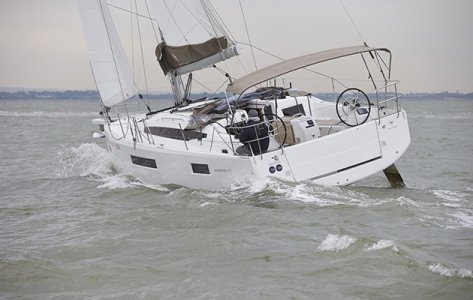
These are not chimes as the old plywood “straight panel” boats. At rest these chines are not in the water. As the boat heels and they start to immerse, the latest designs are sailing more like a narrow boat at this point, as everything to windward of the centreline is now out of the water. Sometimes even more than that. And that’s kind of the point, go upwind as if you’re an IACC boat, go downwind as if you’re a pogo. Here’s a pic of that AWB, the jeaneau sun oddessy 410. Now, just to be absolutely clear I am NOT holding this up as some sort of wonder design, but when I heard the reports from the Sunsail skippers that it was faster than the old first 40s, I was interested In understanding why. And here you see that at a very modest angle of heel most of the hull is now out of the water. The actual wettest surface area is now actually less than the older boats. And at the same time the form stability is considerably higher, and the chine is acting like a long edge in the water helping directional stability. And that, to someone like you who professes to be a student of yacht design ought to be interesting. Especially when this performance isn’t at the expense of interior volume, cruising comforts etc. But instead is actually working with that.

1769364567994.jpeg

Obviously the trade off is that this is going to be really sticky in the light. Again, this shouldn’t come as the slightest surprise to anyone who’s done any sailing.

And go downwind in some wind and it will be slightly faster than narrower boats, but arguably more importantly it will not roll anything like as much.

So do not write off boats like this as having got chines purely for either some sort of lazy fashion following of race boats, or just an attempt to shoehorn more volume into a charter hull. There’s more to it than that, and the benefits to the average sailor are not always realised.
 
However, if you have a racing crew, they’ll all be on the lee rail in the light stuff, which helps it to heel sooner. We do that, I get Mrs to steer, and my 15 st crew and I sit on the lee float. Out pops the windward one, that’s worth at least half a knot in 5 knots of wind. Cruising 2 up, you just pay the price of course.
 
There are two elements to any product: good or bad design and good or bad manufacturing. It is a case of looking at the different aspects of the design and identifying what is key to you; perhaps accommodation over weatherly or do you want a stainless steel rudder stock over a fibreglass one. So many people skirt around such arbitrary issues. When you need to be honest about how you will use the boat, where it will be used and with what crew. Happy hunting.
 
I’m convinced that your boat is rapidly supplanting the mythical A22 is the forum byword for pure speed.

Literally nothing you say is surprising, or relevant to the point I’m actually making. Nobody who’s ever done any sort of competitive sailing in light winds would be in the slightest bit surprised that you saw an X pass a pogo. And nobody who’s ever seen the same boats in 20 knots should be at all surprised when the Pogo is way faster. I once passed a class 40 as if it was standing still in 6knots of breeze in the elan. Because it basically was standing still. Wetted surface area is not your friend in light airs. Which is why venues globally that are predominantly light wind venues have strikingly different fleets than venues that are predominantly heavy air. The Swiss lakes are the absolute extreme of light air flyers.

Please do try and answer the actual words written, rather than ones you imagine I have written. Remember that what I’m talking about is chines on bog standard boats. Witness, for example, my comments on the direct match up between the heavily chined Sunsail AWBs and the same size of slimmer direct predecessors.

These are not chimes as the old plywood “straight panel” boats. At rest these chines are not in the water. As the boat heels and they start to immerse, the latest designs are sailing more like a narrow boat at this point, as everything to windward of the centreline is now out of the water. Sometimes even more than that. And that’s kind of the point, go upwind as if you’re an IACC boat, go downwind as if you’re a pogo. Here’s a pic of that AWB, the jeaneau sun oddessy 410. Now, just to be absolutely clear I am NOT holding this up as some sort of wonder design, but when I heard the reports from the Sunsail skippers that it was faster than the old first 40s, I was interested In understanding why. And here you see that at a very modest angle of heel most of the hull is now out of the water. The actual wettest surface area is now actually less than the older boats. And at the same time the form stability is considerably higher, and the chine is acting like a long edge in the water helping directional stability. And that, to someone like you who professes to be a student of yacht design ought to be interesting. Especially when this performance isn’t at the expense of interior volume, cruising comforts etc. But instead is actually working with that.

View attachment 205579

Obviously the trade off is that this is going to be really sticky in the light. Again, this shouldn’t come as the slightest surprise to anyone who’s done any sailing.

And go downwind in some wind and it will be slightly faster than narrower boats, but arguably more importantly it will not roll anything like as much.

So do not write off boats like this as having got chines purely for either some sort of lazy fashion following of race boats, or just an attempt to shoehorn more volume into a charter hull. There’s more to it than that, and the benefits to the average sailor are not always realised.
Good explanation.

I suspect the difficulty some have with modern design is that they benchmark it against the norms of 40 years ago and tend to look at any deviation from that norm in terms of why it is inferior - too little ballast, too wide beam, flat bottom, short keel, spade rudder, saildrive, windows in the hulls and so on. Therefore from this perspective they are less seaworthy, poorer load carriers, uncomfortable, lightly built and overall no faster and unsuitable for serious sailing (good for lounging about in the Med is the ultimate put down).

They fail to appreciate that the whole concept of boat design has changed and despite what they seem to believe people buy such boats for what they do offer and seem to have no qualms in taking them off bluewater sailing. For people of my generation an HR 352 was the dogs b****x for modest bluewater sailing. Today's buyer looking for similar with no baggage from 40 years ago would be delighted that HR could sell them a new 370. Objectively it will do the job better in just about every way.

Obviously some find it difficult to accept this perhaps because they have never owned or even sailed a modern boat. The defensive tone and partial view of what their old boats can do that modern boats (with or without chines at the stern) allegedly can't says a lot.
 
..... HR could sell them a new 370. Objectively it will do the job better in just about every way...............

Just about every way.
But not quite.

An older boat may well be more directionally stable, easier to handle singlehanded, kinder on the helm pilot, steerable in a crises without its rudder, a better load carrier, more seakindly and happier in poor weather.

Choose wisely and it's keel is less likely to drop off, leak, gape, prompt the insurer to insist on expensive testing or be pushed through the bottom of the boat. Choose wisely and you will have less underwater hindrances, prone to damage, fouling and picking up nets. Choose wisely and you can have a lead keel and high ballast ratio just like most racing boats, having her stand up well, upwind and down.

These are factual advantages you can have, if you want. If you want them is another matter a subjective choice, this or that? You might like another set of factual advantages from a bang modern boat.
What people do find difficult to accept is separating the subjective from the objective.

.
 
On the subject of Hallberg-Rassy .... here's their take on it all ...

FAQ

Why is typically a twin rudder configuration safer than a single skeg hung rudder?​

The rudder design of the latest generation Hallberg-Rassys is the safest you can get. Because of the reduced rudder surface, compared to a single rudder solution, the rudder loads will also decrease which will increase the safety factor. There are two self aligning bearings for each rudder, which can handle even a slight bend of the solid shaft. That is not the case with a skeg hung rudder with three bearings. And twin rudders are shallower than a single rudder, so less exposed. And two give better redundancy than one. Twin rudder blades are far easier to control in reverse than a single rudder with skeg close to the keel. With twin rudders you have full control even at excessive heel. Also the hull design is very efficient. Making a good 24 hour run is the best way to sail safely between high- and low pressures. Twin rudders give a superior ride when motoring as the boat will head forward when letting the wheel lose, and not turn to one side as with a single rudder boat.

Why is in-mast furling better than in-boom furling?

Because of several reasons: In-boom furling is good as long as you do everything 100 % correctly. But in reality that is not always the case. In-boom is far more sensitive about the angle between boom and mast and angle between sail and wind. In-mast is more forgiving and consequently more reliable. You cannot reef in-boom sailing downwind, without going up into the wind, in-mast you can reef sailing downwind, very important, not if, but when you suddenly get into a squall. You do not gain any sail area with in-boom vs a well designed in-mast mainsail. Also in-mast allows full roach and a real headboard. What is really the limit is the room to the backstay. In-mast is quicker to reef and to unreef, which means it is always easy to have the correct sail area to the wind situation. A well designed in-mast furling main is at least as efficient as in-boom. In-mast has a better sail shape when reefed.

What core is used in a Hallberg-Rassy hull and deck?​

Hallberg-Rassy use Divinycell closed cell PVC foam that does not absorb water but insulates well against cold, heat and noise. Hallberg-Rassy use Divinycell cored hulls on all Frers designs. No Enderlein designs except the 382 have cored hulls. Horizontal areas of the decks are always cored. The transom is never cored. Hallberg-Rassy has never used balsa, which may soak water and rotten.

What keel bolts torque does Hallberg-Rassy recommend?​

The recommended torque for keel bolts on a Hallberg-Rassy are:

M16: app. 125 Nm

M18: app. 170 Nm

M20: app. 250 Nm

M24: app. 400 Nm

M30: app. 800 Nm

M36: app. 1300 Nm

How to cure a squeaking noise​

Our experience is that if you should have a squeaking noise from the deck, it is never the deck itself, but is friction because of too tight clearance between inner ceilings and bulkheads or lockers in moist areas. This because different moisture expands or shrinks those panels. If the ceiling panels in question are removed and the edge towards bulkheads or lockers are reduced two mm or so, you will see that the squeaking noise completely disappears. This is often in connection with a deck hatch and to be able to remove the ceiling panel, one has to start with removing the deck hatch, revealing screws that keep the wooden frame in place, which in turn keeps the ceiling panel in place.
 
I’m convinced that your boat is rapidly supplanting the mythical A22 is the forum byword for pure speed.

Literally nothing you say is surprising, or relevant to the point I’m actually making. Nobody who’s ever done any sort of competitive sailing in light winds would be in the slightest bit surprised that you saw an X pass a pogo. And nobody who’s ever seen the same boats in 20 knots should be at all surprised when the Pogo is way faster. I once passed a class 40 as if it was standing still in 6knots of breeze in the elan. Because it basically was standing still. Wetted surface area is not your friend in light airs. Which is why venues globally that are predominantly light wind venues have strikingly different fleets than venues that are predominantly heavy air. The Swiss lakes are the absolute extreme of light air flyers.

Please do try and answer the actual words written, rather than ones you imagine I have written. Remember that what I’m talking about is chines on bog standard boats. Witness, for example, my comments on the direct match up between the heavily chined Sunsail AWBs and the same size of slimmer direct predecessors.

These are not chimes as the old plywood “straight panel” boats. At rest these chines are not in the water. As the boat heels and they start to immerse, the latest designs are sailing more like a narrow boat at this point, as everything to windward of the centreline is now out of the water. Sometimes even more than that. And that’s kind of the point, go upwind as if you’re an IACC boat, go downwind as if you’re a pogo. Here’s a pic of that AWB, the jeaneau sun oddessy 410. Now, just to be absolutely clear I am NOT holding this up as some sort of wonder design, but when I heard the reports from the Sunsail skippers that it was faster than the old first 40s, I was interested In understanding why. And here you see that at a very modest angle of heel most of the hull is now out of the water. The actual wettest surface area is now actually less than the older boats. And at the same time the form stability is considerably higher, and the chine is acting like a long edge in the water helping directional stability. And that, to someone like you who professes to be a student of yacht design ought to be interesting. Especially when this performance isn’t at the expense of interior volume, cruising comforts etc. But instead is actually working with that.

View attachment 205579

Obviously the trade off is that this is going to be really sticky in the light. Again, this shouldn’t come as the slightest surprise to anyone who’s done any sailing.

And go downwind in some wind and it will be slightly faster than narrower boats, but arguably more importantly it will not roll anything like as much.

So do not write off boats like this as having got chines purely for either some sort of lazy fashion following of race boats, or just an attempt to shoehorn more volume into a charter hull. There’s more to it than that, and the benefits to the average sailor are not always realised.
Very good summary. I love the contessa 32 but have been passed by a Pogo doing twice my speed.
 
Hallberg Rassy are not afraid to move with the times, clearly.
An interesting account, but it avoids the point that twin rudders, while maybe being easy to steer going astern, are at a disadvantage going ahead when trying to do a tight turn, and many owners may want to fit a bow thruster to compensate.
 
An interesting account, but it avoids the point that twin rudders, while maybe being easy to steer going astern, are at a disadvantage going ahead when trying to do a tight turn, and many owners may want to fit a bow thruster to compensate.
And in the days when skeg mounted rudders were the norm, there were no bow thrusters. All part of the modern yacht these days. Twin ruddrs are better for everything else when you have a wide transom boat and there’s the solution to the downside.
 
An interesting account, but it avoids the point that twin rudders, while maybe being easy to steer going astern, are at a disadvantage going ahead when trying to do a tight turn, and many owners may want to fit a bow thruster to compensate.
Watching the twin rudder charter fleet return to Marina Veruda on a Friday afternoon and spend hours spinning round in circles, going forwards and backwards, and generally faffing about waiting to get to the fuel berth, I would say they don't seem to have a maneuvering problem. Afterwards they also seem to manage to get back in their berths - although I'll admit, that bit is accompanied by a cacophony of bowthruster noises - but then bowthrusters are on everything these days, even the boats with huge spade rudders that can spin in their own length.
 
Watching the twin rudder charter fleet return to Marina Veruda on a Friday afternoon and spend hours spinning round in circles, going forwards and backwards, and generally faffing about waiting to get to the fuel berth, I would say they don't seem to have a maneuvering problem. Afterwards they also seem to manage to get back in their berths - although I'll admit, that bit is accompanied by a cacophony of bowthruster noises - but then bowthrusters are on everything these days, even the boats with huge spade rudders that can spin in their own length.
As I said, they are a problem without bow thrusters. Even in a cross-wind my old Sadler 29 was easy to push to windward in spite of the windage from a furling jib and high prow because the rudder could be put over to almost 90 degrees. My HR 34 is much less easy, with a saildrive gap to the rudder and less rudder movement. I have never sailed one, but a light boat with twin rudders and no prop effect on the rudder looks like a recipe for berthing awkwardness to me.
 
Just about every way.
But not quite.

An older boat may well be more directionally stable, easier to handle singlehanded, kinder on the helm pilot, steerable in a crises without its rudder, a better load carrier, more seakindly and happier in poor weather.

Choose wisely and it's keel is less likely to drop off, leak, gape, prompt the insurer to insist on expensive testing or be pushed through the bottom of the boat. Choose wisely and you will have less underwater hindrances, prone to damage, fouling and picking up nets. Choose wisely and you can have a lead keel and high ballast ratio just like most racing boats, having her stand up well, upwind and down.

These are factual advantages you can have, if you want. If you want them is another matter a subjective choice, this or that? You might like another set of factual advantages from a bang modern boat.
What people do find difficult to accept is separating the subjective from the objective.

.
Have you actually owned and sailed both to underpin your claims? Those who have sailed the newer boat and similar say exactly the opposite about handling - easy to sail single handed, light on the helm, directionally stable easy on the autopilot. How many keels have fallen off HRs with bolt on keels - or indeed moat other boats of the type. Facts and evidence please. suggest also you listen to what the builder says about the rudders (it has 2 so in the unlikely event of one failing you can steer with the other), and the keel construction - and it has a lead ballast keel and high ballast ratio. Can you give some examples of insurers requiring expensive testing on keels?

You have truly illustrated you last paragraph by demonstrating that you are unable to fact from fiction and subjective from objective.
 
As I said, they are a problem without bow thrusters. Even in a cross-wind my old Sadler 29 was easy to push to windward in spite of the windage from a furling jib and high prow because the rudder could be put over to almost 90 degrees. My HR 34 is much less easy, with a saildrive gap to the rudder and less rudder movement. I have never sailed one, but a light boat with twin rudders and no prop effect on the rudder looks like a recipe for berthing awkwardness to me.
On the type and size of boat being discussed here bow thrusters are pretty universal anyway. The problem is not necessarily the lack of prop wash on the rudder, but high windage of the boat plus for many with a saildrive a large distance from the prop to the rudder(s).

You have to think differently from older boats particularly those with skeg hung unbalanced rudders where prop wash is valuable as a means of control at low speed. To take full advantage of twin rudders as HR and for example Southerly you have to accept that bow (and stern) thrusters are necessary. You still need to learn how to use them o a particular boat.
 
Just about every way.
But not quite.

An older boat may well be more directionally stable, easier to handle singlehanded, kinder on the helm pilot, steerable in a crises without its rudder, a better load carrier, more seakindly and happier in poor weather.

Choose wisely and it's keel is less likely to drop off, leak, gape, prompt the insurer to insist on expensive testing or be pushed through the bottom of the boat. Choose wisely and you will have less underwater hindrances, prone to damage, fouling and picking up nets. Choose wisely and you can have a lead keel and high ballast ratio just like most racing boats, having her stand up well, upwind and down.

These are factual advantages you can have, if you want. If you want them is another matter a subjective choice, this or that? You might like another set of factual advantages from a bang modern boat.
What people do find difficult to accept is separating the subjective from the objective.

.
Here we go again ………
A modern HR with twin rudders will be very directionally stable, and with modern sail handling systems (probably including at least one electric assisted winch and a bow thruster) a doddle to singlehand.
 
Watching the twin rudder charter fleet return to Marina Veruda on a Friday afternoon and spend hours spinning round in circles, going forwards and backwards, and generally faffing about waiting to get to the fuel berth, I would say they don't seem to have a maneuvering problem. Afterwards they also seem to manage to get back in their berths - although I'll admit, that bit is accompanied by a cacophony of bowthruster noises - but then bowthrusters are on everything these days, even the boats with huge spade rudders that can spin in their own length.

As I said, they are a problem without bow thrusters. Even in a cross-wind my old Sadler 29 was easy to push to windward in spite of the windage from a furling jib and high prow because the rudder could be put over to almost 90 degrees. My HR 34 is much less easy, with a saildrive gap to the rudder and less rudder movement. I have never sailed one, but a light boat with twin rudders and no prop effect on the rudder looks like a recipe for berthing awkwardness to me.
Awkward yes, but like most things boats compromises win and a little learning goes a long way.
Last summer was my first with twin rudders plus I chose not to have a bow thruster. I now know how to manoeuvre my boat and am happy to stay with the two bladed folding prop as well. This boat is easier than many long finned and skegged up older designs, and they weren’t impossible, just different.
The plusses of a modern design are legion and I no more want an old boat than i want a Sierra1600LS.
 
Have you actually owned and sailed both to underpin your claims? Those who have sailed the newer boat and similar say exactly the opposite about handling - easy to sail single handed, light on the helm, directionally stable easy on the autopilot. How many keels have fallen off HRs with bolt on keels - or indeed moat other boats of the type. Facts and evidence please. suggest also you listen to what the builder says about the rudders (it has 2 so in the unlikely event of one failing you can steer with the other), and the keel construction - and it has a lead ballast keel and high ballast ratio. Can you give some examples of insurers requiring expensive testing on keels?

You have truly illustrated you last paragraph by demonstrating that you are unable to fact from fiction and subjective from objective.

Here is a little honesty test:

1) Give a few paragraphs on the advantages of a long keel, skeg hung rudder, low windage hull configuration
Marks will be given for the number of advantages you can think of and a short elaboration of each one, you should be able to identify about ten

If you can't or won't answer let us know.

.
 
On the type and size of boat being discussed here bow thrusters are pretty universal anyway. The problem is not necessarily the lack of prop wash on the rudder, but high windage of the boat plus for many with a saildrive a large distance from the prop to the rudder(s).

You have to think differently from older boats particularly those with skeg hung unbalanced rudders where prop wash is valuable as a means of control at low speed. To take full advantage of twin rudders as HR and for example Southerly you have to accept that bow (and stern) thrusters are necessary. You still need to learn how to use them o a particular boat.
Looking back, I don't think a size range was specified. My personal range, or the one that occurs to me, is up up around 35', but I can see that today's 'starter boat' can easily be 37' and upwards. I would be mortified if I felt the need for a bow thruster in a boat in my 34' size, though I could understand it for a heavy old motor-sailor perhaps. A friend chose to fit one to his Hanse 370, mainly because his rheumatoid made him less agile, and he reckoned that the performance was noticeably degraded, so I don't see the need for a bow thruster as a cost-free option.
 
Looking back, I don't think a size range was specified. My personal range, or the one that occurs to me, is up up around 35', but I can see that today's 'starter boat' can easily be 37' and upwards. I would be mortified if I felt the need for a bow thruster in a boat in my 34' size, though I could understand it for a heavy old motor-sailor perhaps. A friend chose to fit one to his Hanse 370, mainly because his rheumatoid made him less agile, and he reckoned that the performance was noticeably degraded, so I don't see the need for a bow thruster as a cost-free option.
The original OP was talking about 34' although that focus has long gone. The last boat used to illustrate a discussion point was a Jeanneau 40i which has twin rudders and chines. There is not an absolute size determinant of when a thruster becomes useful. It all depends on the type of boat and the difficulties it presents that might be lessened by a bow or stern thruster or both. For example there is a Southerly 32 in our club which as you may know is very shallow and has huge topsides so despite being heavy at 7 tonnes it is uncontrollable without its thrusters. My current boat is 31' heavy long keel, last boat was modern 33' single rudder, immediate neighbours in the marina are a Freedom 33 drop keel, Southerly 110, drop keel twin rudders and Malo 36 conventional long fin keel. All have bow thrusters so that the owners (age range 76-88) can enter and exit their berths safely.

You may feel mortified, but why? It is simply not logical. If a bow thruster makes life easier for you and enables you to use your boat more and carry out arguably the worst bit of boat handling better dhy should you feel bad about or be bothered about what others think?
 
Top