boat brands - prejudice or reality

But that almost certainly is the case. To a huge majority of people a car is a means of transport, running kids to school etc. Only a small minority even read comparative car reviews - if it gets from A to B then fine.

And similarly with boats. Few compare polar diagrams of potential purchases, or compare key measurements etc. If it has a nice interior and a decent specification many will go for it. And that is perfectly fine.

But I suspect that buyers of Dragonfly, Arcona, XY etc think differently, and punish their wallets accordingly.
As long as you feel you’ve got what you paid for, that’s all fine. I guess Geem’s boat is the yacht equivalent of a LWB Defender, mine the Audi R8. And most AWBs are the Ford C max, the ‘classier’ ones a VW California. I suspect some more parallels there, in that most Defenders are on the school run, and not many R8s go on 1000 mile joy rides. Still, as you say, a C Max actually works for many, and probably would work for even more. Certainly the boat equivalent wouldn’t change much for us, except the fun factor and how far we’d go in a day. Is the Ford ‘worse’ in any particular way? Probably not.
 
Baggywinkle gets his bag squeezed😅😅

New boats are cleaner? What? Cleaner, really? Maybe if you don't clean a boat its becomes and old one? You really are clutching at straws.
You bring wooden boats into the discussion. Why didn't you mention the Noah's Ark or how about Kon Tiki? You could have had a field day with that one.

You see me as a luddite, stuck in the past. That couldn't be further from the truth.
I regularly raced on full carbon race boats in the last few years. A love the high tech, and in the racing world it makes total sense.
I am a keen wingfoiler embracing the carbon foil tech and aramid and aluula sail technology that is far ahead of the sailing cruising world. Ditto my kite surfing with carbon boards and the shared technology from wing foiling. I love all this stuff.
I think those that can't grasp that I have an old boat that fits perfectly with my lifestyle and use don't appreciate that it isn't a museum piece that has sat unmodified since the 80s. Its not like that at all.
Thr hull was ahead of its time. Its composite construction with Airex core hull and deck. No rotting balsa deck like on your modern boat. (Mine is much like the current offerings today in the higher end production boat market) We carry modern Vectran cruising sails and all halyard are Marlow racing dyneema. We have a three bladed folding prop and a modern direct injection diesel engine.
The boat is all electric galley. No gas onboard. A large bank of lithium batteries, two fridges and freezers, ice machine, hydronic heating, loads of solar, diesel genset, huge storage compared to any modern boat of the same LOA. This is simply because all tankage is below the floor leaving all the space under bunks for storage. The cockpit can seat 10 people and 4 people can eat at the cockpit table out of the wind and in a Caribbean evening.

In race boats, the adoption of lightweight composite materials and chiefly carbon, has revolutionised the sport. This produces stiff and lightweight machines that can fly across oceans at breakneck speed and race around the cans taking prizes every race day.
All this tech doesn't make its way down to the average production cruiser. Why? Because of cost.
Its always been the case that fashion for speed sells boats. It was the same in the 70s with pinched transoms and wide beam. We now have IMOCAs with super wide hulls and chines and we have cruising boats copying the shape because speed sells.
The reality is that the IMOCA is an empty carbon shell where the skipper saws his toothbrush in half to save weight. The cruising boat copy is a polyester hull with a cast iron keel, poor righting moment so consequently they get a relatively short mast. Large wetted area and relatively small canvas area. Such boats are often slow in light wind with white sails.
The back of the boat has two double cabins with thick comfy mattresses and plywood bulkheads meaning that the keel now needs to move forward to compensate for the extra weight in the stern so they move the mast forward to maintain the CofE.
This means you need a large mainsail and you get a small jib. Nothing like an IMOCA at all that has a mast position well back running 3 furlers up front.
The marketing of modern cruising boats is excellent. They sell the dream and good luck to them. Its a business, but just like car brands, we all choose different cars for different reasons.
Some people drive a Morgan. Others will suggest they must be mad. Others drive Volvos because they have a history of building super safe cars. Some buy a hybrid because they want economy. We all make choices but every new car isn't better than the last one. They are always bigger! But not necessarily better. Who wants a wet belt engine?
For my usage, which is fundamentally cruising both sides of the pond and across, the boat is a perfect fit for us. In this usage, it isn't slow. We make fast ocean passages comparable or faster than modern production boats of the same length.
If I wanted to race around the cans or coastal cruise UK waters, I would have a different boat.

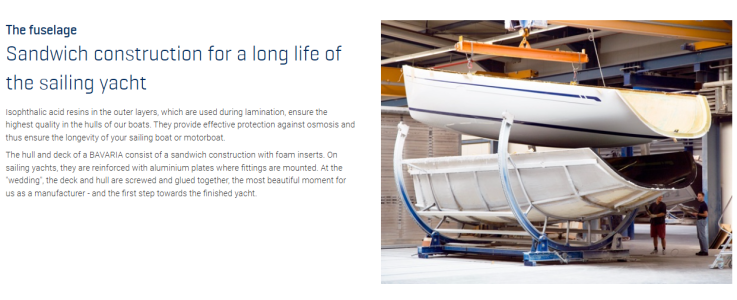
Many modern production boats use vacuum infusion in their composite hull construction. Very few use use PVC core material because balsa is cheaper. Built to a price. Balsa is like a sponge if you get it wet from a leaking through hull. It will rot from the inside out. PVC core doesnt rot. Guess what the core is on my boat? You mention rotting balsa. Do you think your boat is immune to rotting balsa?
Balsa core is routinely used as a core material by all the familiar boat manufacturers because its cheaper than PVC core material.
I posted a video of Parley Revivial with quality issue with the vacuum infusion construction in Lagoons. Modern built practises are not immune to build quality issues. Lagoon are owned by Beneteau.
Grid systems glued in that get knocked out off the hull when you ground. Look at the massive amount of work that Utubers Expedition Evans did to rectify that disaster. They improved the build by glassing in the grid. Something the builder should have done from day one but that would have cost more. Again, built to a budget.
The shape of modern boats has changed dramatically. Most old designs were dark and dingy below. The quality of the interior were poor. Droopy headlining were common. Then there are people like Concerto and myself that restore a boat to better than original. We did it because we wanted to. It wasn't a horror story. It was a pleasure. When boats like ours get compared to modern equivalents, the difference really don't exist. It simply comes down to personal choice.
I could go on and on about IKEA interiors glued in windows, spade rudders, bearing failure, drive legs, but I don't want to upset you😅
 
Last edited:
In amongst your good points Geem, you sadly have some misconceptions and some incorrect data. For example your contention that modern hulls are that shape because they have been influenced by racing shapes. I simply don't see that, when I go onto a modern cruising "charter" boat at a boat show I see that this hull shape makes a shed load of sense because it has a shed load of space, which people buying new boats generally like. The last charter holiday I did was with 10 of us on a 50 foot AWB. What an incredible holiday that was, and the boat was basically perfect for it, that shape allowed for 4 double cabins and tons of space. And the shape has very little in common with my boat, let alone an IMOCA. In fact the word "shed" is quite apt for some of them.

Ditto the mast moving forward, I'm not seeing that as in any way a negative for a cruising boat. The idea that a cruising boat, specifically a coastal cruising boat, wants a big genoa is nuts. Who do designers of family cruising boats with large genoas imagine is going to be winching the thing in? Also not convinced they even are moving forward particularly. Look to be aft of where traditional fractional rigs used to be, and not far off the middle of the boat. Looking at the specs of a few modern ones, and with non overlapping fractional jibs the main and jib area are very similar, which doesn't point to a mast shoved forward at all.

Oh, and btw, for example the current Dufour 44 (which is the only 44 foot current AWB I could think of) has a taller mast, by about 2m than your boat, So not sure where this dumpy mast idea of yours is coming from. It also sets more sail area. By quite a margin. According to sailboatdata Its non overlapping jib is marginally bigger than your genoa, and the main is 16sqm bigger. And weighs 4 tonnes less. So somewhat unlikely to be slower... You definitely wouldn't like the hull windows though....

And literally nobody is saying you have the wrong boat. It's clearly a great boat, and the mods you've done, especially the removal of gas, are fascinating.

Quite why people saying "hey, these modern ones are quite good too you know!" seems to get you so worked up is quite beyond me.
 
I was on a modern HR the other day. No chart table is not a feature I'd like on any boat irrespective of age or manufacturer.
 
I was on a modern HR the other day. No chart table is not a feature I'd like on any boat irrespective of age or manufacturer.
But in many places paper charts are already being discontinued - and in practice few buy paper charts even in the UK. Before the new boat is a decade old they will likely be very difficult to obtain.

Personally I do like my “chart table” - but it is rarely if ever used for any detail chart work (though I do have plenty on board), but rather the skipper’s domain and office - when using the laptop at anchor, for example. There is a chart plotter there, which is handy - not least to check when not on deck.
 
In amongst your good points Geem, you sadly have some misconceptions and some incorrect data. For example your contention that modern hulls are that shape because they have been influenced by racing shapes. I simply don't see that, when I go onto a modern cruising "charter" boat at a boat show I see that this hull shape makes a shed load of sense because it has a shed load of space, which people buying new boats generally like. The last charter holiday I did was with 10 of us on a 50 foot AWB. What an incredible holiday that was, and the boat was basically perfect for it, that shape allowed for 4 double cabins and tons of space. And the shape has very little in common with my boat, let alone an IMOCA. In fact the word "shed" is quite apt for some of them.

Ditto the mast moving forward, I'm not seeing that as in any way a negative for a cruising boat. The idea that a cruising boat, specifically a coastal cruising boat, wants a big genoa is nuts. Who do designers of family cruising boats with large genoas imagine is going to be winching the thing in? Also not convinced they even are moving forward particularly. Look to be aft of where traditional fractional rigs used to be, and not far off the middle of the boat. Looking at the specs of a few modern ones, and with non overlapping fractional jibs the main and jib area are very similar, which doesn't point to a mast shoved forward at all.

Oh, and btw, for example the current Dufour 44 (which is the only 44 foot current AWB I could think of) has a taller mast, by about 2m than your boat, So not sure where this dumpy mast idea of yours is coming from. It also sets more sail area. By quite a margin. According to sailboatdata Its non overlapping jib is marginally bigger than your genoa, and the main is 16sqm bigger. And weighs 4 tonnes less. So somewhat unlikely to be slower... You definitely wouldn't like the hull windows though....

And literally nobody is saying you have the wrong boat. It's clearly a great boat, and the mods you've done, especially the removal of gas, are fascinating.

Quite why people saying "hey, these modern ones are quite good too you know!" seems to get you so worked up is quite beyond me.
Flaming, I enjoy the discussion with you. One of the formites where its a pleasure to discuss issue, without getting personal.
 
In amongst your good points Geem, you sadly have some misconceptions and some incorrect data. For example your contention that modern hulls are that shape because they have been influenced by racing shapes. I simply don't see that, when I go onto a modern cruising "charter" boat at a boat show I see that this hull shape makes a shed load of sense because it has a shed load of space, which people buying new boats generally like. The last charter holiday I did was with 10 of us on a 50 foot AWB. What an incredible holiday that was, and the boat was basically perfect for it, that shape allowed for 4 double cabins and tons of space. And the shape has very little in common with my boat, let alone an IMOCA. In fact the word "shed" is quite apt for some of them.

Ditto the mast moving forward, I'm not seeing that as in any way a negative for a cruising boat. The idea that a cruising boat, specifically a coastal cruising boat, wants a big genoa is nuts. Who do designers of family cruising boats with large genoas imagine is going to be winching the thing in? Also not convinced they even are moving forward particularly. Look to be aft of where traditional fractional rigs used to be, and not far off the middle of the boat. Looking at the specs of a few modern ones, and with non overlapping fractional jibs the main and jib area are very similar, which doesn't point to a mast shoved forward at all.

Oh, and btw, for example the current Dufour 44 (which is the only 44 foot current AWB I could think of) has a taller mast, by about 2m than your boat, So not sure where this dumpy mast idea of yours is coming from. It also sets more sail area. By quite a margin. According to sailboatdata Its non overlapping jib is marginally bigger than your genoa, and the main is 16sqm bigger. And weighs 4 tonnes less. So somewhat unlikely to be slower... You definitely wouldn't like the hull windows though....

And literally nobody is saying you have the wrong boat. It's clearly a great boat, and the mods you've done, especially the removal of gas, are fascinating.

Quite why people saying "hey, these modern ones are quite good too you know!" seems to get you so worked up is quite beyond me.
Some good point there also. I was specifically thinking of modern grp hulls that have chines for no reason other than mimicking race boats that are constrained by rules that make them necessary.
I'm did say in my post that if I wasn't using my boat in the specific way we do, I probably would have a different boat. We have no pretentious to be a charter boat. We aren't craving huge internal volume. I fully understand why volume sells boats, particular in the charter market where bunks count.
Your charter boat for your holiday was absolutely the right boat and its built to do that job perfectly.
Modern designs make better charter boat than anything built 25 years ago. If you don't need a charter boat though, you choose something else. This is what we did.
With regard to comparison with a Dufour 44 that is actually 45.6ft LOA compared to our 44ft LOA, the main of the Dufour is 150ft2 more and the genoa is 205ft2 less. In addition, we have a blade jib and mizzen for more sail options plus of course an asymmetric spinnaker and 430sqft mizzen staysail. In light winds we can carry 2500sqft of sail behind the beam.
I have no problems with modern boats being described "as quite good you know". My friend just ordered a Pegasus 50. It looks superb. I might even crew for him across the pond next year. I just don't accept that all things modern are necessarily better simply because they are modern as some suggest on this forum.
Around the cans and racing light weight has many advantages but in cruising boats light weight doesn't always deliver performance. This is especially true when you liveaboard and sail long distance. I am sure you have seen the footage of IMOCA sailors being battered, wearing full body armour to move around their boat as their carbons sledges bounce off waves at 30kts. Cruising oceans isn't like that. Comfort and speed are a balancing acts. In this scenario weight provides more comfort by virtue of an easier motion. The ocean is a great leveler in cruising boats. A lightweight Dufour with the cruising gear necessary for liveaboard would be no faster and likely slower than us doing what we do. Around the cans, we would have no chance competing against one. If I wanted to beat one around the cans I would own a lightweight carbon machine such as Taz. A boat I used to crew on here in Antigua.
With regard to large genoas. This is just a shift. Modern hulls use bowsprits to fly code sails. They usually have a small jib, sometimes self tacking. They have swept back spreaders and this whole set up leads to a different kind of sailing. Crossing oceans, its less than ideal. You can't sail DDW with any efficiency so you have to gybe down wind. You don't sail particularly fast unless you have a big crew for sail changes and you have to do lots of extra miles as a trade off. This isn't a carbon race boat gybing through 90°. its a polyester cruising boat with cast iron keel and less down wind sail area than a 45 year old Trintella. Don't expect miracles.
Sailing short handed as we do, straight spreaders, main on the preventer, twin poles to gybe the large genoa across and jib set on its furler behind the main give us super easy sail handling without needing to douse a code sail at night in a squall. We can sail between 160-180° and one person on watch can control sail area by virtue of adjustment to the genos size on the pole.
Nobody is suggesting that the 1970s 150% genoa and tiny jibs were a great idea. Again a victim of copying race boats of that era. Moderation is always a better approach. Solent rigs are prevalent on many long distance boats whether old designs or new simply because they give simpler sail handling.
My friends Pegasus 50 comes with such a rig with a mast set quite far back allowing a selection of up to 3 furlers on the foredeck and bowsprit.
It will be really interesting to see how it sails and what a transat will be like. The keel design with its slot will be interesting. Something I had on my windsurfing fin about 35 years ago!
 
Some good point there also. I was specifically thinking of modern grp hulls that have chines for no reason other than mimicking race boats that are constrained by rules that make them necessary.
……….
The comment about chines on cruising boats being driven by mimicking race boats is rather wide of the mark.
Cruising yachts had chines way back in the days of the Silhouette and similar.
And in GRP cruising yachts, they were introduced for two good reasons - more space in stern cabins and better form stability, whilst keeping stern narrow at waterline.
The Hunter cruising yachts were one of the first to introduce mini chines at the stern last century.
Also more recently adopted by many cruising yachts - but for the reasons above, no mimicking race boats.
Wider bow sections, and mini chines at the front are also being adopted for space reasons - but also as they seem to give better stability compared to a very fine bows. Though race boats are also discovering that a scow bow can have advantages, as the winner in the RORC Transat shows.
 
Cruising boats have been influenced by racers since at least the '70s. Some of the cruisers, such as UFOs were competitive cruiser-racers, but the style was also imitated by others such as the Mirage that wasn't a racer, and the Sadler 32 that also wasn't really, with unfortunate effects on accommodation and sometimes handling. I haven't felt the need to study modern cruiser designs for some years, but I get the impression that the current hull shapes that have apparently improved sailing speeds compared to the stodgy designs common 20 years ago are themselves derived from racing practice, though without the deep and impractical keels of racers.

The first boat I can remember having a chine, other than wooden Waarships and others, was the Scampi in the late '70s. I am probably too old-fashioned to want my stability reliant on a chine rather than my current 40%+ ballast of lead, but I am glad to see progress even if it strains my aesthetic sense.
 
The comment about chines on cruising boats being driven by mimicking race boats is rather wide of the mark.
Cruising yachts had chines way back in the days of the Silhouette and similar.
And in GRP cruising yachts, they were introduced for two good reasons - more space in stern cabins and better form stability, whilst keeping stern narrow at waterline.
The Hunter cruising yachts were one of the first to introduce mini chines at the stern last century.
Also more recently adopted by many cruising yachts - but for the reasons above, no mimicking race boats.
Wider bow sections, and mini chines at the front are also being adopted for space reasons - but also as they seem to give better stability compared to a very fine bows. Though race boats are also discovering that a scow bow can have advantages, as the winner in the RORC Transat shows.
The original 1950s Silhouette was designed for home build. Chine construction made home completion possible. Built in the same vane as Mirror dinghies.
Chines cause drag by creating turbulence. X yachts and J boats don't use them for good reason. They are true performance boats not trying to look like race boats but actually perform like fast boats.
Transat East to West racing guarantees down hill sled rides. Perfect for a scow bow designs that are sub-optimal upwind. I watched one of the scow bow open 40s enter Falmouth Harbour after racing. The noise from the bow as it bimbled along under motor was extraordinary. I can't image owning one as a cruising boat. You could never sleep on it due to the noise created by the tiniest wave
 
….
Chines cause drag by creating turbulence. X yachts and J boats don't use them for good reason. They are true performance boats not trying to look like race boats but actually perform like fast boats.
Sorry, wrong again. The Mk 2 versions of most recent X Yacht fast cruisers have stern chines which were not on the Mk 1 versions X4³ MkII |
 
The original 1950s Silhouette was designed for home build. Chine construction made home completion possible. Built in the same vane as Mirror dinghies.
Chines cause drag by creating turbulence. X yachts and J boats don't use them for good reason. .
Yet more wild assertions! Yes early plywood boats used chined construction because it made joining the flat panels easier. However if properly designed even those chines do not cause turbulence and drag. I have owned 2 well designed chine boats and never experienced any turbulence from the chines. The very opposite, both leave clean wakes.

Modern chines came about for very different reasons. David Thomas who used them extensively on designs for Hunter did a lot of tank testing on chines at the aft end. Their purpose is to clean up the water flow and increase buoyancy at the stern when heeled. The same idea is used on modern wide stern. They are not used by X an J because traditionally their design philosophy is very different based on relatively narrow hulls. The chines now appearing at the bows of many newer designs have a different purpose - they are there to provide reserve buoyancy above the fine waterline stem sections to give a better balanced waterline plane when heeled. The added bonus is that it allows fuller bow sections above the waterline giving more internal volume.

You seem to think that designers and builders don't know what they are doing. Chines on modern cruising boats are little to do with aping racing, although many of the designers also design successful racing boats. They are chosen to improve handling and performance while supporting increased hull volume above the waterline.
 
Chines work well for cruisers and short handed racers because they make the centre of buoyancy move rapidly as the boat heels, so more ribhting moment, a bit like a tri or a cat lifting it’s windward hull. They’re not mimicking racers, it’s convergent evolution.
 

Other threads that may be of interest

Top