
Will anyone give me a sailing lesson...

EricPaws

New Member
Joined
21 May 2020
Messages
1
Visit site
Hi All,

I’ve been meaning to take up sailing for years and have finally decided to bite the bullet and go for it. I have the use of a small house in Seaview on the IOW and having recently had a baby I want to learn to sail now so I can teach my son when he’s old enough.

My plan is to buy a wooden GP14 and this will force me to learn. I know any sensible person would probably get trained up first, get a feel for the sport and then get a boat but I’ve decided to do it the wrong way round!

I’m really not keen to do a RYA Dinghy course due to price and the fact that courses can be so sterile. I’d much prefer to learn from someone (preferably in their/my GP14) but open to any small boat. Ideally on the south coast around the Solent

I’m very happy to pay anyone a nominal amount for a few hours of their time to show me the ropes.

Please let me know if this could be of interest to anyone!
 
Why not do something like a taster session at the Eastern Road in Portsmouth?
£25, everything provided, and tutors who have a clue about teaching beginners.
There are lots of competent sailors like me who are bloody terrible teachers....

I'd really advise against rushing to buy a wooden boat unless you have somewhere to store and work on it.
If you buy something like a cheap Laser, you will be able to sell it on for about what you paid for it.

But if you have a place in Seaview, you should be looking at the yacht club. Unless your place has better access to the water?
 
Seaview...one of my very favourite places. Also one of the steepest slipways! Are you looking for a tutor, or somebody to give a hand hauling the hefty GP14 up that steep concrete slope?

Only kidding (well, mainly). I was sailing a Topper there in the mid-'eighties, and if it hadn't been a very light boat, I'd have had trouble.

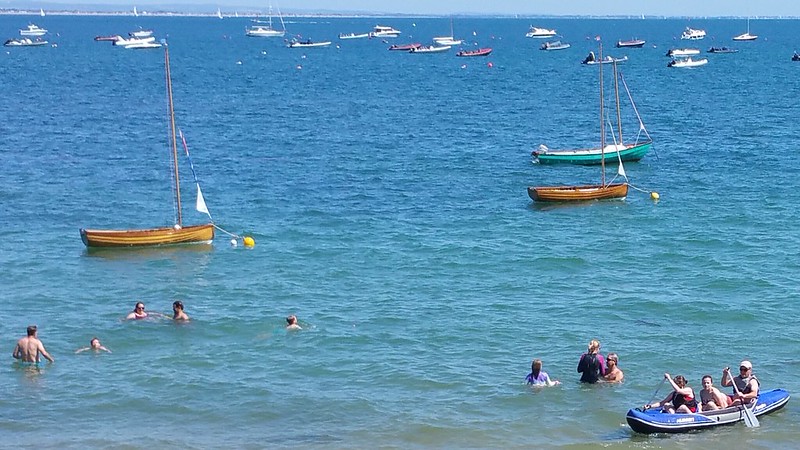
Back then, and for quite a while later, the hundreds of moorings off Nettlestone Point almost all had the lovely clinker-built Seaview dinghies on them. Returning in recent years, I've been slightly appalled to see most of the moorings with RIBs on them.

32249103468_a2b4496257_c.jpg


But, if you haven't already bought a rather heavy wooden dinghy, and especially if you'll be based in the classiest little village on the island, LW395 is right - you should join the club and hire one of their boats, which stay afloat on the moorings. All the fun and none of the hassle, and you're sure to get all the tuition you could want from members there.

If you're as keen next year as you are now, that will be the time to buy your own boat, and take on all the bother of it.

Hope you have a great time staying there, I'm deeply envious. (y)
 
Last edited:
Hi All,

I’ve been meaning to take up sailing for years and have finally decided to bite the bullet and go for it. I have the use of a small house in Seaview on the IOW and having recently had a baby I want to learn to sail now so I can teach my son when he’s old enough.

My plan is to buy a wooden GP14 and this will force me to learn. I know any sensible person would probably get trained up first, get a feel for the sport and then get a boat but I’ve decided to do it the wrong way round!

I’m really not keen to do a RYA Dinghy course due to price and the fact that courses can be so sterile. I’d much prefer to learn from someone (preferably in their/my GP14) but open to any small boat. Ideally on the south coast around the Solent

I’m very happy to pay anyone a nominal amount for a few hours of their time to show me the ropes.

Please let me know if this could be of interest to anyone!
50 odd years ago aged 18 I bought a National 12 and sailed it from Portsmouth Sailing Club, on several occasions ending up in Seaview. On one occasion I took a mate as crew and having arrived back ashore I remarked that we'd only been out for a couple of hours. He replied that that was a long time to be terrified.

After about three trips I discovered that when it heels a lot you can ease the sheets rather than just leaning out further. You get the picture. Buy one and have a go. You'll learn and you'll never forget. Have fun.
 
Unfortunately, many experienced sailors are poor teachers. I learnt from my father, and although I'm a fair sailor and a better navigator (my career was in maps and mapping!) I'm not a good teacher of sailing because I do too many things without conscious thought - I react to wind and waves almost automatically. That makes it very difficult to teach, as teaching requires the ability to explain what you're doing - and while I can explain what I'm doing, by the time I've explained, I've done it! I can (and have) run courses on geographic information systems at several different levels, but even that required considerable preparation thinking through things that were second nature to me.
 
Hi All,

I’ve been meaning to take up sailing for years and have finally decided to bite the bullet and go for it. I have the use of a small house in Seaview on the IOW and having recently had a baby I want to learn to sail now so I can teach my son when he’s old enough.

My plan is to buy a wooden GP14 and this will force me to learn. I know any sensible person would probably get trained up first, get a feel for the sport and then get a boat but I’ve decided to do it the wrong way round!

I’m really not keen to do a RYA Dinghy course due to price and the fact that courses can be so sterile. I’d much prefer to learn from someone (preferably in their/my GP14) but open to any small boat. Ideally on the south coast around the Solent

I’m very happy to pay anyone a nominal amount for a few hours of their time to show me the ropes.

Please let me know if this could be of interest to anyone!
Have you considered joining Seaview Sailing Club?
 
50 odd years ago aged 18 I bought a National 12 and sailed it from Portsmouth Sailing Club, on several occasions ending up in Seaview. On one occasion I took a mate as crew and having arrived back ashore I remarked that we'd only been out for a couple of hours. He replied that that was a long time to be terrified.

After about three trips I discovered that when it heels a lot you can ease the sheets rather than just leaning out further. You get the picture. Buy one and have a go. You'll learn and you'll never forget. Have fun.

40 odd years ago, aged 18, I bought a National 12 and sailed it from Lee on Solent to Osbourne Bay. After about 3 trips I found out how to save having to lean out all the time............

Sounds like an eerily similar start to both our sailing careers! Even terrified a mate when we capsized!
 
50 odd years ago aged 18 I bought a National 12 and sailed it from Portsmouth Sailing Club, on several occasions ending up in Seaview.

I used to sail the Topper from Bosham, where my club was, to Seaview. Eight clear miles from Chichester Entrance, across the eastern approaches to the Solent, and I couldn't always see the far side when starting. Never thought of compass or chart, it was T-shirt, shorts, buoyancy aid, and dead reckoning. Nuts. :ROFLMAO:
 
Surely, learning in a dinghy needs to be done in a group so a safety boat can help out if you get stuck? If you are already experienced then fair enough taking a dinghy out. Surely there must be plenty of crewing opportunities to start with? Either in keel boats or dinghies? A quick visit around some of the clubs as social distancing eases? Plenty of YouTube videos? Was the library when I was young and learnt with the youth activities centre. But I had read all the books on sailing in the local library before I got in a dinghy at age 14. Then progressed to crewing at the local club.
 
The current pandemic will have taught you that sterile environments preclude infection. As sailing instructor, I would say that what you are paying for, with a sailing course, is an opportunity to learn how to do things the right way and not be infected with bad habits from random sailors who may or may not know how to sail.
Apart from the safety back-up provided by formal instruction there is also the need to learn about navigation, tides, meterology etc., so as know how not to put yourself in life-threatening situations.
The RYA syllabus is structured in such a way as to impart the knowledge progressively, building on the skills learned at each level and combining them to produce a sailor competent enough to progress to instructor level.
This, I believe, would fit in with your plan to teach your son to sail.
(Please note, I am not a spokesman for the RYA, as I live in Ireland and am a member of the Irish Sailing Association.)
 
Last edited:
A GP14 is a lovely dinghy; historic I would say. But in its time it was one of the fastest dinghies. So you should regard it as a thorobred and learning on her in a moderate to brisk wind, you give an odds on tip over the side. It would be handy to have a few - not many - basic lessons at least on something forgiving. RYA courses are great fun.
 
Unfortunately, many experienced sailors are poor teachers. I learnt from my father, and although I'm a fair sailor and a better navigator (my career was in maps and mapping!) I'm not a good teacher of sailing because I do too many things without conscious thought - I react to wind and waves almost automatically. That makes it very difficult to teach, as teaching requires the ability to explain what you're doing - and while I can explain what I'm doing, by the time I've explained, I've done it! I can (and have) run courses on geographic information systems at several different levels, but even that required considerable preparation thinking through things that were second nature to me.
That is true, some are still good though. To be an rya yachtmaster instructor you have to complete a cruise instructor course first to demonstrate you have the ability to communicate the information and work with the students.
 
40 odd years ago, aged 18, I bought a National 12 and sailed it from Lee on Solent to Osbourne Bay. After about 3 trips I found out how to save having to lean out all the time............

Sounds like an eerily similar start to both our sailing careers! Even terrified a mate when we capsized!
Stuff which soon became second nature was all on a very steep learning curve then. Like the time I put up the sails while still on the water's edge at PSC, blissfully ignorant that the wind was coming from astern until a gust accelerated the boat down the shingle and off, me desperately jumping in over the stern then trying to get the fixed blade rudder onto its pintles when the water was deep enough as the boat accelerated.
 
For a beginner, the price of a course will be nominal compared to your total sailing costs over the years. You'll cover a lot of basic essentials that, as others have said, may be missed by an old hand since they are automatic to them. Some clubs want you to have adult RYA level 2 before using their dinghies (or assessed skill level).
I'd leave the boat for now, get on a course once able, then use club dinghies. They may also have a choice of boats so you can see what suits.
By all means get someone to take you out on their boat in the meantime. Although you'll learn from that, do it mainly for the experience and don't expect too much.
 
Surely, learning in a dinghy needs to be done in a group so a safety boat can help out if you get stuck? If you are already experienced then fair enough taking a dinghy out. Surely there must be plenty of crewing opportunities to start with? Either in keel boats or dinghies? A quick visit around some of the clubs as social distancing eases? Plenty of YouTube videos? Was the library when I was young and learnt with the youth activities centre. But I had read all the books on sailing in the local library before I got in a dinghy at age 14. Then progressed to crewing at the local club.
I only ever sailed with a safety boat in attendance, when I joined a club, which insisted on using them for any organised event.
Otherwise solo, in tidal waters within Solent & outside, sans radio, flares, compass. Self bailing Topper, Kestrel with bucket, Drascombe, Scow etc,etc.
You learn very quickly, not to make the same mistakes twice.
 
I'm a little surprised by the echoing recommendation that it's best to get official training. It's definitely worth reading sailing theory, specific to dinghies, in order to understand why and how the wind drives the boat, and how to de-mystify the boat's behaviour in variable conditions...

...but once the basic dynamics are reasonably clear in the mind, it's not too soon to go and put it to the test.

The only thing that matters is not being daft about the wind - if it's breezy or gusty, it's a bad day to start learning the basics unaccompanied, because too much is happening too quickly, to allow easy learning of the reasons and appropriate responses.

Likewise, if the wind is blowing offshore, making return to the beach much more challenging.

With that in mind, the prudent singlehanded novice might want to learn to row before he sails. Then he has auxiliary power if it all goes bad, or the wind dies.

Aside from that, go for it. Several brilliant sailors were reputedly self-taught.
 
I'm a little surprised by the echoing recommendation that it's best to get official training. It's definitely worth reading sailing theory, specific to dinghies, in order to understand why and how the wind drives the boat, and how to de-mystify the boat's behaviour in variable conditions...

...but once the basic dynamics are reasonably clear in the mind, it's not too soon to go and put it to the test.

The only thing that matters is not being daft about the wind - if it's breezy or gusty, it's a bad day to start learning the basics unaccompanied, because too much is happening too quickly, to allow easy learning of the reasons and appropriate responses.

Likewise, if the wind is blowing offshore, making return to the beach much more challenging.

With that in mind, the prudent singlehanded novice might want to learn to row before he sails. Then he has auxiliary power if it all goes bad, or the wind dies.

Aside from that, go for it. Several brilliant sailors were reputedly self-taught.
I have always been surprised by the number of trainees (and unfortunately other instructors) who, having read up on the subjects and been given lectures in a classroom, still manage to have serious misconceptions. Also proper instructors will only allow novices out on the water when conditions are appropriate for their skill levels.
I recommend a proper course, at a proper sailing school, it could save your life.
 
Have you considered joining Seaview Sailing Club?

I think your first task is to contact Seaview Sailing Club, especially as they are local to you,With luck the Covid19 restrictions will slowly be lifted and clubs can start to operate again.
SeaviewSC seem to have very comprehensive training facilities so should be able to help.
Our club used to run a 'Try sailing weekend' at minimal cost, a bit of theory on Friday night, rigging your dinghy and sailing on Saturday, BBQ Saturday evening, Sunday more dinghy sailing. It was a good starting point which if you decided you liked 'messing about' in boats then you could go further.
 
I am a hopeless teacher, indeed utterly pathetic, but I know a bit about sailing. One thing that I have observed is that people either get it, or they don't. They can all be taught to sail reasonably effectively, and some of them will enjoy it, but only the 'getters' can do it without hands-on tuition. If you are a natural sailor, you will be able to sense the conditions around you and it will more or less fall into place. If you can't think in three dimensions, you can learn to do it in stages, and should become competent if you can overcome the various discomforts, embarrassments and general mortification that accompanies learning new skills, and if you have the right/wrong frame of mind, you may become as addicted as the rest of us.
 
Top