What lessons for this week

A point about gluing the rudder halves, I always thought that époxy was the prefered glue for polyester components? Always use it myself, on the basis that polyester is a good ( & cheaper) laminating material but a poor glue, esp for wood.
 
Both boats are essentially in identical positions, no shading to speak of, neither dry out, both in the same river flow, on a full ebb of about 2knts.

A point about gluing the rudder halves, I always thought that époxy was the prefered glue for polyester components? Always use it myself, on the basis that polyester is a good ( & cheaper) laminating material but a poor glue, esp for wood.

Epoxy is the best solution except for when the polyester is still in cure and that can take 3 or 4 weeks for the styrene in the polyester resin to disperse.
Epoxy over uncured polyester is very likely to delaminate within three or four months.
Also on a flexible grp laminate its important you don't make an epoxy repair too stiff as this can cause failure as well.
For these two reasons I went with 3m adhesive sealant though Sabatac or even Sika would have done just as well.
 
anti-fouling. Intriguing.

Other variables. Wood vs GRP, round bilge vs chine; Meridies not in use, Rumpole in use ? (I am thinking possible localised effects of heads dscharging into weedy area on hull and supporting growth).

Other than that it has to be launching quickly after A/Fouling.
 
Hi,

just a blind shot. I'm not sure if the stuff I see is plants or animals, but it could be that there is a specific season for spreading seed cells and you have to go out to sea to catch them. Rumpole may have been out there and got the seed. I'm sorry I don't bring knowledge, only speculations.

Jan
 
Delivered the Lady of Hamford to Chichester YC earlier this week.
Left Southwold on Sunday and arrived at daybreak Tuesday morning.
I decided to take a breather from the 28knts on the nose from Dover by diving into Eastbourne for a much needed few hours kip.
The 55 year old girl did really well.
Averaged over 6knts and didn't put a foot wrong although it has to be said we did get pretty wet!

Learn't a couple of things though.

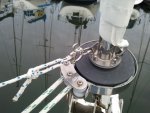
When part furling the excellent new North jib, the teeth in the sailspar furler drum eats its way through the continuous furler rope above 25knts.
Not having owned one before I hadn't appreciated this and I'm not sure at this time how to avoid it in future apart from either hoisting a smaller jib or furling completely.

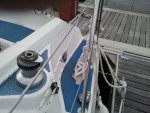
Highly polished ss cleats look very nice but when the going gets tough they can allow new braid on braid halyards and reefing lines to slip if you're not careful on how to tie it off.

Autohelms and AIS transponders are gifts from the gods.

Easbourne marina is a soulless place, though I'm thankful it was there so I didn't have to stop off at Brighton.

Ipad with navionics and the Inavx app was far easier to use than the 9" raymarine e series multi function display.

Dungeness is not a pleasant place to be, westbound in 28knts westerly wind against tide.

The Vashti class does not slam in big waves, it just plows on regardless.

Switching your auto helm from using compass to using wind data makes life a lot easier at night.

Why do they call it the Seven Sisters? I'm sure I counted at least ten.

Ais transponder (via marine traffic) apparently provides much entertainment at workplace as they discuss where I'm likely to be run down by a ship.

Border control vessel Valiant obviously don't look at your AIS track before they interrogate you about your movements.

Three big ships obviously do use AIS as they called us up directly to helpfully explain their intentions and suggest politely that I don't run them down.

Don't be tempted to cut the corner at Selsey bill despite the fact that there is plenty of water.

If there's a chance your crew will suffer from seasickness ensure you can keep them warm when they insist on suffering in the cockpit instead of dying down below.
(new use of mainsail cover and fender skirt discovered)

Mobile phones are useful to receive texts from swmbo informing you that England are 1:0 up against Iceland after only 6 minutes before promptly losing the signal and not getting an update for two hours!

Ginger biscuits are still appreciated even by people who profess to not liking them before.

Force 10 cookers are very good. (fast to boil = fast cups of tea)

I really hate Yacht mines (lobster pots) especially at night.

Arriving at Chichester at the crack of dawn just at the wind died off is worth all the above and more, see little video below.
 
Last edited:
Some good tips there, thanks.
We are leaving Burnham on Betty Alan this morning for the RTI.
I hope we make it to the start in time.
 
When part furling the excellent new North jib, the teeth in the sailspar furler drum eats its way through the continuous furler rope above 25knts.
Not having owned one before I hadn't appreciated this and I'm not sure at this time how to avoid it in future apart from either hoisting a smaller jib or furling completely.

Hmmm, i have a Sailspar continuous furler. For part furling i have a cam cleat on the coaming to prevent the sail from unfurling. Doesn't sound like this would stop what you are describing though. There are two tabs welded to the bottom of the foil, the sail tack is shackled to one of them. The other one could be shackled to the pullpit and the furling line slackened, should stop what you describe.
 
Hmmm, i have a Sailspar continuous furler. For part furling i have a cam cleat on the coaming to prevent the sail from unfurling. Doesn't sound like this would stop what you are describing though. There are two tabs welded to the bottom of the foil, the sail tack is shackled to one of them. The other one could be shackled to the pullpit and the furling line slackened, should stop what you describe.

The trouble is when you want to furl in a couple of reefs the foredeck is not the place to be trying to attach a shackle.
That said I think there's scope there for a strop with a hook or some such idea, thanks I'll have a ponder.
 
I agree it can be a fair old tug part furling in a blow, but my continuous line has never shown any sign of deterioration of the mind described on my Sailspar, sure there isn't something else doing the damage?
 
Back from having way too much fun sailing Lady of Hamford, firstly down to Chichester and then in the Round the Island race, it's back to the real job.

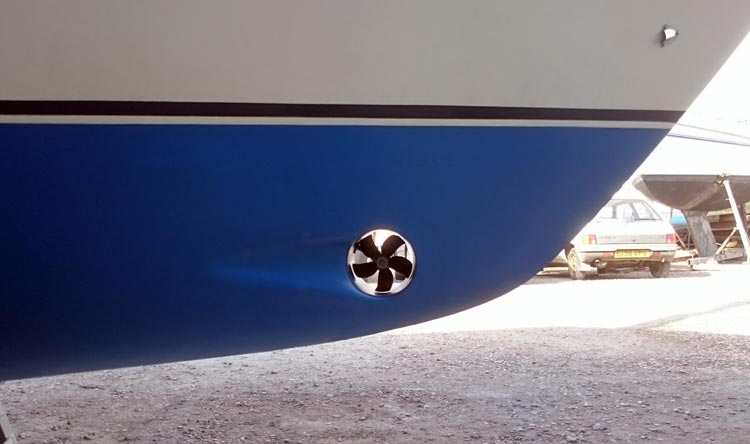
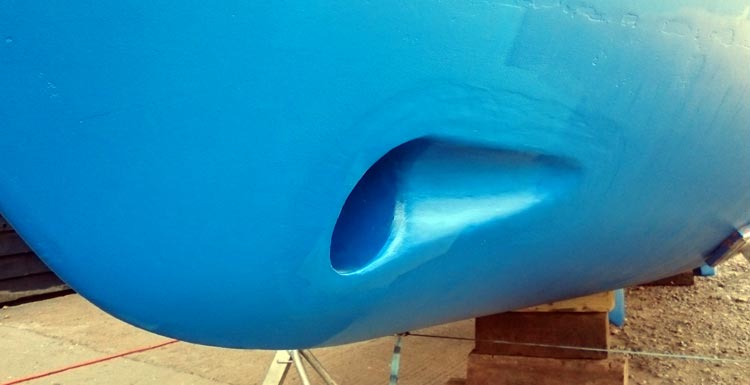
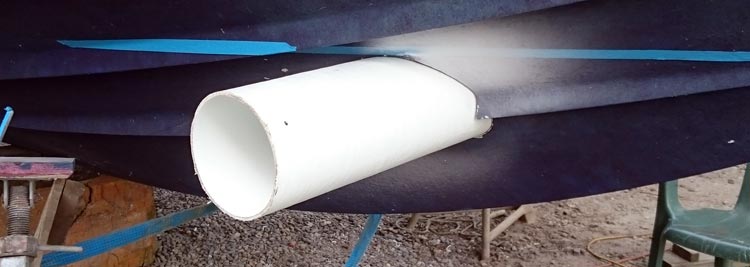
Today's challenge is to fit a bow thruster into a Fairline 36, only the owner was aware of the scalloped tube I fitted to the Southerly and the Ovni and wants a similar solution.
In the early pages of this thread I reported on the thruster on the Ovni as seen here.
fl_0011.jpg

I continued to develop the system as it really did make a difference compared to the usual eyebrow method.
Since then I've done a couple more.
fl_0012.jpg

fl_0013.jpg

However the big challenge is now is how I manage the spray rails and to be honest I'm not quite sure yet but a solution will present itself, it usually does.
fl_001.jpg

Anyway the initial process is the same.
The tube needs to be the dia of the tube below the waterline and as far forward as is practicable.
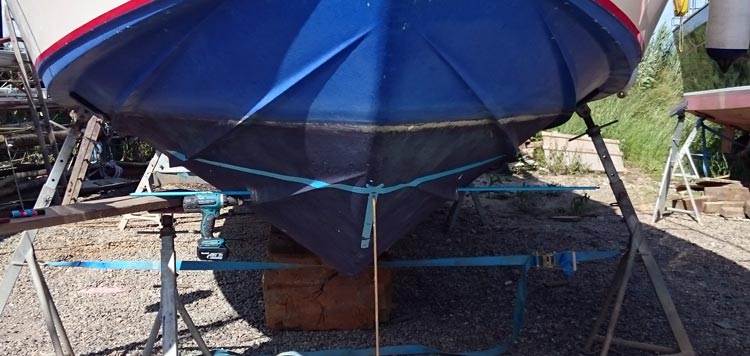
To begin with you need the boat level and then determine a couple of datum points.
Measuring down from the waterline (in this case 8") to give the upper extreamety of the tube.
fl_002.jpg

From there a length of string tied to a pen using a datum on the bow 8" below the waterline marks two arcs on either side of the hull.
Measure down from the upper tube line gives me a possible center.
Drill a hole and go and look inside to gauge if this position is workable.
In this case the first hole would result in the tube cutting into a bulkhead so I drilled another center hole 2" further aft.
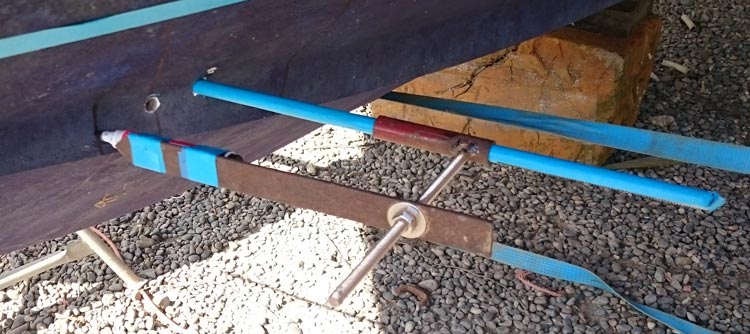
Then I pass a rod right through the hull and sight to check the hole is in exactly the same place either side.
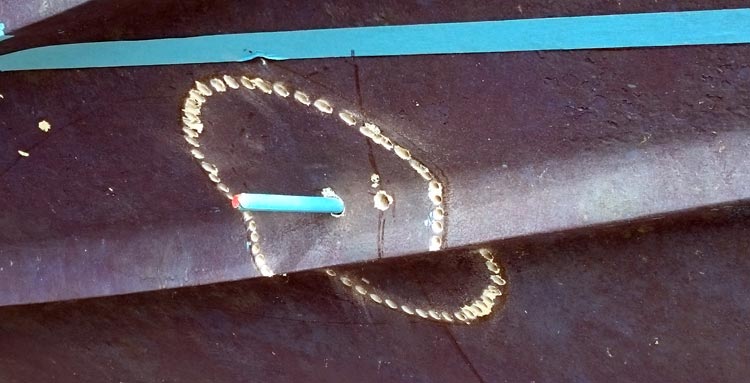
Next I use my trusty jig to mark the area I'm going to cut out.
fl_003.jpg

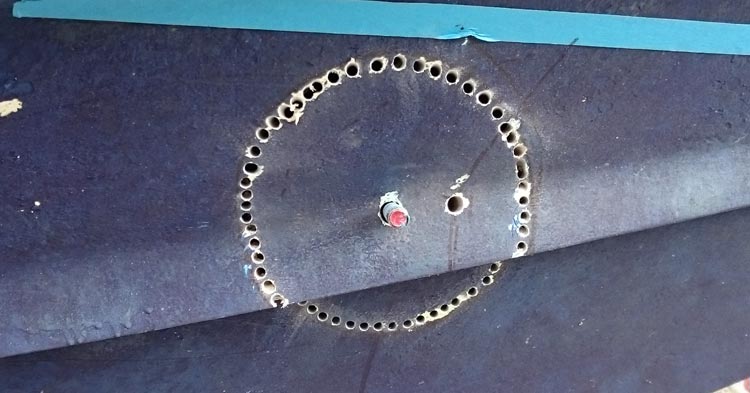
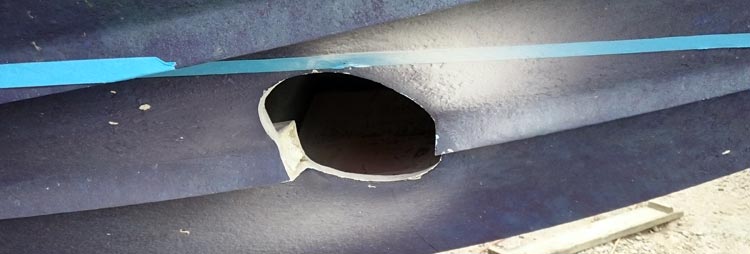
and then I stitch drill at the same angle of the rod just inside the marked area.
fl_004.jpg

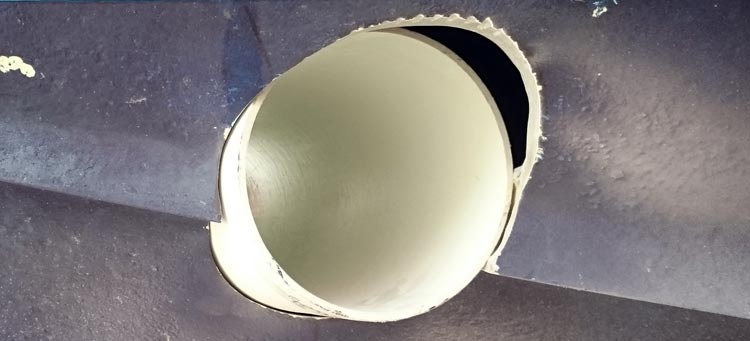
The area never looks right, how can that shape allow a round tube in??
But viewed from the angle the tube enters the hole it becomes clear.
fl_005.jpg

I'll continue with this tomorrow and report back in a later post.

The other day we had an issue with a volvo in a Oceanis 34.
The owner reported a lack of revs and he thought there might be a bit of a leak.
At first glance all looked clean and good but frankly we know this one from old.
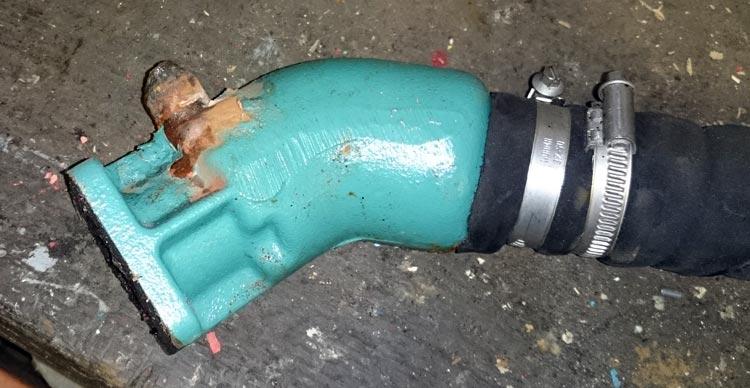
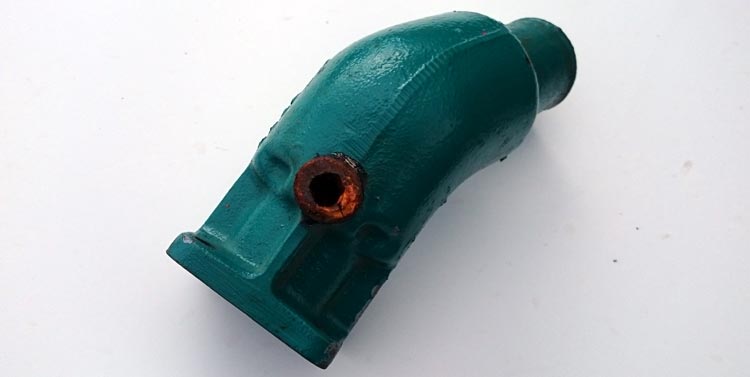
volvo_001.jpg

The leak was from the water injection pipe on the exhaust and removal of the pipe showed the corrosion.
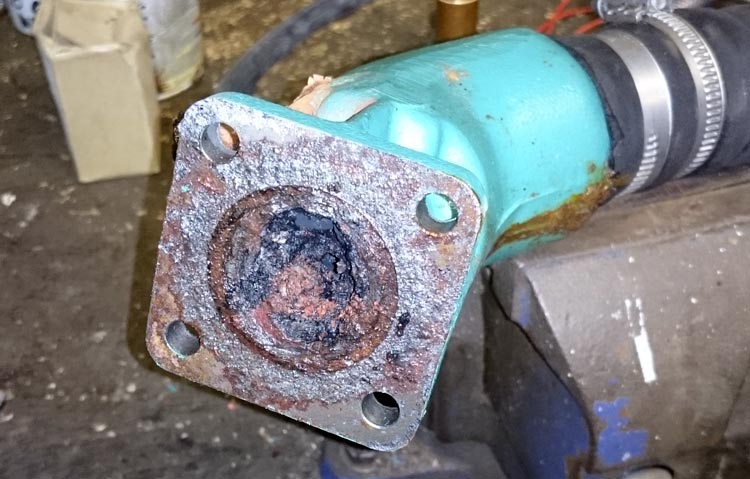
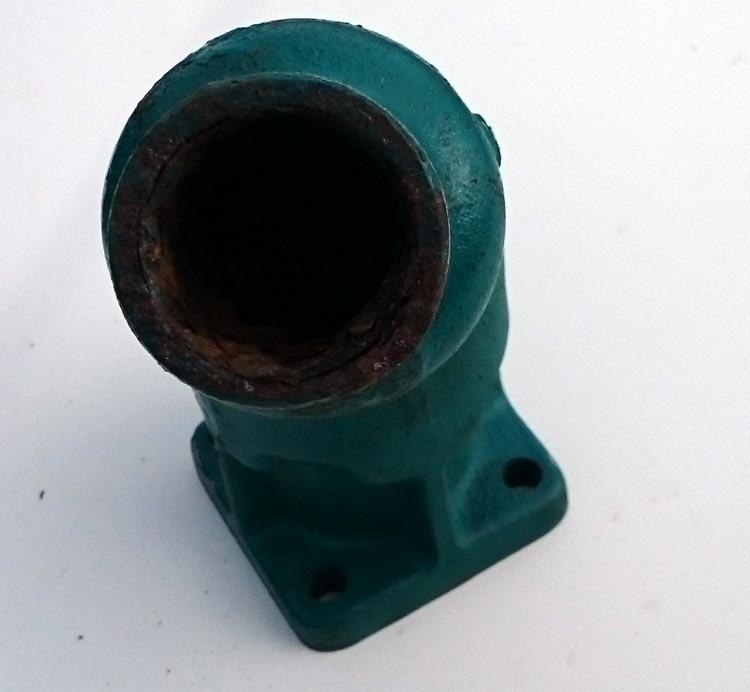
On removal of the mixer pipe the true problem was immediately obvious.
volvo_002.jpg

The exhaust was almost totally blocked.
Just a tiny hole existed to allow a smidge of water out to fool the owner that things were fine.
The owner decided to source a replacement on ebay which duly arrived today.
Its injection pipe was still on so we removed it to find what was described at "delivery miles only" pipe was what we consider almost past half life already.
Buyer beware.
volvo_003.jpg

volvo_004.jpg


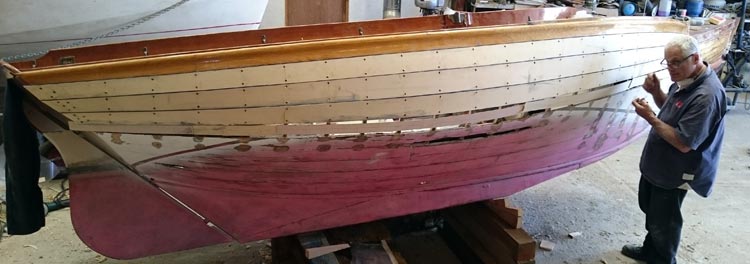
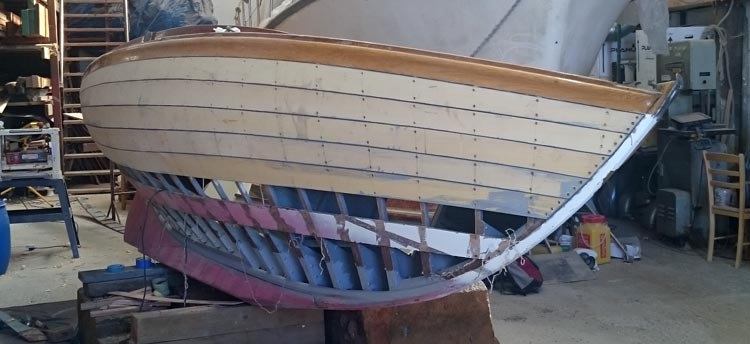
To finish up today's report a couple of shots of the Herreshoff that's in the process of being re-planked in white ceder.
Not much to say only its great to see a small classic boat being worked on in the yard as most of the stuff we do is so big.
herr_003.jpg

herr_004.jpg
 
I'll see if I can remember to take a shot of the inside.
If Mark has any concerns he places timbers on the inside to give support but also he's pretty careful how many planks he removes at a time, and usually only one side at a time.
The lower planks are not so bad as the floor supports, keel, stringers and frames etc are all in great nick.
 
That said I think there's scope there for a strop with a hook or some such idea, thanks I'll have a ponder.

A short s/s or Dyneema strop with a small snaphook, which clips onto a hole near the edge of the furling drum, stops rotation/sail unfurling when away from the boat/moored/at anchor. Takes the load off the furling line and jammer when the boat is bouncing a bit in a chop.
 
As you can see from the first pic, there isn't any scope for fixing anything to the furler drum. There is, as i mentioned earlier a drilled lug opposite the tack lug. It isn't a very big hole, but could be drilled out a little. However, the small shackle in the picture could be left in place, as it is. The line from the snap shackle is tied off to the pulpit.

This is something i just put together quickly for illustrative purposes here. If i was making this up for real i think a stainless strop would be better. I think i'd have one end crimped around the snap shackle and the other end fixed to a small rigging screw and a pelican hook. The pelican hook would go around the pulpit rail, through one of the eyes for the guard wires.

2016-07-06 20.18.11.jpg

Another issue with the Sailspar furler is that of the looped end of the furler line back at the cockpit end. Mine ran through stanchion blocks, with the last one being just over halfway from the bow, the aftmost stanchion didn't have one. If this line wasn't kept taught when unfurling the sail the stainless guide around the black furler rotated around the headstay. One it had done a couple of turns the whole lot jammed. Basically, you have to unwing some sail with the furling line as you pull the slack out of the working sheet. A two handed, if not a two man job, especially if you don't want the sail flogging as you unfurl it.

My answer to this issue was to fit another block to the aftmost stanchion, the fit a single block inside the looped furling line. This block runs through a guide on the pushpit (really wants a nice rail mounted bullseye, but i didn't have one handy) and forward to a small cleat. I also fitted a simple cam cleat to the coaming. This only comes into play when you want to stop the sail unfurling. On a normal day it isn't used until i'm back in the marina and furl the sail away, placing the line in the cam cleat to stop it unfurling. If i wanted to put a couple of rolls in the sail due to conditions i'd also use the cam cleat to keep the sail where i put it.

Javelins comments about the line being chewed cast a little doubt on the use of the cam cleat for part furling in rough conditions though. I shall monitor that and if need be will make the aforementioned stainless strop. I'll knock a rope one up for now, just in case i need one in a hurry.

2016-07-06 20.45.47.jpg
 
Thanks for the ideas, I'll pass them on.

The furler got quite a lot more abuse during the Round the Island last weekend.
We missed having a second luff groove option and it really was tough rolling in to the second reef after Bembridge Ledge buoy.
Though it has to be said I didn't see any more rope damage.
The general consensus is we'll swap it out at the end of the season for a Harken one.

It's one of the most important controls on the boat so worth spending a bit more for a good one.
I have a Harken on my boat with a similar size genoa and its a pleasure to use.
 
"I continued to develop the system as it really did make a difference compared to the usual eyebrow method.
Since then I've done a couple more."
A great thread-it is good to see how a professional approaches these jobs.
Can I ask how you prepare a GRP tube surface prior to glassing in? Also the Sidepower tube I am going to fit looks quite thin at 4-5mm thick and being below the waterline I would prefer the comfort of it being thicker. I understand the tube between the prop and motor housing has to stay as is but do you build up GRP tubes apart from the hull bonding?
I understand you are a busy working man unlike us layabout retirees but your comment on this would be appreciated.
 
I know what you mean when you look at the thruster tube at 5mm and compare it with the 20mm thick section of hull you've cut out, it looks a bit underweight.

However there is a huge difference from a 5mm thick flat-ish panel and a 5mm thick cylinder in terms of strength.
The joint between hull and tube will be at least 10mm and the actual fillet I add will be more like 20 to 25mm.

Prep on the outside is usually 40 grit sandpaper to roughen up the surface followed by a good blast from our compressed air line which will remove all the dust and loose stuff.
Inside the hull I'll hit with a 60 grit flap wheel and remove all the gelwash or paint to at least 10" around the area to be glassed.
And again a good hoover out and a blast with the air line.

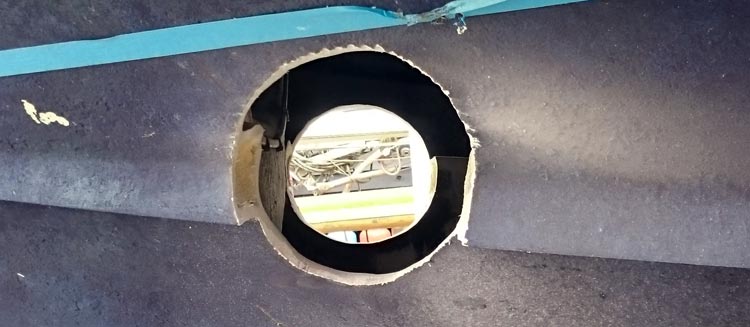
Anyway today I cut out the Starboard side and carefully sanded using a flap wheel on a 80 degree angle drill until the tube slid in.
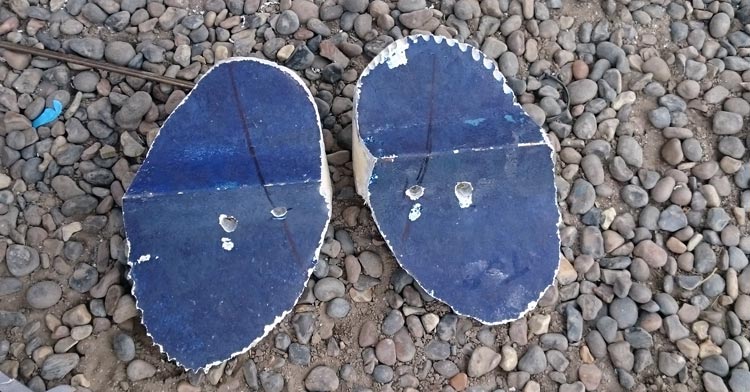
Then I stitch drilled the port side and then cut out.
fl_006.jpg

fl_007.jpg

The removed sections never look like they're the right shape but they are.
fl_008.jpg

Once the tube was inserted on the starboard side it makes trimming the port side a whole lot easier.
fl_009.jpg

fl_010.jpg

Tomorrow I'll finish trimming the port side and fully insert the tube.
Attention will shift to inside the hull to prep for glassing.
In this case there is a foam filled bulkhead, a section of which I'll have to cut away to give me access to glass the tube in.

More later......
 
Top