Only one battery?

DoubleEnder

Well-Known Member
Joined
27 Apr 2002
Messages
1,554
Location
N Hemisphere
Visit site
My new (70 year old) boat will be launched soon. She is a 25’ daysailer/weekender
I’ll spend some time sorting things out and learning how everything works, but I’m thinking about electrics. The boat has limited dry space suitable for a battery/ batteries.
We have a Yanmar 1GM with an alternator whose size is unclear, but it isn’t going to be big. I’ll check.
My electrical requirements are small and will stay small:
LED nav lights. Unlikely to be doing overnights.
Sounder and log
Tiller pilot
2 LED cabin lights
USB charger for phone and tablet.
Auto bilge pump (wooden boat)

No fridge, heater, fixed VHF, plotter, stereo, TV, radar, AIS, jacuzzi or windlass.

The current set up is a bit of a mess, with a variety of switches and in line fuses. There are two 12v batteries: one dedicated to the bilge pump, sitting in a cockpit locker and charged by a small solar panel. The other is in a proper battery box, in the cabin, charged by the alternator. The batteries are not linked in any way.

The boat will be moored on a pontoon, but I don’t want the aggro of shore power, so I would keep a solar panel. We will be at the top of the river, & it’s a good 30 minutes of motoring both in and out.

I’m going to figure out where to put a proper small switch panel, and am wondering about having just one, decent size lead acid battery in the cabin to start the engine and run everything. I could fit a meter (what sort would be best?) to keep an eye on charge.
This would save space (which is at a premium) cost, and complexity. And then I could keep one of those engine emergency starter packs just in case I exhaust the battery.

I’d value your thoughts. And, is there any advantage in using a lithium battery rather than a good quality lead acid? As you can tell I prefer simplicity if possible

Thank you
 
An AGM of around 100Ah will be fine. The alternator is 35A and more than capable of topping the battery up. The solar powered bilge pimp battery is a good idea.. You might want to reconsider using shorepower if you have it so that the main battery is always fully charged or alternatively use another solar perhaps a portable one when you are not using the boat. A simple voltmeter wll show state of charge but a battery monitor such as a NASA BM1 will enable you to more accurately monitor both charging and consumption.
 
I can’t see an advantage of lithium for you, it’ll just be a bucketload of jobs to do, money to spend. Buy a semi flex solar panel from fleabay, and a matching MPPT charge controller, connect it to your main battery, and go sailing. Hopefully this is a double ender, or I’m going to have some concerns about your user name….
 
If you're going to carry an emergency engine starter, why not use the space and weight for a dedicated starter battery? You only need something in the 30-40 AH range (the AH rating isn't too important, but the CCA rating is. The minimum for your engine is 200, so I'd look for 300), and it's always there, no faffing around. Tranona's 100AH house battery and a 0-1-2-both switch and a voltage sensitive relay will complete a robust, flexible system. I used this on a similar boat to yours for years. Add solar power - there's no such thing as too much, but the 2, 20w panels I had room for on my hatch garage, plus a PWM controller kept both batteries fully charged, and would keep up with our use at anchor in the summer, given decent weather.

Lithium in any flavour is definitely OTT for your needs. It's a good bit more complicated than just dropping the battery in and wiring it up - that could result in all sorts of exciting things happening.
 
In your position I would just fit a decent lead acid battery, with a small solar panel and charge controller, and to play it safe, a Victron Battery Protect to ensure that you don't accidentally discharge the battery too far to start the engine.
 
If you're going to carry an emergency engine starter, why not use the space and weight for a dedicated starter battery? You only need something in the 30-40 AH range (the AH rating isn't too important, but the CCA rating is. The minimum for your engine is 200, so I'd look for 300), and it's always there, no faffing around. Tranona's 100AH house battery and a 0-1-2-both switch and a voltage sensitive relay will complete a robust, flexible system. I used this on a similar boat to yours for years. Add solar power - there's no such thing as too much, but the 2, 20w panels I had room for on my hatch garage, plus a PWM controller kept both batteries fully charged, and would keep up with our use at anchor in the summer, given decent weather.

Lithium in any flavour is definitely OTT for your needs. It's a good bit more complicated than just dropping the battery in and wiring it up - that could result in all sorts of exciting things happening.
Yes but the issue is that I think I only really have satisfactory space for one single battery. It would require a fair bit of joinery work to create space for two separate batteries. So I’m thinking one decent battery to handle both starting and domestics. An emergency engine starter pack is small, light and doesn’t need to be permanently mounted. It can live in one of my tiny lockers below and provide psychological support.
 
Doubt you will ever need the backup if you have a means of topping up the battery in addition to the engine. Suggest you look at Stop/Start car batteries, either AGM or the slightly cheaper EFM. I have had good experience with these tayna.co.uk/car-batteries/exide/ek960/?gad_source=1&gclid=Cj0KCQiAlbW-BhCMARIsADnwasrUKmetsfeOWLk_e0mJDO6geu-18X1fFZKtYbb3cz1jSkoRX1bcJiYaAkKvEALw_wcB which are used in Jaguar and Range Rover diesels. Also available in smaller sizes around 75ah if you do not have the space. Obviously plenty of CCA to start the Yanmar and greater charge acceptance and lowe self dicharge than cheaper FLA. Would expect with your kind of use to get more than 10 years life. Similar type in my stop start CMax was still going strong after 7 years.
 
Is your 1GM positioned in such a way that you can hand crank it?
If so have you tried it?
If the above is true, then that could be part of your fallback emergency start strategy.
My thoughts on solar is that you can never have too much, so fit as much as you can and if that's not much then look at the portable fold away units.
You don't say what capacity your current batteries are. If you have room for a 100ah battery then also look at 110/120/130ah batteries as they are more often than not the same footprint and price isn't a linear rise with capacity.
 
If space is at a premium, but cash is not, specialist AGM starter batteries can be very much smaller than a conventional battery (lead-acid or AGM) so take up a lot less space, and can be laid on their sides so may fit into some of the odd shaped spaces one finds on boats. They are likely smaller than an engine starter pack. They have low amp-hour ratings, but very high CCA (i.e. ability to put out a lot of amps) for their size, and hence ideal for engine starting (which takes an awful lot of amps but for only very brief periods, and so actually very little in the way of amp/hours). I've had very good service from Red Flash ones. In a previous boat with restricted space that enable a much larger size and capacity domestic battery than would have otherwise been possible, or required a single battery system with the continual worry about potentially flattening the battery with domestic use and not being able to start the engine. In your case perhaps a combination of a small AGM starter battery and a medium sized domestic battery of whatever type might fit?

You might also consider getting a Voltage Sensing Relay (VSR) which will allow you to direct your charging inputs (alternator and/or solar) to your engine battery, and as soon as (and only when) it is fully charged (which is usually very fast unless it is near flat to start with) they are switched to charge the domestic battery. Much more reliable than separate or 1-2-Both type battery/charging switches, in my view.
 
I think a single battery sounds fine provided your engine is a good starter. The two most serious power drains you have are starting the engine and the tiller pilot (that can consume a fair number of Wh). It is worth going for something slightly better than the cheapest batteries (e.g. AGM) as it will more than repay the intial cost in longer working life

To monitor the state of charge all you really need is a volt meter. If you see 12.3V or below consider starting the engine to give it a bit of charge
 
. . .The two most serious power drains you have are starting the engine and the tiller pilot (that can consume a fair number of Wh).

The two are not the same thing at all. They are completely different types of drain.
- Engine starting requires a lot of amps, but very few amp hours
- A tiller pilot requires few amps, but will use ups a lot of amp hours.
It is the tiller pilot that will flatten your battery. It is the engine that won't start when the battery state of charge is low.
 
The two are not the same thing at all. They are completely different types of drain.
- Engine starting requires a lot of amps, but very few amp hours
- A tiller pilot requires few amps, but will use ups a lot of amp hours.
It is the tiller pilot that will flatten your battery. It is the engine that won't start when the battery state of charge is low.
But if your engine is a poor starter then (a) it can take quite a lot out of the battery and (b) it may be reluctant to start with a battery that is not close to fully charged. If your engine will start 1st or 2nd pull with a battery at 50% charge you should have no issues.
 
If space is at a premium, but cash is not, specialist AGM starter batteries can be very much smaller than a conventional battery (lead-acid or AGM) so take up a lot less space, and can be laid on their sides so may fit into some of the odd shaped spaces one finds on boats. They are likely smaller than an engine starter pack. They have low amp-hour ratings, but very high CCA (i.e. ability to put out a lot of amps) for their size, and hence ideal for engine starting (which takes an awful lot of amps but for only very brief periods, and so actually very little in the way of amp/hours). I've had very good service from Red Flash ones. In a previous boat with restricted space that enable a much larger size and capacity domestic battery than would have otherwise been possible, or required a single battery system with the continual worry about potentially flattening the battery with domestic use and not being able to start the engine. In your case perhaps a combination of a small AGM starter battery and a medium sized domestic battery of whatever type might fit?

You might also consider getting a Voltage Sensing Relay (VSR) which will allow you to direct your charging inputs (alternator and/or solar) to your engine battery, and as soon as (and only when) it is fully charged (which is usually very fast unless it is near flat to start with) they are switched to charge the domestic battery. Much more reliable than separate or 1-2-Both type battery/charging switches, in my view.
Thank you. I hadn’t realised that the small specialist engine starting batteries were quite that…small. Good idea. I will remeasure.
 
Thank you. I hadn’t realised that the small specialist engine starting batteries were quite that…small. Good idea. I will remeasure.
I have one of those - and also had one (a Red Flash) in a previous boat with a 1GM. However they are difficult to justify with your modest needs for the DC circuits. I went down that route because I wanted to get a larger house battery plus a separate start in a restricted space. However you then need a charge splitter and 2 separate circuits (I used a BEP cluster) and this gets costly. Approx £500 for the 2 batteries, wiring and switching plus you still need solar and/or mains to keep the house topped up.

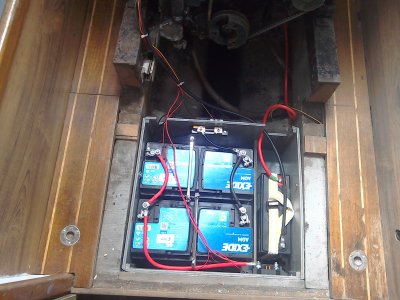
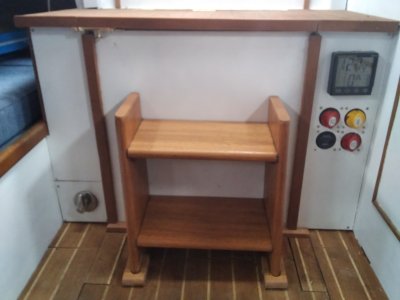
This is my current arrangement with 2 AGMs, Odyssey start battery, BEP cluster and NASA BM1 - but this is on a 31' with far more electrics including a fridge. NOt fully wired when the photo was taken OTT for your needs. The single battery will be more than adequate and doubt you will ever need a jump start. BTW although the GM can be started by hand in theory I only managed it once in the 10 years I had it.
 

Attachments

  • IMG_20220413_150908.jpg
    IMG_20220413_150908.jpg
    1,017.5 KB · Views: 6
  • IMG_20230223_132529.jpg
    IMG_20230223_132529.jpg
    1.9 MB · Views: 6
Personally ? I would stay as you are .... that dedicated battery for bilge pump is good idea as then you will not risk being able to start the engine.

Solar panel - separate for each battery is also a good idea ... they don't need to be big panels.

Of course tidying up to a reasonable switch panel and sorting wiring ... yes.
 
My new (70 year old) boat will be launched soon. She is a 25’ daysailer/weekender
I’ll spend some time sorting things out and learning how everything works, but I’m thinking about electrics. The boat has limited dry space suitable for a battery/ batteries.
We have a Yanmar 1GM with an alternator whose size is unclear, but it isn’t going to be big. I’ll check.
My electrical requirements are small and will stay small:
LED nav lights. Unlikely to be doing overnights.
Sounder and log
Tiller pilot
2 LED cabin lights
USB charger for phone and tablet.
Auto bilge pump (wooden boat)

No fridge, heater, fixed VHF, plotter, stereo, TV, radar, AIS, jacuzzi or windlass.


Thank you
No JACUZZI 😞
 
The second battery is desirable if you want a back up for engine starting. Assuming you can not start engine by hand crank. So one battery should be fine until and if it dies of old age. However the tiller pilot could flatten your one battery if you use it for long periods. Only you know what sort of usage it will have. An hour total between engine runs no problem. 10 hours will flatten battery. Lights probably not a problem.
Then there is the auto bilge pump. This could flatten your one battery over a long period. The solar PV panel might recover it over that period or may not. The result could be a failure to start engine when you return to the boat. Not dangerous just inconvenient. if you have jump start pack this could save your bacon. However it might be better to go second battery in lieu of jump starter. ol'will
 
The second battery is desirable if you want a back up for engine starting. Assuming you can not start engine by hand crank. So one battery should be fine until and if it dies of old age. However the tiller pilot could flatten your one battery if you use it for long periods. Only you know what sort of usage it will have. An hour total between engine runs no problem. 10 hours will flatten battery. Lights probably not a problem.
Then there is the auto bilge pump. This could flatten your one battery over a long period. The solar PV panel might recover it over that period or may not. The result could be a failure to start engine when you return to the boat. Not dangerous just inconvenient. if you have jump start pack this could save your bacon. However it might be better to go second battery in lieu of jump starter. ol'will

I've had boats in the past reliant on ONE battery ... I will not do that again.

OP has a battery serving his bilge pump ... easy to take a plastic tool box and modify to keep the battery in and safe from other gear in the locker. Jump leads can be carried in event of engine start battery going down ... or a Li start pack. BUT take note that the Li start packs do not like being stowed away and forgotten ... come the day you need it - display will show 100% ... press start and it fails
 
I had just one battery on my Spring 25, the posts above are all very sensible, but in real life, once I had got rid of the ageing battery the boat came with, there were no problems. Prior to that, carrying a set of jump leads and a couple of bottles of good wine helped on a couple of occasions.
 
I had just one battery on my Spring 25, the posts above are all very sensible, but in real life, once I had got rid of the ageing battery the boat came with, there were no problems. Prior to that, carrying a set of jump leads and a couple of bottles of good wine helped on a couple of occasions.

I too had single battery boats .. in fact I have one now - the Soviet Speedboat ... but that has solar and shore power for all time moored at bottom of garden. Battery is never allowed to go down.

My Snap23 - in UK - had one battery and I was forever trying to catch up on it ... I admit it was in the days when Wind was usual answer for green energy .. solar was hardly heard of. I had a Dolphin vertical wind unit ... useless !! The Outboard barely had enough out to power lights let alone charge the battery.
 
Top