
lustyd
Well-Known Member
Which begs the question of what you need to demonstrate to get liability insurance as a marine electrician, which seems the main requirement here.


Your cheque bookWhich begs the question of what you need to demonstrate to get liability insurance as a marine electrician, which seems the main requirement here.

In the US they insurers lean into ABYC certification (right or wrong). Obviously, dry-land certification would not mean anything in this case.There is a difference between "professional" and "qualified". In your domestic example above the person is likely to be both. It is possible to be a professional without being qualified. What qualifications does a professional sports person have, for instance ? What qualifications can a professional "marine electrician have ?

In the US they insurers lean into ABYC certification (right or wrong). Obviously, dry-land certification would not mean anything in this case.
I have not noticed the same extent of lithium paranoia in the US. Shhh ....


Pantaenius has excluded fire originating onboard for the past 2 years from my policy. Doesn't affect third party liability.Can you imagine excluding fire from your policy, and then burning down your own boat and your 3 neighbours. Could be a big personal bill.
Do you have Lithium batteries ? If so, who fitted them ?Pantaenius has excluded fire originating onboard for the past 2 years from my policy. Doesn't affect third party liability.
Electrical engineering is mainly maths.[
Have you though, what have the insurance company got to go on except your word (a rhetorical question)? From an insurance company perspective, they only have "professional installation" as an objective to minimise risk to them.
Yes, 2x 200ah, 3000w inverter etc. the boat is fully off grid for 9 months a year when i liveaboard.Do you have Lithium batteries ? If so, who fitted them ?
| Kind regards Nickie Morgan Customer Service Executive Noble Insurance Services |
Hi,
What is your policy for DIY installed Lithium Phosphate battery set ups?
Thank You
That's why the fire exclusion is there, Pantaenius won't insure DIY installs, they are fine with pro' installs.Yes, 2x 200ah, 3000w inverter etc. the boat is fully off grid for 9 months a year when i liveaboard.
I fitted them 4 years ago.
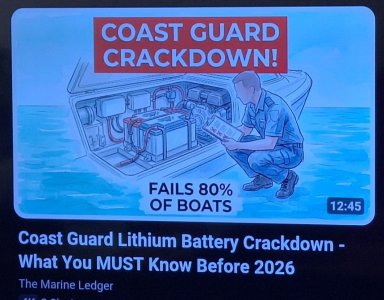
And it is internet fiction, as it applies to yachts. It is an AI generated channel that spreads misinformation and disinformation to generate clicks and stir things up. Not worth a click.View attachment 207502
This isUS l think...
Maths and a liability insurance policy for when you get the maths wrong. I think it's the second that the insurance company are interested in.Electrical engineering is mainly maths.
My boat is in Greece, i wouldn't let 90% of the professionals touch anything on my boat.
But yes, obviously insurance companies need to manage risk. I would happily pay more or pay an excess for a lithium phophate clause, as i prefer to do everything myself.
ABYC E-13 is the voluntary standard in the US, but it has become the defacto standard. I believe it is accepted world-wide. Yes, you have to pay $$$ for a copy.Maths and a liability insurance policy for when you get the maths wrong. I think it's the second that the insurance company are interested in.
Although it's more than maths, it's understanding what maths to apply when and what additional de-risking is required. It would be significantly easier if a standard or recommended practice could be created but at present we have an IET guidebook with no specifics on LiFePO4 batteries and an MCA requirement for pleasure craft used for non-leisure purposes which goes well beyond what many yachts have (or even could have) installed.
As others have said, its not hard to understand:
Q. "what you mean by "professionally installed"?"
A. Did you pay someone who is "in business on their own account" to fit it?
Q.E.D.

Entirely agree. I am perfectly competent to handle the maths and physics of an electrical installation (it's A-level physics at most) - but I am NOT familiar with standards, best practice and current recommendations regarding equipment, connectors, etc. For that reason, except in the simplest cases, I get a professional (who posts here!) to do major electrical work.Maths and a liability insurance policy for when you get the maths wrong. I think it's the second that the insurance company are interested in.
Although it's more than maths, it's understanding what maths to apply when and what additional de-risking is required. It would be significantly easier if a standard or recommended practice could be created but at present we have an IET guidebook with no specifics on LiFePO4 batteries and an MCA requirement for pleasure craft used for non-leisure purposes which goes well beyond what many yachts have (or even could have) installed.
Only if it's your normal profession. If you are a professional footballer i doubt the insurance company would accept an invoice from yourself for a Lithium installation.By that definition you could just pay yourself to professionally install the batteries.


