How would spend £200K and £1400 per month to buy a bluewater yacht to liveaboard and sail / maybe circumnavigate for years to come?

Most boats will go most places. The crew….

Money is good stuff. Hang on to as much of it as possible. A solo sailor, or a couple, can be happy and comfortable on a 10m ish boat no problem. You do not need 44 feet. Everything will be heavy, and expensive. You need big expensive winches. Long, thick, expensive ropes. Huge heavy expensive sails. A new impeller for the big heavy engine is expensive. Prices of gear are not proportional to LOA.

Moorings & storage become much more expensive. And less available.

Keep a home in the U.K. or somewhere, ashore.

Do a few short cheap courses now while the prices are low and the weather is bad. Good learning, good value. I would not do that £14k thing. Inappropriate for most people.

Be realistic about who you are, where you are, what you are. A friend’s daughter did some expensive pro courses at UKSA and has had interesting and well paid work on big boats. But she started at 19 years old, and is a very good dinghy sailor. She does not own a boat! It is going to be very very hard to make any meaningful income from sailing for most of us. Maybe the odd interesting trip on an interesting boat, a few ££ for a delivery. Not an income.

Modern designs are great. Loads of people go all over the world in them, no problem. They are well understood and excellent in many respects, 21st century is in some ways a golden age of yacht design, and there are lots available. I like all boats. Depends what you want, and if you want to sail reasonably fast and reasonably comfortably, modern will be fine. But maybe the older style pleases you in some way? That’s ok too. Mine is 75 years old and built of teak, quite insane. Tranona would kill me…..

DM if you want a chat or a sail ( Hamble)

Don’t worry about insurance if you’re going off long distance. Get 3rd party and wreck recovery. The day you buy the boat, write it down to zero on your personal balance sheet. That may be optimistic of course ……..

Oh, and consider buying a boat that’s not in the U.K. A good friend recently bought a beautiful US built boat in Malaysia. I’m going to see him soon I hope. Sounds like great cruising. And the food!
Thanks so much DoubleEnder, DM inbound shortly.
 
Here’s a personal view but biggest advantages I found on moving from a 10.8 Bav to a 12.8 moody
1 self tacking headsail with a second large out Genoa ie 2 headsails so you can be lazy and self tacking or when winds drop put on the power with Genoa etc;also has a chute on bow spirit;
2 electric winches to haul the main and trim it on German mainsheet system -you really can helm single handed;
3 two wheels -you can navigate while another helms;
4 blue tooth from the plotter -put the boat on autohelm and watch from under sprayhood ;
5bowthruster- good at 12.8m but not essential in your 10. 8m Bav;
6 bigger cockpit tent area and being able to add in side panels as required to cockpit tent (Tewsew at a price) so can sail with some protection(plus hard windscreen)
7 space to blow up dingy on coachroof and use those power winches to haul deflated dinghy from locker and haul over edge;
8ginand tonic seats on stern means in calm weather you can sit there while autohelm does its job;
9additional weight -you don’t slam in any waves at least in uk-cross channel
10 bigger boat mooring in marina-you pay for it but you can often gain a better berth in marina eg Jersey to take a resident berth or at st cast you are given a much better location;
11 more space for a crew of four -stuck on a mooring at Alderney in bad weather feels cramped at 10.8 but fine at12.8
12 much larger lockers in stern each sideto carry the kit plus you have decent seats behind wheels with something behind you -even a 470 Hanse does have this though so do consider when looking what’s behind you when at wheel -we looked at a number which felt quite exposed;
Low freeboard ideally-it really makes it easier to berth if you mid gate is closer to pontoon -some more modern designs have high freeboard(this gives headroom I suspect)
Good size bow locker to store fenders
Foldin J Prop
Greater crusing speed at quieter noise
Holds its helm up to greater wind strength -you have to reef early in Bavs whatever anyone says
Greater sail away factor
Not the same price as as Hallberg 40 etc (which was about another150k) and had less cabins/space
Parts are pretty much common to an equivalent Hanse eg lights,fidge etc


Downsides
More to berth insure etc
More than your Hanse equivalent to buy but rarity has a price
Moody 41 Classic? ... that was on my list but couldn't find a 3 cabin one at the time. Very nice boat. 👍
 
Here’s a personal view but biggest advantages I found on moving from a 10.8 Bav to a 12.8 moody
1 self tacking headsail with a second large out Genoa ie 2 headsails so you can be lazy and self tacking or when winds drop put on the power with Genoa etc;also has a chute on bow spirit;
2 electric winches to haul the main and trim it on German mainsheet system -you really can helm single handed;
3 two wheels -you can navigate while another helms;
4 blue tooth from the plotter -put the boat on autohelm and watch from under sprayhood ;
5bowthruster- good at 12.8m but not essential in your 10. 8m Bav;
6 bigger cockpit tent area and being able to add in side panels as required to cockpit tent (Tewsew at a price) so can sail with some protection(plus hard windscreen)
7 space to blow up dingy on coachroof and use those power winches to haul deflated dinghy from locker and haul over edge;
8ginand tonic seats on stern means in calm weather you can sit there while autohelm does its job;
9additional weight -you don’t slam in any waves at least in uk-cross channel
10 bigger boat mooring in marina-you pay for it but you can often gain a better berth in marina eg Jersey to take a resident berth or at st cast you are given a much better location;
11 more space for a crew of four -stuck on a mooring at Alderney in bad weather feels cramped at 10.8 but fine at12.8
12 much larger lockers in stern each sideto carry the kit plus you have decent seats behind wheels with something behind you -even a 470 Hanse does have this though so do consider when looking what’s behind you when at wheel -we looked at a number which felt quite exposed;
Low freeboard ideally-it really makes it easier to berth if you mid gate is closer to pontoon -some more modern designs have high freeboard(this gives headroom I suspect)
Good size bow locker to store fenders
Foldin J Prop
Greater crusing speed at quieter noise
Holds its helm up to greater wind strength -you have to reef early in Bavs whatever anyone says
Greater sail away factor
Not the same price as as Hallberg 40 etc (which was about another150k) and had less cabins/space
Parts are pretty much common to an equivalent Hanse eg lights,fidge etc


Downsides
More to berth insure etc
More than your Hanse equivalent to buy but rarity has a price
Thanks, reading these kind of detailed replies is great.

I’ve recently been watching YouTube to start understanding the sails you might use on a sloop. The single handed aspects of handling the Genoa or even a Spinnaker using weirdly named things like a snuffer is pretty fascinating.
 
Yes Baggy a 2015 moody 41ac -there is a kitted out 45ac moody for sale down in med but out of the OP budget -if buying one now you might be looking to replace the standing rigging and sails but would suit the OP on basis you don’t want all the other extras like . We are 3 cabin one heads with lighter woodwork (not the dark varnished type and with non leaking windows)

Rob 44 if you have to get a cruising chute forget snuffers and fit one on a Karver furler(other makes of furler are available so speak to you sailmaker as a source of info having researched by a day atSIBs even) but snuffers are so last generation tech but a Karver furler costs of corse compared to a £150 snuffer,with a squeezer head. We are a sloop and have a self tacker jib,a Genoa and if needed a cruising chute on bow spirit which fits in the spare bow roller (2 bow rollers are useful not jut for anchoring)
 

Attachments

  • IMG_2019.jpeg
    IMG_2019.jpeg
    1.9 MB · Views: 7
Yes Baggy a 2015 moody 41ac -there is a kitted out 45ac moody for sale down in med but out of the OP budget -if buying one now you might be looking to replace the standing rigging and sails but would suit the OP on basis you don’t want all the other extras like . We are 3 cabin one heads with lighter woodwork (not the dark varnished type and with non leaking windows)

Rob 44 if you have to get a cruising chute forget snuffers and fit one on a Karver furler(other makes of furler are available so speak to you sailmaker as a source of info having researched by a day atSIBs even) but snuffers are so last generation tech but a Karver furler costs of corse compared to a £150 snuffer,with a squeezer head. We are a sloop and have a self tacker jib,a Genoa and if needed a cruising chute on bow spirit which fits in the spare bow roller (2 bow rollers are useful not jut for anchoring)
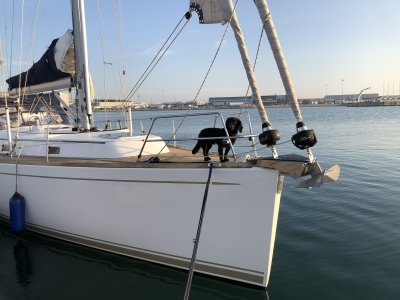
That looks a lovely boat (and dog). I also feel like I’m on a foreign language course here - in a good way though :)
 
I might indeed hate it. I’ve done very, very little sailing, however, even I can fathom dingy sailing on sunny and calm tropical waters doesn’t equate to all kinds of sailing. If I have the freedom to sail wherever and live aboard however I please, I’m going to love it. I do know this.
I don’t know how you can possibly know this! I know I love sailing, I’ve been doing it for over 30 years. I still don’t know if I’d love “blue water” sailing taking weeks to cross an ocean, I am sure I wouldn’t like doing it solo, and would be reluctant to be locked up in a confined space with people I just met. I am unsure if I would like living aboard. It would be fun for a few months but maybe not years and certainly not in poor weather: I’ve spent a week aboard with rain pouring down and everything damp, where half the crew were sea sick at anchor and was quite glad to get ashore. Even if you are tougher than me I don’t know how you can know that you will neither regret sailing or your priorities in selecting a boat. Having no option to go home is quite different. Having to move your entire home because your visa etc is about to expire could be a PITA.
I also intend to do the shorter courses where appropriate, prior to committing to the expensive long one, if that is indeed what I decide to do.
The zero-to-hero course is designed for people with no prior experience. Doing the shorter courses and then doing zero-to-hero is a waste of time and money. Doing it that way you will be paying for mile building which you could do on your own (or by chartering, volunteering to crew etc).

I’m not completely mad, and apologise if that’s how I might’ve come across.
I think someone should probably tell you that your post to PCO32 came across as rude and arrogant. You seem to have already decided which bits of advice you will attach weight to and which you will dismiss. If people point out the gaps in your logic, being snarky back is probably not the best way to actually gain the understanding you say you want.
 
I think I’ve already explained enough in my previous posts, but will add, it isn’t just the sailing, it’s the freedom and the adventure and lifestyle. I hope that paints a clearer picture. That you’ve sailed for 30 years and never crossed an ocean surprises me, but then, people are different and have different objectives. It’s no big deal.

And sometimes people just know. I knew I’d love flying without having experienced it. And numerous other very significant things. And for the life of me, I’m sat here right now trying to think of something “I knew” I’d love and didn’t, but can’t think of anything. Is that arrogance? Am I dullard? I don’t think so. I’d call it just simple honesty.

Haven’t you ever just known you’d be into something, without having fully experienced it? Perhaps not. We’re all different, and that’s perfectly fine in my book.

As I learn a little more about the courses I agree with your point here. But the very rapid gains in experience, along with presumably excellent instruction, and of course the qualification, really appeal. Much depends on my own timeline I eventually decide on though, in order to achieve my own objectives, but like selecting a boat, isn’t a lot based on compromise? Am I likely to make too many compromises and mistakes, through impatience or through being unrealistic and inexperienced? Definitely. I’ll still make efforts to mitigate against such things though.

I expect sailing to be much like flying in some aspects. Fairly straightforward, even easy, in the right conditions (unless it’s a helicopter, helicopters are nails, but we digress...) But long distance flying will inevitably see poor conditions and eventually airborne mechanical issues. Maybe some where no mention is made in the Flight Reference Cards regarding the required Immediate Actions and Subsequent Actions, and then it’s down to raw experience and airmanship. You can’t teach trainee pilots all aspects of airmanship, but good instructors can certainly assist their learning and application of it. They can create testing scenarios both in the air and simulator to help them gain experience. That kind of training is my expectation from the Yachtmaster offshore course. Hopefully that helps you understand another reason why I’m keen to do it?

I want to do the ocean course too, but mainly for the astral navigation aspect, if I’m honest. I like old fashioned nav techniques. Had to rely on them enough times :)

To finish, I’m a bit disappointed you misinterpret my reply to PCO32 as rude and arrogant, that was never my intent. The persistent questioning of my own perception is a little tiresome though.

Maybe I’m wrong, maybe you’re both right. Either way, thanks for the repetition of something you both perceive as important and apologies for my defensiveness. I look forward to getting back to speaking about boats.
 
I think I’ve already explained enough in my previous posts, but will add, it isn’t just the sailing, it’s the freedom and the adventure and lifestyle. I hope that paints a clearer picture. That you’ve sailed for 30 years and never crossed an ocean surprises me, but then, people are different and have different objectives. It’s no big deal.

And sometimes people just know. I knew I’d love flying without having experienced it. And numerous other very significant things. And for the life of me, I’m sat here right now trying to think of something “I knew” I’d love and didn’t, but can’t think of anything. Is that arrogance? Am I dullard? I don’t think so. I’d call it just simple honesty.

Haven’t you ever just known you’d be into something, without having fully experienced it? Perhaps not. We’re all different, and that’s perfectly fine in my book.

As I learn a little more about the courses I agree with your point here. But the very rapid gains in experience, along with presumably excellent instruction, and of course the qualification, really appeal. Much depends on my own timeline I eventually decide on though, in order to achieve my own objectives, but like selecting a boat, isn’t a lot based on compromise? Am I likely to make too many compromises and mistakes, through impatience or through being unrealistic and inexperienced? Definitely. I’ll still make efforts to mitigate against such things though.

I expect sailing to be much like flying in some aspects. Fairly straightforward, even easy, in the right conditions (unless it’s a helicopter, helicopters are nails, but we digress...) But long distance flying will inevitably see poor conditions and eventually airborne mechanical issues. Maybe some where no mention is made in the Flight Reference Cards regarding the required Immediate Actions and Subsequent Actions, and then it’s down to raw experience and airmanship. You can’t teach trainee pilots all aspects of airmanship, but good instructors can certainly assist their learning and application of it. They can create testing scenarios both in the air and simulator to help them gain experience. That kind of training is my expectation from the Yachtmaster offshore course. Hopefully that helps you understand another reason why I’m keen to do it?

I want to do the ocean course too, but mainly for the astral navigation aspect, if I’m honest. I like old fashioned nav techniques. Had to rely on them enough times :)

To finish, I’m a bit disappointed you misinterpret my reply to PCO32 as rude and arrogant, that was never my intent. The persistent questioning of my own perception is a little tiresome though.

Maybe I’m wrong, maybe you’re both right. Either way, thanks for the repetition of something you both perceive as important and apologies for my defensiveness. I look forward to getting back to speaking about boats.
I think you will find sail training far less structured and rigorous than flying .... you can think of it like "What happens if something goes seriously wrong?" on a light aircraft, a yacht, and a campervan (Ignoring catastrophic failure)

Light aircraft you have little time to solve your problem, and gravity will get you very quickly, so as I understand it that is why there are strict maintenance schedules, pre-flight checks etc.

In a sailing boat you are usually left drifting without and engine or sails and need another factor like injury, land, or serious weather to put the boat in real danger. Most likely outcome of a serious problem, waiting for assistance in the boat itself or a liferaft. Applying the same rigour to sailing as you would to flying would put you in the gold standard of skippers.

A campervan, most likely stuck at the side of the road somewhere waiting for a recovery service.

... so boating comes somewhere between driving and flying in terms of training IMO.
 
I remember that in a thread from 7 years ago .... but now I'm confused, was it one Jeanneau 54, or two? In the last thread it was one ... or have you since met another Jeanneau 54 owner with bearing problems? The 2018 ARC had 2 Jeanneau SO 54DS Entries - but they went out of production in 2008, but only one Jeanneau Yacht 54 which would have been in warranty - I guess that was the one? Is it one of these? Jeanneau Yacht 54

Here's a refresher of the last time this anecdote got posted ... with only one Jeanneau 54.


You did say you had no idea what kind of bearings are installed in modern production boats, but as ever conclude that everything built after some indeterminate halcyon era of boat building has the same problem.

So it's yet another anecdote bashing newer boats and going on to sing the praises of a selected feature of Trigger's broom .

If you want to help, then post something about your experience of refurbishing your boat - so we get an idea of the complete picture of buying old. The owners of newer boats can't do that because we don't have any direct experience of major refurbishments, or of the problems lurking in 40 year old boats - apart from watching YouTube rebuilds.

You have that experience, so tell us about it. The leaking teak deck removal and replacement with non-skid, the replacement of the corroded windscreen with a sprayhood, the corroded mast support and subsequent problems with the internal joinery, and the multi-national attempts to fix it, the rotting plywood on the foredeck, snapped boom etc. etc. .... these would be useful for someone contemplating buying an older boat for long distance cruising.

You've done posts on your Lithium batteries, why not do something on the structural and age related work on your boat?

... it looks like yet another disingenuous new bad, old good, post, summed up as "A Jeanneau Yacht 54 had a rudder bearing replaced under warranty after an Atlantic crossing."
But now I know what bearings are installed. I helped a friend replace his self aligning bearings.
It is interesting how upset you get about anybody criticising modern boats.
You ignore the bit about my engineering friend replacing with proper bronze bearings because thst doesn't suit your arguement.
There is no argument to have that cheap plastic bearing are a poor solution compared to bronze bearings that may never need changing so stop digging a hole
 
But now I know what bearings are installed. I helped a friend replace his self aligning bearings.
It is interesting how upset you get about anybody criticising modern boats.
You ignore the bit about my engineering friend replacing with proper bronze bearings because thst doesn't suit your arguement.
There is no argument to have that cheap plastic bearing are a poor solution compared to bronze bearings that may never need changing so stop digging a hole
It's very simple, this and many more threads on this forum appear regularly seeking experience and advice about boats. There are a multitude of experienced people here, from racers to liveaboard cruisers, creek crawlers to ocean voyagers, it is our responsibility IMO to talk honestly about the experience we have had with the boats we have owned.

Every post you make follows the same format ..... anecdotes about problems with a boat type you don't like, followed by how wonderful yours is, and usually accompanied by a CV for whatever it is you think qualifies you or a friend to be an authority on everything boats.

The one monohull you have owned has had a massive amount of remedial work done to it, but this never gets a mention on this forum. Your boat has been a regular visitor to boatyards on both sides of the Atlantic. You have numerous examples of the issues that come with older boats but never post about your lived experience. Just a continual stream of anecdotes about boats you don't like. It does seem strange, that with all your time socialising with other yachties, you don't seem to mention problems with your preferred type of boat.

The @Concerto wiki in comparison is fantastic, all the details without the ego. It is a go to resource for anyone contemplating buying a Fulmar https://wiki.westerly-owners.co.uk/images/3/3f/Concerto.pdf ... honest, open information.

Back to rudder bearings ...

With increased environmental concerns, the world has moved on from greased bearings so many shipbuilders and leisure manufacturers now use grease free polymer bearings instead. The EPA provides legislation and guidelines for bearing type and allowed discharge. Where grease is unavoidable there are EALs (environmentally acceptable lubricants), but the obvious answer to avoid pollution all together is water lubricated composite materials - the choice made by modern manufacturers.

Dropping a spade rudder, as you have noticed, is bread and butter for most boatyards - the bearings are serviceable items that don't constitute a threat to the integrity of the boat and should be inspected every year. (even if made from bronze)

By all means replace composite with bronze and a greasing mechanism if you feel the need - but self-modified rudder bearings would not be a plus point on a second hand boat, in the same way a modified keel would be a cause for concern. Hope your friend hasn't inadvertently devalued his Sunbeam.

Any belief that bronze is still the best solution is unfortunately false, and as you have stated, it requires lubrication, not to mention exact alignment or it will wear out quickly.

An anecdotal story where you cannot know the composition or history of the materials involved does not negate an industry wide move towards water lubricated polymer bearings.

Thordon for example produce grease free polymer bearings for ships rudders ... your friend would have been better replacing his bearings with a better polymer, machined to the correct tolerances, like Thordon, rather than bronze IMO.

Some resources:

https://thordonbearings.com/docs/de...ocuments/no_grease_rudder_bearing_systems.pdf

https://nyzbearing.com/rudder-bearing-comprehensive-guide/
 
But now I know what bearings are installed. I helped a friend replace his self aligning bearings.
It is interesting how upset you get about anybody criticising modern boats.
You ignore the bit about my engineering friend replacing with proper bronze bearings because thst doesn't suit your arguement.
There is no argument to have that cheap plastic bearing are a poor solution compared to bronze bearings that may never need changing so stop digging a hole
Just to add to Baggywrinkles reply - your embellished anecdote about ruddder bearings in (was it one or two?) Jeanneau 54 s several years ago does not justify your subsequent claim that they are all cheap rubbish. This ignores the 10s of thousands of boats built in the last 35 years or so using such bearings and sailing all round the world. Just because one of your mates modified his to bronze bearings is irrelevant - there is no need but if it makes him and you feel better then fine. You arre one to talk about a singular example "not fitting your argument" - pot and kettles because that is exactly how you treat others who question what you say, but in most cases ignoring either sound technical explanations or as in this case huge amounts of empirical evidence that says the opposite of what you claim.

Hardly surprising that some find your approach irritating

Just to a bit more on the subject of bearing materials. When I rebuilt the keel and new rudder on my Eventide in 1992, I designed a new heel fitting for the bottom rudder bearing. I intended casting in bronze so I consulted with 2 of my university colleagues, one an expert in metals with a PhD for his study on corrosion in stainless steels and the other a well respected expert in trybology (wear and use of lubricants). Recommendation was 316 rudder stock bronze casting with top hat Delrin insert. When I dismantled it to do some repairs to the hull around the stern 25 years later both the Delrin and stock were perfect, no sign of wear. The spare bearing I had made at the time is still buried in my bits and pieces box in the garage.
 
Last edited:
The @Concerto wiki in comparison is fantastic, all the details without the ego. It is a go to resource for anyone contemplating buying a Fulmar https://wiki.westerly-owners.co.uk/images/3/3f/Concerto.pdf ... honest, open information.
Thank you for that nice comment. Behind the scenes I have helped 9 potential Fulmar owners become owners with unbiased advice on the best boat for them based on the boats they are interested in. The advice does not stop there. I have provided lots of advice on specific problems they find, either by email, WhatsApp, phone or on the forums I participate. For members of the Westerly Owners Association, I am a BoatLine member for the Fulmar, or in other words an expert on the Fulmar.

For anyone interested in Fulmars, I have links in my forum About Me web page for the presentations I have given on renovating Concerto, and every video I have on YouTube and the forum threads that I wrote during my single handed sail round Britain via the top of Shetland. There is a link to this page in my forum signature.
 
@Rob44

So, as you can see, there is some diversity of opinion here... 😉

You pretty much already know what you want anyway and you're the one spending the money so that's what you should get..it's not a rational purchase at the end of the day. As long as a) you're not buying a project and b) you have an reasonable exit strategy if things don't go to plan then it doesn't really matter that much.

Qualifications..likewise. I took three courses (CC,CS & YM) with several thousand miles in between each. That would cost you about £1500 if you did it today. The miles were both paid and unpaid It worked for me at 20, but might not be the best for you. Only you can decide. You don't need qualifications to go sailing but as I understand it you want to give yourself options to work.

One thing to note is that YM is not the most important ticket here. STCW basics are what will open doors to you earning realistic money, the better paid yacht jobs require them as does commercial. Yacht delivery does not, but it is not vey well remunerated and you are competing with a lot of other people in your position (or the position you intend to be in) and also, annoyingly, people with time on their hands who will do it for expenses plus a bit of pocket money. Rates haven't really gone up a great deal since the '90's so in real terms they've gone through the floor. STWC's are around £1K for a weeks course and you will have no doubt done something similar with an aviation slant.

In the sector I work in now I know quite a few people who do the peak months flat out in the North/Baltic/Irish Sea are then retire to tropical climes for the remaining 8. Maybe not pilot money but enough over 4 months to keep 'em in in dusky maidens and rum for the rest of the year. You'd easily double your cruising budget with STCW's just working as a deckhand. More with a YM on top, considerably more with the MCA equivalent. Probably tax free in your situation as well. That's just one route out of many, but plenty of options out there.
 
I think you will find sail training far less structured and rigorous than flying .... you can think of it like "What happens if something goes seriously wrong?" on a light aircraft, a yacht, and a campervan (Ignoring catastrophic failure)

Light aircraft you have little time to solve your problem, and gravity will get you very quickly, so as I understand it that is why there are strict maintenance schedules, pre-flight checks etc.

In a sailing boat you are usually left drifting without and engine or sails and need another factor like injury, land, or serious weather to put the boat in real danger. Most likely outcome of a serious problem, waiting for assistance in the boat itself or a liferaft. Applying the same rigour to sailing as you would to flying would put you in the gold standard of skippers.

A campervan, most likely stuck at the side of the road somewhere waiting for a recovery service.

... so boating comes somewhere between driving and flying in terms of training IMO.
Sure, but it’s the instruction I’m after more than dealing with emergencies. I guess using an aviation-based emergency situation wasn’t a particularly good example to highlight this.

My perception of expert instruction would be someone who can create testing scenarios for the student that fully utilise their level of skill and knowledge and then develop it further.

Someone who can quickly identify errors and demonstrate better methods, and so on.

So I’m currently planning to get sailing and be around boats as soon as possible, look at shorter courses as mentioned previously and identify times to book them (soon), and whilst definitely keeping an open mind in regard to boat choice/s, compile a list similar to your one shown earlier. And of course, remain mindful of the possibility I might not like sailing.
 
@Rob44

So, as you can see, there is some diversity of opinion here... 😉

You pretty much already know what you want anyway and you're the one spending the money so that's what you should get..it's not a rational purchase at the end of the day. As long as a) you're not buying a project and b) you have an reasonable exit strategy if things don't go to plan then it doesn't really matter that much.

Qualifications..likewise. I took three courses (CC,CS & YM) with several thousand miles in between each. That would cost you about £1500 if you did it today. The miles were both paid and unpaid It worked for me at 20, but might not be the best for you. Only you can decide. You don't need qualifications to go sailing but as I understand it you want to give yourself options to work.

One thing to note is that YM is not the most important ticket here. STCW basics are what will open doors to you earning realistic money, the better paid yacht jobs require them as does commercial. Yacht delivery does not, but it is not vey well remunerated and you are competing with a lot of other people in your position (or the position you intend to be in) and also, annoyingly, people with time on their hands who will do it for expenses plus a bit of pocket money. Rates haven't really gone up a great deal since the '90's so in real terms they've gone through the floor. STWC's are around £1K for a weeks course and you will have no doubt done something similar with an aviation slant.

In the sector I work in now I know quite a few people who do the peak months flat out in the North/Baltic/Irish Sea are then retire to tropical climes for the remaining 8. Maybe not pilot money but enough over 4 months to keep 'em in in dusky maidens and rum for the rest of the year. You'd easily double your cruising budget with STCW's just working as a deckhand. More with a YM on top, considerably more with the MCA equivalent. Probably tax free in your situation as well. That's just one route out of many, but plenty of options out there.
I’m glad there’s a good diversity of opinion! 👍

Thanks for the advice. The idea of doing delivery was only from me trying to figure out a means to earn when it became absolutely necessary. The idea also being whilst I’m doing said delivery, I’m not spending and my pension is ticking up slowly, despite the costs of boat being moored somewhere cheap/safe.

Obviously I can just continue longer-term with the “grind”, and saving better, maximising further pension contributions, and so on, whilst also getting myself sailing and learning. I just don’t particularly want to do all that grind long-term. Not when I could be sailing across oceans and living anchored off some tropical reef.

So whilst I don’t expect to be pulling the plug anytime soon, I’m still going to try figure out how soon I can, even if that does send me exploring the feasibility of more dramatic avenues.
 
Sure, but it’s the instruction I’m after
Fine, but a couple of things, I found different instructors had different advice,
Same situations just different approaches.
I found the instruction useful, but learnt to do things my way on my boat.
I bought a 47ft loa. Sail boat and went off livaboard for 6 years in the Agean, no problem wth length and handling, always single handing, except when visitors, and then it was easier to do it myself rather than rely on crew, and roomy enough not to feel claustrophobic.
I might not like sailing.
With me, it's the desire to be on the water, sailing is good fun, but there's always motorboating..

You only live once, go for it.
As for burning bridges , you can always rent if you want to return.

With the qualifications (tickets,bits of paper) , i found they are of absolutely no value whatsoever if you reside in other countries, example I now am resident in Spain, as a resident I have to have Spanish qualifications making my RYA tickets useless.
 
It's hard to know which courses to recommend without knowing where you're starting from.
Have you done sea survival already?
I found VHF very useful, it's a legal requirement (not that I've heard it anybody being pulled up on it) and doing the course gave me the necessary confidence to actually use the radio. But again you might already know everything you will need here.
Day Skipper is a good level to aim for if you can already sail a dinghy and you are capable enough to take on the nav side of things. Which I suspect you will be.
I wouldn't be in a rush to do further courses at this stage. You'll learn more buying a boat and getting stuck in.
 
Fine, but a couple of things, I found different instructors had different advice,
Same situations just different approaches.
I found the instruction useful, but learnt to do things my way on my boat.
I bought a 47ft loa. Sail boat and went off livaboard for 6 years in the Agean, no problem wth length and handling, always single handing, except when visitors, and then it was easier to do it myself rather than rely on crew, and roomy enough not to feel claustrophobic.

With me, it's the desire to be on the water, sailing is good fun, but there's always motorboating..

You only live once, go for it.
As for burning bridges , you can always rent if you want to return.

With the qualifications (tickets,bits of paper) , i found they are of absolutely no value whatsoever if you reside in other countries, example I now am resident in Spain, as a resident I have to have Spanish qualifications making my RYA tickets useless.
I’d anticipate different instructors having differing views. I know a lot about it ;)

Were you doing any work in those 6 years? And going by what’s been said here, did you ever wish the boat was <12m?

Yeah, motorboats are great, and I’ve had a some fun experiences on them too. I think I get the desire to be on or even in the water pretty well. As a young kid I was given a snorkelling set in New Zealand and that was me trying to spend every waking hour in the ocean, driving my parents mad. Pretty sure they loved me regularly building and floating away in rafts as well, come to think of it.

I thought the quals would be ok if you were getting work, like from an agency, from the same country they were issued?
 
It's hard to know which courses to recommend without knowing where you're starting from.
Have you done sea survival already?
I found VHF very useful, it's a legal requirement (not that I've heard it anybody being pulled up on it) and doing the course gave me the necessary confidence to actually use the radio. But again you might already know everything you will need here.
Day Skipper is a good level to aim for if you can already sail a dinghy and you are capable enough to take on the nav side of things. Which I suspect you will be.
I wouldn't be in a rush to do further courses at this stage. You'll learn more buying a boat and getting stuck in.
I used to run mandatory sea survival training in a previous job quite a while back. If the course is still necessary then no probs. If the VHF qual is also necessary, no probs there too. I’ve used few different radios on both land and air over the decades, and VHF line of site propagation is a bit simpler than trying to bounce a HF skywave from an 8m piece of copper wire off the ionosphere as it’s getting dark 😁

Day skipper sounds like a good place to start. I believe there’s an online theory course of a few hundred pounds that goes with it?
 
Top