How would spend £200K and £1400 per month to buy a bluewater yacht to liveaboard and sail / maybe circumnavigate for years to come?

Hi Ylop, as a means to maximise experience in the minimum time frame I find the UKSA residential Yachtmaster Offshore course particularly interesting. And at 114 days long and £14500 that’s quite time consuming and expensive for me.
I wonder what the demographics are on those courses? I suspect a lot of young people trying to get into the industry, maybe some coming out of the forces in their late 20s / early 30s? I’ve no idea what age you are - but worth considering if you want to spend 114 days in close proximity to others? And if after spending £14.5k you’ll have learned the skills YOU actually need for the sailing YOU plan. I’m not knocking the RYA syllabus or the fast track approach, I think they play a role. But you could, depending on your attitude to risk, creature comforts etc, spend £2k on training, £10k on an old boat and start your adventure!
 
If you want experience another way of getting is to sign up as crew on an ARC boat or a leg on Clipper boats as crew ? Sure many other like opportunities exist but based on comments it depends if you can take time off work /sabattical type break. Weekend cross channel trips might be another option for a training course for fastnet boat -I’m not a racing type but it might prove a quick learning route even just as crew.
 
Hi Ylop, as a means to maximise experience in the minimum time frame I find the UKSA residential Yachtmaster Offshore course particularly interesting. And at 114 days long and £14500 that’s quite time consuming and expensive for me.

I appreciate I absolutely don’t have to do such a course and that the vast majority don’t, but given my situation I thought it would be money well spent.

I’ll also add I appreciate and agree with yours and other people’s sentiments to do some sailing / crewing / shorter courses prior.

And I’ll add further I’m primarily interested in hearing what boats experienced sailors might buy with that money and why. For example, today when the Moody 376 was mentioned, and looking at some online, I noticed one with a bilge keel. So I was trying to learn a little about bilge keels and how advantageous they might be with their shallower draft when it came to living onboard, primarily mooring up somewhere tropical. I figure in such circumstances the shallower draft the better (to free up more options), but how much of that advantage would be lost in performance caused by the extra drag? Would it really matter? Or would the increased stability at anchor offset that aspect? Or is it really just for sailing / mooring where there’s a considerable tidal range and it can sit on its feet? How bad is the upwind performance? And so on.

I can read of people’s opinions, which is great. I know the one that matters most is my own, and I know it won’t be of much use if I have no experience to base it on.
The UKSA programme is aimed at people who aspire to become professional skippers. Probably not suitable for what you want to do. Making a modest cruising boat go where you want to go safely is really not difficult. Most of us who cruise at this sort of level might do Day Skipper theory and maybe practical then set off in our modest boats with a good grounding in two aspects of boating - how to manage the boat and an understanding of how the external factors such as tides weather and sea states affect our boats.

As to what boat to choose - if you ask experienced people you will get twice as many recommendations as the number of people you ask - or more. It will likely be the boat they would buy if money was no object and the boat they actually bought. When I was in a similar position to you 25 years ago planning for post retirement cruising in the Med after 25 years wandering around the Channel and North coast of France and Channel Islands my money no object boat was an Oyster, my realistic boat was a Moody 376 like Grahams. As part of my research and preparation we chartered boats in the Med, including a 376 and quickly came to the conclusion that for us it was totally the wrong boat and after trying a Beneteau and a Bavaria bought a new Bavaria 37 which served us well for 15 years.

The default boats for UK based would be liveaboards cruisers starting from the UK have traditionally been the 1970-90s British built boats in the 10-12m range - many already mentioned here such as Moodys, Westerlys, Sadlers, Rivals Victoria Countesses. The reason is simple - they do the job, are affordable and in relatively plentiful supply. However the world has changed and now there is a much wider range of boats available mostly from the 1990s to early 2000s that are on the whole superior, partly because the old faithfulls are getting on in years and partly because the newer European boats have superior accommodation, are easier to sail and were built with more and better equipment. So for a notional £50k you can get a maybe reasonably refitted old British boat or a 20 year younger Beneteau, Jeanneau or Bavaria with everything more modern and up to date. Once you start looking you will see the difference.

As you will see from the many responses there are basically 2 schools of thought. The first says just buy a boat and go, learning along the way. You will find many accounts from people who do this with varying success. The second is to take a bit more time, buy a well found modest boat and spend a couple of years learning the ropes and then buy THE boat. As you might think I am in the second camp. I have seen too many people get it wrong by buying the wrong boat and setting off (or not!) without a clear understanding of what is involved in long term cruising outside our nice comfortable UK coastal waters. We nearly made that mistake but 3 years chartering in the Med made us realise that the boat must match the environment and the newer and more modern the boat the less likely you are to become a slave to the boat - spending time keeping it going rather than sailing and enjoying your freedom. The boat is a means to an end, not an end in itself.

On the question of bilge keels. These were popular in the early days of mass boating in the UK because they could be kept on shallow or drying estuary or harbour moorings which were the common type then before deep water marinas were built. They are very practical below 10m but cease to be be common above that size , partly because drying out something like a Moody 376 is hard work. I live in Poole with its shallow harbour and for the first 25 years of sailing had a shallow draft boat that could dry out on its keel and bilge plates. Once I had a marina berth I never dried out and actually converted the boat to a deeper keel and removed the bilge plates. Early bilge keel boats did not sail well - too shallow and inefficient foils for keels, but later boats are much better and do not lose much. However unless your plans involve regularly going up shallow tidal estuaries or using drying harbours there really is no benefit in having them.
 
what you might earn as a Captain
As you'll presumably be buying a British registered pleasure craft, if you want to do anything above sharing the daily expenses, you move in to a world of pain.

You'd need commercial endorsement and the boat would need to be coded. There are also limitations on single handing.
 
my realistic boat was a Moody 376 like Grahams. As part of my research and preparation we chartered boats in the Med, including a 376 and quickly came to the conclusion that for us it was totally the wrong boat and after trying a Beneteau and a Bavaria bought a new Bavaria 37 which served us well for 15 years.

drying out something like a Moody 376 is hard work.

You always seem to knock centre cockpit boats which many of us find ideal for what we want. In the 376s case, airflow through the boat is fine with forward hatch opening to the bow and aft cabin hatch opening to stern.

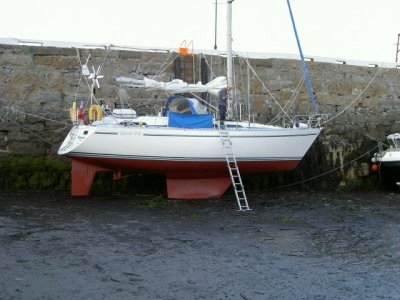
Drying out on a suitable tide isn't hard work, photo below is ours as purchased, in Castletown (before gantry, bimini etc. fitted) OTOH many newer boats you seem to like with high aspect keels aren't suitable for drying out.
 

Attachments

  • PICT0309.JPG
    PICT0309.JPG
    74 KB · Views: 8
What makes you think I am knocking centre cockpits in general? Very specific about what I wanted a boat for so tried one and we all agreed it was not suitable despite it being a nice boat for some. Cramped space on deck in the cockpit, poor access over the stern for the daily swim and nightly mooring stern too, steep steps down into a gloomy cabin. Fine for you 2 to liveaboard but not for a crew of 4 or 5 to enjoy the outdoor life of cruising in the eastern Med. And for the same money I could get a brand new boat delivered in the water ready to go.

As to drying out - yes, of course you can dry out against the wall (I have done the same with both my fin keel Bavarias), but for a single hander like the OP it may not be so easy and drying to an anchor in an estuary or tidal bay needs care - and on that size boat you end up a big ladder away from land. The OP is planning to go off deep water so no benefit in bilge keels although maybe not a deal breaker if the rest of the boat is OK.
 
In addition to Tranona's analysis I would add that when you first own either your first boat or THE boat don't try to make it your perfect boat straight away. You ca easily go down a rabbit hole of modifications that you think you need; and then one day wonder why you did it. Just because there was a cleat there on a boat you've been on doesn't mean you need one there on yours. Do you really need a cooker with a grill? Try living in the boat without the mods first. See how you get on. One thing we did was to take everything out of the lockers and then spent a while identifying each item and thinking about where we would expect to find it; or where it would be useful. That led us to identify things that we would like to change. But those ideas changed over time - so did we!

Only one thing did we deem essential: to make the forepeak a comfortable bedroom/cabin.
 
What makes you think I am knocking centre cockpits in general? Very specific about what I wanted a boat for so tried one and we all agreed it was not suitable despite it being a nice boat for some. Cramped space on deck in the cockpit, poor access over the stern for the daily swim and nightly mooring stern too, steep steps down into a gloomy cabin. Fine for you 2 to liveaboard but not for a crew of 4 or 5 to enjoy the outdoor life of cruising in the eastern Med. And for the same money I could get a brand new boat delivered in the water ready to go.

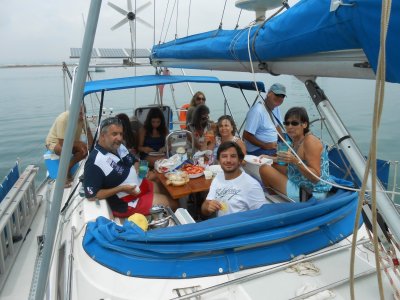
After 23 years with the boat, I don't recognise your description. Having had two aft and two centre cockpit boats, still prefer the latter and see plenty of them around Algarve and western Med. Like you, we could have bought new at the time but preferred older. Cramped, yes possibly if we had more than the 12 on board in the photo.:) Sugar scoop and boarding ladder make swimming and docking stern to, simple.
 

Attachments

  • Dscn0144a.jpg
    Dscn0144a.jpg
    342.1 KB · Views: 8
That’s clearly some good advice there Tranona, and much appreciated.

I’d want to go south and west for warmer/tropical climes, and something just shy of 12m makes perfect sense. I would hope to purchase after gaining experience and upon completion of courses. I figure the expense of an entire yachtmaster offshore course and then further oceanic would be money very well spent.

I think such courses / qualifications along with ever increasing experience could make offshore insurance easier?

The “what after” is a bit of a headache. I’m not so old where I couldn’t go back to flying, but I would be likely too old for a mortgage, so it would be either work and rent, or somehow keep a small property to rent out in the UK whilst away.

And hopefully I wouldn’t want to come back permanently until I’m ready for the old folks home.
It's not just being ready for the old folks home.
We used to joke about being carried off the boat feet first. Then one of us was, and the other became seriously ill and didn't want to live aboard, abroad, alone.
So a UK bolt hole was vital.
 
As much as I appreciate and use modern technology, such as for navigation, I seriously doubt I’ll ever be into IT enough to earn from doing remote work. Most likely work-abroad options I can envisage might be yacht delivery when suitably qualified / eventually experienced. Not just from what you might earn as a Captain, but from what you’re saving too, less the mooring fees, etc, of own boat.
Are you now thinking about becoming a full-time professional delivery skipper? it sounds idyllic - until you consider:
  • you'll need somewhere to stay in between jobs (you'll be pulling off miracles to get seemless back to back work).
  • if you do have your own boat its costing you money when you aren't using it
  • you have to work to (within reason) to the client's schedule; if this week is safe but next week is glorious sailing you are still going this week.
  • you'll be living out a holdall - not creating any "comforts" you might on your own boat
  • if you are commercially endorsed you are one failed medical from unemployment - and the medicals can trip you up on stuff which would not even make leisure sailing a second thought.
I think its a good job for either someone young, with the qualifications looking for some adventure and travel OR someone with decades of experience.
 
It's not just being ready for the old folks home.
We used to joke about being carried off the boat feet first. Then one of us was, and the other became seriously ill and didn't want to live aboard, abroad, alone.
So a UK bolt hole was vital.

It's no joke for some, we've had various liveaboard friends die abroad, others too ill to continue. Two couples who come to mind both sold their boats for peanuts and went back to UK to find they were out of NHS and bottom of the lists for social housing. Fortunately for one couple they had relatives who took them in, the others wound up in an ancient static caravan. I'll be 80 in June so having to make a decision about continuing isn't too far away. Maybe change sail for power:(.

Personally, I wouldn't consider not having a backup property, boats decline in value whereas houses increase so, very hard to get back on the housing ladder once off it. We just leave ours empty, others rent them out.
 
Buying your first boat is a journey of discovery .... my top tips to add to the advice already given are as follows.

Get on as many boats as you can just to see the variety and get a feel for all the different possibilities - second hand boat shows, new boat shows. No need to sail them at this point, just have a look. Could you live on the boat? Be honest and think about your intended cruising ground and most importantly, the lifestyle you currently lead. Do you expect everything to be shiny and new looking, or are you OK with a bit of dirt, a dated look, and minor damage or heavy wear? Get on all the boat sales web sites and see what is available. Mark favourites and see how your preferences change with time.

Educate yourself on boats ... and I don't mean the plethora of YouTube channels proclaiming to tell you which boats to buy or avoid ... go to surveyors channels, the ones that don't have a lifestyle to sell or an axe to grind. They post the issues they find. Riggers channels, repair channels, even boat scrapping channels. They will give you a good idea of what goes wrong with boats. Restoration channels are also good, they show what is lurking under the surface of relatively sound looking boats. "Sail Life" and Mads restoration of Athena is a must see. He is totally over the top in his meticulous approach, but his channel shows how he does top-shelf repairs and upgrades to his various boats. He is honest and straightforward.
This playlist from Sail Life is well worth watching - it's the restoration of his second boat, a Warrior 38 called Athena. Project Athena (DIY sailboat restoration)

Every boat owner on this forum has a boat they bought for their own reasons ... their decisions are down to budget, experience, DIY capability, actual usage, lifestyle expectations/aspirations and the compromises they are prepared to make ... but most of all, there is an awful lot of validation-seeking behviour. Don't know why it is so tribal, but it is - you will never get boat owners to agree on anything unless they sail the same boat. So ignore it all - this is your boat, and your decision. You just need to be honest with yourself and get it right for you - every boat is a compromise and that compromise is unique to each of us.

Make a wishlist for the things you want in a boat - it gives you something to focus on and you can change it as you see more and more boats ... mine looked like this and it will in no way match yours ... but it gives an idea of what to think about.

Overall requirements ….

Mediteranean live aboard.
Extended cruising, don't sail to a fixed schedule, will avoid bad weather.
Mainly anchoring, avoid marinas, swimming & showering often.
No interest in northern/southern cold weather or heavy weather sailing.
Might do an ARC later.

Dealbreakers … MUST HAVE!

12-13,99m LOA
White textured gelcoat decks.
Dry, clean bilges, no water under the floor, no leaks into bilges.
At least 3 private sleeping cabins (bunks OK) - sleep 6 in comfort without saloon.
Clean contemporary interior - must be bright and airy with plenty of windows and light - no dark wood.
Freezer or space for a freezer.
Chart Table/Desk - big enough for laptop/tablet.
No more than 2 heads.
Seperate shower cubicle that can be closed off - preferably no sink or toilet in shower area.
Roller furling main - furling from cockpit.
Twin helm with easy walkthrough into seating area.
Big aft cockpit - must seat at least 8 in comfort underway and 10+ for entertaining.
Big bimini/sprayhood - plenty of shade
Big, sturdy cockpit table
Swim platform or sugar scoop stern with swim ladder and shower.
Space for a Watermaker.
Engine with enough reserve power/space for additional high-output alternator or room for a generator.
Mainsheet/Boom clear of cockpit occupants.
Front Opening Fridge

Dealbreakers …. MUST NOT HAVE!!!

Teak Deck
Sun damaged caulking on cockpit teak causing black stains.
DIY disasters - random equipment/decorations fixed all over the inside of the boat.
Screw holes, discoloured veneer, damaged interior wood from removed equipment/decorations, hard use.
Damp/Mould/Leaks or bad smells.
Large repairs from accident damage (Grounding/Heavy collision)
Water damaged or rotten balsa core, exterior screws into balsa core, exposed balsa core, non-original deck fittings.
Keel problems (leaking or suspect keel bolts - ineffective keel sealant).
Moisture in the hull/deck or water ingress in the rudder
Water stained interior wood or signs of water ingress.
Leaking windows, vents, fittings.
Failing rudder bearings.
Engine oil/fluid leaks
Electrical bodges, DIY amateur wiring
Solar Panels glued or screwed to deck - holes in deck.

Wanted features ….

Teak in cockpit (if in good condition)
4th cabin with bunks.
L-shaped galley
White fiberglass hull, not painted or wrapped.
Built in last 10 years.
Master cabin with good view outside.
Salon convertible to sea berths with lee cloths.
Main, genoa and code zero sheets/winches accessible from helm.
Engine control on binnacle, not floor.
Water Tankage over 400l.
Fuel tank around 200l.

Wanted Mods/Extras …. The more the better

Electric or Hydraulic bathing platform.
Big robust arch on stern with dinghy davits, solar, outboard crane.
Babystay fixing point on foredeck.
Cool box in cockpit or ability to fit one
Furling Code Zero or equivalent.
Folding Prop.
Air Conditioning/Heating
Double anchor roller
Windlass drum usable with anchor locker closed.
Midship cleats and gates in guard rails.
Electric winches
Self tacking jib
Generator or space to fit one.
Washing machine or space to fit one e.g. Daewoo wall mounted.
Upgraded engine option

Not important if reflected in lower price ….

Condition of cooker
Condition of toilets
Condition of sails
Condition of sprayhood/bimini
Condition of mattresses/upholstery
Condition of anchor/chain
Condition of safety equipment
Condition of standing rigging
Condition of running rigging
Condition of seacocks and through hulls.
Condition of antifouling
Condition/Age of electrical equipment/instruments
 
Buying your first boat is a journey of discovery ..

That is something of an understatement with our first boat.

Knowing nothing, we relied on sellers 2 year old survey which stated "hull epoxied". Did speak to their surveyor who confirmed it but we didn't pay to have the survey assigned to us. Yes it had been epoxied, over a very damp hull which looked like craters on the moon 2 years later. Engine (MD11C) lost oil pressure coming out of Falmouth on delivery trip to Conwy.

For first boat, always get your own survey.
 
Last edited:
Maybe because the dreamer gets so much carp to read, realise it's a waste of time.
I mean have you really read and thought about what's written above....
Nonsense. If you look at the responses on here and the other threads then the common theme is that a lot of people have put a lot of effort into responses aimed to help. Some really positive, others more cautious but rightly so. The other common theme is that after a handful of interactions the poster is never heard from again. We don't know whether they followed their dreams or wandered on to a different one. The exception mentioned above bought a boat and kept everyone updated.
If a couple of cautious replies puts someone off from the forum then they are not likely to have the resilience to become a World girdling liveabord.
Do a search and you will likely find a few dozen similar posts. I pulled out 4 or 5 after a 2 minute search.
 
Is there a price floor where this becomes no longer economically viable? How much would you spend without getting a survey? Paying survey costs for a £5k boat is a big percentage of the purchase price.

Much depends on purchaser's financial state, whether they have enough reserve to carry out potentially expensive repairs but, if wanting comprehensive insurance, insurers will want survey unless pretty new. Old very cheap boat, third party + wreck removal + pollution is OK for some folks.
 
The UKSA programme is aimed at people who aspire to become professional skippers. Probably not suitable for what you want to do. Making a modest cruising boat go where you want to go safely is really not difficult. Most of us who cruise at this sort of level might do Day Skipper theory and maybe practical then set off in our modest boats with a good grounding in two aspects of boating - how to manage the boat and an understanding of how the external factors such as tides weather and sea states affect our boats.

As to what boat to choose - if you ask experienced people you will get twice as many recommendations as the number of people you ask - or more. It will likely be the boat they would buy if money was no object and the boat they actually bought. When I was in a similar position to you 25 years ago planning for post retirement cruising in the Med after 25 years wandering around the Channel and North coast of France and Channel Islands my money no object boat was an Oyster, my realistic boat was a Moody 376 like Grahams. As part of my research and preparation we chartered boats in the Med, including a 376 and quickly came to the conclusion that for us it was totally the wrong boat and after trying a Beneteau and a Bavaria bought a new Bavaria 37 which served us well for 15 years.

The default boats for UK based would be liveaboards cruisers starting from the UK have traditionally been the 1970-90s British built boats in the 10-12m range - many already mentioned here such as Moodys, Westerlys, Sadlers, Rivals Victoria Countesses. The reason is simple - they do the job, are affordable and in relatively plentiful supply. However the world has changed and now there is a much wider range of boats available mostly from the 1990s to early 2000s that are on the whole superior, partly because the old faithfulls are getting on in years and partly because the newer European boats have superior accommodation, are easier to sail and were built with more and better equipment. So for a notional £50k you can get a maybe reasonably refitted old British boat or a 20 year younger Beneteau, Jeanneau or Bavaria with everything more modern and up to date. Once you start looking you will see the difference.

As you will see from the many responses there are basically 2 schools of thought. The first says just buy a boat and go, learning along the way. You will find many accounts from people who do this with varying success. The second is to take a bit more time, buy a well found modest boat and spend a couple of years learning the ropes and then buy THE boat. As you might think I am in the second camp. I have seen too many people get it wrong by buying the wrong boat and setting off (or not!) without a clear understanding of what is involved in long term cruising outside our nice comfortable UK coastal waters. We nearly made that mistake but 3 years chartering in the Med made us realise that the boat must match the environment and the newer and more modern the boat the less likely you are to become a slave to the boat - spending time keeping it going rather than sailing and enjoying your freedom. The boat is a means to an end, not an end in itself.

On the question of bilge keels. These were popular in the early days of mass boating in the UK because they could be kept on shallow or drying estuary or harbour moorings which were the common type then before deep water marinas were built. They are very practical below 10m but cease to be be common above that size , partly because drying out something like a Moody 376 is hard work. I live in Poole with its shallow harbour and for the first 25 years of sailing had a shallow draft boat that could dry out on its keel and bilge plates. Once I had a marina berth I never dried out and actually converted the boat to a deeper keel and removed the bilge plates. Early bilge keel boats did not sail well - too shallow and inefficient foils for keels, but later boats are much better and do not lose much. However unless your plans involve regularly going up shallow tidal estuaries or using drying harbours there really is no benefit in having them.
I want to do the course for more than just fast-track experience. I figure it could be a useful qualification for work in the future. I can’t exactly go fly multi-million pound aircraft after years of not flying or at the drop of a hat/part-time, but could deliver yachts and so on. And the course content hugely appeals.

May I ask why the Bavaria over the Moody? I guess at least partially through being much more modern / newer and better value for money, given your following paragraph? I seem to be seeing some negativity and arguments around Bavaria, such as people questioning their offshore ability in rougher weather and so on, and maybe even some clips of experienced people on YouTube being somewhat negative of them. I’ll defo have a re-watch and look into this further, because I trust what you say and it makes perfect sense.

I plan to be in the 2nd school you mention, just within a tighter timeline if it’s possible :)
 
In addition to Tranona's analysis I would add that when you first own either your first boat or THE boat don't try to make it your perfect boat straight away. You ca easily go down a rabbit hole of modifications that you think you need; and then one day wonder why you did it. Just because there was a cleat there on a boat you've been on doesn't mean you need one there on yours. Do you really need a cooker with a grill? Try living in the boat without the mods first. See how you get on. One thing we did was to take everything out of the lockers and then spent a while identifying each item and thinking about where we would expect to find it; or where it would be useful. That led us to identify things that we would like to change. But those ideas changed over time - so did we!

Only one thing did we deem essential: to make the forepeak a comfortable bedroom/cabin.
Things I’m thinking I want are primarily an off-grid capability. So for example…Professionally fitted lithium batteries/modern solar panels, water maker and wind generator and so on.

Also, a decent well fitting bimini enclosure. I seem to be attracted to large central cockpits with comfortable space to lie down.

An autopilot and hydrovane.

An ability to reef / manage the sails from the cockpit.

An electric windlass, with a good modern anchor and lengthy chain that’s in good order.

A decent tender with 2 stroke. Probably with those davit thingy’s to raise and lower it.

Sugar scoop stern.

A sloop for single-handed simplicity.

Live-aboard space that’s at least relatively spacious and light. Lots of space for storage, diesel and water.

Bow-thrusters.

I’m sure there’s other things, but all that’s at the forefront of my thoughts for now.
 
Top