How I hate the anchor trip line

After having tried all of them, if necessary I now use type "E".
It does not tangle either boat/keel/chain even after repeated 180° turns, it does not annoy other boats passing by, no need to swim to use it.
The floaters must be made of stiff foam, those for underwater nets; the swimming pool ones come up crushed.


View attachment 158233

Here it is, on the anchor side a fixed shackle is better, sometimes the opening ones have gone free, possibly because of the amount of soil accumulating around them. The other one is attached to a specific point of the chain where I put some markers.

View attachment 158234
I'm planning on anchoring in Plymouth this summer and tripping lines are advised in certain areas. I rigged myself option C some years ago but never used it in Dorset and Solent areas as good sand and also little wary of causing a problem to others and getting it all tied up when retrieving the anchor!!

I've wondered whether option D using a ski tow rope which as it floats may make it easier to retrieve with the anchor. Once deployed I would then keep it tight ish to the bow rather than let it float everywhere and be a risk to others.

Any thoughts?
 
I'm planning on anchoring in Plymouth this summer and tripping lines are advised in certain areas. I rigged myself option C some years ago but never used it in Dorset and Solent areas as good sand and also little wary of causing a problem to others and getting it all tied up when retrieving the anchor!!

I've wondered whether option D using a ski tow rope which as it floats may make it easier to retrieve with the anchor. Once deployed I would then keep it tight ish to the bow rather than let it float everywhere and be a risk to others.

Any thoughts?
I will first confess I rarely use them, option B to me looks interesting and possible in large tidal ranges.

In my favourite anchorage, with a 2m draft I anchor in 2.5m at LW. Tidal range at springs is circa 9m. The tripping line only needs to be 12m BUT with 4 times scope I can be 40m away, not where someone would expect a small buoy, or worse think they had found a spare mooring buoy!
 
I'm planning on anchoring in Plymouth this summer and tripping lines are advised in certain areas. I rigged myself option C some years ago but never used it in Dorset and Solent areas as good sand and also little wary of causing a problem to others and getting it all tied up when retrieving the anchor!!

I've wondered whether option D using a ski tow rope which as it floats may make it easier to retrieve with the anchor. Once deployed I would then keep it tight ish to the bow rather than let it float everywhere and be a risk to others.

Any thoughts?
If you don't have a copy of this it is well worth a look.

https://spba.org.uk/wp-content/uploads/2019/03/Plymouth-Anchorages-Moorings.pdf
 
...surprised that anybody bothers with a trip line in places where the water is warm, shallow, and clear. Not only can you see what's going on, but you can easily dive to fix it. Maybe it's to mark out their space to stop anybody getting too close.

We had a similar approach and used only in anchorages that were known to be foul and >10-12m deep. They don't even 'mark your space', over the years we must've had 6 or 8 occasions where another boat (fortunately small motorboats) have moored-up our trip-line buoy, despite it being clearly marked.
A favourite remains the chap in Sardinia, who tagged onto our trip line buoy and then shouted across to suggest that we were too close to each other, but as he was on a mooring, it was we who would have to move. I think he was suprised by and certainly smug at, how readily we agreed - we were planning on leaving in another half hour any way - the look on his face changed markedly when having got the anchor aboard, we then began hauling in the line on his mooring buoy too.-
 
I've always been tempted to have a marker buoy marked up with 'Unexploded Ordnance'.

I wouldn't rely on that working: We once got caught in an unexpected southerly blow to the north of Sicilly - not what you want as you approach the Messina Straits - so after a glance at the charts I identified a likely looking bay a couple of miles to the SW of us and we beat into that and anchored no more than 50m from the beach... it was lovely. With more time and less bouncing I had a better look at the chart the following morning ahead of our departure to Messina, which was when I saw the chart note about 'No Anchoring, Unexploded Ordnance', I reckoned that our anchor was set just about on the U of unexploded... oops.
 
We have a trip line that we've only used twice in the last 20 odd years. The 'buoy' is a decoy duck...
The first year we were cruising - 2003 - we met a chap in Normandy or maybe the Channel Islands who had similar and when not fastened to the anchor, the duck got towed astern; he reckoned the duck had completed three Atlantic Circuits on its own, keel(?) and to be fair, the duck was sufficiently weatherbeaten for the story to be true.
 
I wouldn't rely on that working: We once got caught in an unexpected southerly blow to the north of Sicilly - not what you want as you approach the Messina Straits - so after a glance at the charts I identified a likely looking bay a couple of miles to the SW of us and we beat into that and anchored no more than 50m from the beach... it was lovely. With more time and less bouncing I had a better look at the chart the following morning ahead of our departure to Messina, which was when I saw the chart note about 'No Anchoring, Unexploded Ordnance', I reckoned that our anchor was set just about on the U of unexploded... oops.
As Plymouth is my current home port and given the latest UXB find

Plymouth bomb weighs 500kg and is 80 inches long

My idea might not be as daft as it first sounded.

I do wish journalists would stick to metric values.
 
After having tried all of them, if necessary I now use type "E".
It does not tangle either boat/keel/chain even after repeated 180° turns, it does not annoy other boats passing by, no need to swim to use it.
The floaters must be made of stiff foam, those for underwater nets; the swimming pool ones come up crushed.


View attachment 158233

Here it is, on the anchor side a fixed shackle is better, sometimes the opening ones have gone free, possibly because of the amount of soil accumulating around them. The other one is attached to a specific point of the chain where I put some markers.

View attachment 158234

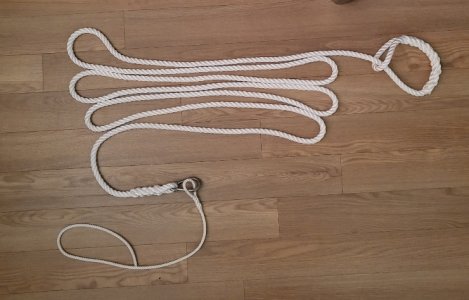
So i've gone for floating 8mm rope that is rated to excess of the anchor in line with a D/E variation. I bought 6m and then spliced both ends. The large spliced end will be looped through the head of the anchor (mine has a small bar); chose this to avoid a shackle that i'd no doubt drop the pin overboard when attaching! The small spliced end with the SS carabiner will clip to anchor chain as its fed out. The small rope (im going to modify further) will be tied to a cleat as a safety anti-drop measure whilst the carabiner is attached to the chain. Im hoping this will make the whole process easy when i need to deploy.
 

Attachments

  • tripping setup.jpg
    tripping setup.jpg
    133.2 KB · Views: 15
So i've gone for floating 8mm rope that is rated to excess of the anchor in line with a D/E variation. I bought 6m and then spliced both ends. The large spliced end will be looped through the head of the anchor (mine has a small bar); chose this to avoid a shackle that i'd no doubt drop the pin overboard when attaching! The small spliced end with the SS carabiner will clip to anchor chain as its fed out. The small rope (im going to modify further) will be tied to a cleat as a safety anti-drop measure whilst the carabiner is attached to the chain. Im hoping this will make the whole process easy when i need to deploy.
Can you feed back how you get on in due course?

I use a 'sinking' line with buoy tied to the amchor and I hank the rope to shorten it for depths under 10m. But am open to try these alternative systems.

I nearly always use it. One of the few times I didn't I picked up a massive old rope about 4 inches diameter which my winch managed to raise and I could free the anchor.
 
I like the look of Option D. If this was executed with non floating rope would it follow the chain more closely?

thanks
 
I like the look of Option D. If this was executed with non floating rope would it follow the chain more closely?

thanks
If the boat wanders left to right, the rope risks to grab a rock or being tangled somewhere along the sea bottom, which in principle is something one is trying to avoid, of course no risk if sand or mud; also, if you anchor in a place with tide reversals, there is the risk of the rope twisting/interfering with the chain: if the rope eventually becomes tighter and shorter than the chain you risk to trip the anchor.
 
First come first served, maybe they do take up a lot of room, but in small anchorages it is over crowding that causes the problems. there is always someone who feels they can squeeze themselves in. Then the next morning when you want to leave early you find their chain has crossed over yours, or they can step into your cockpit.
 
Am I alone In my dislike of deploying an anchor trip line? I have a trip line from the back of the fluke up to a block which is attached to a pick up buoy. Line then through the block with a lead weight on the other end so the float is pulled directly over the anchor by the upward tension on the vertical line from the fluke to block. All good methinks. But then the flukey wind blows the boat over the top of the anchor buoy and it disappears under the boat, then pops up the other side. So skipper stress develops at the thought of the trip line getting wrapped around keel, rudder or prop. Sometimes I think the worry of not getting the anchor up is less than the stress induced by the trip line. Do all of you old sea dogs just chuck it over the side and don’t worry about it?

I should confess to an incident twenty years ago in the Morbihan where I had the trip line wrapped tightly around the prop which required a dive to sort it - so there’s bad history in my head!

Any wise guidance as to technique and stress reduction gratefully received……
Two years ago we were anchored in a busy French anchorage with a trip line to a buoy. We got back from the restaurant to find we were the only boat pointing away from the wind. The line had got wedged between the top of my rudder and the skeg. I was effectively moored by the rudder . Fortunately the rocna was so well dug jn that the line hadn't tripped. I had to cut the line to free myself. Since then I haven't bothered with the trip line at all.
 
Two years ago we were anchored in a busy French anchorage with a trip line to a buoy. We got back from the restaurant to find we were the only boat pointing away from the wind. The line had got wedged between the top of my rudder and the skeg. I was effectively moored by the rudder . Fortunately the rocna was so well dug jn that the line hadn't tripped. I had to cut the line to free myself. Since then I haven't bothered with the trip line at all.
I feel your pain, been there and done that. In theory an anchor buoy is good practice but in reality it’s a PITA.
 
Top