
Genoa size (furling) vs windward performance

skyflyer

Well-Known Member
Joined
26 Jan 2011
Messages
1,433
Location
Worcester, UK
Visit site
I'm going to replace my (original, 1996!) genoa at the end of this season and would like some advice as to what would be the best sizing given the following criteria. I should point out that my current 135% genoa is not giving us great pointing - although whether that is due to age or sizing I don't know!

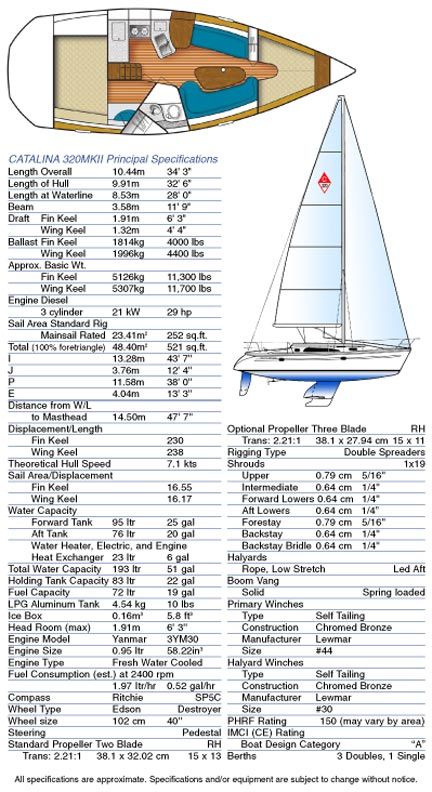
32ft masthead rigged sailboat with a broadish beam (13ft) and sugar scoop stern (i.e. it doesn't narrow significantly once aft of max beam). 4.5 tonne displacement, drawing 1.3m with a wing keel of approx 2.5 tonnes.

Heres the spec sheet of the Mk 2 model which is pretty similar
970c4a6160bd7efdfbbc92940b443f64.jpg


I dont race I only cruise. We happily get 6+ knots at the start of the season before the hull grows the green stuff,. In very light winds I either accept that I don't need to be anywhere and let things happen slowly, or if I do need to be somewhere we motor; i.e. light wind performance isn't much of an issue.

But I do get hacked off that we don't point well to wind. Obviously there isn't much keel area so its never going to be great, but once the wind gets up we get a fair bit of weather helm too, which doesn't help matters. We seem to reef (main and genoa) quite a lot of the time (boat based in Cornwall)

I'm still feeling my way on the finer points (actually, probably on some of the basic points) of sail trim and rigging, but I suspect I might be better off with a smaller genoa that spends most of its time fully unfurled rather than a large one that spends most of its time partly furled up.

So do I go 120%, or would a new 135% likley give me a noticeable improvement?

By the way the main is quite new and standing rigging recently replaced too

(Perhaps worth stating that I used to think the primary cure for too much weather helm was reefing the main, but it has since been suggested to me that on a masthead rig the first thing to do is reef in the genoa - can't quite work this out; anyone care to explain?)
 
I think some of your current issues probably relate to the bagginess of your old genoa, compared to when it was new. Our boat is 35ft masthead rig. When we decided to change it , the boat would not point as well as we would like, and was not great when reefed. We played about with backstay tension- which helped a little. Elder son who races regularly was incensed. We went for a tri radial taffeta laminate sail of roughly the same dimensions we had. With a foam padded luff- to improve sail tension and shape when reefed. It was a vast improvement over the old sail, and forestay sag is no longer much of an issue. She points better and behaves more favourably when the sail is reefed. Indeed we did almost 100NM on the Genoa alone on a North Sea passage, with it blowing 24-30Kts, regularly delivering 7-8Kts.
On reefing? the time to do it is the very first time you think about it. Later is usually rather too late!
If you regularly go out in 20Kts +, than you would be better going for a 110 or 120% sail, it will be better shaped for that purpose. Reefed a little if need be?.
Get your backstay tension sorted, new cloth and you will be in much better shape :)
 
Well, a mainsail that is c. 23sqm out of a 100% sail area of 48sqm leaves you with 25sqm of 100% jib, so your boat is going to be predominantly headsail driven. I would talk to a sailmaker before you make too many decisions about cutting overlap on a headsail driven boat. You will find that a new laminate headsail with a padded luff will perform radically better than 20 year old dacron, and you may not need to reduce your overlap. Talk to a good sailmaker.

Re. the weatherhelm issue; if your genoa has a large overlap it may be able to contribute to drive aft of the boat's pivot point (essentially the keel). When the centre of effort is aft of the pivot the boat will try to spin up into the wind, creating weather helm. If the genoa is reefed such as its leech is forward of the keel it will no longer be contributing to this effect.

The first thing to do when weather helm gets noticeable is to depower the main by dropping it down the traveller if you have one.
 
Looking at that hulls shape a lot of your weather helm is likely to arise due to heeling. Reefing earlier and letting the traveller down to keep the boat upright will help. Also tighten the backstay and genoa halyard as the wind rises. But a new sail will produce more forward drive and less heeling force.
 
Thanks for replies so far; the backstay is not adjustable (of course it is with rigging screws, yes, but not designed to be changed day by day).
Catalina apparently say that the boat sails best at 15 degrees of heel or less, which bears out what you say DJE. (plus the more heel, the less effective the keel is against leeway, I assume)

I am aware that when heeled over any forward drive from a sail, because it is now acting off centre (to leeward of boat's centre line) will tend to make the boat round up into wind, whether that be headsail or main. I understand therefore that reducing heel will reduce that effect.

Because of the position of the genoa car tracks it is really quite difficult to flatten the headsail in any sort of breeze - if I can get the leech of the sail 24-18 inches from the spreaders that's about as good as it gets - nowhere near the 'couple of fist widths' that was suggested by a racing friend, although no doubt every boat is different. This genny has no foam or rope in the luff either - definitely something I will have on the next one!

I will indeed speak to the sailmaker that I eventually use but just wanted to have a better understanding of what is going on and an idea in my mind so that I can get some estimates without - at that point - asking them all to come down and look at the boat etc!
 
If possible get the sailmaker to come and measure the boat. He can then either cut the sail to suit the fairlead tracks or tell you what needs doing to them.
 
I don't understand your comments of the genoa tracks - will the cars not go far forwards enough with your sail?

Is the OP not mostly concerned with pointing ability- and comfortable sailing?. Putting the cars for'ard is fine for deeper reaching- or lighter winds, but won't do much for upwind performance. If you are trying to counteract weather helm in decent winds by doing that - without a good deal of genoa reefing, you are likely to get very overpowered and have loads of heel. To get out of that you need to sail more off the wind to reduce the loads- and adjust sails...??
 
To quote from Rob Gibson's Sail Trim Handbook:

'When sailing close hauled the sails of a fore and aft rigged boat combine to form a single foil. .......
If we accept that the two sails are acting as a single foil when close hauled then the concept of overlapping foresails becomes invalid. What you gain in effective foresail area you lose in effective mainsail area....'

So going upwind on a modern yacht with a relatively large main and small fore triangle there is no point in having an overlapping genoa, particularly given the convenience of easy tacking that a non-overlapping jib brings.

Having said that, a large genoa is helpful on a broad reach in light winds
 
Yes - I'm wondering how it is that he can't get his genoa closer to the spreader than 18-24". If the cars are way too far back...

Sail is knackered or badly cut, cars are too far back, possibly forestay is not tight enough.....

It does explain a lot of the performance problems he is experiencing if the best he can do is 2 feet off the spreaders going upwind in a stiff breeze.
 
Last edited:
To quote from Rob Gibson's Sail Trim Handbook:

'When sailing close hauled the sails of a fore and aft rigged boat combine to form a single foil. .......
If we accept that the two sails are acting as a single foil when close hauled then the concept of overlapping foresails becomes invalid. What you gain in effective foresail area you lose in effective mainsail area....'

So going upwind on a modern yacht with a relatively large main and small fore triangle there is no point in having an overlapping genoa, particularly given the convenience of easy tacking that a non-overlapping jib brings.

Having said that, a large genoa is helpful on a broad reach in light winds

When we got our relatively modern design, fractionally rigged boat (with generous sail area), I had it rated for a non overlapping headsail. We then struggled to compete in lighter airs, so we went to a 145% genoa and re-rated. We're noticably faster now and the penalty is worth it, so the theory above didn't pan out in practice (for me at least). Depends on the boat I think.
 
The Catalina is not one of those race-derived designs that are now appearing and with a moderate draft I would not expect great pointing ability compared to new boats, so I would settle for a set of sails that let me sail full and by in most conditions. The size of the genny isn't going to make much difference to pointing until you get to the stage of part-furling, when the smaller one will have a definite advantage. Since a good shape also makes such a contribution, you should find that a laminate will give you better and more consistent pointing, and worth the extra money. My last one survived twelve years of cruising two thousand plus miles a year.
 
When we got our relatively modern design, fractionally rigged boat (with generous sail area), I had it rated for a non overlapping headsail. We then struggled to compete in lighter airs, so we went to a 145% genoa and re-rated. We're noticably faster now and the penalty is worth it, so the theory above didn't pan out in practice (for me at least). Depends on the boat I think.

Some degree of overlap is obviously going to increase slot acceleration, so I don't think I believe it either :)
 
Some degree of overlap is obviously going to increase slot acceleration, so I don't think I believe it either :)

Hmm, not sure what slot acceleration is. If referring to the slot between the leeward side of the main and the windward side of the genoa leach then de acceleration without stalling is what your after but thats perhaps for another thread.

Simply put you will get weather helm when the center of effort of your rig is aft of your center of lateral resistance (hull,keel,rudder)
Obviously with just the foresail up the center of effort will be much farther forward than if you just had the main up.
With both up the center of effort is relatively stable fore and aft.

At small angles of heel your center of lateral resistance or pivot point will be around or a little aft of the center of your keel.
However depending on your hull shape things change a lot when you heel over.
Shallow draft keels quickly lose their lateral resistance and the hull form takes a much larger role.
This can result in quite significant shifts fore and aft of the pivot point making a boat suddenly developing weather helm due to heeling rather than sail plan.
Modern wide stern boats suffer this as heel tends to lift the stern due to increase in buoyancy among other reasons and push the bow down.

in other words there's more to it than just your sail plan.
 
Looking at that hulls shape a lot of your weather helm is likely to arise due to heeling. Reefing earlier and letting the traveller down to keep the boat upright will help. Also tighten the backstay and genoa halyard as the wind rises. But a new sail will produce more forward drive and less heeling force.

Yes. With that hull form, weather helm will be a nearly linear function of heel. This took me years to figure out on my present boat (going from a more traditional hull form). I suggest you experiment moving the CE of the sail plan forward and aft by reefing or dropping first one sail then the other, and then you will see how much the effect is vs. the effect from heeling. I wish I had done this exercise a few years earlier than I ended up doing it.

Weather helm (and also heel) is also very much driven by drag of the sails, and will be much worse with baggy old sails. So you may see this disappear in any case once you have your new sails.

To choose the right sail, you will need advice from a good sailmaker, who will consider the way you use your boat. In general, however, very large overlapping genoas give more power over a fairly narrow range of point of sail, while making it harder to go well hard on the wind (because of the low aspect ratio), and also making it hard to trim well off the wind (because of the low clew). I don't like them, personally. On my boat I have a 120% yankee jib with high cut clew, for light wind, and a 90% blade jib for going hard upwind, and for stronger weather. The higher aspect sail works much better, when hard on the wind, produces far less drag and far less heeling, also produces less backwash on the main, while producing lots of power. It produces less power than the 120% yankee only well off the wind. YMMV.
 
I raced a 320 about 20 years ago. They had fairly poor performance in the light but ok-ish once the breeze was up. The wing keel and rig set-up does not help windward performance. Here are a few suggestions, varying in cost and complexity!

- The boat needs a number 1 as big as you can get for light airs and then change to a 3 once the breeze is up to help pointing
- You can add an adjuster to the backstay. you have a triangle shaped piece of stainless with 3 blocks. 2 go around each leg of the fixed backstay and the 3rd to a purchase. You gain backstay tension by effectively squeezing the fixed legs together.
- rig tension, higher on the caps than you would think. We ended up having to trim some of the forecabin door off once rig was set so it would close.
- finally, move the traveller in front of the wheel (not easy!). The stock position on the coachroof means you can never get enough leach tension, the boom bends as soon as you try.

In general though, they are well put together, solid boats just not very racy
 
Top