

lustyd
Well-Known Member
I thought this may be of interest to some here. I just connected my fuel sender to a Victron Cerbo GX in order to display fuel levels on the plotters, phones, and my Garmin watch. Now that we're calibrated, I have fuel litres remaining on the displays as well as percentage full, which is very useful for range calculations. It also enables the plotter to understand range left, since I hooked up NMEA 2000 from the Cerbo.
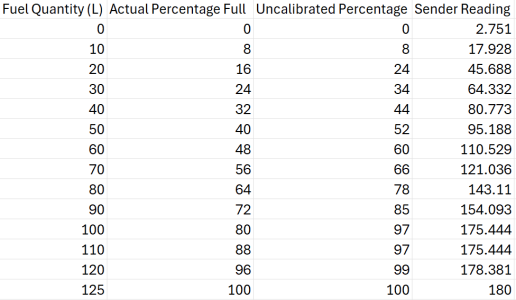
Obviously we all know fuel tanks aren't a regular shape, but I bet not many would have guessed on a 125l tank that 20 litres is a quarter of a tank on the standard guage.
Calibration on the Cerbo was very easy, I just put in the uncalibrated and actual percentages and now I can see actual litres remaining rather than the wooly guess we had before.
The process I followed was to suck all fuel out via the air bleed screw on the filter housing. This left it empty as far as the engine is concerned, rather than actually emptying the tank - important difference. I then topped up by 10l at a time, noting down the percentages and sender readings from the Cerbo display on my phone. Finally put it all in a spreadsheet and added the percentage column to do the calibration. All in it was about 3 hours work including three trips to the fuel dock.
Obviously we all know fuel tanks aren't a regular shape, but I bet not many would have guessed on a 125l tank that 20 litres is a quarter of a tank on the standard guage.
Calibration on the Cerbo was very easy, I just put in the uncalibrated and actual percentages and now I can see actual litres remaining rather than the wooly guess we had before.
The process I followed was to suck all fuel out via the air bleed screw on the filter housing. This left it empty as far as the engine is concerned, rather than actually emptying the tank - important difference. I then topped up by 10l at a time, noting down the percentages and sender readings from the Cerbo display on my phone. Finally put it all in a spreadsheet and added the percentage column to do the calibration. All in it was about 3 hours work including three trips to the fuel dock.


