
Fuel return valve slight leak - question?

Irish Rover

Well-Known Member
Joined
5 Feb 2017
Messages
8,709
Location
Türkiye
Visit site
Below is a picture of the generator fuel tank return valve on my boat. Both engines have similar valves. There's a very slight leak from the generator valve when I fill the tank to the max. I'd like to remove the valve, clean it up, and do whatever's necessary to stop the leak. My oncern is how the valve is secured internally - I'm concerned something will fall off when I loosen it and end up in the tank. Any advice appreciated.20260405_115423.jpg
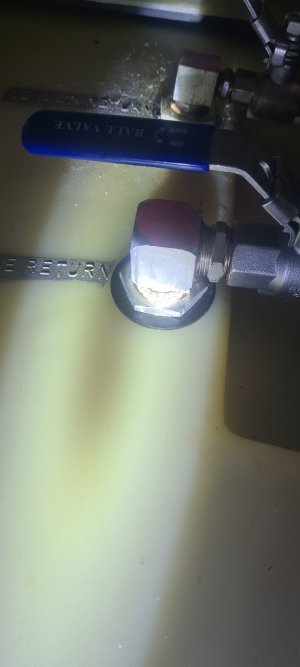
Edit. I see I posted the pic of the engine valve. They're identical.
 
Last edited:
Below is a picture of the generator fuel tank return valve on my boat. Both engines have similar valves. There's a very slight leak from the generator valve when I fill the tank to the max. I'd like to remove the valve, clean it up, and do whatever's necessary to stop the leak. My oncern is how the valve is secured internally - I'm concerned something will fall off when I loosen it and end up in the tank. Any advice appreciated.View attachment 209279
Edit. I see I posted the pic of the engine valve. They're identical.

If you're unscrewing the valve from the 90 degree elbow there shouldn't be any loose parts anywhere.

You haven't said where the leak is. There appears to be dark red sealer on the threads?
 
If you're unscrewing the valve from the 90 degree elbow there shouldn't be any loose parts anywhere.

You haven't said where the leak is. There appears to be dark red sealer on the threads?
Thanks. I suppose technically it's not the valve that's leaking. The leak is from the part attached to the tank but I'm not certain exactly where from. By the time I got to it, it was already slightly wet and it only happens when the tank is completely full or almost full and sloshing around in a bit of weather.
 
Get it totally dry and install small collars made from twisted blue hand roll paper tight around every joint. You will see which is leaking, there could be more than one. Or smother talc all over the joints, the diesel will stain it. I would not attempt any tightening of the square unions in the tank or their lock nuts. Changing the ball valves would be easy.
Is there an access port into the tank?
 
Get it totally dry and install small collars made from twisted blue hand roll paper tight around every joint. You will see which is leaking, there could be more than one. Or smother talc all over the joints, the diesel will stain it. I would not attempt any tightening of the square unions in the tank or their lock nuts. Changing the ball valves would be easy.
Is there an access port into the tank?
No access port. I don't want to tighten anything right now. I want to loosen, remove, clean, reseal the square part, but I want to be sure nothing from inside will be set free to drop.
 
There's a very slight leak from the generator valve when I fill the tank to the max
Is there an air vent on the tank, is it clear?
Insects build nests in little holes....and the tank may be pressurising when full ...just a thought...but as said, determine the leak with toiler/kitchen paper or talc.would help
 
Is there an air vent on the tank, is it clear?
Insects build nests in little holes....and the tank may be pressurising when full ...just a thought...but as said, determine the leak with toiler/kitchen paper or talc.would help
Thanks. No problem with the air vent. As I said earlier I'm pretty certain the leak is from under the square fitting, but I'm not certain if it's from the above or below the large nut attached to the actual tank. The leak only occurs when filling to the max or when it's almost full and the diesel is sloshing around underway in weather.
I'm pretty sure I can sort it and my question is whether there's any danger of something dropping into the tank as I loosen/remove the connections for inspection, cleaning etc.
 
whether there's any danger of something dropping into the tank as I loosen/remove the connections for inspection, cleaning etc.
Obviously I cant be sure,(from over 2k miles away) but the fittings look like tank connectors (similar to through hull),and all that can drop in the tank is the actual fitting if you take the nut off.
Problem is playing with it could make it worse, so (if it was mine) I would try first to gently tighten what's there (the tank fitting back nut) just to ennsure its not vibrate loose..but give yourself time to do a strip down if disturbing makes it worse.
 
I had a similar problem with a previous boat which had a plastic fuel tank.
Having used pink toilet paper or blue towel to determine the souce of the leakage and being sure that it is actually from that joint at the junction of the connector and the tank, there are two possibilities: firstly, that there is backnut in the tank, which requires an access port, or secondly that the connector is screwed into a tapped hole in the plastic tank. If you are absolutely sure where the leakage is coming from, given that diesel can track around in a surreptitious manner, you need to get some thread sealant onto the male part of the joint and tighten it up. It may be possible to get a boroscope into the tank and visualise the internal aspect of the fitting before you commit to unscrewing it. If there is a backnut, this is likely to be impossible to manage without an access port. If the tank was tapped for the fitting, you should be able to back the connecter out, clean the threads, apply some Clesstite or similar anaerobic diesel-resistant sealant, and GENTLY tighten it up. Good luck!
 
Top