
Fuel Gauge Calibration

lustyd

Well-Known Member
Joined
27 Jul 2010
Messages
14,253
Visit site
I thought this may be of interest to some here. I just connected my fuel sender to a Victron Cerbo GX in order to display fuel levels on the plotters, phones, and my Garmin watch. Now that we're calibrated, I have fuel litres remaining on the displays as well as percentage full, which is very useful for range calculations. It also enables the plotter to understand range left, since I hooked up NMEA 2000 from the Cerbo.

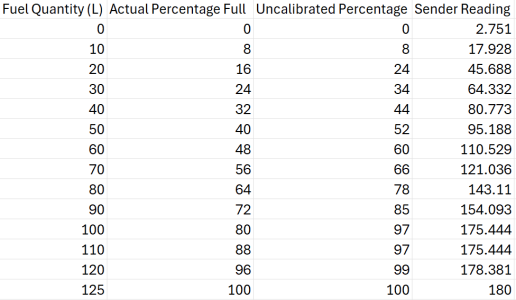
Obviously we all know fuel tanks aren't a regular shape, but I bet not many would have guessed on a 125l tank that 20 litres is a quarter of a tank on the standard guage.

Calibration on the Cerbo was very easy, I just put in the uncalibrated and actual percentages and now I can see actual litres remaining rather than the wooly guess we had before.

The process I followed was to suck all fuel out via the air bleed screw on the filter housing. This left it empty as far as the engine is concerned, rather than actually emptying the tank - important difference. I then topped up by 10l at a time, noting down the percentages and sender readings from the Cerbo display on my phone. Finally put it all in a spreadsheet and added the percentage column to do the calibration. All in it was about 3 hours work including three trips to the fuel dock.

1766242357914.png
 
Why? That’s the record of the actual number so there’s no point rounding it. I’m quite good with data and data tooling…
 
Garbage in garbage out?

The data after the decimal point is meaningless surely? Even 1/10th of a litre can be filed in the "don't need to know" box.
No, not meaningless at all. The data is there to record values. This includes the minimum and maximum that the sender outputs. Had the sender had a range of only 40 ohms in this tank, I would have needed to work out the percentages based on those values. As it was, I didn't need to do that so the percentages are entirely separate.

Hiding detail unnecessarily is much, much worse than rounding too early. Only round numbers which need to be human readable. If you feel the need to hide them as it affects you somehow then go ahead, I was just providing the data collected. The Cerbo goes to 3 DP so I did too. I am an expert in data and analytics though, so follow best practices.
 
Looks pretty good, I intend to expend my Victron installation on the new boat and the Cerbo GX looks pretty capable, I like the idea of fuel tank calibration, rather than using the random gauge and shaped tank.
It's very good so far. We've had the Cerbo for years and I only just realised I could just hook up resistive senders to it when I was adding the NMEA2k link to it, so aside from a bit of cable it was a free upgrade for us to add fuel level. The tracking over time on VRM is handy for seeing diesel usage for heating right now, and we'll be able to record fuel usage for trips when we get moving again.
 
Sounds intesting, I keep an eye on the VDO gauge as a guide, but allow 2.5 litres an hour for our VP2030 and that seems pretty accurate. Perhaps I am just looking for a way to use more Victron kit. I know I could use my phone to monitor but like the idea of the Touch 50 or Touch 70, any recommendations which to get, they seem pretty inexpensive in the great scheme of things
 
We don’t have a Victron screen at all. It shows enough on a plotter via ethernet and nmea2k and we have phone access to the cerbo on wifi which literally shows the same as the screen but with less power.

Yes we do 2l/hour but this shows the litres in the tank so feels more accurate. Filling up is now 125l-current fuel so we know how much will fit in. Before we sort of guessed, including on passage when I was deciding whether to put the jerry cans in the main tank.

We’ll see though, only just done it 🤣
 
Isn't technology marvellous. Fuel tankage to three decimal places of a litre. Really?
My sight glasses are marked off for every 20 litres. Absolutely foolproof, and no electrickery involved. 😀
 
Isn't technology marvellous. Fuel tankage to three decimal places of a litre. Really?
My sight glasses are marked off for every 20 litres. Absolutely foolproof, and no electrickery involved. 😀
That’s not what I said at all, nor is it what I showed. Were you interested in this or just being an arse?
 
That’s not what I said at all, nor is it what I showed. Were you interested in this or just being an arse?
What a bad tempered response. I described my fuel gauge(s), which are obviously simpler and more basic than yours, and questioned whether it was of any benefit to know fuel capacity down to three decimal parts of a litre, as shown by you in your first post.
If you can't contribute in a normal reasonable way, why post anything?
 
know fuel capacity down to three decimal parts of a litre, as shown by you in your first post
I didn’t show that though, did I? You apparently came here to start an argument and have no interest in the thread.
For the avoidance of doubt, only the sender reading in Ohms has decimals, and this is raw data that you can ignore.
 
I didn’t show that though, did I? You apparently came here to start an argument and have no interest in the thread.
For the avoidance of doubt, only the sender reading in Ohms has decimals, and this is raw data that you can ignore.
Have a happy Christmas.
 
On my long term liveaboard Moody 33, my best fuel gauge was a small removable plug in the top of the tank and some dowel rod to dip the fuel level.... :)

I've been lucky enough to sail dozens of different yachts and lots of motoring on various cruising motor boats. I've never had a fuel gauge that was anything like accurate.

Hove spent oodles of time pondering distance to go versus probable fuel remaining. It would be a Very Good Thing to have an accurate gauge.....
 
In theory you could calibrate the stick in the same way, just add a notch every 10 litres from empty.
The problem is how do you define accurate? The sender and gauge (or stick) just tell you how high the top of the fuel is in your tank, not the quantity.
My sender is very accurate, I can see the precise reading and watch it slowly rise. I can see it fluctuate as the boat rocks. The interpretation is what caused the issue. The Cerbo averages over 10 seconds by default, so rocking goes away. After calibration it also converts the fuel height to litres, giving a more meaningful reading that can be used for planning.
The old gauge also showed 1/4 full when only 20 litres out of 125 were present. That was accurate as a height reading and very consistent. Same as the uncalibrated stick.
 
Your approach is quite logical - although spending 3h on calibrating a fuel guage lugging cans about is probably not most people’s idea of fun!

A tape measure, a pencil and the back of an envelope should enable anyone with an odd shaped tank to to to have a pretty good estimate of the volume for say each 1/8th of the of the height. I think that’s going to be less than 30 minutes work and accurate enough for most.

The old gauge also showed 1/4 full when only 20 litres out of 125 were present. That was accurate as a height reading and very consistent. Same as the uncalibrated stick.
I’m surprised the gauge on your production boat has a linear scale. My AWB’s gauge has a non linear scale behind the needle.

My water tank however goes: full - full - full - full - full - 3/4,1/2,1/4 - empty!
 
I’m not even sure there is a scale on the original gauge, although perhaps I’ve become blind to it as it was useless 🤣

No it wasn’t fun really, especially sucking the old fuel out, but only had to do it the once and it seem very worthwhile. With the VRM logging we’ll get a very accurate idea of fuel consumption next year which can also give a picture of engine health.
 
What a bad tempered response. I described my fuel gauge(s), which are obviously simpler and more basic than yours, and questioned whether it was of any benefit to know fuel capacity down to three decimal parts of a litre, as shown by you in your first post.
If you can't contribute in a normal reasonable way, why post anything?
Eh? I think you’ve completely misunderstood the OP’s post.

The column with three decimals is sensor reading therefore it’ll be ohms. The variable resistance is calibrated to give a reading showing how full the tank is and it looks like it shows 0-100% on the chart plotter. seems quite a good idea to me.
 
Top