
Do you aim for the fenders to contact the pontoon as you park?

We've always moored as taught on competant crew course many years ago. Step over the guard rail as you approach holding a mooring line, wait until close to pontoon then STEP down and tie off upwind/tide first followed by downwind. I've always assumed this was the RYA approved method and its always worked for us.
 
There can be no "Step Down" on most boats I have owned.

Being 'Shorthouse's' it is a gentle jump for both of us.

Current vessel was chosen for its 'easy on - easy off virtues and the pontoon is accessed from the large rear swim platform.

Few sailing vessels have this feature.
 
I’ve not met a situation where my hook could get a hold on a bird’s nest cleat but I suppose it’s possible. I have a reel of anchor tape on my pushpit and the hook works well with it, though some may prefer the type with a closable end. I can’t say that I have had much call for it in home waters though, but it is simple enough to keep tension on, especially in non-tidal waters.

Both my boats have Ankorline (tape reels) ..... the smaller is portable and I take that on my other river boats for short stops fishing etc.

The cleat idea was just my mind wandering about uses ....
 
We've always moored as taught on competant crew course many years ago. Step over the guard rail as you approach holding a mooring line, wait until close to pontoon then STEP down and tie off upwind/tide first followed by downwind. I've always assumed this was the RYA approved method and its always worked for us.

Any method that is safe - minimal risk and successful is fine ... why would RYA stipulate an approved method ?

But yes stand outside guardlines with plenty slack in hand ... STEP off .. make fast .. get back for any other line ...

Guy's who sail with me are experienced and often step ashore with BOTH bow and stern lines ... as long as there's enough slack - it works.
 
But yes stand outside guardlines with plenty slack in hand ... STEP off .. make fast .. get back for any other line ...

I used to do that when I crewed on the sailing safety boat until is slipped of the toe rail and was in danger of being squashed between the boat and the dock. I could not get on board as nowhere to put my foot to lift myself up onto deck of dock

I now use a giant spring closing clip that will attach to a boat hook to hook onto a dock cleat with a line attached to the mid boat cleat

Mine is bigger than the ones posted above
 
I knew my OP would get a response and nice to get more thoughts. The big thing for me, and even bigger for her, is that we are reversing roles, with my wife going on the helm, which means her boat handling skills will need work....which obviously can go one of two ways :)..... And if it goes to me single handed ,for berthing, then the single handed techniques will be employed. I tried out a couple of these last weekend, specifically the stern bridle and the midship spring (both Duncan Wells and on YouTube). I was lassooing cleats (from a pretty static boat) and then winching in with the boat in gentle forward until nicely against pontoon. It was all good apart from the one time that I was busy winching in the line (stern bridle arrangement) but was not driving the boat forward. Consequently the line just slipped up past the rear horn of the cleat and we detached. My conclusion from that experience is the midship spring is more foolproof. (The line just goes out and back from the midship point as an adjustable loop, whereas the stern bridle leaves the stern quarter, and returns from pontoon cleat to the midship cleat, and then a cockpit winch).
 
I knew my OP would get a response and nice to get more thoughts. The big thing for me, and even bigger for her, is that we are reversing roles, with my wife going on the helm, which means her boat handling skills will need work....which obviously can go one of two ways :)..... And if it goes to me single handed ,for berthing, then the single handed techniques will be employed. I tried out a couple of these last weekend, specifically the stern bridle and the midship spring (both Duncan Wells and on YouTube). I was lassooing cleats (from a pretty static boat) and then winching in with the boat in gentle forward until nicely against pontoon. It was all good apart from the one time that I was busy winching in the line (stern bridle arrangement) but was not driving the boat forward. Consequently the line just slipped up past the rear horn of the cleat and we detached. My conclusion from that experience is the midship spring is more foolproof. (The line just goes out and back from the midship point as an adjustable loop, whereas the stern bridle leaves the stern quarter, and returns from pontoon cleat to the midship cleat, and then a cockpit winch).
I make use of both of these techniques singlehanded. Work really well. Midship cleat is essential for me.
 
I don't have a method per se. There are so many possible scenarios that I generally wait until I have appraised the situation before deciding. I think we can all agree that jumping off is not a good idea, though some of the younger folk seem to have charmed lives and get away with it. No so for the crew of a friend who was taken by surprise when the crew, who was not a regular, took it upon himself to leap over the pulpit in St Helier but failed to take one of his legs with him and ended up with a nasty leg fracture, time in hospital, a leg thrombosis and I believe eventually a flight home.

My current boat from 2000 has only moderate freeboard, and this makes coming alongside much easier than even my previous boat a Sadler 29. It was usually my wife doing the donkey work, when standing on the toe rail facing inboard and holding onto the cap shroud was the obvious starting-point. Much depended on conditions of course. Sometimes it was better for her to stay at the bow to hand a line ashore, leaving me to step ashore with the stern line, or maybe spring from the centre. With more freeboard I would have invested in a fender-ladder.
 
I can hardly wait until the weather starts improving and I can get out again, I need a good bit of practice with the boat to get the handling of her a bit more understood as I have a very tight berth between to rather large displacement boats, both about the 14m size and a meter fore and aft of my boat between them.
I want to get the procedure down so I can do it myself if need be, I have a bollard on the quay side about my midships and one between my boat and the one in front, each time I have come in there has been someone there to take the lines which has helped but I want to be ready for that time no one else is around.
IMG_8265sm.jpg
 
I agree that freeboard is a big factor. If the skipper insists in somebody stepping ashore (rather than doing the middle rope technique), one of these by the shrouds makes MUCH safer Majoni Step Fender Colours
I hate those things, as one cannot get one's foot fully into the fender. Only the toes. So one always feels one is going to slip out.
 
I have had a large one for years but tend not to use it as it is a big lump of heavy metal on the end of a pole od useful length. It needs to be much lighter.

I have lighter sprung clips - but have had them bend open ... crazy as it sounds without pulling out the deck cleat !

But it is heavy .. given that there are strong 'aircraft' alloys that cn do the job such as Dural .. there really is no reason to be so heavy.
 
I agree ... never felt safe using one ... good idea - shame about the product.
I have never had one, but occasionally used them on others’ boats. I can’t say that I have found them unduly awkward but I only have size 7 1/2 feet. At any rate, they are better than nothing when a pontoon step is not possible. Fixed ladders may be better when moored, but a friend with a 46’ boat left his down inadvertently when moving his boat and managed to bend it.
 
I have never had one, but occasionally used them on others’ boats. I can’t say that I have found them unduly awkward but I only have size 7 1/2 feet. At any rate, they are better than nothing when a pontoon step is not possible. Fixed ladders may be better when moored, but a friend with a 46’ boat left his down inadvertently when moving his boat and managed to bend it.

I have three means of getting up / down ...

A kitchen folding step ... folds down flat / small enough to go in a small locker ...

A Lazilas folding ladder with large round deck hooks - all in nylon. It has stand-offs to make sure its well off from hull to get feet on it securely.

An alloy / plastic step 5 rung ladder with keeper plates to fit deck .. the vertical alloys turn inward to make it flat ... I have it velcro'd to guardlines midships.
 
I can hardly wait until the weather starts improving and I can get out again, I need a good bit of practice with the boat to get the handling of her a bit more understood as I have a very tight berth between to rather large displacement boats, both about the 14m size and a meter fore and aft of my boat between them.
I want to get the procedure down so I can do it myself if need be, I have a bollard on the quay side about my midships and one between my boat and the one in front, each time I have come in there has been someone there to take the lines which has helped but I want to be ready for that time no one else is around.
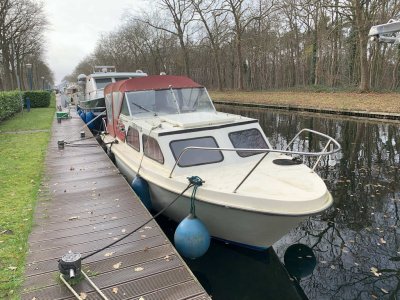
View attachment 170621

Sorry but those mooring lines are positively dangerous and anyone walking down could trip causing then to fall in particularly at night

Any mooring cleats should be close to the edge of the dock to avoid a danger of tripping over moorings lines

Regarding boarding steps / ladder they need a flat surface to place you foot firmly on without the risk of slipping

I have a a single step that will lift up to and down as shown on the stern but it can also be fitted to the side entrance

 
Last edited:
Top