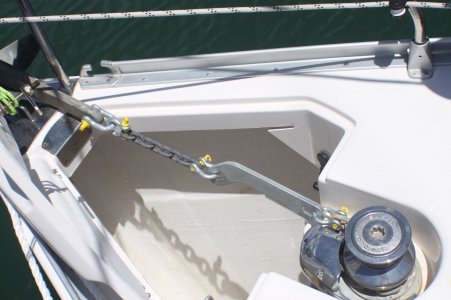
Maxwell windlass 10 VW looks interesting (to a windlass noob)

. . . You need a short strop, see Noelex post above, to keep the tension and any snatch loads off the windlass. A snubber does this but snubbers fail and you may need to use a strop as back up to secure the anchor when at sea, clutches fail. . .
For a snubber to have the elasticity needed to fulfill the snubbing function, it will almost certainly (unless it's VERY long and thick) not be nearly strong enough to be the ultimate attachment of ground tackle to boat. The windlass obviously is totally unsuited to this.

Chain lock or very strong strop, is fundamental.
 
For a snubber to have the elasticity needed to fulfill the snubbing function, it will almost certainly (unless it's VERY long and thick) not be nearly strong enough to be the ultimate attachment of ground tackle to boat. The windlass obviously is totally unsuited to this.

Chain lock or very strong strop, is fundamental.
We carry two snubber/strops for this reason. See the last item on this page Snubbers
 
We would use a short strop with chain hook attached to a strong point, not the windlass. The short strop acts as a back up should the 'elastic' snubber fail. The short strop can also be attached to the chain when the anchor is on the bow roller - in case through vibration in seas the clutch fails. The short strop is not designed to be elastic and can be dynema.

We carried a bridle, long - at least boat length long. We also carried a spare, long, bridle in case the bridle failed. Snubbers are consumables, they are constantly cycled in use and they will fail. Snubber/bridle are designed for their elasticity not their strength, if they are too strong they will not stretch sufficiently to act as a snubber.
 
Depends on the size of the boat. On the Discovery 67 I sail on regularly, we use the warping drum A LOT. It's used not for rope rode (which we don't have on that boat) but for hauling on mooring warps.

I have been tempted to add a warping drum to my Lewmar windlass, but the vertical protrusion stops me (and the £££ of course).
But a 67 footer is a completely different proposition to a 32 foot Fulmar. You shouldn’t ever need to use a windlass to pull a mooring rope on a Fulmar (though occasional use of a sheet winch can assist in some situations in a gale).
 
.

You mention robustness and indicate that Lewmar are inferior to the other two.
I was deterred from Lofrans substantially by some examples of poor after sales service and in the absence of other reasons, that seemed adequate to look in a different direction. The Maxwell I can believe is an excellent product and I don't know about after sales service or spares availability, whereas Lewmar are everywhere here (UK).
I don't mind going a bit OTT - I understand that a margin extra is no bad thing with windlasses.
My views are based on having had both Lofrans and Lewmat Pro. The Lofrans is way better for hard use - loved by charter operators in Greece where they get more use in a year than a typical UK leisure sailor will do in a lifetime. The Lofrans Cayman 88 was on a charter boat I owned in Corfu. The windlass would be used typically 3 times a day, 6 days a week for 16-20 weeks a year - so roughly 300 a year. It did 7 years of this type of use plus a further 5 years of lighter use, so maybe 2500 cycles before the motor started giving problems. Pretty sure it would have been repairable except for 3 things. It was impossible to take apart because of the stainless fastenings into aluminium, Lofrans were out of business at the time (2014) and the base was heavily corroded. Fortunately I was able to source a new one which we stripped and replaced all the fastenings using Duralac and epoxy coated the base before bedding down without the supplied gasket.

The downside of the Lofrans is that it is a big heavy beast and OTT for your size boat. Ideal for catching sheets when tacking!. My replacement boat was another Bavaria, a smaller 2015 33 here rather than in the Med and it came with a Lewmar. The obstruction bit is not an issue with either Bavarias because the windlass is on a platform in a well under cover. I had the boat 6 seasons and between 250-300 anchoring cycles and at the end of the last the motor failed. Annoying, but it was easy and cheap to replace. In terms of performance it was fine with a 10k Delta and 8mm chain.

For your boat where you have to mount it on deck and make a new hole in the deck to take the chain into the locker the Lewmar would be a good choice as it is low profile and all stainless construction. A vertical axis particularly with a capstan is a big obstruction on a small foredeck. I understand how you used it to pull the boat in against a strong tide, but would suggest that on the rare occasions this might happen a turning block and using a sheet winch is just as effective.

My current boat which is a similar size to yours but about a tonne heavier has a Lofrans Kobra vertical motor but horizontal axis. Because of the deck layout it is not an obstruction. Chain is 50m of 6 mm and anchor is a new generation Epsilon. More than adequate for my type of sailing which is similar to yours.

As I mentioned earlier, and as Neeves explains in more detail, the key to efficient anchoring is matching the while system - anchor, swivels, shackles, chain. bow roller and controls. My 33 achieved this with a Lewmar windlass, 8mm chain (although through choice I would have gone for 6) a Kong swivel and self stowing roller plus a wireless remote (that also controlled the bow thruster). Single handed anchoring was always drama free as I could operate the windlass from anywhere on the boat.

Hope this helps
 
and self stowing roller

Sorry - I'm not being pedantic but

what is a self stowing roller?

Is this one of those bow rollers that folds over and slots into a bow locker, leaving the bow and stem roller free.

or

an anchor that self stows on the roller.


A minor point, I'd not use a swivel I'd use a Boomerang, or equivalent, if there is room, see link.

The dimensions to make your own are in the link, if you make from 316 stainless it will not need galvanising - all you need is a steel sheet (thickness of the wire from which the chain is made), angle grinder and decent drill (the holes are sized for a 3/8th" shackle)

If you have the equipment - cheaper than a Kong swivel, )might actually be cheaper than anything Kong sell :))

Sail Delmarva

Jonathan
 
Last edited:
We would use a short strop with chain hook attached to a strong point, not the windlass. The short strop acts as a back up should the 'elastic' snubber fail. The short strop can also be attached to the chain when the anchor is on the bow roller - in case through vibration in seas the clutch fails. The short strop is not designed to be elastic and can be dynema.

We carried a bridle, long - at least boat length long. We also carried a spare, long, bridle in case the bridle failed. Snubbers are consumables, they are constantly cycled in use and they will fail. Snubber/bridle are designed for their elasticity not their strength, if they are too strong they will not stretch sufficiently to act as a snubber.
This is purely semantical, I guess, but for whatever it may be worth, I don't think of the strop or chain lock as "backup". I think of it as the primary connection between ground tackle and boat. The whole system is only as strong as its weakest link, so the whole system will be weaker if this is less strong than the chain. The purpose of the snubber (the way I think about it, for whatever that may be worth) is not to keep ground tackle and boat attached to each other, but to dampen snatch loads. It's subject to failure not only from overload, cyclical loads, etc., but also from chafe.

I rarely use a snubber on my boat anyway, unless I'm in very shallow water (<5m) or poor shelter, never unless there is a material risk of wind over 30. 12mm chain produces a great deal of catenary force.
 
But a 67 footer is a completely different proposition to a 32 foot Fulmar. You shouldn’t ever need to use a windlass to pull a mooring rope on a Fulmar (though occasional use of a sheet winch can assist in some situations in a gale).
Indeed, and I wouldn't see the point of a warping drum on a boat that size.
 
Indeed, and I wouldn't see the point of a warping drum on a boat that size.
As I said earlier, we replaced a Maxwell without a drum for one with, on a 35 ft boat. This was intended specifically for use when berthed stern-to in marinas in Greece on a rope attached to ground chain. We have used it a great deal and found it very useful.
 
This is purely semantical, I guess, but for whatever it may be worth, I don't think of the strop or chain lock as "backup". I think of it as the primary connection between ground tackle and boat. The whole system is only as strong as its weakest link, so the whole system will be weaker if this is less strong than the chain. The purpose of the snubber (the way I think about it, for whatever that may be worth) is not to keep ground tackle and boat attached to each other, but to dampen snatch loads. It's subject to failure not only from overload, cyclical loads, etc., but also from chafe.

I rarely use a snubber on my boat anyway, unless I'm in very shallow water (<5m) or poor shelter, never unless there is a material risk of wind over 30. 12mm chain produces a great deal of catenary force.

Not many members here use 12mm rode - maybe 100m?

The most common mention is 8mm chain, and this turns out often to be oversized and there are repetitive recommendations to replace with 6mm chain. I confess - someone mentions 8mm chain and I immediately think 'I wonder if its oversized?". I don't know if others have the same reaction but its amazing how often in a thread with 8mm chain..... the recommendation is ..... 6mm.

I'm involved in someone, today, who want to downsize from 10mm to 8mm (100m) with Thermal Diffusion Galvanised HT 8mm chain - and of the 1,000m of chain with which I have been involved - he is not the first. I just marvel at the number of yachts lugging around oversized chain (needing a big windlass, more power to retrieve (bigger motor using more amps) filling up a bow locker with redundant weight and destroying sailing ability.

Specific aluminium US patrol vessels went to great lengths to test Fortress anchors as their ground tackle, to save weight. They would have been better considering the rode. But times move forward and some vessels now use smaller sized HT chain.

US_Navy_030113-N-2972R-114_A_Landing_Craft_Air_Cushion_(LCAC)_Vehicle_from_Assault_Craft_Unit_...JPG

Snubbers should not be subject to chafe - chafe is a failure mechanism over which the owner has control and because the chafe can be seen - something he can manage. Overloading and cyclical loading usually results in internal failure that is difficult to identify.

Something has to be the weakest link - and it cannot be the chain (if it fails you have a significant problem). It should not be the chain lock, commonly part of the windlass and it should not be the shackle - as it will be over spec to cater for unusual, side loading. That really leaves the rope strop aka snubber - which I recommend as Dyneema (which by definition will be stronger then the snubber. So the snubber will fail first, with the noise like a rifle shot, and crystallise in the owners mind his foresight in carrying a spare snubber, or bridled maybe his, or her, thoughts will look to assess the whole rode as a single, compatible package.

Jonathan
 
Sorry - I'm not being pedantic but

what is a self stowing roller?

Is this one of those bow rollers that folds over and slots into a bow locker, leaving the bow and stem roller free.

or

an anchor that self stows on the roller.


A minor point, I'd not use a swivel I'd use a Boomerang, or equivalent, if there is room, see link.

The dimensions to make your own are in the link, if you make from 316 stainless it will not need galvanising - all you need is a steel sheet (thickness of the wire from which the chain is made), angle grinder and decent drill (the holes are sized for a 3/8th" shackle)

If you have the equipment - cheaper than a Kong swivel, )might actually be cheaper than anything Kong sell :))

Sail Delmarva

Jonathan
This is a standard early Fulmar foredeck apolloduck.co.uk/boat/westerly-fulmar-for-sale/784930 and as you will see it is going to be a challenge to fit a windlass and a self stowing anchor, never mind room for a boomerang. Others have a more substantial double bow roller like this apolloduck.co.uk/boat/westerly-fulmar-for-sale/805976 on which an NG 10kg (but maybe not a 15kg) might self stow. However when you look aat the space available and the location of the naval pipe down into the chain locker space for the stock and any swivel will be at a premium. The Op will need to do a lot of measuring and thinking - and then probably some structural work to install an efficient system. a pivoting self stowing roller may well be part of the solution.
 
Something has to be the weakest link - and it cannot be the chain (if it fails you have a significant problem). It should not be the chain lock, commonly part of the windlass and it should not be the shackle - as it will be over spec to cater for unusual, side loading. That really leaves the rope strop aka snubber - which I recommend as Dyneema (which by definition will be stronger then the snubber. So the snubber will fail first, with the noise like a rifle shot, and crystallise in the owners mind his foresight in carrying a spare snubber, or bridled maybe his, or her, thoughts will look to assess the whole rode as a single, compatible package.
Indeed, just this.

Dyneema is good for the strop, if you don't have a chain lock, but it's important to pay attention to the strength of what you attach it to.

The last 35 years my sailing has been, excluding charters, 3 boats -- a Pearson 365, a Moody 54, and a Discovery 67. Chain locks on the Pearson and Discovery; stainless steel chain strop on the Moody. Snubbers do fail, and indeed it's like a rifle shot. Been there, and done that, multiple times. You need to be damned sure that whatever is holding the chain, after the snubber fails, is strong enough to save your boat.
 
This is a standard early Fulmar foredeck apolloduck.co.uk/boat/westerly-fulmar-for-sale/784930 and as you will see it is going to be a challenge to fit a windlass and a self stowing anchor, never mind room for a boomerang. Others have a more substantial double bow roller like this apolloduck.co.uk/boat/westerly-fulmar-for-sale/805976 on which an NG 10kg (but maybe not a 15kg) might self stow. However when you look aat the space available and the location of the naval pipe down into the chain locker space for the stock and any swivel will be at a premium. The Op will need to do a lot of measuring and thinking - and then probably some structural work to install an efficient system. a pivoting self stowing roller may well be part of the solution.
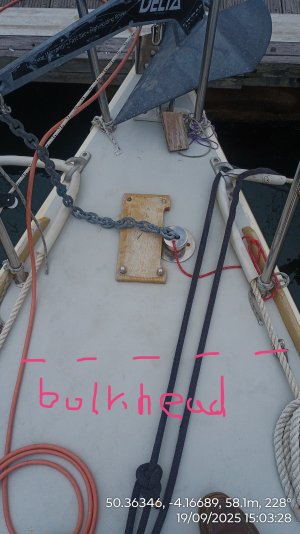
This is what we've inherited. The old, manual windlass was dead and removed prior to selling.
I'm prepared to do an amount of structural work, certainly minor works like moving the spurling/navel/naval/chain pipe. Ours is now aft of the original spurling pipe position (which is where I thought it was when I saw this Maxwell windlass, and would work for that). I could reinstate it...
However, there's more height for the chain to fall where it is now, so it has that in it's favour, although possibly the chain originally slid down the bow to the locker case and heaped up from there.
We have a double roller, but it's got the forestay integrated, so I'm not sure how far I'd want to go with alterations there. IDK about anchors self stowing - something I'll have to look into and see if it motivates me to make possibly significant structural changes.
I've got all winter to get this right and won't be rushing into anything.
 

Attachments

  • IMG_20250919_150328.jpg
    IMG_20250919_150328.jpg
    1,009.1 KB · Views: 4
You are part way there. You may have to mount the windlass further back than the current position to get enough distance from the bow roller to enable the anchor to sit in the deck when fully in. The double bow roller should effectively stow the anchor - the forestay fitting is not an issue, it is very common with double rollers. The critical bit is the clearance below the roller before the fluke hits the bow. The further back the windlass the greater the fall giving the chain a chance to drop cleanly without piling. Smaller chain helps with this as well. With most windlasses you don't need a separate pipe, just a hole in the deck in the right place to take the fall from the gypsy.
 
Totally different yacht, but it illustrates Tranona's pointIMG_7317.jpeg


In this picture the anchor fluke is hard against the bow roller and the shank (which is quite short), with 2 shackles a D and a bow is a long way from the windlass, so far away from the windlass we have been able to add a Boomerang that self rights the anchor. But your shank shackle needs to have at least one link preferably more between the shank's shackle and the windlass - other wise you cannot house the anchor securely and it will wobble and bounce around in any chop. If you wanted a boomerang you would need lots of space (as illustrated) - (Boomerangs can be shorter)

You can obviously lash the anchor to secure it, good practice anyway, but you might be under pressure to move and then forget lashing until the clutch fails/loosens and the rode deploys - all of it.

The reason for the 2 shackles - the anchor is a Manson Ray which like a genuine CQR has a circular hole at the shank end, not a slot, and the only shackle that will fit was the big "D" shackle. But to join to the chain the D shackle was too big and we had to introduce a smaller bow shackle so that the shackle pin would fit in the link. Really clumsy (and not yet moused) but it was the only way.

The three bow shackles are all WLL 1t, not strong enough in my opinion (as if these shackles lock up at an angle the WLL can be halved) and then the shackles are the weak link as the WLL of the chain is 750kg. 3/8th" bow shackles with a 2t WLL are easily available in the UK, Crosby make them and they might be available from a Gunnebo stockist or mail order from Tecni in the UK. Yoke (Taiwan) also supply and they have a UK Sales Manager who might have stock. Other suppliers are Peerless and Campbell, but both are US based and I've never heard of UK stock. The CMP Titan Yellow pin are good shackles, at 1t WLL for a 3/8th", the ones used with the Yellow Pins but I don't recommend the CMP Titan Black Pin shackles (2t WLL x 3/8th")- make the effort and buy from the other suppliers).

Jonathan
 
Top