Converting my Catalac 9M to electric outboards

patrickza

Member
Joined
30 Dec 2019
Messages
39
Location
South Africa
Visit site
A quick introduction here to myself and my upcoming project. I'm Patrick, originally from South Africa, but moving to Croatia soon where I've bought a modified 1976 Catalac 9M:
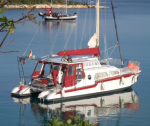
MyCatalac9m.png
This is a 4 year old picture, the boat isn't anywhere near as clean and shiny at the moment, but it'll get back to that.

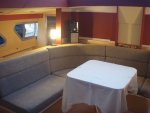
The previous owner, a German engineer, did a lot of work I quite liked and would have done anyway if I bought a standard boat. The front cabins have been joined to make a king sized cabin, there's now full standing headroom in the salon, and a hard bimini over the cockpit with a decent enclosure. He also did a couple of things that need to be undone, primarily moving the backstays from the rear arch back to the original attachment points, and cleaning up the wiring spaghetti.

When I bought it it had twin 30HP Perkins diesels onboard. I know they're great engines, but sadly I married a wife with the worlds worst superpower. She has the sense of smell of a bloodhound, and either the Perkins had to go or I'd need to find a new wife. Fortunately I'm a huge fan of electric propulsion, and have built quite a few different electric vehicles, so the wife got to stay. It'll also be much easier for me maintaining the electric setup rather than learning how to be a diesel mechanic.

FYI if you're going to try and talk me out of switching I have to let you know that the diesels are already out, along with the gearboxes, shafts and props. That'll all hopefully get sold when I get back to Croatia in April, and then I'll have a bit of cash to buy a pair of ePropulsion 6kW outboards. I'm aware they also make the 6kW motors in pods, but I prefer the outboards as they cal be lifted for sailing. I'm also planning on installing a 14-15kWH 48v lithium pack, and 3.2kW of solar to keep it charged.

Anyway, hope to get a lot of advice on the various systems here. I'm also going to be asking a ton of questions as a 1st time boat owner who is quite likely going to be in over my head many times.

Maybe the first question, does anyone have good contacts people to do boat work in Pula, Croatia. I'll be doing a large amount of the work myself, but for one-off or very infrequent type jobs where there's a steep learning curve I'd much rather hire a pro. I'll need to have a good rigging person, and find a decent surveyor (yes I know I should have had one done before I bought it...) to do an insurance survey before it goes back into the water.

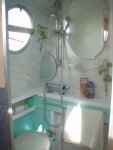
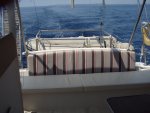
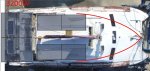
Here's a few more pictures for you. Again they're all old. The boat still looked good, but there was obviously a lot of wear and tear and sun damage that needs to be sorted out:
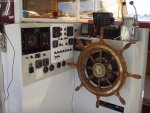
4.gr.jpg
16 Cockpit6 Anonymous.jpg
145593-scaled.jpg
841687-scaled.jpg
42108-scaled.jpg
 
Welcome to the forum

I think you will find you are just about on your own with this project. Not sure there are many people who would consider spending £20k repowering an old boat like that to end up with a significant drop in capability, particularly range under power - and a boat not known for its sailing ability (perhaps that is why it was fitted with 2 large diesels!). Fine if you don't want to go anywhere reliably, particularly cruising in a part of the world where there is either too little or too much wind.

You may already have seen this youtube.com/c/SailingUma/videos - and even inspired by it - but if not it is perhaps the best source of information and real life experience of trying to use electric power on a cruising boat. The fact that they are using pods rather than outboards is irrelevant, the physics of electric power are the same as are the limitations. They are lucky in that they don't seem to have to pay for all their different motors so the question of whether in is a financially feasible course of action, that is, would I spend my hard earned cash on this, is not addressed.

Will be interesting to follow your project.
 
Tranona summaries the issues succinctly.

I note that moving to electric is a done deal as you have rejected the new wife option (and removed the original power sources). The problems with electricity is that it is a finite resource unless you are going to be reliant on shore power. However it seems you have accepted some of the issues.

I don't think you will find many examples even remotely close to what you want to do - so you are going to be largely on your own. I would suggest that the outboards you are considering are going to prove, too, small - especially if you need to motor into the wind to get to where you MUST go. The outboards will be fine departing a sheltered anchorage or marina - but the sailing ability of the cat is not great so you will need to choose your destinations with care, never to windward.

Welcome to the forum. I for one will follow your project with interest.

(We sail a 38' cat with conventional 20hp inboard diesels, with sail drives. We are in no way tempted by an electric real;acment. we recently had need to replace the outboard for the dinghy - electric versions did come into consideration - but were rejected - even though we could have optioned one that MIGHT generate electricity.).

Jonathan
 
Here in Oz, home of many cats, Seawind started their business off with small cats, not unlike yours. I think they still make the Seawind 1000 and it is powered with petrol outboards, held in 'pods', wells or bays' external to the accomodation. They also build a larger version some with inboard diesels - and some with outboards that they designate as 'Lite'.

Petrol outboards on cats are not uncommon here - it maybe an option for you to re-consider, it will be cheaper, much.

Jonathan
 
Agree about the suggestion for petrol outboards. A pair of 15hp would do very nicely at a fraction of the price of electric and give you charging capacity when motoring. You would then be able to reduce your solar to just enough to keep up with your domestic needs.
 
It depends on how hedonistic your lifestyles but you will need a very large solar display to cope with your 'domestic' electrical issues. The size of your vessel does not matter - a 'cruising' couple with guests uses roughly the same amount of power whether the yacht is big or small. Whatever your calculations for electrical power needs you will find, within about 6 months, that your solar display is too small. If you have freinds/children/grandchildren whom you hope to come with you - they think unlimited electricity (along with many hot showers) is a birthright.

This raises another issue - if you expect hot showers - how are you going to heat the water. We have a gas fired instant hot water boiler vented outside. I note that they seem to have been the attention of much design (presumably for the motor home/caravan market and are now surprisingly small.

On conventional outboards - if you think petrol dangerous (it does need to be handled with care) but as I mention petrol is used in many production catamarans and I don't recall one being lost to fire in the last 20 years. Before we bought our current cat we charted a Seawind 1000 (and there are hundreds in Australia and a good few in the US) and petrol fumes simply did not register. And my wife, like yours, is very fussy - after all she must be - she chose me! :)

Jonathan
 
Last edited:
I hope you are not too discouraged by the previous replies. If you are aware of and accept that the power and range are less than the dirty old diesels that's fine. Sailing boats used to have low powered unreliable auxiliary engines (or no engine) and sailors used thier sailing skills to compensste.
I will watch your project with interest as I am embarking on something similar albeit in a smaller non-sailing boat for use mainly in inland waterways and estuaries, using a single 6kW E-propulsion outboard and 15kWh (300Ah) battery of 16 LiFePO4 cells.
I anticipate this will give me about 50 miles range at a cruising speed of 4 knots in good conditions or 10 miles if I ever have to punch into a headwind in choppy conditions. Enough for my needs. A generator could be carried for extended range.
Good luck, keep us informed.
 
Thanks for the great feedback everyone. I realise I'm on my own on this one. Fortunately the electric part of the boat is something I'm fairly good at, it's the rest of the boat work I'll hopefully be able to pick all the brains here on!

I've been a huge fan of Sailing Uma for a while, they've done really well on just electric, with a much smaller solar array than I'm planning. I do believe I will have to make compromises. I won't be able to motor at 6 knots all day long, but I could for short periods. The Catalac is famously bad at sailing into the wind, but reasonable off the wind. One of the benefits of going electric is you can add just a touch of power, so I imagine I'll do a lot more motor sailing than a typical diesel boat would.

The 6kW electric is rated to be a 10hp gas equivalent. The Catalac 9M was originally fitted with 10hp diesels. I also know of one 8M using twin 3kW electric outboards and he seems to do just fine.

That said I'm not ruling out some form of a backup. In the beginning I considered one electric outboard, and one Yamaha 9.9. It seemed to be the best of both worlds, but, and I know I'll get laughed at for this, I just like the symmetry and simplicity of a matching pair of electrics. Maybe a Yamaha 9.9 in between the two petrol inboards if I really need more power and range!

More likely I'd put in a small genset as a range extender. But first I want to test the solar setup and see how well it works.

I suspect with the 3.2kW solar array, and 15kWh's (equivalent to 12v 1250AH) of battery, on the days when I'm motoring I should have plenty of electricity for comforts, but on motoring days I'll need to be sparse with what I use.

I will most likely keep gas onboard for cooking and heating water, but will also have electric options for both.

@Alan S I'll also likely be going for 16 300ah lifepo4 cells, actually 20 as I'm using another 4 for a 12v bank. My calculations look close to yours for range, with the potential for more when it's sunny.
 
You will only get anywhere near 3.2kw on a very bright midsummer day at noon. In winter on a cloudy day it will be 10 to 20% of that. Also the hours of daylight will be lower. What's the calculation you are working on for kwh generated over an average day during your cruising season?
 
You will only get anywhere near 3.2kw on a very bright midsummer day at noon. In winter on a cloudy day it will be 10 to 20% of that. Also the hours of daylight will be lower. What's the calculation you are working on for kwh generated over an average day during your cruising season?
I'm hoping for 4-4.5 time rated capacity. That would mean 12.8 - 14.4kwh per day. Winter I realise this would be wishful thinking, but I'll likely stay in a marina all winter with day sails when the weather is good. I'm hoping not to have too much shade, but obviously it's a sailboat. There's shade. My solar plan is 8 x Sunpower Maxeon 3 panels. All wired in parallel, feeding 4 Victron 100/20 48v MPPTs.
SolarPlan.JPG

If I'm short of power often I'll get something like a Honda 2200 to help. I may just get one as an insurance policy anyway.

I realise none of this makes any financial sense, particularly
 
*pressed send too quickly and can't find the edit button*

particularly... for such an old boat. But I've lived frugally my whole life, and I'll also still be working remotely, so the income tap won't be turned off if it goes very badly, so I can afford to put some money into this as it's a combination hobby/future home for a few years. If I can pull it off, I end up with a boat that's comfortable to live on, with much lower running costs than a typical boat, and I get to tick the low environmental impact box too. But I'm generally optimistic, and happily, most of my hair brained ideas have actually panned out in the past :)


I am very grateful for the critical eye on things from everyone though, it helps me catch things and look for ways to improve, so keep them coming.
 
It's a lovely boat, I love what's been done with the saloon and the bimini, and a great project for someone with deep pockets, but I do have to wonder if it's the right boat for the project, and vice versa. Judging by the prices I've seen for Catalacs, I doubt the finished job would be worth much more than £25k, and it wouldn't be hard to spend that on electrification. Uma, mentioned above, were able to do it on a monohull because they have a good bit of sponsorship, and it works because they're quite happy to sail most of the time. Catalacs are fine off the wind, but not so good upwind, so an uphill slog will punish the batteries something fierce. Will they get you home or to safety?

I don't want to put you off. What I do want is for you to ask yourself these hard questions and do your sums before you start. It would be WAY cheaper to to fix the source of the smells!

One final thought. Most of the early Catalacs had a single outboard that turned with the rudders. If you could do something similar, it would reduce the cost significantly, and you'd get to keep those neat bathing platforms, which aren't something I've seen on a Catalac before.
 
Couple more observations. First the "equivalence" issue. The power available from the motor is only part of the story - it is not the motor that moves the boat but the propeller. Where an electric outboard gains is because it uses a slower moving larger diameter propeller which is perfect for moving heavy boats at low speeds in benign conditions, compared with a typical 10hp petrol that has a small high speed propeller intended, for example, to get a 3m inflatable on the plane with 2 people on board, but will also (inefficiently) move a slow heavy boat. So for a heavy boat the equivalence is sort of valid in that both will do the same job, but a 6KW electric will not work so well on planing boat.

Attaching an outboard of either type to the back of your hulls is not a trivial job, and as Stemar says you will lose the boarding platforms - a great feature on a Med boat. Also I don't see any benefit in being able to lift them out of the water as draft is not an issue where you sail, and indeed motors stuck on the back are bad for mooring stern to a wall or pontoon as is common where you boat. So his suggestion of a single outboard in the middle linked to rudders is worth consideration. You have already accepted that you will have a significant drop in capability - that is you will be limited as to where and when you sail by the limited speed and range you have available and a single rather than 2 motors will be nearly as good (or bad!).

Horrified you are even considering having a petrol generator on board. These have to be among the most anti social and environmentally unfriendly bits of kit to use on a sailing boat (or indeed anywhere). Electric propulsion works best on boats that are based where there is access to shorepower and daily energy consumption replaced from grid provided sources. Not surprising that they are most popular on inland waterways - and have been for well over 100 years. Also becoming more common on marina based small day sailers, but the limitations hit you when (as you are hoping) you want to become independent of grid power for any length of time. OK if you don't want to move very far, but that rather defeats the object of having a seagoing sailing boat.
 
…………….
The 6kW electric is rated to be a 10hp gas equivalent. The Catalac 9M was originally fitted with 10hp diesels.
…..….. and 15kWh's (equivalent to 12v 1250AH) of battery, on the days when I'm motoring I should have plenty of electricity for comforts, but on motoring days I'll need to be sparse with what I use.

I will most likely keep gas onboard for cooking and heating water, but will also have electric options for both.
You are right that 2 x 6kW (2 x 8hp) won’t be substantially less powerful than a pair of 10hp diesels - other than perhaps at flat out throttle on the diesels (and most old diesels probably have lost a hp or 2 by now). However, you may find outboards have more difficulty outting full power down in waves.

If the boat originally had shaft drives, it might be worth considering twin electric shaft drives as:
- the outboards and the batteries are heavy - inboard drives would allow the weight to be lower and more central
- even at 48V there will be substantial current in the cables - and the cable runs will be smaller with inboard drives (particularly if the batteries are split half in each hull
- inboards will avoid clutter at the back for stern to mooring and swimming
- I suspect there are many more suppliers of suitable shaft drive motors, probably cheaper and much less stealable.

You can probably forget about hydro recharging. Unless you fit something like the latest Oceanvolt feathering props (Uma generation 4, but v expensive and too deep for a Catalac), regeneration won’t be material until averaging 6 knots, and preferably 7-8 knots. Averaging. And deduct 1/2 - knot from usual speeds for hydro drag when generating. A heavily laden live-aboard Catalc, plus heavy batteries etc, ain’t going to average 7.5-8.5 knots under sail, unless caught with the spinnaker up in a Bora, in which case the mast will probably come down before the batteries are charged. But harbour hopping in Croatia the distances are short and plenty of shore power available.

You are wise to keep gas for cooking and hot water off grid - though a cheap IKEA induction hob for use on shore power would be worthwhile addition. Heating in winter could be a challenge, but if in harbour on shore power easily solved.

Economically, as you realise, this is barking mad on such an old boat. But divorce lawyers are even more expensive, so if you have the skills and the cash, hey each to their own. But after spending a very large wedge of cash, inboard drives might be preferable.
 
It's a lovely boat, I love what's been done with the saloon and the bimini, and a great project for someone with deep pockets, but I do have to wonder if it's the right boat for the project, and vice versa. Judging by the prices I've seen for Catalacs, I doubt the finished job would be worth much more than £25k, and it wouldn't be hard to spend that on electrification. Uma, mentioned above, were able to do it on a monohull because they have a good bit of sponsorship, and it works because they're quite happy to sail most of the time. Catalacs are fine off the wind, but not so good upwind, so an uphill slog will punish the batteries something fierce. Will they get you home or to safety?

I don't want to put you off. What I do want is for you to ask yourself these hard questions and do your sums before you start. It would be WAY cheaper to to fix the source of the smells!

One final thought. Most of the early Catalacs had a single outboard that turned with the rudders. If you could do something similar, it would reduce the cost significantly, and you'd get to keep those neat bathing platforms, which aren't something I've seen on a Catalac before.
It is lovely, out of all the catalacs I've seen this one has the best modifications. It wasn't a head decision in taking it, and it's not my head telling me to do the conversion either.

Based on relative figures for a very similar cat I'll be able to motor at 4.6 knots (2000w) for 50km without any sun using 80% of the battery. If the sun is shining I should be able to do that without draining the battery at all, and in good direct sun, the 3.2kw of panels could even charge the battery slightly at that speed. Hopefully that'll get me home. If not, and I do buy the honda 2200, I should be able to motor at 4.6 knots for as long as I have fuel onboard. Based on a similar boat, top speed should be 7.1 knots, but I can only do that for 1 hour. I can go at 6.5knots for 3 hours though. Hopefully I never get into a situation where the above performance can't get me out of trouble. I'm generally low risk, so I try avoid danger and will be investing in an oversized anchor and good chain too.

Horrified you are even considering having a petrol generator on board. These have to be among the most anti social and environmentally unfriendly bits of kit to use on a sailing boat (or indeed anywhere).
Agreed. The genset is a maybe if needed. And then it will only be operational when underway as a range extender. Never at anchor, the massive solar array will take care of that.

If the boat originally had shaft drives, it might be worth considering twin electric shaft drives as:
- the outboards and the batteries are heavy - inboard drives would allow the weight to be lower and more central
- even at 48V there will be substantial current in the cables - and the cable runs will be smaller with inboard drives (particularly if the batteries are split half in each hull
- inboards will avoid clutter at the back for stern to mooring and swimming
- I suspect there are many more suppliers of suitable shaft drive motors, probably cheaper and much less stealable.
...
Economically, as you realise, this is barking mad on such an old boat. But divorce lawyers are even more expensive, so if you have the skills and the cash, hey each to their own. But after spending a very large wedge of cash, inboard drives might be preferable.
I'd prefer outboard simply for being able to access the motor and prop, and for slightly faster sailing. The same motor comes in a pod drive which is entirely below the waterline. That is better and simpler, but I'm not 100% convinced of an always submerged electric motor... It is a consideration though. Even if I do go outboards, they won't go on the scoops, I'll either find a way to have them between the hulls, or learn to like the pods.

And yes, economically I am completely barking mad (although happy wife happy life gains me some credibility), but when you look at what we want in a boat the final product could still come out pretty cheap. We'll end up with:
-A catamaran, that was a must for my SO, for the usual reasons
-It has a king sized bed, with access from each hull
-A huge comfy covered cockpit
-A decent sized head with standing shower
-No fuel or engine maintenance costs
-The ability to do the French canals, which is another dream for my wife

All in all there aren't a lot of catamarans that can do that. The prout is the only other large one that can do the canals, but we far prefer the layout of the catalac. And as far as catalacs go, this one is much better than the original in design.
 
Last edited:
The genset is a maybe if needed. And then it will only be operational when underway as a range extender. Never at anchor, the massive solar array will take care of that.
Try to find the Uma episode where they try to extend their range with a suitcase generator. They stuck at it for the sake of their sponsor but I don't think we'll see it in use again. Very painful to watch!
 
Top