Electric winches - sobering reading

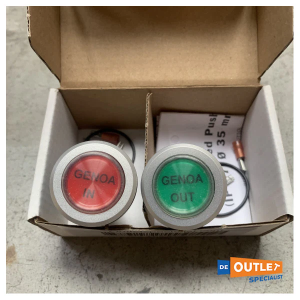
I don't see any labels on the buttons?
The red/green buttons are labelled and illuminated and look like this ...
1764943012776.png
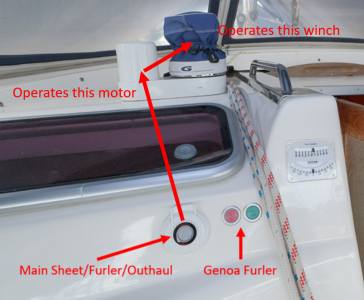
The other button is fairly obvious once the crew know what the red/green buttons do.
1764943485398.png

The ones for the genoa sheet winches are only safe to operate from the helm, and I ensure the crew are told what the buttons do before they are allowed near them. They are also shut off at the battery when we are not using the sails.

Crew are also told that if they don't know what a button does, then don't press it, just ask and I will explain ... some of the symbols on the Bavaria switch panels are not exactly self-explanatory, but if I ever add electric drives to the code-zero/spinnaker winches, I'll label them all as the buttons will be next to the genoa sheet winch buttons.
 
Update: Found this for Selden electric winch/furler kits, maybe Santa will be nice to me this year.

Dec 16, 2024: Seldén Mast adds an emergency stop to their electric functions

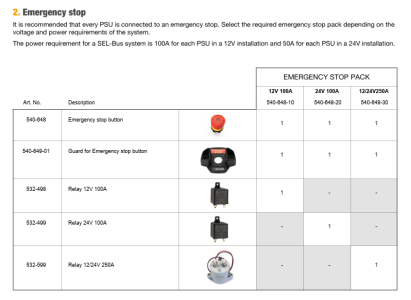
The emergency stop is usually placed withing reach of the helmsman and when the emergency button is pushed, the power to the SEL-Bus system is cut immediately. To reactivate the functions, you twist the button to release it. Supplied as a kit, this emergency function consists of a big and illuminated push button, a protective guard to prevent unintentional use and a relay which is installed between the battery and the Seldén Power Supply Unit. It is easily retrofitted to an existing SEL-Bus installation and available from Seldén’s network of authorized dealers.

Technical information can be found at Seldén’s website.
https://support.seldenmast.com/files/1731397374/597-219-E.pdf

Pack consists of the following which cuts power to the main unit delivering drive power to all the winches.

1764945498141.png
 
Notwithstanding that using a winch (or windlass) with a known switch fault is a terrible idea, and that being able to isolate simply if a fault occurs is a very obvious mitigation...

I've always treated electric winches and windlasses with the same respect (mild fear) as chainsaws - you keep away from the sharp end unless the thing is definitely made safe.
 
Sounds to me like a cultural issue. The placement of high torque windlasses in a.. 'leisure' space, and in particular one thats slippery and wobbling all over the place doesn't sound right to me. I'm amazed their aren't actually more accidents. Factory workers using high torque lathes and mills implicitly understand that if you get wrapped up in one you are seriously going to ruin your day, and their operating in a controlled environment.
 
I've always treated electric winches and windlasses with the same respect (mild fear) as chainsaws - you keep away from the sharp end unless the thing is definitely made safe.
Sounds sensible. I think i am happier with my stihl chainsaw!
In all seriousness i get what people are saying about mindset and a proper process for safe operation. My problem is I often have family and friend crew members where it is hard enough to explain how to fit into a lifejacket and the dangers of a boom, let alone the number of turns and safe operation of an electric winch.
 
Sounds sensible. I think i am happier with my stihl chainsaw!
In all seriousness i get what people are saying about mindset and a proper process for safe operation. My problem is I often have family and friend crew members where it is hard enough to explain how to fit into a lifejacket and the dangers of a boom, let alone the number of turns and safe operation of an electric winch.
If it's any help - when I was introduced to them it was "one hand for the tail, one for the button, lean away"
 
The types likely to cause trouble are the ones that work both ways.

Our 'KISS' system only pulls. Little chance of getting into the line it is pulling due to its position. They are mostly internal, only about a foot shows above the horizontal winch. The foresail control lines have about 2 feet going across the rear cockpit from the quad footblock on the toerail to the winch. As they are moving TOWARDS the operator, not likely to be a problem as the control switch means the operator is in the 'safe zone. We have to slip the lines manually using a clutch and cleat.

Much different using it to trim/adjust a big sail. That could cause issues if not done properly.
 
Last edited:
Sounds to me like a cultural issue. The placement of high torque windlasses in a.. 'leisure' space, and in particular one thats slippery and wobbling all over the place doesn't sound right to me. I'm amazed their aren't actually more accidents. Factory workers using high torque lathes and mills implicitly understand that if you get wrapped up in one you are seriously going to ruin your day, and their operating in a controlled environment.
Particularly agree re your "leisure setting" comment.

People use powered winches on boats/ships all over the place, all of the time. Yes they are very dangerous... Personally, I've worked commercial winches pulling 100T or more, and I've a nephew who fishes commercially, using pwerful haulers - alone...I hesitate to add "singlehandedly ". No pun intended.
Accidents often happen, but more usually in much more "difficult " circumstances than those on yachts?

I've limited experience of powered winches on yachts. However, what I've witnessed has been pretty scary. One instance when lifting heavy, smi-permanent racing marks with chain, on a side mounted hauler, that means I don't volunteer anymore!
Little thought for fingers etc, never mind the potential consequences of the load on the end of the line. Dropping/falling, "snap-back", vessel stability etc etc.

A lack of discipline, formal training, experience, and respect/understanding of the machinery resulted in gross complacency...and several near misses.
 
Last edited:
Top