Electric winches - sobering reading

Thinking about safety is all about assuming the worst, and mitigating that. Peeing over the side even. Don’t assume that because you’re in a quiet anchorage, no passing ship will project it’s wash in there. If you must use both hands, wrap one arm round a shroud! Obviously the lee shroud, to mitigate other risks. I should think failing to stop is a minor risk with electric winches, much more likely is it eating your gear before you notice how mch stress you’ve created. That has potential to be pretty serious of course. Stickers, yeah. No sticker prevents idiocy. Sailing is more dangerous than reading, as a pastime. It’s why we do it, in part. Hence the problem with thinking about safety.
 
…when your doing something, develop an internal mindset that is curious about what ifs, and have a plan to deal with that what if.

Absolutely. I regularly ask myself what I would do if something serious went wrong in a given situation. What helped me develop that attitude was the little book What now Skipper, by JD Sleightholme if I remember correctly. It confronts the reader with a number of situations where something goes wrong and depending on the action you would take it puts you in a following situation where again something happens. That may seem far fetched at first sight, but it contributes to a mindset where at least you try to prepare yourself for eventualities
 
Obviously the lee shroud, to mitigate other risks.
😂

I should think failing to stop is a minor risk with electric winches,
Agreed. Very low likelihood even with the potential for significant injury is low risk.

But……

In this case there was history of failure to stop.
That increases the likelihood and in this case I’d argue the risk wasn’t low.
 
I always wonder with radio controlled windlasses, whether your control could activate a neighbouring boat's windlass. I do realise that a range of different frequencies are used, but still....
It's not just frequencies; the control signal will include an identifier so that it ONLY works with one winch. At least, I'd hope that's the case - there hasn't been a reason for not doing it that way since I was a teenager! I can remember many an article about model aircraft remote controls in Practical Electronics....

PS, this whole discussion has reminded me why I don't have any electric winches or windlasses on my boat. But I can see that while this is feasible on my 31' boat, it might not be on something larger.
 
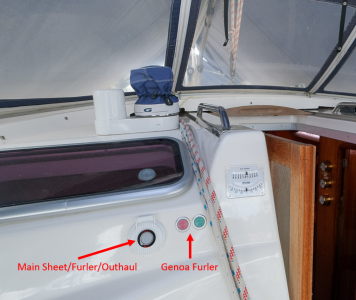
I have two electric genoa sheet winches on the cockpit coamings, one on the cabin roof behind the jammers for the main furler and main sheet, and an electric furler for the genoa. The master switches which cut all winches off from power are in the saloon using battery switches with removable keys. Not suitable as emergency shut-off but when not actively sailing they are all switched off.

1764833037339.png

Button for main sheet is well protected, and has been recently replaced. Lead from jammer to winch is very short, so no need to get fingers/hands near the winch when in operation, usually, one hand has the rope tail, the other operates the button, and there is no real way to get any body parts, or dangling hair/clothing near the winch when in operation. This is a very typical installation for AWBs with electric cabin-top winches.

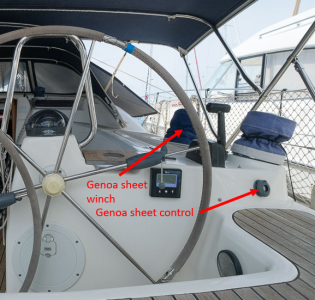
1764834498724.png

The Genoa sheet winches are controlled by buttons at the helm, which are protected against accidental activation. In practice, what happens is the sheet is initially pulled in by hand and put on the self-tailer before it is loaded up, and then led to the cockpit floor. The electric winch is used to do the heavy sheeting instead of a winch handle, I can keep the tail clear of the winch from behind the helm, although if the autopilot isn't engaged I do sometimes flip up the button guard and operate the winch with my foot, using one hand to keep the tail clear, and one hand to steer. The run from the turning block to winch is short, and flogging of the genoa sheets has no effect on the rope at the winch - riding turns don't happen. The code-zero/asymmetric winch is manual only, although the sheet can be lead to the electric genoa sheet winch. Crew are told to keep clear of the winches when in operation. Again this is quite typical of an AWB setup.

I can tell there are massive loads involved and the winches are quite scary so need respect, and they are always switched off at the master switches when not needed.

I am looking at an elegant way to fit an emergency cut-off without introducing potential additional problems.
 
A sharp knife would have been handy to cut the sheet.
How does it go - a sailor without a knife is as much use as a whore without a ...............
We both carry one whilst sailing, plus there’s another just inside the companionway. Not used one in anger on the current machine, but have, once before, intervened in a destructive event by cutting the line. Lifejacket, safety line, knife, all absolute essentials.
 
A sharp knife would have been handy to cut the sheet.
How does it go - a sailor without a knife is as much use as a whore without a ...............
My winches go quite fast, I'd be very hesitant to try and cut the part of the rope being led into the winch with a knife, no matter how sharp, there is a chance the knife will get pulled into the winch too, creating an additional rotating, slicing hazard - might compound the problems? If there is access to the moving sheet a long way from the winch then maybe,

A sharp axe and a single hard blow might be safer on a moving line, I wouldn't want to by sawing away at a moving line heading into a winch.
 
A sharp knife would have been handy to cut the sheet.
How does it go - a sailor without a knife is as much use as a whore without a ...............

My point exactly (post #9).

It seems we have gone full circle.
Everything that can be said on the subject has now been said, maybe just not by everybody. 😇
 
In my experience, lessons learned, is one of the most ineffective ways of controlling risk, which is why we note similar incidents are repeated.
As the old saying goes, experience is what you get just after you needed it.
A sharp knife would have been handy to cut the sheet.
How does it go - a sailor without a knife is as much use as a whore without a ...............
Possibly, as long as it's an easily accessible fixed blade knife. I carry a multitool on my belt when sailing, but it would be no use at all if I've got one hand trapped in a rope that's winding me in like the poor guy that sparked the discussion. I doubt I'd be able to get it out in time if it were someone else being wound in.

Where would you put an emergency stop button? Near the winch, so you can reach it for yourself, but you might be blocking your crew's access, or further away so the crew can reach it, but you might not?
 
As the old saying goes, experience is what you get just after you needed it.

Possibly, as long as it's an easily accessible fixed blade knife. I carry a multitool on my belt when sailing, but it would be no use at all if I've got one hand trapped in a rope that's winding me in like the poor guy that sparked the discussion. I doubt I'd be able to get it out in time if it were someone else being wound in.

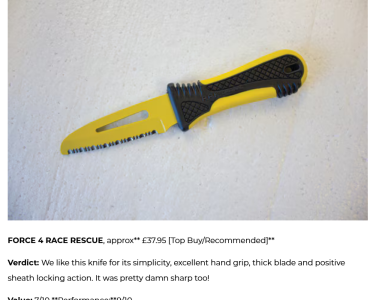
We have one of these.
On our previous boat (wheel steering) it was tied to the pedestal and EVERYONE knew where it was.

My current boat comes with a tiller and as I now sail solo 95% of the time I keep it on my belt.

Screenshot 2025-12-04 at 11-02-19 Best sailing knifes 23 options tested.png
 
If it is desired to install an E-stop button consider a safety relay. There’s a whole industry devoted to making effective E-stop devices for industrial machinery. Pilz are a leader. It’s not enough to interupt the power as contacts can be bridged or welded shut.

Personally, I ask the crew to be in a position to unload the winch jaws and unwrap most of the winch instantly. There’s no a avoiding the fact these things are very dangerous in so many ways. And not just the winches/windlasses, but the blocks and rope can fail also.
 
Our two electric winches are new to us this year and they make me nervous.
Whilst the risk of fatal injury is very low, the risk of life changing injuries is reasonably foreseeable. Fingers don’t grow back.


All in all, sobering reading and it must be worth thinking about your own use case.
As you say, sobering reading.

The biggest worry i had before reading all this was the risk of breaking the rig. Many times i have manually winched up the mainsail and it has got stuck on something. Whether the lazyjacks, a slider catching the edge of the track feed, the topping lift caught around something. Whatever, but the resistance in the manual winch allows you to stop and sort it out. An electric winch would just break whatever had got stuck.
 
As you say, sobering reading.

The biggest worry i had before reading all this was the risk of breaking the rig. Many times i have manually winched up the mainsail and it has got stuck on something. Whether the lazyjacks, a slider catching the edge of the track feed, the topping lift caught around something. Whatever, but the resistance in the manual winch allows you to stop and sort it out. An electric winch would just break whatever had got stuck.
Wrong thinking, wrong process.
We have a simple rule for exactly this reason - when using the electric halyard winch it is ONLY two turns round the winch and NEVER use the self tailer function. Then if the sail catches - which it occasionally does, perhaps once in a 50 (so 3 or 4 times a year) - the rope just slips. Which gives the hint to stop and fix. The final 6 inches is done manually with 4 turns and the self tailer.
I strongly recommend this procedure for all electric halyard winches.

We have once had gear break due to over winching the halyard when hoisting. But that was with teenagers and a manual winch!
But I have also seen on another boat causing gear breakage over winching a genoa sheet with a pole up using the electric winch on self tailer mode. Wrong procedure.
 
Wrong thinking, wrong process.
We have a simple rule for exactly this reason - when using the electric halyard winch it is ONLY two turns round the winch and NEVER use the self tailer function. Then if the sail catches - which it occasionally does, perhaps once in a 50 (so 3 or 4 times a year) - the rope just slips. Which gives the hint to stop and fix. The final 6 inches is done manually with 4 turns and the self tailer.
I strongly recommend this procedure for all electric halyard winches.

We have once had gear break due to over winching the halyard when hoisting. But that was with teenagers and a manual winch!
But I have also seen on another boat causing gear breakage over winching a genoa sheet with a pole up using the electric winch on self tailer mode. Wrong procedure.
Electric winches free up both hands for tailing. It’s actually easier to use them right, than wrong. Then, as you say, you can sense the load, and let it slip, in the first instance of increased resistance.
 
Some good safe working systems described by several in this thread. And by the the recognition that an emergency stop is not a breaker hidden in a locker.

A safe working system is protection provided it is rigorously followed (and there are no mechanical or electrical faults). Its the moment of crisis when fatigued or distracted that can expose the hazard.

The core issue is to have a well designed, fully operational system with regular function checking in combination with a clear and simple safe working system which all crew are practiced in.

If this incident clarifies all the above then it will help many with electric winches stay safe.
 
In my opinion, the winches associated with the incident would have been safe enough if the intermittent fault had been fixed, when it was detected, or the winches used in manual mode, until it was fixed. Instead, it was lived with, risk was normalised or not appreciated, and the incident occurred. There are of course compounding factors like the absence of an emergency shut down button, or breaker, or where the battery isolator was located. Unfortunately, while we can all sing lyrical about safe solutions, human beings are exceptionally good at living with high levels of risk.

Personally, this has made me think about my electric windlass set up, controlled at the winch, how can I make the operation of it safer, what would I do if single handing and I got snagged in the winch or it ran away, the role of the lever that engages the cone clutch, awareness of the breaker location (it is beside the pedestal, but just inside the cockpit locker).

I think for most of us, just thinking about how it is set up on our boats, how we can use the winch, windlass to reduce risk, and what we would do if the winch snagged someone or would not stop is good enough. There is likely no need for any changes to most winch and windlass set ups. However, think about managing change, such as a new person to your boat, or if a fault develops, what will you do then to ensure that risk is managed?
 
Top