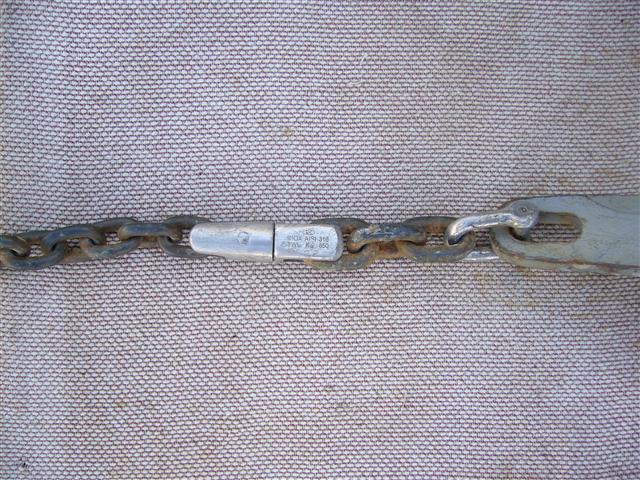
Anchor Chain Swivel

It is a great solution, well done for coming up with it Vyv.

The only pity is that it is not used more often. 99% of swivels I see are directly connected to anchors. There are a small number of swivel models where it is arguably not needed, and some boats where there is no room for this solution, but it deserves more publicity.
 
Plus two pins, plus stainless bling. :rolleyes:

The Kong design is pretty clever. The pins are forged lugs, part of the body. The single screw carries no load, just holds the body parts together. I Loctite the screw and it takes some effort to undo at the end of the season. If you want a swivel, and I do, then this is the one to go for. Did well in the tensile test too.
 
The Kong design is pretty clever. The pins are forged lugs, part of the body. The single screw carries no load, just holds the body parts together. I Loctite the screw and it takes some effort to undo at the end of the season. If you want a swivel, and I do, then this is the one to go for. Did well in the tensile test too.

That's fine, but I honestly don't see what a swivel achieves. I see it as a solution looking for a purpose. On my previous boat, the bow roller was 8-9ft above the water, and the stem was nearly vertical. We had a mark on the chain showing when the anchor (140lb) was just clear under the stem. If the anchor was incorrectly orientated, it was fairly simple to lean over and rotate the chain with a "poker". I don't see where a swivel would have helped.

Our present, much smaller, 36ft ketch, has her bow roller extended forward from the stemhead. By fitting a "bent link" between the chain and the anchor, if the anchor comes up facing the wrong way, the link automatically rotates the anchor every time. I appreciate that not every boat can accommodate a link like that, either from lack of distance from bow roller to windlass gypsy, or because of the potential for damage caused by a rapidly rotating anchor, on a boat with a bow roller mounted close in to a vertical stem.

In the latter example, one is faced with poking the anchor with a boathook, and I accept that if you have to do that, then a freely rotating swivel might help, but if design permits, a "bent link" does the job for you.
 
Attaching the swivel to the anchor and the other end to the chain eliminated all shackles, but I understand that non linear pull could compromise the jaws of the swivel. I don’t understand what the separate 2/3 links achieve but I will copy Vyvs recommendation.
I know my swivel isn’t Kong but it was the only one stocked by Boat Gear Direct near Levington when I bought new chain. The pins are massive and it didn’t seem cheap at the time, however I’ve no idea how the two parts are linked together.
 
That's fine, but I honestly don't see what a swivel achieves. .

One of the advantages of a swivel is solving the problem of the chain becoming excessively twisted in an anchorage where the boat repeatedly spins around.

Once the anchor is broken free, the twists will spin out even without a swivel (sometimes very dramatically), but the gypsy cannot retrieve twisted chain, so when trying to retrieve the anchor all the twists become concentrated in the last section of chain. You need to achieve a very short scope, close to 1:1, before good quality modern anchors can be broken out. If there are many twists in the chain (and it takes a lot) the chain can start to hockle, or bunch up, before a short enough scope is reached.

Not a very good photo, but you can see the hockled chain. When this photo was taken, the chain was under a very large load trying to break out a completely buried anchor. If look closely, you can see the bunched up chain. In spots it is so twisted that some of the links are lying at 90°(see the link the arrow is indicating). The torque was great enough that I was concerned about permanently damaging the chain.

This is a rare problem that you are not likely to see unless you anchor a great deal, and have an anchor that is difficult to break free at shortish scopes. Whether it is worth the drawback of a swivel to solve this issue is debatable. Personally, I still use a simple shackle, but there have been occasions, such as the one pictured, where a swivel would have made life much easier.

lZRcVlL.jpg
 
Only one shackle.

Vyv,

Any critical reason why the three links are 10mm rather than 8mm like the rest of the chain? With 60m of 8mm chain on board I could easily put three links between the swivel and the anchor, but I don’t have 10mm links to hand.

Mark
 
One of the advantages of a swivel is solving the problem of the chain becoming excessively twisted in an anchorage where the boat repeatedly spins around.

Once the anchor is broken free, the twists will spin out even without a swivel (sometimes very dramatically), but the gypsy cannot retrieve twisted chain, so when trying to retrieve the anchor all the twists become concentrated in the last section of chain. You need to achieve a very short scope, close to 1:1, before good quality modern anchors can be broken out. If there are many twists in the chain (and it takes a lot) the chain can start to hockle, or bunch up, before a short enough scope is reached.

Not a very good photo, but you can see the hockled chain. When this photo was taken, the chain was under a very large load trying to break out a completely buried anchor. If look closely, you can see the bunched up chain. In spots it is so twisted that some of the links are lying at 90°(see the link the arrow is indicating). The torque was great enough that I was concerned about permanently damaging the chain.

This is a rare problem that you are not likely to see unless you anchor a great deal, and have an anchor that is difficult to break free at shortish scopes. Whether it is worth the drawback of a swivel to solve this issue is debatable. Personally, I still use a simple shackle, but there have been occasions, such as the one pictured, where a swivel would have made life much easier.

lZRcVlL.jpg

I fully agree with you that chain should not be treated like that! Presumably you would have to be anchored for a very long time in the one spot, to get either enough wind shifts or tide reversals to get all these twists. Actually, from the photo, it looks as if the most severe twists are at the top, with somewhat less twisted chain lower down. If this is the case it is doubtful if the swivel would be inclined to rotate away down at the bottom. With the chain in the photo, was there a swivel fitted? (Having read your post a gain, I see that there was no swivel).

I anchor all the time, but normally for 1-3 days, so don't suffer from the twisting shown. I do leave my boat anchored for a four week period once every year, but for that I arrange a Bahamian Moor, so don't get any twisting.
 
I tried to turn by hand some *used* swivels, those with grit, mud particles etc, even the spherical Wasi, and if any moderate+ tension is applied to the chain it becomes increasingly difficult up to impossible to make it turn, I seriously doubt it would be of any help with moderately twisted chains, anyway one Kong I personnally used was totally uneffective. Not convinced enough to fit one of any kind, I periodically drop all the chain to the bottom and put it right while lifting it.
 
Vyv,

Any critical reason why the three links are 10mm rather than 8mm like the rest of the chain? With 60m of 8mm chain on board I could easily put three links between the swivel and the anchor, but I don’t have 10mm links to hand.

Mark
10mm chain is used as 8mm won't fit on the swivel I seem to remember when I tried this set up on my boat. 10mm chain also allows a bigger shackle pin to be used on the anchor. I've got to have another go at setting my system up so that the anchor is self stowing
 
When anchored for a long time the problem can occur, but the spins to port and starboard often even out. The biggest problem seems to be with those rare conditions where there are two competing light wind patterns. For example with a sea breeze at 180° to the prevailing wind. As one wind or the other takes over the boat swing around to align with the dominant force.

Note, the boat does not have to move around the swing circle to put a twist in the chain it only has to spin through 360°. The compass direction to the anchor can remain the same. I have never had this problem from current. I think it could occur, but the number of rotations is likely to be too low. It takes a lot of twists to get the chain to this stage.

Anyway, it is a rare problem, but if you find yourself spinning the same way and do not have a swivel it is something to watch, especially with modern anchors where they can be difficult to break out unless you can get the scope very short. It is not something you will notice until you try to retrieve the anchor and the twists become concentrated between the bow roller and the anchor.

The chain was twisted all the way. I am sure a swivel would have rotated. The torque was very impressive and felt close to level where the chain itself was going to be permanently distorted although I have no idea if this was a real concern.

This is a photo of the chain near the seabed. Not very sharp, but you see the chain bunching up near the seabed. The chain is leading directly to end of shank which is just about to break out from under the substrate.

0Ec7q8W.jpg
 
Last edited:
Roberto has the observation, post 30. Swivels may reduce twists but you need a lot of twists generating enough torque to turn a swivel. As mechanical devices that are meant to rotate - they are pretty useless. There is, (you guessed it) another article I'll have a search.

If chain is on the seabed - twists will not fall out until the chain is lifted - and then torque and gravity will remove most twists. You would need to be anchored in one spot for a very long time to generate enough twists for a swivel to operate - and how many here anchor for such long and extended periods and also have their yacht turning in one direction only. For the rest of us either buy an expensive swivel, Kong, Ultra, use a bent link or a broom handle or boat hook.

There should be no need to periodically remove twists in the rode - its obviously easier to lift the chain until the anchor hangs free and allow time and torque to remove any twists. The twists will not, cannot, pass into the locker. If you have twists in the chain in the locker - they were in there from 'commissioning'

Most anchors work by burying the shackle and the toe at the same time. A well set anchor will have buried some chain - anything big and chunky, big swivels (think of the Mantus swivel) big chain, big shackles will reduce the amount of chain you bury. Buried chain reduces the impact of veering on an anchor. Have no or less buried chain and you impact the anchor more frequently (or all the time).

Unless you are prepared to buy a Kong, Ultra - there maybe other good brand name swivels (but I cannot think of them - most are unbranded) then you have introduced an unknown risk to your rode. If a broom handle will solve the problem, or a bent link - ditch the swivel (or you, or the swivel rather) may one day ditch your anchor.

Jonathan

There are more than one

https://www.practical-sailor.com/issues/37_83/mailport/Stopping-Anchor-Chain-Twist_12295-1.html

but this is the one I was referring to:

https://www.practical-sailor.com/blog/How-Well-Do-Swivels-Reduce-Twist-11938-1.html
 
Last edited:
Considering the number of swivels I see I can only think its the marine lemming instinct that encourages people to buy them. Yes - there are yachts where a swivel is useful, but few where it is essential. There are no example where a bent link would not suffice. I am not aware of any literature praising swivels but am aware of literature (including this forum and this specific thread is simply one example of many) that damn them.

So why do I see so many? - most are unbranded and most have at least one, sometimes more than one, inherent manufacturing/construction weaknesses as outlined in this thread. People agonise over anchors, people agonise over chain (and less, but a few, agonise over shackles) - and then go off and buy an unbranded swivel.

I suspect its the allure of the stainless and the fact one's neighbours have one.

Its a bit like tearing up $20 notes and throwing them in the sea.

Jonathan
 
Considering the number of swivels I see I can only think its the marine lemming instinct that encourages people to buy them. Yes - there are yachts where a swivel is useful, but few where it is essential. There are no example where a bent link would not suffice. I am not aware of any literature praising swivels but am aware of literature (including this forum and this specific thread is simply one example of many) that damn them.

So why do I see so many? - most are unbranded and most have at least one, sometimes more than one, inherent manufacturing/construction weaknesses as outlined in this thread. People agonise over anchors, people agonise over chain (and less, but a few, agonise over shackles) - and then go off and buy an unbranded swivel.

I suspect its the allure of the stainless and the fact one's neighbours have one.

Its a bit like tearing up $20 notes and throwing them in the sea.

Jonathan

I blame vyv_cox's who seems to have inveted it , but I have to say it works for me and I bought the same set up as him after a good bit of research.
only time will tell , but ty to the invetor
Anchor is 25kg Rocna, not that that is the way forward just pointing it out:D
 
10mm chain is used as 8mm won't fit on the swivel I seem to remember when I tried this set up on my boat. 10mm chain also allows a bigger shackle pin to be used on the anchor. I've got to have another go at setting my system up so that the anchor is self stowing

Boathook,

Thanks - makes perfect sense,

Mark
 
Vyv,

Any critical reason why the three links are 10mm rather than 8mm like the rest of the chain? With 60m of 8mm chain on board I could easily put three links between the swivel and the anchor, but I don’t have 10mm links to hand.

Mark

No major reason. Load and wear are highest at the anchor connection, the swivel and shackle would accommodate a size bigger, so it seemed like a sensible precaution. 8 mm will be fine but inspect occasionally.
 
No major reason. Load and wear are highest at the anchor connection, the swivel and shackle would accommodate a size bigger, so it seemed like a sensible precaution. 8 mm will be fine but inspect occasionally.

Don't want to start a major argument, but surely the greatest load is not at the anchor, but at the bow roller.
 
That's fine, but I honestly don't see what a swivel achieves. I see it as a solution looking for a purpose. On my previous boat, the bow roller was 8-9ft above the water, and the stem was nearly vertical. We had a mark on the chain showing when the anchor (140lb) was just clear under the stem. If the anchor was incorrectly orientated, it was fairly simple to lean over and rotate the chain with a "poker". I don't see where a swivel would have helped.

Our present, much smaller, 36ft ketch, has her bow roller extended forward from the stemhead. By fitting a "bent link" between the chain and the anchor, if the anchor comes up facing the wrong way, the link automatically rotates the anchor every time. I appreciate that not every boat can accommodate a link like that, either from lack of distance from bow roller to windlass gypsy, or because of the potential for damage caused by a rapidly rotating anchor, on a boat with a bow roller mounted close in to a vertical stem.

In the latter example, one is faced with poking the anchor with a boathook, and I accept that if you have to do that, then a freely rotating swivel might help, but if design permits, a "bent link" does the job for you.

I have explained this several times before but here it is again. Jill does the foredeck as she is not confident under engine in tight anchorages. The anchor inevitably comes up reversed if the boat is moving forward. She rotates it by hand courtesy the swivel. Easy and always successful. We have tried various alternatives including no swivel, a different type and a cranked Osculati one but the Kong works well for us. With no swivel the anchor will rotate reluctantly using the boathook but I need to go forward to turn the chain in the roller because she does not have the strength to lift and turn as needed. This is highly inconvenient. The cranked Osculati was a disaster, inhibited anchoring and led to frequent dragging, abandoned after a week.
 
Top