An eventful journey from Southampton to Chatham

A lot of people seem to think their engine uses x litres per hour.
The reality is, that 'x' is hugely variable according to how fast you go and whether there's a head wind or some chop to drive through.
'motor sailing' can vary from half a litre per hour when the sail is doing most of the work, to 2litres or more when the prop is doing all the work and the sail is really just damping rolling from the waves and swell. It can be absorbing several kW.
As it's late season, a lot of boats are draggy with growth, that can easily be a few HP.
A typical diesel uses about 0.22 litres per hour for every HP it's producing.
That's a matter of the energy in the fuel and the efficiency of the engine.
Clean hull flat water, not making waves, might only be 2HP of load on the engine.
It soon escalates from there!
My 14HP Beta can develop about 9HP at 2400 rpm, so could use 2 litres an hour without trying.
When my brain is working properly - that is just not the case. A Beta 28 which is what concerto has will average just under 2l an hour when cruising at 2400rpm when it produces around 18hp. Your Beta 14 will use half that - under 1l hour.

I have good records for my Volvo 2030 over several hundred hours of "normal" mixed use of under 2l and similar for my Nanni 14 (same engine as yours) in another boat at under 1l hour.

Sure your Beta will burn more if you run at over 3000rpm constant, but not at 2400.
 
Nice job Concerto, you ought to think about writing that up for e.g. YM ar PBO, you might get a few quid for the story.
What sort of drone is it? (Nearly 'was' it!)
I will probably write it up for a magazine, which one will not be my decision. The press officer at the Cruising Association has asked me for articles and tips for publication. She will decide whether anything will appear in the CA Magazine or YM or PBO, all will still be under my name.

The drone I fly is a DJI Mini 2. It is under 250g and quite small but very powerful with a 4K video camera. I should mention this has now been superceded by the Mini 3, but this has extra sensors to help avoid collisions. Great on land but useless on a boat that is moving around. If you have not watched some of my videos on my round Britain trip, then click on https://www.youtube.com/@FulmarConcerto
 
There is no fuel guage fitted, to check the tank I have to dip it as described before. Before I left Chatham I filled the tank and that would usually last me a number of months. The light winds leaving Chatham meant I motored most of the way to Southampton. Whilst at the boat show everyday, I returned feeling very tired after being on my feet most of every day and the 20 minute walk each way to the berth in Ocean Village. My FitBit showed between 15,000 and 22,000 steps every day.

Personally I do not consider a trip between Chatham and the Solent a major trip. I have done it so many times over the decades, it is more like a bus ride. On Sunday I finally got back onboard, after helping pack the stand away, just before 7. Cooking a meal, checking the navigation, tidying the boat ready for sea, filling the water tank, etc. were the most important. Then off to bed to be up at 4.30. There are no fuel facilities at Ocean Village, but there is a fuel berth in the Itchen, but it is closed at weekends and does not open until 8am. It was not possible to fill the tank during show or as I left. I had planned to fill up in Dover and expected to get there with what was in the tank.

Just thinking about it over the past decade, I cannot think of anywhere I have used in the Solent to fill up with diesel. Certainly used Brighton and Eastbourne, but never Ramsgate.
If something had gone badly wrong, people would be suggesting that setting off on a substantial singlehanded trip in a busy shipping area, while already tired and not prepared with adequate fuel, sounds a bit like you are complacent because you've done it a few times before.
 
If something had gone badly wrong, people would be suggesting that setting off on a substantial singlehanded trip in a busy shipping area, while already tired and not prepared with adequate fuel, sounds a bit like you are complacent because you've done it a few times before.
There are only 3 small parts of the journey that have any busy shipping activity. Firstly using the small craft channel going down Southmapton Water there were ferries in the main shipping channel, so not a problem. Crossing the entrance to Portsmouth Harbour there were 3 ferries and a hovercraft, so nothing unusual. The final busy area was off Dover with 5 ferry movements and the RNLI, but I had notified Dover VTS of my presence. For the rest of the journey there were no other interactions with commercial shipping as the route taken was inshore of main shipping channels or traffic separation zones. So roughly 98% of the whole journey was completely away from any busy shipping area.

You do seem to always comment like an armchair sailor rather than getting out there and doing something momentus. I cannot find if you sail singlehanded, if not give it a try. How far have you travelled in a day? Have you never had anything go wrong on any journey? I prefer to be open about my mistakes as they can be a lesson to others.

Remember that last year I sailed round Britain via Out Stack, the most northerly point in the UK, and only after I completed this journey did I find out how very rare this journey was to do singlehanded. You cannot fail to agree this journey from Ocean Village to Chatham was a very long trip at 174 miles. I had one problem that I solved without involving anyone else, surely you can see that requires a higher level of competence than most sailors on this forum.
 
Setting off with insufficient fuel is a very low level of competence.
I don't think sailing a boat somewhere busy while extremely tired is big or clever.
There's not much of the English Channel where I'd not want to be keeping an adequate lookout.

You may think you're more competent than most sailors on this forum, personally I don't think you've shown that.
 
Have I read this correctly? You decided not to anchor, but instead sailing solo went to sleep for 2 hours at a stretch (and also for 1.5 hours twice) whilst underway close to the shore in the English Channel. So no lookout at all for up to 6 miles (15 in total) in the dark?
I don’t know these waters, but at what point does “pushing the boundaries” start to become “unwise” or even “unseamanlike” or “reckless”?
Certainly sounds like failing SOLAS watch keeping - which might be fine mid Atlantic but not heard being done in the busy SE coast.
Does your insurance not have any restrictions on solo voyages (typically nowadays up to 18 or 24 hours for general coastal waters - for good reasons)?
Might provoke a few adverse comments if written up for a magazine (and might prompt your insurers to take an interest also).
 
Have I read this correctly? You decided not to anchor, but instead sailing solo went to sleep for 2 hours at a stretch (and also for 1.5 hours twice) whilst underway close to the shore in the English Channel. So no lookout at all for up to 6 miles (15 in total) in the dark?
I don’t know these waters, but at what point does “pushing the boundaries” start to become “unwise” or even “unseamanlike” or “reckless”?
Certainly sounds like failing SOLAS watch keeping - which might be fine mid Atlantic but not heard being done in the busy SE coast.
Does your insurance not have any restrictions on solo voyages (typically nowadays up to 18 or 24 hours for general coastal waters - for good reasons)?
Might provoke a few adverse comments if written up for a magazine (and might prompt your insurers to take an interest also).
Having done more or less the same passage a couple of times single handed, but using the 15 min nap technique, twice off the Brighton region I came up and found a fishing vessel rather closer than expected for such a short time, so reduced the timer to 10 min.

Really worries me to think that people sail along there with no watch whatsoever for extended periods.
 
Concerto made a judgement based on boat speed, conditions and location at the time. Given his situation, and the stress of dealing with the discovery and replanning of fuel running out, getting some rest probably makes the remaining trip safer, albeit with some risk while resting.

Solo passage making will never sit comfortably with marine regulations and guidance for keeping watch even if you use VHF, radar and AIS monitoring (which some fully crewed boats don't). It reminds me of when I first "discovered" the M2 weather buoy in the middle of the Irish Sea.

I respect the sharing of the account because it allows discussion of the issues raised and allows others to learn from it.
 
Concerto made a judgement based on boat speed, conditions and location at the time. Given his situation, and the stress of dealing with the discovery and replanning of fuel running out, getting some rest probably makes the remaining trip safer, albeit with some risk while resting.

Solo passage making will never sit comfortably with marine regulations and guidance for keeping watch even if you use VHF, radar and AIS monitoring (which some fully crewed boats don't). It reminds me of when I first "discovered" the M2 weather buoy in the middle of the Irish Sea.

I respect the sharing of the account because it allows discussion of the issues raised and allows others to learn from it.
I agree. We've all made a slip up - we learn from them and, by sharing help others to learn & improve.

Solo sailing rather scares me and I salute all that are brave enough to do it.
 
Concerto made a judgement based on boat speed, conditions and location at the time. Given his situation, and the stress of dealing with the discovery and replanning of fuel running out, getting some rest probably makes the remaining trip safer, albeit with some risk while resting.

Solo passage making will never sit comfortably with marine regulations and guidance for keeping watch even if you use VHF, radar and AIS monitoring (which some fully crewed boats don't). It reminds me of when I first "discovered" the M2 weather buoy in the middle of the Irish Sea.

I respect the sharing of the account because it allows discussion of the issues raised and allows others to learn from it.
What would be wrong with anchoring? Or at least heave to? If neither is an option then sounds like a failure of the passage planning.
 
.
Solo sailing rather scares me and I salute all that are brave enough to do it.
Done 8k or so miles solo in coastal waters. Not an issue if properly prepared (and stay on board!), it’s only the parking in marinas that can be challenging.
But inshore happy to stick within my insurer’s limit of up to 18 hours, and never considered going for extended sleep underway. That’s what anchors are for.
 
Done 8k or so miles solo in coastal waters. Not an issue if properly prepared (and stay on board!), it’s only the parking in marinas that can be challenging.
But inshore happy to stick within my insurer’s limit of up to 18 hours, and never considered going for extended sleep underway. That’s what anchors are for.
Well done - at first I thought you had written 8km, which didn't sound too bad!
 
What would be wrong with anchoring? Or at least heave to? If neither is an option then sounds like a failure of the passage planning.
I agree and anchoring is my favourite way to get a rest. Not everyone is comfortable doing it in new places. A big part of passage planning is identifying alternatives. However I don't usually make a plan for if my engine fails.

I identify possible refuge anchorages en route and especially those easily approachable in the dark in case. Anchoring in the dark even in a new place is for me much less stressful than entering a new harbour or confined waters in the dark.
 
My insurance company has a limit of 15 hours or 100 miles solo. I do quite a bit of singlehanding and think these limits are more than reasonable in coastal waters. The concentration needed to navigate close to the coast in busy areas and steer around fishing pots makes it a very tiring exercise. Completely different from singlehanding across oceans. I have no doubt that Concerto is a very skilled sailor, but endurance is not the same as competence.
 
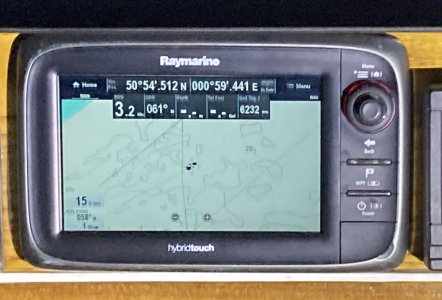
I admit I made an error in not checking the fuel tank. I did not note exactly when I ran out of fuel but it was before 7. However after I decided to rest for the first time the boat was making about 2.2 knots over the ground and I estimated it would take about 5 hours to reach Dungerness. The wind forecast was to remain low for about 6 to 10 hours and then slowly increase. At about 12.30 I was approaching Dungerness and on watch as there usually are some fishing boats working. I passed Dungerness just after 1 and this photo of the chart plotter shows the boat speed had increased slightly as the tide had turned in my favour.

IMG_8289 1000pix.jpg

In reply to the insurance question, my policy allows for up to 24 hours singlehanded sailing. A couple of years ago I spoke with them to clarify the exact wording. The 24 hours was for the expected/planned journey time, but I would still be covered if something affected this like bad weather, no wind, mechanical breakdown, etc. The waters where I rested do not have fishing pots, there are no buoys, and have very few boats passing by. At night the number of boats, except fishing boats close to Dungerness, is usually none.

So, by making only a slow speed was certainly different than charging along at 6 knots. I covered a relatively short distance in waters that were highly unlikely to have any other craft. This was a risk I thought was acceptable. May be having sailed long distances and frequently seeing no boats for hours on end has made me less twitchy about taking this risk.

Returning to the insurance question, I feel the journey had a problem that caused a necessay change of destination. I did get some sleep, in total 5 hours, which is a fairly normal amount for me. I did not feel tired, so felt there was not any problem in continuing. Edward Heath always said all of his racing crew should be able to go 36 hours without sleep, well this distinguished yachtsman may have a point. However I did get an almost regular amount of sleep for me.

In the same situation again, I would do exactly the same. At no time did I feel I was unsafe or a danger to others or need the aid of a rescue service. We all have differing opinions and I am happy this has turned into a proper discussion and may make someone think through their options before calling for outside help just because they ran out of fuel.
 
Last edited:
As I had slept reasonably well I decided to keep sailing with a new plan. I would continue to keep sailing and grab some more sleep, 2 hours followed by an hour and a half making a total of 5 hours.

If you're asleep for 5 hours while navigating in coastal waters, whatever speed you are doing, I'm more than pleased that you don't sail anywhere near me. You will almost certainly be uninsured as it will be caught by a catch-all phrase in your insurance about sailing competently or with care at all times. If you had an incident that prompted the MAIB to investigate I expect that you'd face a prosecution as well.
 
Last edited:
What would be wrong with anchoring? Or at least heave to? If neither is an option then sounds like a failure of the passage planning.

I brought a new-to-me Dragonfly 35 from Hamble to North Wales a few weeks ago on my own and used no harbours or marinas on the whole trip, but anchored every night. No single handing records were broken, no passage longer than 12 hours, and no more than 2 night hours on any leg. In my opinion, pushing myself to the point of exhaustion, as well as dangerous, is also unpleasant.
 
Last edited:
At no time did I feel I was unsafe or a danger to others
A dangerous attitude, and a time when accidents most likely to happen. How do you know you didn't have a close encounter when you were asleep - you will never know.

Do you have radar, and if so were you running it with a guard zone?

Very wise to edit your original post.
 
Top