
How does a tacho get RPM and engine-hours data, and how to fix faulty readings?

Babylon

Well-Known Member
Joined
7 Jan 2008
Messages
4,385
Location
Solent
Visit site
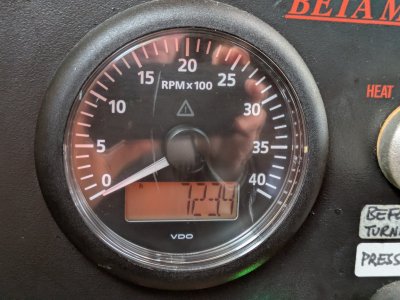
After my Beta 25 had a brief overheat problem earlier this year (the freshwater pump bearings failed spilling coolant out the front while I was on deck and didn't hear the alarm for a while) the engine suffered no harm, except that ever since then the tacho on the panel started under-reading, with the needle bouncing around considerably.

My local Beta engineer then fitted a replacement alternator, on the basis that the old one had gotten wet (when I'd later tipped a load of cold water over the whole engine to risk using it again for a few minutes single-handed tricky berthing after ghosting up the ebbing river under sail) but the problem remained: actual RPM and hours about a third higher than tacho reading. Now on my most recent visit found the tacho to be completely dead.

I understand that it is the alternator that supplies the tacho with the basic RPM signal, but as the replacement alternator results in the same problem, the cause must be elsewhere? Also, re engine hours, this is surely wholly independent of actual RPM so how come that was under-reading as well?
 

Attachments
  • Beta Tacho.jpg
    Beta Tacho.jpg
    584.2 KB · Views: 6
Last edited:
After my Beta 25 had a brief overheat problem earlier this year (the freshwater pump bearings failed spilling coolant out the front while I was on deck and didn't hear the alarm for a while) the engine suffered no harm, except that ever since then the tacho on the panel started under-reading, with the needle bouncing around considerably.

My local Beta engineer then fitted a replacement alternator, on the basis that the old one had gotten wet (when I'd later tipped a load of cold water over the whole engine to risk using it again for a few minutes single-handed tricky berthing after ghosting up the ebbing river under sail) but the problem remained: actual RPM and hours about a third higher than tacho reading. Now on my most recent visit found the tacho to be completely dead.

I understand that it is the alternator that supplies the tacho with the basic RPM signal, but as the replacement alternator results in the same problem, the cause must be elsewhere? Also, re engine hours, this is surely wholly independent of actual RPM so how come that was under-reading as well?
Looks like it is the tacho that is at fault. You are correct in that the tacho gets the RPM signal from the alternator in the form of a.c. frequency, the faster the engine runs the higher the frequency of the signal. The runnining hours normally work from a 12 volt feed to the meter when you turn on the ignition switch. So I would suspect the display unit or its connections.
 
Many tachos use a set RPM as the hours factor ... so for example if the tacho uses 1600rpm as the factor ... if you run your engine at 2400rpm for 1 hour - the Hours meter will register 1.5hrs.
The hours function is not just time based - its work + time ...

Therefore it would appear that your tacho has lost calibration and needs recalibrating ..... IMHO ... but that depends also on the way your tacho works.
 
Many tachos use a set RPM as the hours factor ... so for example if the tacho uses 1600rpm as the factor ... if you run your engine at 2400rpm for 1 hour - the Hours meter will register 1.5hrs.
The hours function is not just time based - its work + time ...

Therefore it would appear that your tacho has lost calibration and needs recalibrating ..... IMHO ... but that depends also on the way your tacho works.
I think not , with that sort of display? never say never :unsure: :p
 
I think not , with that sort of display? never say never :unsure: :p

I have a cheap chinese tacho on my boat and that is exactly what it does ... and I have an extra wire (white if I remermber correct) that I use to calibrate it ..

My Solis tractor shows hours on the dash - same system ... my Husqvarna Lawn tractor ... same ...

Just commenting ....

Of course his may not do it .. but its actually hard for display to have a counter working that way.
 
I originally had just an engine hours counter that clocked up the hours it was powered up. When I later fitted a Durite tacho I left it powered up for a week to increase the hour reading to the correct value. If you leave the ingition switched on it will add engine hours even if the engine is not running.
I had to calibrate the tacho with DIL switches and a pot on the rear to account for the difference in crankshaft and alternator pulley sizes.
I think this is quite common.
 
I originally had just an engine hours counter that clocked up the hours it was powered up. When I later fitted a Durite tacho I left it powered up for a week to increase the hour reading to the correct value. If you leave the ingition switched on it will add engine hours even if the engine is not running.
I had to calibrate the tacho with DIL switches and a pot on the rear to account for the difference in crankshaft and alternator pulley sizes.
I think this is quite common.

Interesting .. never seen that ... noted !!
 
Now had a really helpful chat with Beta's electrical system guy.

My problem might lie in a loose or corroded connection in the main loom plug which is under the rear of the engine/gearbox. This gave issues some years ago when it all got a bit wet from a previous coolant leak due to corrosion in the old HE housing, and I recall cleaning and greasing all the connections before wrapping it up again in tape to insulate it. So this is likely to have gotten pretty hot then quite wet on the day of the overheat episode, and needs checking again before anything else.

If it isn't the main loom plug connection, then he explained which connections on the alternator and at the rear of the tacho panel to bridge with a long wire to check the pulse signal.

Finally, the engine hours meter isn't proportional to engine RPM as such, but it does only cut in at a few hundred revs to avoid the problem andsarkit experienced when he retro-fitted a Durite tacho (i.e. "If you leave the ingition switched on it will add engine hours even if the engine is not running.")

My guess is that the loom plug connection was compromised at the time, giving an intermittent or false RPM signal over the rest of the summer (nothing to do with either the original or replacement alternator), and has now failed altogether due to continuing corrosion or similar over the cold damp autumn. And in consequence too low an effective RPM signal would have meant that the hours meter wouldn't have recognised the engine as running above the cut-in level for some of the time.

I'll check this when I'm next down.
 
Last edited:
Useful. I have always worried about the loom plug connection at the back of the engine because of servicing spills. I have also had a problem with the loom connector to the panel working loose - now taped up.

Do feedback if it solves the problem.
 
Good to hear Beta are still giving good after-sales support/advice.

I, too, wondered if a dodgy connection in one of the connectors in the loom might be responsible for either or both of the tachometer and hour meter.

Hours DIsplay
As I mentioned, the absence of a display could be a wiring loom fault, but it could also be a dead display. The engine hours display often fails with age on various makes (Volvos used to be notorious for it), but typically (and in Volvos and Betas) the hours are counted on the PCB and not in the display itself. The PCB still knows and counts the hours - you just can't see it if the display is dead. (My Beta's display eventually faded then disappeared, but a long time later it on a couple of occasions it was briefly legible again, and showed it had been counting the hours in the interim. I seem to recall, too, someone recounting replacing an LCD display and it already showed the correct hours.)

Generic hour meters are readily and cheaply available, but might be difficult to fit into the space in the original meter panel. I've read on this forum of people replacing a failed hour meter with a generic one mounted elsewhere on the boat. Someone on here years ago managed to track down the particular display type used in Volvos (it may or may not be the same one in the Beta panels) and a source for them. If you search something like 'YBW Volvo hours meter' you will get numerous threads on the topic, and with a bit of digging one could find the thread that identified the particular component that fits in the original panel. (See also Boater Sam's post #11 above which suggests there is info on this on YouTube.)

I also recall someone replacing an hour meter where the hours to date hadn't been stored on a PCB, so they connected up the new meter to a battery at home prior to installation, and just let it run for days until it clocked up the previous hours.

Tachometer
I can't help much on this. If it is a failed tachometer, rather than wiring, I am sure Beta would sell you a new whole instrument panel, but I'm not sure whether they will sell just a tacho (the panels are made by someone else, I seem to recall). The panel will use one of the few common tachometer brands. If you have a look behind/inside the panel, or with a bit of disassembly, you will probably be able to identify the relevant tacho brand and find the part online.
 
Interesting extra detail, thx.

I'm now almost entirely sure it is the loom-plug rather than the altimeter or tacho itself, which was rock solid for nearly 15 years right up to the engine overheat incident, and the panel is mounted inside the companionway out of both weather and direct sunlight with very clear hours on the LCD.

But if for any reason I permanently lost the tacho and hours meter, then it wouldn't be the end of the world. Revs are just revs which one feels and hears anyway, and I've always kept a simple pocket-book log for every passage including an engine column, so I'd have a paper record going forward starting with about 730hrs - which averages 50hrs a year so there's loads of life left in the engine which is the main thing!
 
I think you’ll be fine without this working on your boat, ours has only been above zero twice this year 😱
GPS altitude can differ significantly from sea-level. It's around 15m different in the UK, but it can be over 100m. That's because GPS measures elevation relative to an ellipsoidal reference surface, but sea-level differs from that by varying amounts (look up geoid). And it's somewhat more complicated than that - sea-level can differ from the gravitational equipotential surface of the geoid in places where there are strong currents.
 
We weren't at sea level on those two occasions ;)

Also, Babylon wasn't talking about an altimeter, I assume that was autocorrect
 
Top