When does an 'old boat' become a 'classic yacht'?

It's like 'classic cars', a very flexible term.

I would say some older GRP boats are classic IOR influence boats for instance.
Yet there are 1950s boats which I personally don't regard as 'classics' just old fashioned.
 
Do they ever?
Does it only apply to some models?
Does it only apply to wooden boats and not GRP ones? Is there such a thing as a 'plastic classic'?
Etc...
:unsure:

Interesting question.

The CIM in the Med has this year modified their rules to allow GRP racing yachts of the IOR period up to 1984 into classic regattas. An excellent and overdue initiative IMO; surely the construction material is only one factor ? What makes (for example) a wood or aluminium two tonner from the early 70s a classic, but a Swan 43 (also a two tonner) that featured in several admirals cup teams) not ?
 
I think that there are essentially two definitions, one based on age and the other on character and quality. I would be hard to deny any yacht built in the '30s say the title of classic, and this might be said of any boat from up to about 1960. From that time on, boats are roughly divided into dogs and classics. Good looks will promote some, such as the Contessa 32, while sheer usefulness will work for others such as the Centaur. Size helps, of course, and it is hard to design an ugly 50-footer, though no doubt someone will come up with an example to prove me wrong.
 
Very difficult to pin down what creates a classic, is it popularity, interesting design, the aesthetics or the sailing performance or all or none of?
If popularity (number of boats sold?) then the Leisure 17 should be on the list, as should the Centaur, but are they really classics? The same goes for my Sadler 25, aesthetically pleasing, good performance, popular (but limited numbers) and an interesting design, but is it a classic?
I think many see the Folkboat as a classic, but what about it's 'offspring' such as the Contessa 26, Invicta 26 or Twister?
 
Do they ever?
Does it only apply to some models?
Does it only apply to wooden boats and not GRP ones? Is there such a thing as a 'plastic classic'?
Etc...
:unsure:
Certainly doesn’t exclude GRP boats - few would deny the “classic” label to a Contessa 32 or a Nicholson 32, for example.

And whilst there certainly are many classic wooden yachts, just being wooden does not make “classic”. Some are simply old and ugly.

To my mind, to become a “classic” a boat needs to have been one of the best boats of its era. A boat that was mediocre even in its day doesn’t become classic just because it is old and shabby.
 
Some time ago I wrote this:-

The definition of a “classic yacht” is a fairly elastic one. Few would argue that a J-class from the 1920s is a classic yacht. What about a James Silver “gentleman's motor yacht” from the late 1940s, or Laurent Giles’ beautiful Nicholson-built “Lutine” from 1952?​


Is however a Rustler 36 (which could have been built in 2022) a classic yacht? It certainly derives it’s pedigree and hull form from the 1942 Folkboat, which general hull form Kim Holman enlarged, refined, and progressively reworked into the Stella, Twister and then the Rustler 31 and 36 designs.​


So if a 2022 Rustler 36 can be a classic yacht, can a 1971 Contessa 32? Some would say no, as these have a separate keel and skeg/rudder, instead of a traditional long keel. Yet separate keels and rudders were already well known over 125 years ago, Herreshoff having started to build such designs in the early 1890s. And if a 1971 Contessa 32 can be a classic design, why not also a shiny new-built electric powered one one from Jeremy Rogers?​


There are also yachts that started life as working boats, whether pilot cutters, fishing boats or the Colin Archer sailing lifeboats? Many such boats are still sailing at over 100 years old, though now used purely as yachts. Others were built as yachts by the same yards that built working versions, such as the Miller Fifers, or the various modern builds of traditional pilot cutters.​


Finally, there are the modern yachts which are consciously “retro” - the Spirits, Morris’ and other beautiful yachts in modern materials. The new Rustler 33 is very much in this mould.​


We believe in a fairly flexible definition of the term classic yacht, in much the same way that some quite modern cars, and cars that were quite commonplace in their day, can now be called classic cars. We are happy for a classic yacht to be built of any material, as long as she is beautiful in her own way, and suited to her purpose, be it cruising or racing.​

 
Do they ever?
Does it only apply to some models?
Does it only apply to wooden boats and not GRP ones? Is there such a thing as a 'plastic classic'?
Etc...
:unsure:
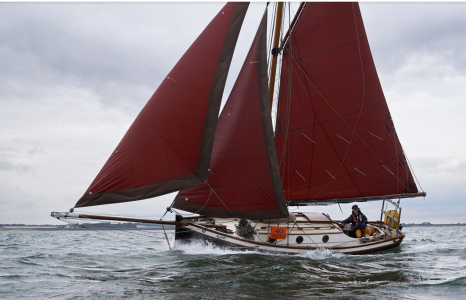
of course there are plastic classics. If you find yourself looking at one boat for longer than the others around and you get a feeling of nostalgia then it is a classic. Such as this plastic one?
Plum at East Coast Race 2019 by Sandy Miller 2Mb.png
photo by Sandy Miller
 
When the people who remember a popular boats heyday reach retirement age and the nostalgia kicks in, that's when the once lusted after boat becomes a "classic".

This aging population then frequents forums and sailing clubs waxing lyrical about the boats capabilities, citing the 1979 fastnet for example. They may even persuade some of the younger generation that "they don't build 'em like they used to" so these chaps roll up their sleeves and go to battle, pouring energy, time, and a lot of money into keeping the antiques afloat - because they've been convinced that "modern designs" are built on the cheap, lightweight, corner cutting monstrosities that basically resemble loft apartments on water.

The reality is that modern designs have better design tools, more detailed computer modelling, more precise manufacturing techniques, more advanced materials, better resins and glues, stronger plastics, better developed sail handling systems, etc. etc. etc.. ..... and they have learned from the designs that went before them, and the numerous ocean races where modern designs are tested to destruction.

So all the older designs, where they just threw more chopped strand and resin at a problem they couldn't accurately model - just to be on the safe side - and where they copied the underwater profiles of older wooden predecessors because, well, that's the way it is done. These boats suddenly achieve "classic" status and every serious sailor must have this type of boat if they want to do anything other than live in a marina queen.

Then that generation die, but the nostalgia lives on, the boats subtly change status though, from a "must have" classic to a "nice to look at but I wouldn't want to own one" classic.

This is where wooden boats are today, and where the popular 70s and 80s, maybe even 90s plastic boats will be tomorrow.
 
of course there are plastic classics. If you find yourself looking at one boat for longer than the others around and you get a feeling of nostalgia then it is a classic. Such as this plastic one?
View attachment 164832
photo by Sandy Miller
That is a jolly little boat but aping an old design style doesn't qualify it as a classic, to my eyes anyway.
 
The boat or the design?
1 Pleasing to the eye
- Yes I know, very subjective but then so is the idea of "classic" be it boats, cars, architecture etc etc.)
2 Well balanced hull and rig giving a "sea kindly" motion.
- That's one that does not require constant rig and helm twitching to remain on course and will reliably make a passage without exhausting the crew.
3 A boat that will look after the crew when sea conditions get really bad.
4 Has been around and in use long enough to prove these qualities.
 
Top