What type of anchors do I need for Mauritius 43ft?

"Manson Supreme 25 galvanised anchor (11kg) bought new and unused. Suit 8-10m boat. "
Thank you Paul, a bit small for Coopec.

I do find it interesting that despite the modern advances in technology, science and the international market of 'sailing' but we still, commonly, measure 'things' with imperial units.

Jonathan
 
Hello Clive
Your statement re Fisherman's anchor in coral is perhaps a bit doubtful. Fisherman's anchor however is the best for dense sea grass. Anything else (certainly Danforth) will choke up with weed. Weed is the biggest type of bottom at Rottnest. (probably your first stop). However I think best you pick up an authority owned mooring. I know they don't like you anchoring in weed or reef due to damage. (so may be illegal) For anchoring in coral the grapnel styl;e with bendable legs seems to be the best. You are very likely to lose any anchor in coral or reef as it becomes permanently stuck. Sometimes recovered by diving an attaching a retrieval line to pull it out back wards. The grapnel style is carfully designed to bend the legs to enable it to be freed by pulling boat up above it and using any swell or waves to overload it and pull it free. Of course it must be strong enough to hold the boat with normal loads. So a bit unreliable. Not sure where you would find one big enough as mostly they are designed for dinghies.
Mostly I imagine you will anchor in sand shallows if you make your way up the coast. I like a danforth but then I never anchor anyway. Go with your skipper's advice.
It is nice to know you are getting close to launching. ol'will
 
Yes, the Manson Plough is “old hat”. That does not stop it working, but there are much better choices these days.

I presume since your boat was equipped with a 27kg (60lbs) sand anchor as well as a 60 lb Manson Plough it can comfortably handle this weight anchoring gear. This should be easy to test. If so, there is no sense going smaller, but switching to a new generation primary anchor would produce some significant advantages.

The Mantus M1, Rocna, and steel Spade are my personal picks. The Manson Supreme is also a very good anchor so if this is significantly cheaper (Manson anchors are made in New Zealand so tend to be cheap in Australia) it is worth some consideration, although when it is blowing hard the best ground tackle always seems like a bargain.

Note that in compiling this list I have not sufficiently evaluated some of the latest anchor designs.

There are many options and you will receive a multitude of opinions, but the bottom line is no matter what advice you choose, your ground tackle can be significantly improved. If you plan on frequently anchoring out this will have a significant impact on your safety, although the Australian substrates are generally close to the ideal medium soft consistency . This not only produces wonderful soft sand beaches, but makes anchoring easy so many older generation anchors work well.
 
Hello Clive
Your statement re Fisherman's anchor in coral is perhaps a bit doubtful. Fisherman's anchor however is the best for dense sea grass. Anything else (certainly Danforth) will choke up with weed. Weed is the biggest type of bottom at Rottnest. (probably your first stop). However I think best you pick up an authority owned mooring. I know they don't like you anchoring in weed or reef due to damage. (so may be illegal) For anchoring in coral the grapnel styl;e with bendable legs seems to be the best. You are very likely to lose any anchor in coral or reef as it becomes permanently stuck. Sometimes recovered by diving an attaching a retrieval line to pull it out back wards. The grapnel style is carfully designed to bend the legs to enable it to be freed by pulling boat up above it and using any swell or waves to overload it and pull it free. Of course it must be strong enough to hold the boat with normal loads. So a bit unreliable. Not sure where you would find one big enough as mostly they are designed for dinghies.
Mostly I imagine you will anchor in sand shallows if you make your way up the coast. I like a danforth but then I never anchor anyway. Go with your skipper's advice.
It is nice to know you are getting close to launching. ol'will

The guy who told me it would be illegal to anchor in coral was a very experienced cruising yachtsman. I think I may have mis-understood him as we were talking in terms of Abrolhos Islands. Just now I notice there are a huge number of Public Moorings so I suppose you are meant to use them rather than anchor in coral.
 
Risking damaging live coral is not acceptable, but many Australian tropical anchorages consist of granular dead coral “sand”.

While the particle size is significantly larger than ordinary sand, this substrate behaves in a similar way to regular soft sand. In other words it is a very easy substrate for an anchor to set and penetrate. The holding is generally excellent.

It is also a substrate where older generation anchors work acceptably. If anchoring frequently it is still worth considering the better new generation anchors, but don’t expect the very significant differences that will be seen in difficult substrates where the better new generation anchors shine.
 
The guy who told me it would be illegal to anchor in coral was a very experienced cruising yachtsman. I think I may have mis-understood him as we were talking in terms of Abrolhos Islands. Just now I notice there are a huge number of Public Moorings so I suppose you are meant to use them rather than anchor in coral.
There are lots of places in the world where local law says ‘do not anchor or damage coral’. The law doesn’t cover the whole world (what law does?) but all the places I know with coral worth protecting have made appropriate legislation. The fines can be draconian. A super yacht owner was fined $100,000 recently. Other examples available.
 
There are lots of places in the world where local law says ‘do not anchor or damage coral’. The law doesn’t cover the whole world (what law does?) but all the places I know with coral worth protecting have made appropriate legislation. The fines can be draconian. A super yacht owner was fined $100,000 recently. Other examples available.

Thanks John I've got the message now. The following refers to areas on the Great Barrier Reef

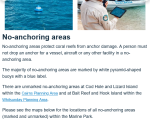
Screenshot 2023-03-01 at 15-17-36 Moorings and No-anchoring areas gbrmpa.png


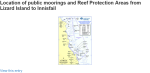
Screenshot 2023-03-01 at 15-21-15 GBRMPA ELibrary Location of public moorings and Reef Protect...png
 
Thank you Paul, a bit small for Coopec.

I do find it interesting that despite the modern advances in technology, science and the international market of 'sailing' but we still, commonly, measure 'things' with imperial units.

Jonathan

Blame the Americans ... they don't do metric and any english speaking nation ends up having to deal with it as the USA is the biggest english speaking economy - and there are still a fair number of "older" yachtsmen who were bought up pre-metrification (U.K. Oz). Germany, where I live, has been metric since Jan 1872.

My pet hate is recipes involving "cups" ... wtf is a cup? .... I now prefer recipes in German, French or Italian as they use sensible measurements like centigrade, ml, and grams and it's easier to translate than deal with measurement conversion.
 
Blame the Americans ... they don't do metric and any english speaking nation ends up having to deal with it as the USA is the biggest english speaking economy - and there are still a fair number of "older" yachtsmen who were bought up pre-metrification (U.K. Oz). Germany, where I live, has been metric since Jan 1872.

My pet hate is recipes involving "cups" ... wtf is a cup? .... I now prefer recipes in German, French or Italian as they use sensible measurements like centigrade, ml, and grams and it's easier to translate than deal with measurement conversion.
Even here in France boat length is typically measured in feet, even for French-made vessels.
 
Blame the Americans ...

My pet hate is recipes involving "cups" ... wtf is a cup? ...

Like so many imperial measures, it's origin is from a practical need. People had 'cups' long before they had weighing scales or graduated measuring jugs. It was an easy, universal way to describe both volume and weight in a pioneering world. It's been standardised these days and you can buy various sized scoops if you want. Simple, cheap, easy - what's not to like?
 
Even here in France boat length is typically measured in feet, even for French-made vessels.

It is decidedly bizarre.

When we bought Josepheline (in Oz) it was either a 10.5 or an 11.5, now its a 35 or 38.

I confess to have been brought up, in the UK, with Imperial units but my secondary school education was interrupted by the waves of metrication. I can cope with lbs and kg - but (in a recent post in which body weight came up) I struggle with the concept of stones (fortunately no-one mentions ounces). It is a long time since being able to think in terms of ounces and stones.

Jonathan
 
Like so many imperial measures, it's origin is from a practical need. People had 'cups' long before they had weighing scales or graduated measuring jugs. It was an easy, universal way to describe both volume and weight in a pioneering world. It's been standardised these days and you can buy various sized scoops if you want. Simple, cheap, easy - what's not to like?

:giggle:
Exactly, similarly the Imperial system refuses to go away because people like it. It's roots are in pre history and it grew through human need , the units mean something to folk because they are relatable.
The evolution of the metric system is one of the most doubtful British gifts to the world.

.
 
:giggle:
Exactly, similarly the Imperial system refuses to go away because people like it. It's roots are in pre history and it grew through human need , the units mean something to folk because they are relatable.
The evolution of the metric system is one of the most doubtful British gifts to the world.

.
Don't think metric is anything to do with Britain (French I think - something to do with Napoleon!) and the UK was a reluctant adopter in the 1970s as part of the then popular Europeanisation movement.
 
Don't think metric is anything to do with Britain (French I think - something to do with Napoleon!) and the UK was a reluctant adopter in the 1970s as part of the then popular Europeanisation movement.


Implemented by blood soaked revolutionary committee, as many impositions commonly are.


"Bishop John Wilkins was, among other things: Warden of Wadham College, Oxford; Master of Trinity College, Cambridge; married to Oliver Cromwell’s sister; writer of the first book in English on secret codes; writer of one of the first science fiction books about a trip to the Moon; and convener and chairman of the first meeting of the Royal Society, still one of the world's most important science academies.

Wilkins' short proposal for a 'universal measure' in 1668 contained almost all the elements of the International System of Units (SI), the modern metric system."
Metrication matters . com

.
 
Like so many imperial measures, it's origin is from a practical need. People had 'cups' long before they had weighing scales or graduated measuring jugs. It was an easy, universal way to describe both volume and weight in a pioneering world. It's been standardised these days and you can buy various sized scoops if you want. Simple, cheap, easy - what's not to like?

I understand that, just don't need imperial measurements in my life - it's just another level of unnecessary complexity IMO

I totally get it that people can relate to a cup or a foot ... but the way a cup or a foot are defined is just nonsense.

Perhaps I should start a movement to push metrification of imperial measures so the conversions are simpler.

1 foot = exactly 25cms, I inch is 2,5cm (10 inches in a foot)
1 cup = 250g or 1/4 liter of water
1 gallon = 5 liters
1 mile = 1,5 km

... and we can just dump fahrenheit. 😁

Then people can keep their quaint names for measurements but the conversion to the metric system is way simpler.

What's not to like?
 
My pet hate is recipes involving "cups" ... wtf is a cup? .... I now prefer recipes in German, French or Italian as they use sensible measurements like centigrade, ml, and grams and it's easier to translate than deal with measurement conversion.

A cup is 250ml

We have a set, 1 cup, 1/2 cup, 1/3 cup, 1/4 cup.
 
'When ah were a lad'....
..... 'cups' were A, B, and C.

I s'pose them metricationists will be on about having just 10 hours in a morning, 10 months in the year, and only 10 Apostles! I reckon they'll have a lot of spare time to argue about which two to ditch....

Then they'll be quite pleased to have Christmas come early, while changing the carol to 'The 10 Days of Christmas'.

However, I'm a Dedicated Remainer when it comes to drinking songs.....

 
A cup is 250ml

We have a set, 1 cup, 1/2 cup, 1/3 cup, 1/4 cup.

Ah ... you have the metric cup already ... (y)

Commonwealth of Nations[edit]
Metric cup[edit]
Australia, Canada, New Zealand, and some other members of the Commonwealth of Nations, being former British colonies that have since metricated, employ a "metric cup" of 250 millilitres.[6] Although derived from the metric system, it is not an SI unit.[7]
1 cup =
250​
millilitres
=
162⁄3​
international tablespoons (15 ml each)
=
12.5​
Australian tablespoons (20 ml each)
=
25​
dessertspoons (10 ml each)
8.80​
imperial fluid ounces
8.45​
US customary fluid ounces

Cup (unit) - Wikipedia
 
Thank you Paul, a bit small for Coopec.

I do find it interesting that despite the modern advances in technology, science and the international market of 'sailing' but we still, commonly, measure 'things' with imperial units.

Jonathan
My wife gets exasperated when we are measuring up for something and I say 17"x 250mm😅
 
Top