What Sextant would you recommend.

There are often some very good ex ships Russian / Soviet Sextants come up on eBay .... no need to spend Tamaya / Plath / Frieberger prices !

My Sextant at sea was the Heath Mates sextant - standard micrometer job designed mostly for sun sights. If I was aiming for stars - then the monocular Tamaya was my goto instrument.
 
There are often some very good ex ships Russian / Soviet Sextants come up on eBay .... no need to spend Tamaya / Plath / Frieberger prices !

My Sextant at sea was the Heath Mates sextant - standard micrometer job designed mostly for sun sights. If I was aiming for stars - then the monocular Tamaya was my goto instrument.

I agree with Refueller. At the end of the Second World War the Russians found themselves with Glashutte (Chronometer makers) Carl Zeiss (optics) and Freiburger (Sextants) in ‘their’ bit of Germany and they also grabbed C.Plath’s sextant making machinery which had been moved out of Hamburg to places in the East which were harder to bomb.

Knowing what they had got, the Russians carried on making all this stuff...with no change in quality, just a change in the labels. Besides Freiburger, the Russians made ‘Plath’ sextants using the equipment that they had shipped back to Russia under the names ‘SNO (M)’ and SNO (T).
 
Last edited:
You've used it more than once? :cool: ;)
Just a handful of times, this is the first about 30 years ago during a Med crossing, by the time I completed the calculations we were almost arrived at destination :D
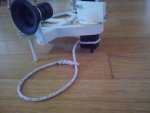
adriapicc.jpg
After taking the picture of the lanyard I have cleaned and waxed the wooden box, I put the sextant back in again and will forget about it for the next few years. The instruction booklet has a "Karl Marx Stadt" indication, the box will fit nicely in my bookshelf near to relic Mao Tse Tung Red Book.
Now off to buy spare batteries for the gps. :)
 
No, it's a function of people who have nothing better to do than thread drift historical threads.
More old threads showing up and people answering them since. So a valid point I made. Perhaps instead of sarcasm an effort by a mod to find out what is going on could be helpful?
 
I agree with Refueller. At the end of the Second World War the Russians found themselves with Glashutte (Chronometer makers) Carl Zeiss (optics) and Freiburger (Sextants) in ‘their’ bit of Germany and they also grabbed Christian Plath’s sextant making machinery which had been moved out of Hamburg to places in the East which were harder to bomb.

Knowing what they had got, the Russians carried on making all this stuff...with no change in quality, just a change in the labels. Besides Freiburger, the Russians made ‘Plath’ sextants using the equipment that they had shipped back to Russia under the names ‘SNO (M)’ and SNO (T).


The usual 'Brand' is СИО ... pronounced SNO
 
Last edited:
A lot of sextants come from the far East where they are salvaged from freighters before they are cut up for scrap. I believe that all commercial ships were required to carry a sextant. Don't know if that is still the case.
 
A lot of sextants come from the far East where they are salvaged from freighters before they are cut up for scrap. I believe that all commercial ships were required to carry a sextant. Don't know if that is still the case.

All vessels that my Superintendents work still have Company supplied Sextants on board ....... but sadly they gather dust ....

I have been on vessels and asked 3rd and 2nd Mates about sextants ...... they literally had to look as to where they were stowed !
 
A lot of sextants come from the far East where they are salvaged from freighters before they are cut up for scrap. I believe that all commercial ships were required to carry a sextant. Don't know if that is still the case.

Most vessels before they go to scrap are divested of all salvageable items such as Sextants ..... even to the extent of the sale contract states items to be returned to Ship Owner that were required to be on board for last voyage.

Far East is actually not the 'scrapyard' .... Indian beaches account for more scrapping !
 
All vessels that my Superintendents work still have Company supplied Sextants on board ....... but sadly they gather dust ....

I have been on vessels and asked 3rd and 2nd Mates about sextants ...... they literally had to look as to where they were stowed !

Check the gyro error... it can be quite informative.
 
Most vessels before they go to scrap are divested of all salvageable items such as Sextants ..... even to the extent of the sale contract states items to be returned to Ship Owner that were required to be on board for last voyage.

Far East is actually not the 'scrapyard' .... Indian beaches account for more scrapping !
I bow to your superior knowledge. Seems strange that such low value items such as sextants, cutlery, crockery and bedding are worth the postage, packing and handling.
 
I have been thinking about buying a sextant for quite a few years but have not been able to justify the expense, I agree that a plastic one will "do the job" but so will the GPS on my phone.
I have tried the plastic sextants and whilst they are functional they are not a pleasure to use. The quality of the engineering of a metal one makes it far nicer to use and as unless something really serious happens to the GPS signal, you will be using the sextant becouse you like using it and not becouse you "need" a position that connot be derived another far more accurate way. At some time I will get around to buying/using a sextant but it will be when I am able to use a "nice" metal one and not a functional plastic one.
Given the easy and inexpensive access to GPS, it is impossible to justify the expense of purchasing a sextant on practical/financial grounds. However, there is more to life than money!

I fully agree with the following passage from John Budlong’s book:

“There are many brands available ... with polarizing shades, prismatic monocular, lighting on the scales, a vernier which reads to 10 seconds of angle - the works! The quality and workmanship in one of these machines is something to behold. Just having one in the house will add joy to a rainy day and a couple of years to your life; using one is an experience in precision” (Sky and Sextant, 2nd ed., pp.14 and 15).

He continues (p.16):

“Your choice may be dictated largely by your finances. Even if money is no problem, consider a couple of practicalities before you go out to buy the best sextant available. When you take sights at sea, a variety of errors may creep into the process, quite apart from sextant accuracy....

“What does the extra money buy for you, then? You get some nice convenience features and exquisite workmanship. You get precision you can almost taste. If you appreciate these things and can afford them, by all means go out and buy the best. But if you’re mainly concerned with the practical aspects of navigation, a cheaper sextant reading to 1 minute will give you equally good results.

“Many people start out with a plastic sextant for practice. After they’ve had some experience and know what to look for, they graduate to a brass one. I think this makes sense. They haven’t invested a lot of money right at first, and in the end they have a good sextant for regular use, and the plastic one as a spare. The spare is a really good idea, for it’s always possible for your regular sextant to get damaged, and there will be the occasional hairy day when you won’t want to take your precision brass sextant on deck”.
 
Anyone practice making a fire by rubbing two sticks together?

[Sorry--I couldn't help myself.]
Dunno why people invariably respond to serious enquiries about celestial navigation topics with such purile responses. It’s like threads about yacht clubs, where sooner or later some fool will recycle the old Groucho Marx quotation (which wasn’t particularly witty even when originally voiced).

May as well chip in. Most people recommend what they’ve got. I’ve got a Plath, but if buying new I’d recommend the Astra. The ships I run all have Astras which is how I have come to play with them....

Plath sextants are not all the same. I have a bronze one and an aluminium one and I much prefer the latter. Similarly you can have a 4x40 telescope or a 6x30. The weak point of the Plath is the incredibly carp electrics, particularly the switch.

The Astra is Chinese, based on the Tamaya, and is a more modern design. It comes in two grades; the professional one and the IIIB which is the yottie’s one. Either will do. It’s light and has a full horizon mirror which is definitely a Good Thing on a yacht.
I used an Astra on a transatlantic a few years ago. I didn’t think the shades were all that great, but overall it was fine. IIRC the box permitted the sextant to be placed within regardless of the position of the index arm: that is a nice feature.

You are right that not all Plaths are the same. I would note that there is a difference between the C.Plath (no longer made) and Cassens & Plath (still in production). Some people consider C.Plath to be slightly higher-grade, except for the lighting issue you’ve mentioned. I don’t know to what extent that opinion is warranted, as I’ve never tried a C.Plath.

I do own, and have extensively used, two Cassens & Plath sextants: one is their ‘Horizon Ultra’ model, the other is the “Professional” with 6x30 scope. Both are excellent, and any spare parts needed are readily available (factory aftermarket support is exceptional).

Tamaya is a quality brand: IMO definitely a step above Astra. I have their “Jupiter” model and rate it highly; also own their little “Venus” yacht model (no longer made) but I have not yet actually used that one except in practice. Their current pricing is uncompetitive, but secondhand sextants aren’t that hard to find.

P.S. If buying a sextant new, you generally have a choice between plastic or wooden cases. Plastic is a bit cheaper and IMO rather more practical. Alternatively you can get a wooden case for show and a Pelican-type case for actual use, but the Pelicans are pretty bulky and a bit heavy.
 
I agree with what Walther has written here.

I must apologise as I had forgotten Cassens and Plath, who are still in business. I’ve not used one of theirs, only C.Plath.

I was briefly the owner of a WW2 Tamaya which was certainly very nice but heavy. I gave it to a friend, as I didn’t need three sextants! (As Walther says, having two is a good idea).

There is nothing wrong with the Ancient British ones - Hughes, (‘Husun’) Heath (‘Hezzanith’) and Cooke (‘Kingston’). Because they went out of production forty or more years ago they don’t have all the modern features but they work. The RN seem to be sitting on a stash of their own very nice sextants, which I think were made by Hughes to an RN design, and flogging them off a few at a time. I was surprised when the television offered a clip of the navigating officers of one of the carriers taking sights that they all seemed to be using Plaths (I couldn’t make out which Plath!)

The main thing is to use a sextant often, and I recommend using one for coastal navigation to get practice. You can use distance off by vertical angle which is very simple and handy and, depending on where the sun or indeed star is vis a vis the sector of the sea horizon that you can see, you can get a position line and cross that with a shore bearing.
 
Last edited:
Top