
Weighing anchor in a chop

Roberto

Well-Known Member
Joined
20 Jul 2001
Messages
5,849
Location
Lorient/Paris
sybrancaleone.blogspot.com
Last time I weighed anchor there was quite a chop and the boat was pitching heavily, as a result, the bow roller shaft has been bent.
P1090949_zpsb643c56e.jpg


The anchor was set very deep in the bottom (has brought up half a cubic metre of mud), I used all possible precautions with the windlass, shortening scope little by little (talking centimetres here) and waiting a lot of time in between to give the anchor plenty of time to break free, but up and down movement of the bow caused the chain to occasionally become bar taut, with the result above.

Should this happen again (should I say when), I would like to have a way of transferring the snatching loads from the bow roller to the side of the bow through this (not my boat, just took the first picture from the net)
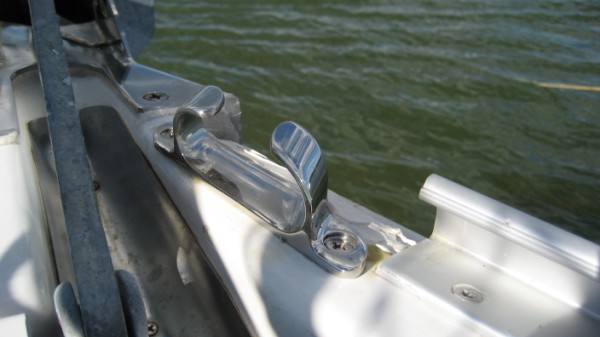
20070905_080327_IMG_1091.jpg


Ideally, I would like to find a sort of metal device that could be fitted around the chain, and through which the chain can only move in one way, the metal device being tied to a rope going through the fairlead, to a cleat.

That is: I retrieve the chain with the windlass (chain on the bow roller), the metal device slips freely down the chain, when the chain is sufficiently taut I release a little from the windlass, the metal device grips and stops the chain from falling back down again, all the hard job is done by the rope through the fairlead leaving the bow roller shaft alone. Then again a little more with the windlass, and so on.

I thought about a one-way chain stopper like this, though I only used them when bolted to the deck, do you reckon if might be used after attaching it to a rope of course; would it slip down on an almost vertical chain?
66840050-1.jpg


fwiw boat 12m, 10mm chain, no way to do anything by hand in this type of situation

thanks
 
Yes, I'd suggest a bigger spindle.
Also the roller has obviously loaded the spindle in the middle of the span.
Could be the roller is worn, or was it distorted in this incident?
You could get a new roller with bushes so it loads the spindle at the edges.
 
I don't have a windlass so in choppy or windy conditions I give the engine a burst ahead,run forwards,take up the slack and make the chain fast.Then I repeat until the anchor breaks loose.This way the spindle and roller are not strained.
 
thanks all

the spindle (what I called shaft, the distorted piece of steel rod in the first picture around which the roller -not shown on the picture as it was badly deformed- spins) has a 12mm diameter, the distance between the two cheeks is 70mm, the spindle had a snug fit. I would not call it undersized, the same dimensions/geometry is found on much larger boats, often same diameter spindle with wider cheeks..
The deformation on the plastic roller (no idea of the actual type of plastic) was due to the spindle being bent, which stopped the roller from turning, hence basically the deformation was only caused by chain friction upon a non-spinning plastic roller.

The deformation is 100% due to the boat pitching up and down. We spent several hundred nights at anchor with the same spindle in all sort of conditions; once the anchor chain was caught by a massive amount of floating debris with a strong current and the stern was up in the air by...a lot, bow down, somewhere I have the figures for moment to trim one inch for the boat, tomorrow I'll find a rough figure but the vertical load was massive and the spindle did not deform at all.
The deformation came from dynamic loads and the chain going taut while being retrieved, when scope was low.
We never had any problems with the same kind of pitching and 5-6-7 or more scope.

While reducing the scope, when I first saw the chain going taut, I released a bit of chain and waited maybe 10, 20 minutes, except the anchor did not move at all.
The water was deep-ish, around 12-15m, so maybe the short scope did not have sufficient leverage to pull up the anchor ?


Anyway, rather than dimensioning the roller/spindle ensemble for unknown dynamic loads -I could put a 14mm steel rod and see it bent next time (not to talk about the windlass)- I'd feel more comfortable with the "slipping one-way chain stopper" solution, no strain on the spindle, no strain on the windlass either, a thick piece of rope with some kind of chain hook.
.
Just looked at the price of the Lewmar one, I think I have to find another one ;)
 
The anchor was obviously caught on something when you tried to retrieve it in the choppy water. Obviously the anchor was close to unretrievable. You might check the anchor for damage. Possibly even the chain could be stretched.
I think you are best served by having the shaft and roller as the frangible part of the system a bit like a fuse. I think the bow roller is the best place to take these loads next time the anchor is stuck. You might relieve the loads or spread them by a chain and hook the chain being attached to a sampson post next time it gets stuck. The fairleads you picture can be useful both for chain and mooring ropes etc. They could take some of the chain load. I don't think rope would help being too stretchy.
So replace the bent axle and rollers if they are damaged. Continue anchoring as before. If the anchor does get stuck again. Pull it up taught then attach another chain and hook via the fairlead to a strong point. Pull this extra chain as tight as possible then wait or hope the chop raising the bow will shift the anchor. Be very careful with fingers when attaching the new chain. In fact I would not add another chain but do exactly as you did last time and if the shaft gets bent then carry a spare. At least you recovered your anchor. good luck olewill
 
The situation you have described is not that unusual, sitting out strong winds (which sets the anchor deeply) the wind veers (or you decide to move anyway). There is a chop and as you shorten the rode the snatch loads get more and more severe. We measured these loads at 2.6:1 in very little chop at 35 knots and measured snatch loads of 600kg - i'm not surprised.

When it happens again, do not shorten the rode too much but drive over the anchor (into the seas) so that you pull it out in a direction opposite to the set direction. This should minimise the snatch loads and pulling it out (opposite to the way it is set) is a 'weak' point for the set anchor. You need not reverse at 180 degrees, 150 degrees would suffice (and then the chain will not rub on the hull. If you cannot drive right over the anchor try to shorten up less aggressively - under the conditions you describe, you need patience, and strong nerves but sitting at 3:1, or 2.5:1, 2:1 etc (whichever you can stomach, and the crew can be a major distraction!) will eventually make the anchor break free but driving well forward is an easier and less traumatic option.

Frankly you are better to have bent the shank/shaft than destroyed anything else. We carry a spare shaft and spare roller. I have seen destroyed bow rollers and cracked bows.

If you have stretched your chain - your chain is inadequate.

If you have bent the anchor, I would not be surprised - in my opinion more anchors are bent on retrieval than 'in use'. However they should be built such that they do not bend.

I am interested - without naming the anchor, what type was it (concave, convex, fluke, ie danforth type etc)

It would be invaluable if you can confirm that the anchor was not damaged and the chain links not stretched.

Jonathan
 
I certainly agree with Jonathan that the best option is to change the angle of pull to as close to 180 deg. as you can manage and with some scope to reduce the snatch load BUT without applying much force to the side until you get to the 180 otherwise you run the risk of bending the shaft on the anchor. Thus it is not so much using more force but using it at a more favorable angle. Andrew
 
thank you for your comments

The option of motoring upwind/up-wave and pulling the chain through a different angle might help, I will try next time, motoring in reverse then trying to remain in a more or less constant position with a reduced scope. I will use one of my chain hooks with rope through the fairlead to relieve the windlass and forget about one-way devices, I had a look and they are way too expensive for such an occasional use.

It's difficult to have an idea if/when the shortened scope is enough to slowly work the anchor out of the bottom, and in deep-ish water the scope needs to be reduced a lot more than in shallow water before any sensible increase in angle of pull at the anchor is reached. Waiting there with waves banging everywhere is not nice... :o


FWIW the anchor is of a convex type. It was not damaged, I checked it afterward and I could not find any visually apparent bending. During a previous anchorage attempt months ago the galvanizing had been scraped a bit at the tip, this time there were no additional scrapes.
Whenever I met strongish conditions the anchor buried very deep and it always takes a lot of patience to pull it out, though eventually out it comes, I never lost an anchor (so far :D ). I reckon the difference this time were the boat pitching and also the greater depth.

I did not check the whole length of the chain, though afterward I anchored a few more times and the chain links turned smoothly around the gypsy, without jumping, so I guess it's ok. It has a non-swivel Kong connector which was not damaged either.

regards
r
 
Roberto, you say that the 12mm spindle is not undersize. I have a similar size boat, also with 10mm chain. The spindle for my twin bow rollers is 1"" ( 25.4mm). I've never had any problems with it. Nuff said.
 
Roberto, you say that the 12mm spindle is not undersize. I have a similar size boat, also with 10mm chain. The spindle for my twin bow rollers is 1"" ( 25.4mm). I've never had any problems with it. Nuff said.

thanks NormanS


sorry fat fingers


Well, the spindle has not budged on many other strong wind/waves occasions, this time there was a different type of forces involved. I can reasonably state it was correctly dimensioned for 999/000 of the work it had to do, but not for the 1/000 at the margin.
Possibly 99% of boat equipment has similar standards, if not lower ones :)
What to do? The two cheeks are of light alloy, I can't remember the thickness but probably 7-10mm -I don't know exactly. Doubling the diameter of the shaft would probably mean on similar occasions the whole light alloy davit might break apart, or possibly the windlass could be torn away, who can say.

Now, I have a setup which has worked properly on many occasions, it was damaged in one particular situation. Instead of modifying everything, moving the forestay attachment, reinforcing the whole windlass bulkhead, etc, I prefer to
a.relieve the loads on bow roller AND windlass with a rope+chain hook through the fairlead
b.try and varying the angle of pull of the chain on the anchor while on short scope
c.bring a spare spindle and roller :)

statistics..

ta
 
Last edited:
Top