The pro's and cons of steel boat building

Status
Not open for further replies.
Steel is recyclable. At the end of its life a steel yacht can be broken up and the steel reused. What do we do with old grp?

Steel boats usually recycle into the elements, via rusting. GRP might end up in a road, when they can get the economics right.
Not sure if your post is pro or con :)
 
I was on a Beneteau first 40.7, when it mightily thumped a steel buoy in the Solent, at about midships......

I like the way you've left the YBW forum readers in no doubt you weren't responsible for this mishap by just being 'on' the boat rather than crew, skipper, trimmer etc!

:-)
 
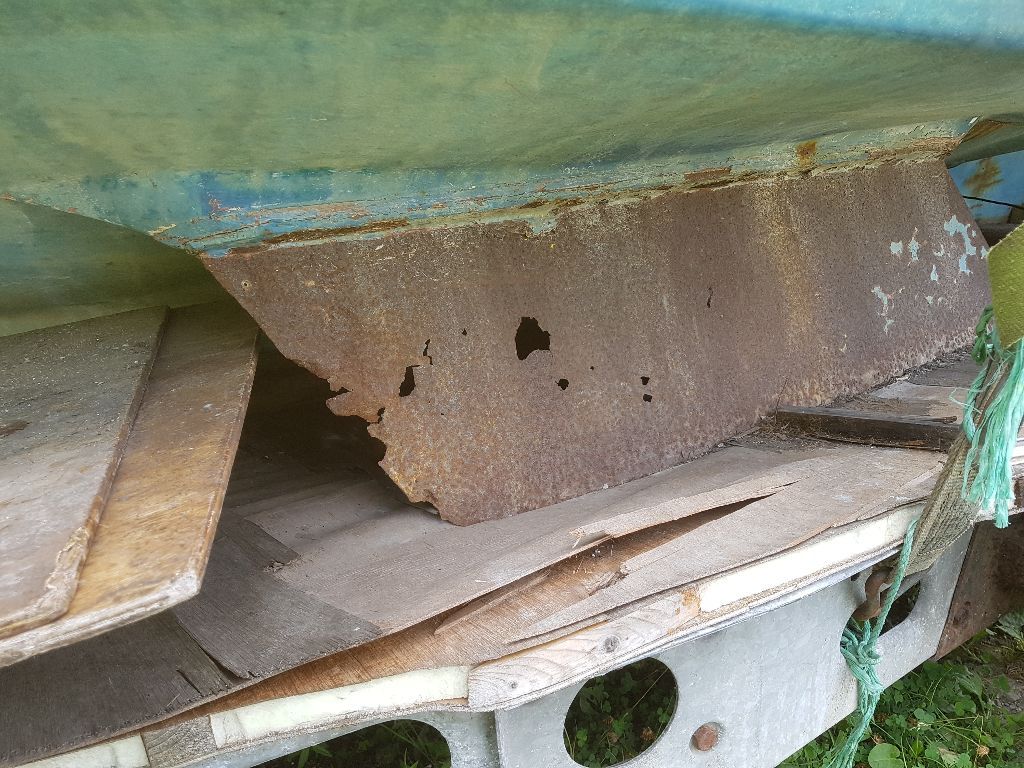
Most of them seem to rust away as unfinished hulls in boatyards, following the realisation by the shaggy and dirndled dreamers who started building them that the hull is fairly minor part of the cost of a yacht.

That is so true, I can think of three within 200m of us, such a shame. One is brand new 20 odd years ago. if I cuold have found the guy we would have bought it a decade or two back. As it is now it is turning in to a colander slowly. Total waste
 
That is so true, I can think of three within 200m of us, such a shame. One is brand new 20 odd years ago. if I cuold have found the guy we would have bought it a decade or two back. As it is now it is turning in to a colander slowly. Total waste

There is a GRP Silhouette project on eBay at the moment. The GRP bits look grubby but sound. No prizes for guessing what has really rotted ...

s-l1600.jpg
 
Actually Brent should, by his own reasoning, refer to his boats as iron, since that is the main component of steel. More so than resin (plastic..) is in a GRP hull. But then, he is not interested in reason.

If you feel like calling steel " Steel reinforced steel" go ahead .if you feel that will give you more credibility. Glass reinforced plastic is still plastic, which the dictionary defines as 'That which can be molded."
 
That is so true, I can think of three within 200m of us, such a shame. One is brand new 20 odd years ago. if I cuold have found the guy we would have bought it a decade or two back. As it is now it is turning in to a colander slowly. Total waste

Yes steel needs some maintenance ,but I have found it minimal, a couple of hours year, if you stay on top of it . Not a problem, if it is your way of life ,but yes ,for leaving abandoned in at yard , where there is zero chance of it ever hitting anything ,fibreglass is far superior, for that situation.
 
If you feel like calling steel " Steel reinforced steel" go ahead .if you feel that will give you more credibility. Glass reinforced plastic is still plastic, which the dictionary defines as 'That which can be molded."
Steel is plastic.

In case you didn't know.

No comment on the steel boat that sunk in the Irish Sea? Steel boats are apparently not so safe when there are no reefs around ...
 
If you feel like calling steel " Steel reinforced steel" go ahead .if you feel that will give you more credibility. Glass reinforced plastic is still plastic, which the dictionary defines as 'That which can be molded."

Forging and die-casting are two methods used to mould steel.
 
Steel is plastic.

In case you didn't know.

No comment on the steel boat that sunk in the Irish Sea? Steel boats are apparently not so safe when there are no reefs around ...

Here is Webster's definition of plastic:
"That which can be molded or shaped.
Any of various nonmetallic compounds ,synthetically produced , which can be molded and hardened for commercial use."
I have never claimed that steel can't sink ,just that the chances of surviving a collision or storm in a well built steel boat are far greater than in a plastic boat.
Are you implying that plastic boats never sink? That no plastic boat has ever sank after a collision? Sounds that way. What happened in the 79 Fastnet? 82 Cabo disaster? Sleavin family disaster? The list goes on ,and on, and on!
 
I was on a Beneteau first 40.7, when it mightily thumped a steel buoy in the Solent, at about midships, with no obvious damage, due I suspect to the hull shape being well rounded at that area. If it had been a flat section convinced it would have holed & possibly sunk. Early 'plastic' dinghies were changed from chine (plywood design) to round bilge, when built, an example being Ian Proctor's Wayfarer & his first 'plastic' Kestrel, which have similar sizes, but design adapted to suit material. So 'strength' isn't simply a material issue.

Yes , shape has a huge influence on stiffness and strength.That is why they use arches in bridges etc.Many simply can't grasp the idea. I use it to eliminate the need for transverse frames.
If you had kicked a Beneteau style, plastic UV damaged thru hull, your boat could have sunk quickly.
Boats which have flat surfaces, need a lot more extra stiffening on flat panels.
 
I have never claimed that steel can't sink ,just that the chances of surviving a collision or storm in a well built steel boat are far greater than in a plastic boat.

Why should steel boats survive a storm better? I have never heard of a storm damaging a hull of any material.

Are you implying that plastic boats never sink? That no plastic boat has ever sank after a collision? Sounds that way. What happened in the 79 Fastnet? 82 Cabo disaster? Sleavin family disaster? The list goes on ,and on, and on!

Since the number of steel yachts is negligible it is hardly surprising that the overwhelming majority of composite ones have most of the accidents. You might as well claim that four wheeled cars are fundamentally unsafe because they have more accidents than three-wheelers.
 
Are you implying that plastic boats never sink? That no plastic boat has ever sank after a collision? Sounds that way. What happened in the 79 Fastnet?

So what makes a small steel boat unlikely to roll in the conditions they faced in the 79 Fastnet? And it's a special steel you have that floats when the boat is full of water.

Of course it would be really interesting to see your design for a competitive steel half-tonner. The steel would be so thin it would be a half-tinner.
 
So what makes a small steel boat unlikely to roll in the conditions they faced in the 79 Fastnet? And it's a special steel you have that floats when the boat is full of water.

Of course it would be really interesting to see your design for a competitive steel half-tonner. The steel would be so thin it would be a half-tinner.


Erm, water ingress and wave height don't matter when parked on a reef -- you can think of it as hove-to++

Sharp joke though!
 
Here is Webster's definition of plastic:
"That which can be molded or shaped.
Steel can be moulded and shaped - so it is plastic.

I have never claimed that steel can't sink ,just that the chances of surviving a collision or storm in a well built steel boat are far greater than in a plastic boat.
I will grant you that rust buckets can be tougher than GRP in certain impact situations. But the kinds of situations in which a rust bucket would survive intact and a GRP would not are vanishingly rare, statistically speaking.
And there is no reason why a rust bucket would survive a storm better than a GRP boat. Waves do not cause hull damage.

Are you implying that plastic boats never sink?
Nope. Just pointing out that your wonder material also sinks.

You really don't get it. Both materials have a place in boat building. So does wood. So does aluminium. No one material is "best". I get that you personally choose rust buckets over GRP. Your choice. I would probably also choose steel if I went high-latitude cruising. But if I were to go long-distance cruising in temperate or tropical climates, my first choice would be GRP. And it would be the right choice.
 
As a qualified Plastic Chemist could I just explain that "plastic" can be used as a noun or an adjective and both have somewhat different meanings.

The "P" in "GRP" is a word being used in a noun configuration .... although whether that word is "plastic" or whether it is a different word being used plastically (whoops .... an adverb slipped in somehow) is anyone's guess. :rolleyes:

Richard
 
Status
Not open for further replies.
Top