Cat A ocean standard need full revision

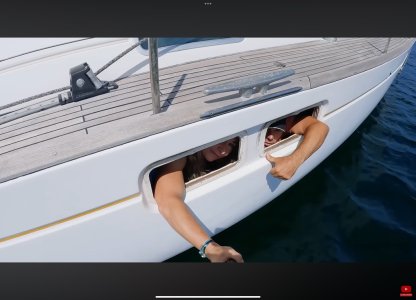
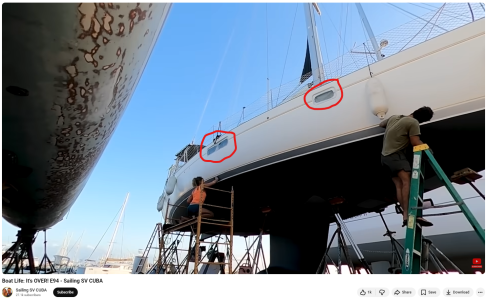
Below is a recent YouTube video of a couple that lost a hull window while sailing. It was a small window only just below the toerail, but it caused them considerable problems with failed electronics (from the water ingress) and a burning smell from a shorted out power bank. This resulted in them declaring a Pan Pan.

Subsequent videos outline the resulting damage, need for an emergency visa (to effect repairs at the nearest port), dragging anchor and running aground (because they were exhausted from the ordeal ) and difficulty they had replacing the window in a remote location.

It appears the window failed because of a hull strike rather than a simple bond failure, but there was only very minor cosmetic damage to the adjacent areas of the hull. This suggests the window (or window retaining system) was a weak point. Anyway, food for thought for those considering purchasing yachts especially with larger windows closer to the waterline:

 
Last edited:
Below is a recent YouTube video of a couple that lost a hull window while sailing. It was a small window only just below the toerail, but it caused them considerable problems with failed electronics (from the water ingress) and a burning smell from a shorted out power bank. This resulted in them declaring a Pan Pan.

Subsequent videos outline the resulting damage, need for an emergency visa (to effect repairs at the nearest port), dragging anchor and running aground (because they were exhausted from the ordeal ) and difficulty they had replacing the window in a remote location.

It appears the window failed because of a hull strike rather than a simple bond failure, but there was only very minor cosmetic damage to the adjacent areas of the hull. This suggests the window (or window retaining system) was a weak point. Anyway, food for thought for those considering purchasing yachts especially with larger windows closer to the waterline:

It certainly shows what a problem it is when it happens. But that’s a framed, mechanically fixed window. Are we now saying all hull windows are bad? I can still see the holes. Not the window holes, the old goalpost holes.
 
It certainly shows what a problem it is when it happens. But that’s a framed, mechanically fixed window. Are we now saying all hull windows are bad? I can still see the holes. Not the window holes, the old goalpost holes.
I am not familiar with the Beneteau model in question, but in subsequent episodes, they replaced. the window, and it appears to be just glued in place. They struggled to devise a system to retain the window while the glue set.

There is some interior trim, but this is just cosmetic and not involved in securing the window.


You_Doodle_2026-01-07T22_05_58Z.jpeg
 
Last edited:
Interesting article about glass windows in super yachts. My question is do the mass boat builders working to the same standards? Are they using glass that is 2.3 times the strength of the surrounding structure or are they using acrylic?

I have tried reading the specification for the Oceanis 40.1 and 5 reviews by major yachting magazines. No where are the hull windows mentioned other than letting in more light. No mention as to the materials or bonding method for hull windows. Are they such a big secret?
 
Interesting article about glass windows in super yachts. My question is do the mass boat builders working to the same standards? Are they using glass that is 2.3 times the strength of the surrounding structure or are they using acrylic?

I have tried reading the specification for the Oceanis 40.1 and 5 reviews by major yachting magazines. No where are the hull windows mentioned other than letting in more light. No mention as to the materials or bonding method for hull windows. Are they such a big secret?

Windows, hatches, washboards etc. are covered in ISO 12216 which references many other ISO standards as part of the specification. Material selection for windows is also in there, and as is usually the case, the devil is in the detail as to what types of glass or plastic can be used - they don't all have the same properties. IMO, a lot of engineering has gone into boat design and I don't believe anyone on this forum fully appreciates the requirements that have to be met to build a modern leisure craft - hence the sneering at the RCD juxtaposed with the low incidences of real world problems. We do have instances where UV damage has weakened bonds but the clue is that they leak long before they fail completely, which means that over the lifetime of a boat, windows are a servicable item that need to be regularly inspected and repaired when necessary, same as keel bolts, chainplates, rudder bearings, and a host of other mission critical items. Manufacturers responsibility is to deliver a boat fit for purpose that meets all the relevent standards, the owners responsibility is to maintain that boat to ensure that over its lifetime, those standards are maintained.

When buying second-hand boats it is extremely important to choose one that is still fit for purpose. I avoided boats with compound window shapes because replacements are expensive and hard to come by, and they are difficult to remove without damage .... just as I avoided boats with glassed in chainplates, shot rudder bearings, spongy decks, rusty keel bolts, etc. etc. etc.... This was not because they can't be repaired, it's because I don't have the time or inclination to get involved in a restoration project - some people do and Concerto is an excellent example of the standard that can be achieved when done right.

Mistakes are made because we are human, and the standards are in permanent review and ever changing as a result, which is a good thing IMO. Material science and our understanding and engineering ability/knowledge is also ever changing so it is pointless to set a standard from the 80s and rigidly stick to it when we've had 4 decades of real world experience in the meantime. IMO this is just another example of people with limited knowledge denying science and applying laymans logic to complex problems, all mixed in with a dose of cynicism and conspiracy theories about motivation and vested interests. These things do occur, but are not at anywhere near the problem insinuated on this forum.

One of my favourite examples is that people are happy to trust their lives to rubber tyres and hurtle down autobahns at 255 kMh but balk at a saildrive seal as being too dangerous. (I know the material is actually different, but in abstract terms it's a good example where a layman can trust a material in one application but not in another) .... similar to use of acrylic in windows.
 
Ah but I didn't say aluminium.
I'm not against it as a building material but it doesn't quite fit my 'best of all worlds' mentality as it's not idiot proof the way that grp is.
This perfectly demonstrates why a "blue water cruiser" definition is not worth the effort ... even in this small forum there is no consensus on what the "best" hull material is. ;)
 
I am not familiar with the Beneteau model in question, but in subsequent episodes, they replaced. the window, and it appears to be just glued in place. They struggled to devise a system to retain the window while the glue set.

There is some interior trim, but this is just cosmetic and not involved in securing the window.


View attachment 204617
Not the first time this has happened ;) Can you get replacement hull windows for a Beneteau Oceanis 331 from anyone except Beneteau dealers? which would indicate that the factory fitted windows need to be re-bedded at around 10-15 years.

Would be interesting to see the channel and if the UV cover was missing ..... or if the window has been replaced at some point with a cheap piece of acrylic and no UV protection for the adhesive (assuming the correct adhesive was used and the surfaces were properly prepared).

Either way, one would hope that these failures have filtered back into the specifications in the relevant ISO standards .... but I think it just reinforces the fact that windows are serviceable items ... even bolted in windows need removing, fastenings inspected, and re-sealing after 20 years in service.
 
I am not familiar with the Beneteau model in question, but in subsequent episodes, they replaced. the window, and it appears to be just glued in place. They struggled to devise a system to retain the window while the glue set.

There is some interior trim, but this is just cosmetic and not involved in securing the window.


View attachment 204617

Surely on a 25 year old AWB you’d drill a couple of fixings to supplement the sealant/andhesive and prevent a reoccurrence of it just falling out?

I could possibly understand the reluctance of getting a drill out on something a little chunkier on the £££ spectrum.
 
Interesting article about glass windows in super yachts. My question is do the mass boat builders working to the same standards? Are they using glass that is 2.3 times the strength of the surrounding structure or are they using acrylic?

I have tried reading the specification for the Oceanis 40.1 and 5 reviews by major yachting magazines. No where are the hull windows mentioned other than letting in more light. No mention as to the materials or bonding method for hull windows. Are they such a big secret?
A clear explanation from Sirius - theirs are glued or sealed in and may need rebedded after decades. I'm sure they would explain what adhesive etc to an owner.

How strong are the hull windows on a boat?
 
This happened to a diving vessel some years ago:
"A massive wave smashed a window on the CSO Orelia, flooding the boat's electrics.
At one stage, the vessel, with 94 people, drifted within three miles of oil and gas platforms.
However, the tug Pacific Blade this morning established a tow and was assisting the CSO Orelia to head for Invergordon."

This wasn't an ex-Med charter boat, but a full on DSV, AKA "The Skip" for obvious reasons.
1767862320724.png
 
Top