The pro's and cons of steel boat building

Status
Not open for further replies.
From The Capable Cruiser by Lin and Larry Pardey "Steel is often touted as the perfect cruising hull material “You can hit a reef and get off again with only a few dents to show for it” I heard one yacht salesman tell a prospective client. Don’t believe this. The rescue rate for any type of hull that is sailed onto a reef is very low. Steel will be driven up the windward side of a reef just as badly as any other. Its spars will be destroyed, its interior shattered, its engine ruined, leaving only a battered hull that you may or may not be able to drag off the reef. No boat belongs on reefs, no one should feel their hull material will give them leeway from constant vigilance, Any well-constructed hull can take a few bumps on the leeward side of a reef, away from pounding surf. A wood boat, just like Seraffyn, spent three days on the reef in the pass into New Caledonia and was restored to like-new condition for less than a thousand dollars; five glass hulls survived the pounding 14-foot surf at Cabo San Lucas. Two steel hulls were total losses at Cabo during that same storm. Bernard Moitessier sold the remains of Joshua, which consisted of only a deeply dented steel shell, for five dollars. A fifty-foot steel motor yacht was hauled out to sea and sunk since all that was left after a night in the surf was its hull, and this sprang leaks as it was being towed away.
 
Last edited:
From The Capable Cruiser by Lin and Larry Pardey "Steel is often touted as the perfect cruising hull material “You can hit a reef and get off again with only a few dents to show for it” I heard one yacht salesman tell a prospective client. Don’t believe this. The rescue rate for any type of hull that is sailed onto a reef is very low. Steel will be driven up the windward side of a reef just as badly as any other. Its spars will be destroyed, its interior shattered, its engine ruined, leaving only a battered hull that you may or may not be able to drag off the reef. No boat belongs on reefs, no one should feel their hull material will give them leeway from constant vigilance, Any well-constructed hull can take a few bumps on the leeward side of a reef, away from pounding surf. A wood boat, just like Seraffyn, spent three days on the reef in the pass into New Caledonia and was restored to like-new condition for less than a thousand dollars; five glass hulls survived the pounding 14-foot surf at Cabo San Lucas. Two steel hulls were total losses at Cabo during that same storm. Bernard Moitessier sold the remains of Joshua, which consisted of only a deeply dented steel shell, for five dollars. A fifty-foot steel motor yacht was hauled out to sea and sunk since all that was left after a night in the surf was its hull, and this sprang leaks as it was being towed away.”

Don't start telling BS facts like this from such seasoned and proven sailors as the Pardey's. He'll go apoplectic.
 
No problem with writing Bull anything here. The only things that aren't allowed are personal abuse and the c and explicit f words.

I can't comment on the origins of BS.

Ok then does it meas that BS is just talking (B)ull (S)hit.

Being an owner and builder of a steel boat I would have the knowledge to asses his statements.

No material is perfect the best metal IMHO is cupro nickel except to the cost.
 
I was reading a book the other day and Brent had a passing mention in it. It was that "Get real, get gone" book. Cant remember who wrote it, left it at the boatyard.
 
I was reading a book the other day and Brent had a passing mention in it. It was that "Get real, get gone" book. Cant remember who wrote it, left it at the boatyard.

That’s all very well, but I’ve seen some of those creations. I’ve seen better looking gunnery targets.
 
Ok then does it meas that BS is just talking (B)ull (S)hit.

Being an owner and builder of a steel boat I would have the knowledge to asses his statements.

No material is perfect the best metal IMHO is cupro nickel except to the cost.

I think that its up to every forum user to assess the veracity of Brent's wisdom and claims and come to their own decision about things. Its how forums (and the internet) work. There's a plethora of false information and some accurate stuff and you have decide what you want to believe.
 
That’s all very well, but I’ve seen some of those creations. I’ve seen better looking gunnery targets.

Gunnery targets are built to be relatively cheap but they are built by professional welders; a shit weld doesn’t save any money over a decent one.

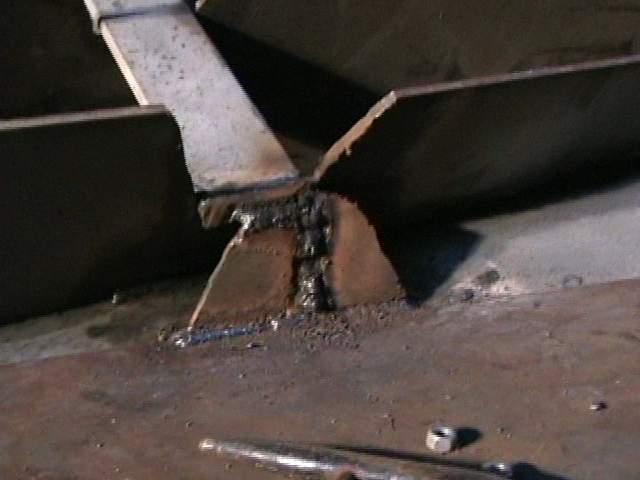
This is the quality of fabrication and welding that Brent is happy to display on his promotional DVD:
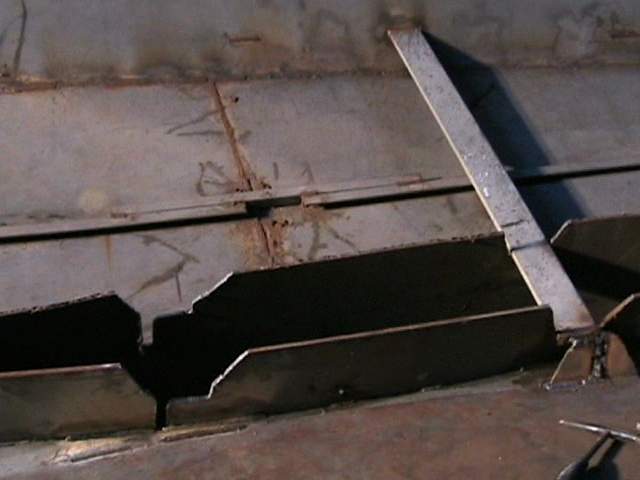
longsand-seam-jpg.45655


keel-support-end-and-bracket-jpg.45657


keel-end-bracket-jpg.45658


Go bounce that lot off a reef?

Pete
 
I was thinking of interior (cabins, bunks, heads, everything) and exterior (rig, deck hardware, everything) completion. Wondering what proportion of the time is spent actually building the hull.

I launched my 31 one month after the steel arrived. No more rent to pay. It was a bare shell, fully welded . A year before building her, I had made up a lot of bits and pieces, at my leisure. I had pre cut much of the bigger parts of the interior from salvaged plywood, and stashed them . I had built mast step, bow roller, rudder fittings hatches , hatch hinges etc . I had a nice piece of spruce for the mast, rigging wire, and turnbuckles , given to me, and used sails , a main for $100 and a jib for $80.
I could have pre-built far more in advance, without the need for a building site. I had half my ballast buried in the bush. It took me ten days on the beach to finish the steel detail, and a day to ballast her. Another ten to paint her, 5 to do the firing strips, and a day to foam her. Then, three days to put the bigger interior parts in. A week to to rig her, move aboard and get sailing. The rest I did while cruising, at my leisure, whenever the materials showed up. Nicer doing trim and interior finer points, in a nice anchorage, than in a yard. Fewer distractions, too.
If I had figured out the alternator welder I posted elsewhere on this site, I could have done far more in nice anchorages.
April 12th to mid October 1984, from steel arrival to living aboard and cruising. I did pull together a couple of 36 ft shells during that time , for extra cash. I started with $4k and had $40 at launch time, so had to go do a couple of hulls , for $'s to finish things more.

I always advise starting making up anything you can, long before starting the hull. While doing that, you have no pressure ,and can take as long as you please, and enjoy the projects, with no rent and no need for a building site.
When you run out of things to build ,then you start the hull, and having so much done ,it goes together far more quickly, while the enthusiasm is still strong, and burnout non existent. The more time you have to acquire things, the cheaper they will be, and the greater the odds of finding a great deal on them.
 
Last edited:
Gunnery targets are built to be relatively cheap but they are built by professional welders; a shit weld doesn’t save any money over a decent one.

This is the quality of fabrication and welding that Brent is happy to display on his promotional DVD:
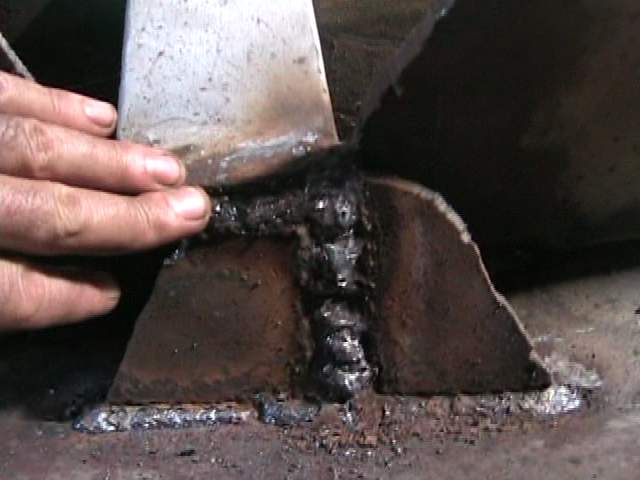
longsand-seam-jpg.45655


keel-support-end-and-bracket-jpg.45657


keel-end-bracket-jpg.45658


Go bounce that lot off a reef?

Pete

That boat T boned a rock ,hitting the keel at full speed with her 4-108 Perkins, going full throttle. No damage to the keel, only a dent on the centreline which he hasn't considered worth repairing in the 8 or more years since. With the keel side joining the tank top a bit further aft, the structural relevance of that gusset is questionable. It didn't budge in the collision . 6011 welds are naturally rough ,but nothing penetrates better ,nor is more forgiving. Grinding things is much safer, and easier, after they have been welded down, than before.
 
Last time I talked to Larry Pardy, in Squirrel Cove BC ,he was considering a metal hull.

Hearsay (from your claimed conversation) vs what they write in black and white and publish? ‘Considering’ might have been politeness on their part in the face of your single minded zeal. Considering (in my understanding) can be the same as saying to someone ‘I’ll think about it” with absolutely no intention of going through with it whatsoever.

I’m considering a steel hull too. But on balance (from my personal experience of sailing steel boats and all the evidence I glean from various sources) I’ll probably stick to GRP.
 
Last edited:
One of BS's problems-apart from his posting style of several consecutive posts, often without reference to what he is answering-is that he often says " Witout decades of steel boat building experience, long term liveaboard and cruising said steel boat "

Well, as has been said previously, you dont have to build one to own one, you dont have to live aboard and cruise full time to get the benifits-or not-of a steel boat.

As to the welding-well!

Perhaps it might be strong enough, but I could not own a boat constructed with welds like that. I have been told that I can weld shit to perspex by those who have used my skills to repair some odd bit made of unobtainium and which has been obsolete for about the time BS has been building his steel boats. Fixing 100 year old veteran motorbikes throws up interesting challenges.......................

My modest steel boat, constructed in the mid 80's from corten steel, is rusting around the windows which were installed inside the apatures, leaving a lip for sea and rainwater to corrode. Looks appalling.

On the other hand, compared to the photo's posted above, the welding is just about perfect-and I know about welding.

Brent-some steel boats are good-there are a couple of very nice ones in Portsmouth Harbour which I see frequently as I sail by on my GRP cockleshell which is unsafe unless tucked up in a Marina.

I know it is-BS keeps telling me..............................................
 
Sounds like Brent purely builds for personal use. It's very different when you build to sell.

Ultimately he is an enthusiastic amature rather that a professional boatbuilder. I wonder what a nautical architect and coding authority would make of his designs. Would an insurance company offer him public liability on his products?
 
Scanning through this thread & trying to eliminate the insults from the more " factual " bits ( of which there are few- Sorry Brent you have not convinced me!!!) I note that no one has mentioned the fact that steel plate is flat ( unless worked to hell). To get a good hull shape one really needs good fair curves. True some yachts have a multi chine construction but I cannot say that many of them are in the "performance" range of sailing boats ( I am sure others will correct me with a couple of minor exceptions ie RM) I do not include a Davidson's crease in that, or the chine placed in the modern Elans etc for a different reason. At least with wood & GRP one has the chance to design a hull shape which is more efficient in its sailing performance. & before the sailors of dog slow cruisers tell me it does not matter; I suspect it might to many. But there again I may have opened another can of worms
 
Last edited:
Scanning through this thread & trying to eliminate the insults from the more " factual " bits ( of which there are few- Sorry Brent you have not convinced me!!!) I note that no one has mentioned the fact that steel plate is flat ( unless worked to hell). To get a good hull shape one really needs good fair curves. True some yachts have a multi chine construction but I cannot say that many of them are in the "performance" range of sailing boats ( I am sure others will correct me with a couple of minor exceptions ie RM) I do not include a Davidson's crease in that, or the chine placed in the modern Elans etc for a different reason. At least with wood & GRP one has the chance to design a hull shape which is more efficient in its sailing performance. & before the sailors of dog slow cruisers tell me it does not matter; I suspect it might to many. But there again I may have opened another can of worms

This is the same as plywood construction which would be single or multi chine construction.

Brent's method tend to be single chine.

The latest designs of steel or aluminium construction are radius chine which is a double chine with a curved section in between, The curves are made up from several sections weldes and shaped.

This gives a better shape but is a lot more time consuming than Brent's method of even a conventional frame/stringer construction as mine is.

https://www.dixdesign.com/radmetal.htm
 
thanks for that Roger, very interesting article.
As for those welding pics in the other posts, well not very good, but it does not have to be very pretty to be pretty strong. There are plenty of agricultural bodge welds that hold. However I would be very concerned about porosity as well as strength.
At the end of the day if he wants to sail a boat welded like that then that's fine for him.
But I do hope he has not welded anything up for anyone else. For someone who extols the virtues of a monocoque there also appears to be little understanding of what may or may not be structural. Anything that is welded to a monocoque imparts a load across the stressed skin , and the flex of the skin imparts a load across those welded members.
 
Status
Not open for further replies.
Top
