
Cat A ocean standard need full revision

I think one of the positive things coming from the RCD is a better understanding of the importance of the angle of vanishing stability.

That this is important was strengthened by the capsize and loss of life of the Pride of Baltimore (I) in 1986.
After the disaster the Pride of Baltimore II was built with a better understanding and a better ballasting arrangement.
 
I think one of the positive things coming from the RCD is a better understanding of the importance of the angle of vanishing stability.

That this is important was strengthened by the capsize and loss of life of the Pride of Baltimore (I) in 1986.
After the disaster the Pride of Baltimore II was built with a better understanding and a better ballasting arrangement.

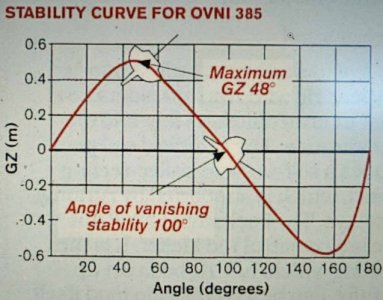
The stability curve is an important characteristic of seaworthiness.

Yachts such as the one below have received Cat A status. The standards should be significantly higher in my view. The stability inverted is similar to upright. With sails deployed underwater the chance of yacht rolling upright following a knockdown seems slim.

To be fair I understand the stability requirements have since been revised ,but why was the highest Cat A standard initially set so low for an ocean going yacht? Should we have to pay for certification when the bar is set so low that in many areas the certification is near worthless?


IMG_9149.jpeg
 
Last edited:
The stability curve is an important characteristic of seaworthiness.

Yachts such as the one below have received Cat A status. The standards should be significantly higher in my view. The stability inverted is similar to upright. With sails deployed underwater the chance of yacht rolling upright following a knockdown seems slim.

To be fair I understand the stability requirements have since been revised ,but why was the highest Cat A standard initially set so low for an ocean going yacht? Should we have to pay for certification when the bar is set so low that in many areas the certification is near worthless?


View attachment 204472
Sailing monohulls are the only ocean going craft with those kind of stability curves. They’re only necessary for craft which are comparatively easy to knock down in the first place. Joshua Slocum’s boat didn’t work that way, nor the tea clippers or square riggers. Nor any kind of multihull. Coming back from a capsize isn’t a given, just because you have a lump of lead on the bottom of ypur keel. Once your stability vanishes, so does much of your capability of floating. There are other ways of making a boat ‘ocean capable’, AVS is not any kind of Holy Grail.
 
Not sure Slocum is the one to point to - didn't he end up lost at sea after all those amazing voyages?

I am very happy with my current boat which definitely would not do well by extreme ocean criteria, so am not in the market for an upgrade. This thread is giving me an idea, though. In 11 or so years' time maybe I can upgrade to something swanky with failed hull windows at a knockdown price. I'll just glass in the window gaps and put a row of small, tough round portholes in them. Should be easy to arrange a set of emergency covers to match and it would look pretty, too.
 
Sailing monohulls are the only ocean going craft with those kind of stability curves. They’re only necessary for craft which are comparatively easy to knock down in the first place. Joshua Slocum’s boat didn’t work that way, nor the tea clippers or square riggers. Nor any kind of multihull. Coming back from a capsize isn’t a given, just because you have a lump of lead on the bottom of ypur keel. Once your stability vanishes, so does much of your capability of floating. There are other ways of making a boat ‘ocean capable’, AVS is not any kind of Holy Grail.
I think that is the paintive cry of a multi hull lover, someone who likes their platform to be as stable either side up.
AVS has been seen as a key indicator, one of several, of seaworthiness by nearly every other study or report into the subject.
 
Given that almost every boat over about 30 feet made today is rated category A "Ocean", is there any evidence that this standard is in any way being used by buyers as a key measure when choosing boats suitable for Ocean crossing and extended cruising?
For example the new First 30 is rated A for 2 people, and B for up to 6 people. It is not what I'd choose if I was looking for a boat to cross an Ocean with, even if looking to do a D/H race like the Transquarda.
 
I think that is the paintive cry of a multi hull lover, someone who likes their platform to be as stable either side up.
AVS has been seen as a key indicator, one of several, of seaworthiness by nearly every other study or report into the subject.
And yet keelboats capsize, or are rolled still. Not an everyday occurrence, I’ll grant you. But I think, far from land, more boats are lost from that than dodgy windows. Though I suppose about 80% of leisure sailing craft are keelboats, and only a tiny number have hull windows. So proof there are lies, damn lies, and statistics.
 
Sailing monohulls are the only ocean going craft with those kind of stability curves. They’re only necessary for craft which are comparatively easy to knock down in the first place. Joshua Slocum’s boat didn’t work that way, nor the tea clippers or square riggers. Nor any kind of multihull. Coming back from a capsize isn’t a given, just because you have a lump of lead on the bottom of ypur keel. Once your stability vanishes, so does much of your capability of floating. There are other ways of making a boat ‘ocean capable’, AVS is not any kind of Holy Grail.

That is true. Any many tea clippers and square riggers were knocked down and sank.

The Pride of Baltimore I was a well made and precise replica of a period Baltimore clipper. It was capsized in a severe squall. In some senses they were just unlucky - as many tea clippers and square riggers which sank were as well.

The Pride of Baltimore II while looking to be very much the same as the Pride of Baltimore I has a much better (and more modern) ballasting arrangement. Basically a big chunk of lead set into the keel outside of the hull. It would not capsize in the conditions which capsized the Pride of Baltimore I.

Indeed my boat has a AVS of 140 degrees and a downflooding angle of 110 degrees when hatches, skylights are closed and washboards are in the companionway. It has external lead ballast inserted into the keel of the boat. About 7 tons of it. It sails very flat. I don't think we have ever had more than 15 degrees heel (this is when the side decks are side rails are under water. And at 15 degrees, you are very definitely overpowered and you will be faster and more comfortable with a reef.
 
I'm not convinced that an RCD directive can ensure the safety of a boat in extreme weather. The decisions of the skipper and chance will become significant factors in extreme wind and sea. That makes it hard to pin blame on poor design or workmanship - something will break in really extreme conditions. The Bavaria originally referred to was in 60 knt winds and 4m+ seas.

A discerning long distance skipper will choose and adapt his craft to meet their requirements - making their personal choices for the numerous design features that can fail or fall off.

Its a big step to expect or want a manufacturing directive to be able to substitute for the skipper's experience.

Better to share the findings of incidents so that others are forewarned and can avoid or correct potential issues.
I don't disagree with the sentiment, but gluing large windows into the hull of a boat then giving it the highest possible rating under the RCD just seems wrong.
 
I don't disagree with the sentiment, but gluing large windows into the hull of a boat then giving it the highest possible rating under the RCD just seems wrong.
But they meet or exceed the RCD and there’s no evidence suggesting there’s a problem with what the RCD requires other than a few people on a forum who have a feeling. You’re not even a customer of the people selling boats!
 
That is true. Any many tea clippers and square riggers were knocked down and sank.

The Pride of Baltimore I was a well made and precise replica of a period Baltimore clipper. It was capsized in a severe squall. In some senses they were just unlucky - as many tea clippers and square riggers which sank were as well.

The Pride of Baltimore II while looking to be very much the same as the Pride of Baltimore I has a much better (and more modern) ballasting arrangement. Basically a big chunk of lead set into the keel outside of the hull. It would not capsize in the conditions which capsized the Pride of Baltimore I.

Indeed my boat has a AVS of 140 degrees and a downflooding angle of 110 degrees when hatches, skylights are closed and washboards are in the companionway. It has external lead ballast inserted into the keel of the boat. About 7 tons of it. It sails very flat. I don't think we have ever had more than 15 degrees heel (this is when the side decks are side rails are under water. And at 15 degrees, you are very definitely overpowered and you will be faster and more comfortable with a reef.
I don’t disagree that AVS is one measure of security for keelboats. The amount of energy required to reach that angle is important too. And whilst wansy’s new boat probably has a respectable AVS, and my XOD an amazing one, the XOD in particular is an inshore boat, we don’t go out in more than 25kn of base wind. Larger boats are favoured by that measure, and we all know how true that is. A F6 is a big deal on a 20 footer, nothing to write home about on a 30, and by the time you get to 60ft, you’ll be wishing there was more.
 
But they meet or exceed the RCD and there’s no evidence suggesting there’s a problem with what the RCD requires other than a few people on a forum who have a feeling. You’re not even a customer of the people selling boats!
They meet a very low standard. Large hull windows in monohulls fixed with glue and no other mechanical fixings are a relatively new phenomenon. Only time will tell if the standard is acceptable. We know glued in windows can fall out in pilot houses and catamarans windows but with limited consequences ( apart from the loss of life in New Zealand on the Bavaria that was certified to ocean standard). If a window failed in a hull halfway across the Atlantic in a storm, it's reasonable to assume the boat would take on a large amount of water.
 
A couple of decades isn’t new by any stretch of the imagination. These things are all over the place with extremely few examples of failure, and of those handful of failures almost nothing is known about the circumstances of failure.
Windows have not failed halfway across oceans, in fact the majority of boats crossing oceans these days have bonded windows.

Also worth highlighting that RCD/RCR doesn’t have an “ocean standard”. Category A is wind above F8 and wave above 4m which are hardly trying conditions for the average modern yacht if well looked after.
 
Given that almost every boat over about 30 feet made today is rated category A "Ocean", is there any evidence that this standard is in any way being used by buyers as a key measure when choosing boats suitable for Ocean crossing and extended cruising?
For example the new First 30 is rated A for 2 people, and B for up to 6 people. It is not what I'd choose if I was looking for a boat to cross an Ocean with, even if looking to do a D/H race like the Transquarda.
We have come across far too many people that just bought quite a big boat with zero experience and set off sailing. I do think that the 'ocean' Cat A is important to some people with no understanding about boats. It would be their defining factor
 
We have come across far too many people that just bought quite a big boat with zero experience and set off sailing. I do think that the 'ocean' Cat A is important to some people with no understanding about boats. It would be their defining factor
Do inexperienced people who buy lower end Cat A boats cross oceans in them? Why don't more of them die?
 
Top