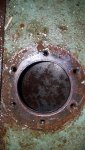
Testing integrity of mild steel fuel tank

I see Roger,not just a case of holding it against the material then
Jumble duck I think that's a good idea. Perhaps you can paint the stuff on. I'll give them a shout
thanks
 
Can you access the whole of the of the tank? If so, you could cut the top off leaving a 50mm lip all round. You can then properly inspect and repair the tank, then fit a new top bolted all round and sealed with a Nitrile rubber gasket.
 
I can't no. The tank is underneath the cockpit floor and there is just a wee access hatch cut in it.
 
Last edited:
The first is to pressure test the tank to see if there is a leak. An old tyre pump would do the job. Pump up to a set pressure say 20 psi the leave it over night and if the pressure has dropped you have a leak. You can then apply more pressure and search for the leak with soapy water.

Once you have found the leak/leaks you can the decide if you wish to repair or replace.

When I built my steel boat I pressure tested all 3 tanks as they were welded as part of the hull.

Dangerous advice there, 20psi is far too high. It's a fuel tank not a pressure vessel.
 
Have you considered that the rust flakes may not be from your tank but the fuel station's tank?
Hi no it didn't occur to me to be honest
I think it's likely to be from my tank. I can feel the inside area where it's rough from bits of the tank flaking away. Attached is a photo I took from when I cleaned the tank when I broke down.
 

Attachments

  • Resizer_15721988227020.jpg
    Resizer_15721988227020.jpg
    263 KB · Views: 24
Not many yacht surveyors do it, not for lack of an instrument, but (so one of them told me) ultrasound testing is skilled: you have to be knowledgeable to get proper results, specially with steel that is painted or has some surface rust. If you go down this route, check their credentials.
I've a tritex ultrasound and it really isn't hard to use, if you get a reading then almost certainly it will be accurate. In the very rare times it isn't then the reading will be miles out and obvious. Clever how it measures through paint. Not so easy to actually get a reading on rough corroded or very thin steel though.
 
I've a tritex ultrasound and it really isn't hard to use, if you get a reading then almost certainly it will be accurate. In the very rare times it isn't then the reading will be miles out and obvious. Clever how it measures through paint. Not so easy to actually get a reading on rough corroded or very thin steel though.

The one I have is not as clever as that one. Any idea of the current cost.
 
The first is to pressure test the tank to see if there is a leak. An old tyre pump would do the job. Pump up to a set pressure say 20 psi the leave it over night and if the pressure has dropped you have a leak. You can then apply more pressure and search for the leak with soapy water.

Once you have found the leak/leaks you can the decide if you wish to repair or replace.

When I built my steel boat I pressure tested all 3 tanks as they were welded as part of the hull.
what ever you do do not pressure test at 20 psi 3 or 4 psi is sufficient to test the integrity. pressure testing with air js dangerous. and if the tank has large un stiffened walls, big pressure may distort the tank and or weaken the welding..
 
Supposing one side of your tank measures 24"x 30"...30 psi will put a force of 21600 pounds on that skinny plate ,very dangerous using air, less so using water
 
Supposing one side of your tank measures 24"x 30"...30 psi will put a force of 21600 pounds on that skinny plate ,very dangerous using air, less so using water
That's why I tested mine with a dinghy pump, giving approximately 1.5psi.
 
I had a similar issue: boat 1979 with mild steel tanks, the water tank rusted through last season and this year a rusty diesel streak started from the fuel tanks, once started there is always the risk of a major leak especially if you poke around with a screwdriver!

Bit the bullet and engine out, tanks cut out, replacements on order, a chance to check everything else in the engine bay, renew engine mounts, clean and re paint, check seals etc and renew fuel system with fresh and clean pipes.

The old tank was full of crud and pipes have blocked despite no apparent problems.

It is a big job being done over a winter with professional help but otherwise a disaster waiting to happen and if it does will ruin the season apart from risk of needing rescue!
 
Slight thread drift - how to tell whether mild or stainless steel? I would expect 33 year old mild steel tank to be covered in rust. 316 s/s doesn’t attract magnets but expect fuel tank would be lower grade.
 
Hi folks here are a couple of photos of the inside of my tank where the surface is rough. And one of the inspection hatch.
It's impossible to tell how bad it is from the photos isn't it?
 

Attachments

  • Resizer_15776335465340.jpg
    Resizer_15776335465340.jpg
    355.7 KB · Views: 37
  • Resizer_15776335465342.jpg
    Resizer_15776335465342.jpg
    324.1 KB · Views: 39
  • Resizer_15776335465343.jpg
    Resizer_15776335465343.jpg
    118.6 KB · Views: 35
It appears that there has been a significant amount of water in there, no measurement scale so cannot say just how much. The result seems to have been rather a lot of pitting. This is the most unpredictable form of corrosion that in some cases may penetrate almost right through.

What is the wall thickness? I have some pitting in my tanks but their wall thickness is 5 mm, so I judge that I can chance it.
 
Top