Tablet chartplotting- not Navionics

I'm afraid that many posts on here have commented on the accuracy (or lack of it!) of Navionics charts! If you want the highest accuracy, you need a system that accepts charts supplied by Hydrographic Agencies; anything else is a derived product and has the potential for introducing error. I'm a (retired) map-maker who has been involved in checking Admiralty charts. And I won't use crowd-sourced chart data; there are too many ways it can go wrong, many of which have been reported here.
AntarticPilot - There is a yes and no to this. Yes I personally use UKHO paper small craft folios (till they dropped them) and have on my iPad as backup (to the Navionics on the ship's plotter, as that is the only product supported). And yes any Crowd Sourced information needs to be used with caution.
BUT Hydrographic Office data is not always the most accurate. There have been quite a few howlers found even in UK waters where the UKHO charts have missed rocks (or invented them) - as you know, in some places the last survey dates back a hundred years or more.
And more recently there have been instances of boats hitting rocks which were not on the HO data but were on the Crowd Sourced data - and many where the rocks are shown on Google Earth satellite images. So I think perhaps intelligent use of all relevant data sources might be better than "won't use crowd-sourced chart data" -personally I would try to avoid any location which has shallow rocks shown on any of a UKHO data, crowd sourced report or satellite image. Conversely I would not attempt a passage through a gap just based on crowd-sourced data. It is a cautious oriented approach.
 
Yes they are c63 charts seem to draw quickly and since they are derived from mandatory carriage charts I have no doubts on the accuracy
Thanks jwfrary & AngusMcDoon

So I am not familiar with AVnav or O-charts. But I am struggling to understand and reconcile what I am hearing from post #32 onwards - ie
  • Vector charts published in S63 (ie encrypted S57) standard data format
  • Data source is current UKHO office supplied data
  • Available either "free" or "£20" for UK waters according to post #32 (I am guessing the free bit is the AVnav software and the £20 the charts?)
I knew UKHO sell their UK raster charts via third parties (as resold by MemoryMap, VisitMyHarbour etc), but wasn't aware that UKHO published their Vector data in bulk at such low prices (clearly they do sell formal vector ENCs to the commercial sector but at massively higher prices).

Can you educate me further, thanks
 
AntarticPilot - There is a yes and no to this. Yes I personally use UKHO paper small craft folios (till they dropped them) and have on my iPad as backup (to the Navionics on the ship's plotter, as that is the only product supported). And yes any Crowd Sourced information needs to be used with caution.
BUT Hydrographic Office data is not always the most accurate. There have been quite a few howlers found even in UK waters where the UKHO charts have missed rocks (or invented them) - as you know, in some places the last survey dates back a hundred years or more.
And more recently there have been instances of boats hitting rocks which were not on the HO data but were on the Crowd Sourced data - and many where the rocks are shown on Google Earth satellite images. So I think perhaps intelligent use of all relevant data sources might be better than "won't use crowd-sourced chart data" -personally I would try to avoid any location which has shallow rocks shown on any of a UKHO data, crowd sourced report or satellite image. Conversely I would not attempt a passage through a gap just based on crowd-sourced data. It is a cautious oriented approach.
Well, I'm speaking from over 30 years experience of mapping, which has included serious consideration of crowd-sourcing.

There have been many cases where crowd-sourced data have completely mis-represented the topography, as in showing passages across drying rocks or channels across drying sandbanks. Examples of both have been reported here, along with examples that demonstrate that Navionics' QA is questionable at best. And there's no real way of knowing whether the data are reliable or not; you don't know whether the data came from a single track or many, and they use interpolation across areas with no data, producing plausible looking contours with no basis in reality.

Crowd-sourced data are fine where there's plenty of data from multiple contributors and a good spatial distribution. But neither can be guaranteed. We all tend to follow well-marked channels, so there's little data away from those channels. We all keep clear of reefs so they are under-represented. And of course, while I am sure we all have our depth sounder carefully calibrated, it only takes one vessel whose depth sounder is not properly calibrated in a region with little data to skew things badly.

The problem isn't with experienced navigators who can take account of all this; the problem is with those who assume that all chart data are correct.

Finally, in areas such as those round the UK, HO charts are based on far more data than is available to Navionics; the soundings on a chart are a representative sampling of what is available. Even in remote areas like Antarctica, in areas that have been charted (few and far between!) there is more data than is shown on the chart; I know because I have had access to the raw data for research purposes. A missing rock can happen in areas without recent survey or where there has been recent engineering works such as dredging.
 
Thanks jwfrary & AngusMcDoon

So I am not familiar with AVnav or O-charts. But I am struggling to understand and reconcile what I am hearing from post #32 onwards - ie
  • Vector charts published in S63 (ie encrypted S57) standard data format
  • Data source is current UKHO office supplied data
  • Available either "free" or "£20" for UK waters according to post #32 (I am guessing the free bit is the AVnav software and the £20 the charts?)
I knew UKHO sell their UK raster charts via third parties (as resold by MemoryMap, VisitMyHarbour etc), but wasn't aware that UKHO published their Vector data in bulk at such low prices (clearly they do sell formal vector ENCs to the commercial sector but at massively higher prices).

Can you educate me further, thanks

With the oeSNC charts they are the same data as the official charts s63/ukho. However come with none of the guarantees or the certification to be used to fufill carriage requirments on vessels. (Much like navionics!)

As they don't have this quality stamp of type approval they are available at a much more reasonable rate, I expect not directly from the admiralty as to not diminish the 'brand'

As always you should use electronic charts that are not type approved with the correct amount of scrutiny when from an established brand they may not be correct and commercially we cant use them for primary navigation. (Though I'm sure many do)

Personally, I use last years chart card from the boat at work in the plotter on my yacht and then run o charts on the rasberry pi down below. Gives me a back up and a different source of data. I do however maintain a proper cataloque of paper charts onboard being merchant navy trained it feels wrong not to have them updated and used in the daily swings of navigation. if your taking longer than 3 mins to plot an EP your well out practice one captain said to me.
 
If you want the highest accuracy, you need a system that accepts charts supplied by Hydrographic Agencies; anything else is a derived product and has the potential for introducing error.

I wouldn't trust the crowdsourced data (particularly the sonar product) much either, but I have seen people mention that 3rd party charts may be more likely to incorporate more recent survey data. For that reason they may be convenient as a second opinion, i.e. to use the "most dangerous" data if they conflict.

But, I do agree, and this is why I use the official ENCs and am somewhat disappointed that so few products support them in contrast to the variety of apps using 3rd party charts. I don't think the current cost model is ideal for safety since it drives the recreational market away from official charts.

I knew UKHO sell their UK raster charts via third parties (as resold by MemoryMap, VisitMyHarbour etc), but wasn't aware that UKHO published their Vector data in bulk at such low prices (clearly they do sell formal vector ENCs to the commercial sector but at massively higher prices).

My impression is the vector data has long been licensed to 3rd party providers such as Navionics and C-MAP, who then incorporate it into their own products and supplement it with whichever other data they can gather. I have no idea what the terms might be, but if so it would suggest the recreational pricing has long been sufficient to cover the licensing costs (assuming there's not a subsidy effect from the US market). I also wonder how much the higher pricing for ENCs is simply because they are viewed as "enterprise" products, which to me is code for "add a few zeros to the price".
 
I also wonder how much the higher pricing for ENCs is simply because they are viewed as "enterprise" products, which to me is code for "add a few zeros to the price".

Yes, type approved equipment is generally at least double or a lot more than of it's none type approved equivalent @
 
Right, I am considering openCPN for Android but there are two versions on the play store, one free, one £7 + change. What's the difference? Is one more official than the other? ?
 
Right, I am considering openCPN for Android but there are two versions on the play store, one free, one £7 + change. What's the difference? Is one more official than the other? ?
The paid one is current and up-to-date with all the latest facilities including built-in access to paid-for maps; the other is a "frozen" version that I think is no longer maintained. The paid for version is the one to go for.
 
I've been playing with a free one for the last couple of days.

It's called sailfreeGPS on Android.

Does quite a lot and the reviews are generally good. Written by a boatowner .

No charts, but maps and water nice and clear with easy to read screens.

I would be interested what others think , and looks as though data might be available to
use with existing systems.
 
I'm afraid that many posts on here have commented on the accuracy (or lack of it!) of Navionics charts
Are you suggesting that all Navionics charts are unreliable, or just the optional crowd sourced part? I was under the impression that their charts used standard data until you turn on the optional and excellent sonar chart feature to get recent crowd sourced data to compliment the official and often extremely dated stuff
 
Are you suggesting that all Navionics charts are unreliable, or just the optional crowd sourced part? I was under the impression that their charts used standard data until you turn on the optional and excellent sonar chart feature to get recent crowd sourced data to compliment the official and often extremely dated stuff
The crowd sourced data are not reliable; many, many dangerous and misleading examples have been posted here. I've gone into detail of why this happens in other posts, but it's intrinsic to their methodology. As you say, their standard charts are no better or worse than others, but you should always bear in mind that they are all derived products, with all that is implied.
 
As you say, their standard charts are no better or worse than others, but you should always bear in mind that they are all derived products, with all that is implied.

I posted numerous examples of their standard charts (eg not "Sonar") where:
1. They add contours interpolated from the original HO contours, of course without making any additional survey (nor any crowd sourced data), plain mathematical surface interpolation
2. They badly interpret/apply datum references: heights of objects on land or bridge clearances referred to LAT and similar errors
3. They badly interpret symbology like obstructions and the like, a
Example, a nice combination: :)
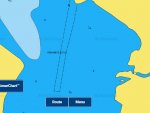
Navionics Standard chart with official soundings
koyu2.jpg

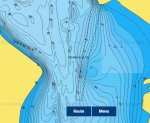
Nav Sonar chart,
koyu1.jpg
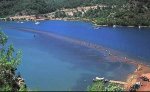
And this is the place, the dots are people walking on the dotted area

koyu3.jpg

https://marmaristown.com/tr/wp-content/uploads/orhaniye.jpg
Other pictures here
Kızkumu, Orhaniye – Aydoğan Apart | ORHANİYE (KIZKUMU) MARMARİS
Note it's Turkey, there is no tide, so no way the depths/contours of the Sonar chart (5-6+m over there) can come from crowd sourced data: just plain mathematical interpolation of a supposed bottom surface interpolated from the few official contours.
I personally cannot see why should I pay for a product having errors introduced by the manufacturer, then send them reports about what is plain wrong.

At least in France, there have been so many user reports about these types of errors (again, Standard charts, not Sonar) that in many areas they reverted their products to show original HO data only, which is good.
 
Last edited:
The crowd sourced data are not reliable; many, many dangerous and misleading examples have been posted here. I've gone into detail of why this happens in other posts, but it's intrinsic to their methodology. As you say, their standard charts are no better or worse than others, but you should always bear in mind that they are all derived products, with all that is implied.
Your post made it look like you were suggesting all Navionics charts are unreliable so you should be more specific when you say stuff like that. I will respectfully disagree about the quality of sonarchart. As an add on to standard charting it's an excellent resource which gives better resolution and detail in areas which may change regularly. I certainly trust it as much as an 1800's survey from the UKHO which has never been revisited and which may have had data points half a mile apart!
 
At least in France, there have been so many user reports about these types of errors (again, Standard charts, not Sonar) that in many areas they reverted their products to show original HO data only, which is good.

Earlier this year I was traversing the Menai Straits using the latest O-Charts on OpenCPN. It showed where a sandbank had moved and had been resurveyed. A friend using the latest Navionics chart (updated 2 weeks previously) the update from the resurvey had not been included, and he ran aground. He sent screen grabs of my chart and his chart to Navionics, but all they could say was that the update hadn't been included yet. Seems strange that O-Charts can do it but Navionics can't when O-Charts are about a sixth of the price.
 
Earlier this year I was traversing the Menai Straits using the latest O-Charts on OpenCPN. It showed where a sandbank had moved and had been resurveyed. A friend using the latest Navionics chart (updated 2 weeks previously) the update from the resurvey had not been included, and he ran aground. He sent screen grabs of my chart and his chart to Navionics, but all they could say was that the update hadn't been included yet. Seems strange that O-Charts can do it but Navionics can't when O-Charts are about a sixth of the price.


The last time I saw the Irish survey cat on the Strait was nearly a year ago.

I would expect this winters storms and the dredging of Victoria dock will have made even that survey invalid . I doubt it was made available to all chart providers especially Navionics. It's a bit futile trying to map rapidly moving sand.

The navionics sonar profile has actually been closer to reality than the ukho charts for the areas covered by locally issued NTMs. The NTMs basically say the depths can vary by as much as 4meters against charted in two major sections south of the Swellies

They might as well do what all old cartographers did when they hadn't a clue and display "There be dragons"


Steve
 
Top